A Sirius star map looks simple: one dot brighter than everything else on the page, sitting low in Canis Major, catalogued at apparent magnitude -1.44. That single dot carries a dozen quiet decisions. Where the coordinate grid is anchored. Which epoch the chart is drawn for. Why the brightest star in the night sky gets a Greek letter and a Latin genitive rather than a proper name. None of this requires an astronomy degree. It does require the vocabulary. The following terms are the ones a Sirius chart actually plots — read in the order a chartmaker would introduce them, foundational first and technical last.
Apparent Magnitude
Apparent magnitude is how bright a star looks from Earth, on a scale where smaller numbers mean brighter and the scale runs backwards on purpose.
The reason it matters on a star map is that every dot size the chartmaker draws is a translation of this single number into ink. A chart with dots that all look the same has thrown away the sky's most legible information. A chart that scales dot size to magnitude tells the reader, at a glance, what the eye would actually see.
Sirius sits at apparent magnitude -1.44 in the HYG catalogue. That negative sign is doing a lot of work. Magnitude 1 stars are the classical first-rank luminaries. Magnitude 0 is brighter still — the level of Vega and Arcturus. Anything below zero is exceptional, and -1.44 is the brightest fixed point in the night sky. On a well-drawn chart, the Sirius dot is roughly twice the diameter of a magnitude 1 dot, because the scale is logarithmic and the visual gap is enormous. If it does not dominate the page, the chart is lying.
Right Ascension
Right ascension is the sky's longitude, measured in hours, minutes and seconds rather than degrees, because the sky rotates on a 24-hour clock.
This is the first coordinate every chart uses and the one most casual readers ignore. Right ascension tells the chartmaker where to place a star along the horizontal axis of an equatorial grid — the imaginary line that runs east-west across the celestial sphere. Because Earth turns once every 24 hours, the sky's full circumference is divided into 24 hours of right ascension rather than 360 degrees, and one hour of RA equals 15 degrees of arc.
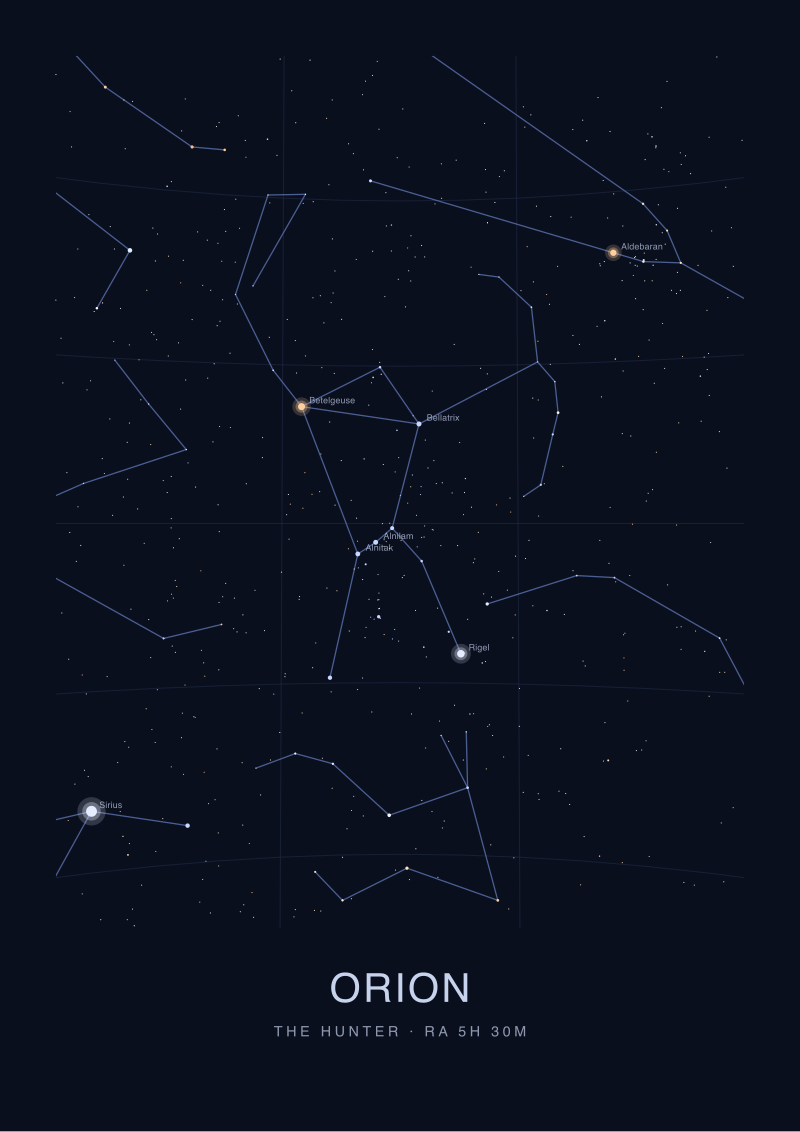
Sirius has a right ascension of 6.75248 hours, which places it slightly past 6h 45m. On a chart drawn for the northern hemisphere winter, that puts Sirius east of Orion, following the Hunter across the sky as both rise in the southeast. Any Sirius map that does not tick RA along its top edge, at minimum every hour, has withheld the coordinate that lets the reader connect the paper to the actual sky above their head.
 Orion
The print from this article · from €29.95
View the print →
Orion
The print from this article · from €29.95
View the print →
Declination
Declination is the sky's latitude, measured in degrees north or south of the celestial equator, which is Earth's equator projected outward onto the stars.
Where right ascension tells you when a star crosses the meridian, declination tells you how high above the horizon it will get. The celestial equator sits at declination 0. The north celestial pole is +90, the south is -90. Everything else falls somewhere between, and the number determines which hemispheres can see the star and how far above the horizon it climbs.
Sirius sits at declination -16.71612 degrees, well south of the celestial equator. That negative value is why Sirius is beloved of southern-hemisphere observers, who see it high overhead in January, and why northerners in London or Berlin see it hugging the southern horizon even at culmination. A chart drawn for Sydney places Sirius near the top of the page; the same chart drawn for Edinburgh pushes it to the bottom margin. Same star, same magnitude, radically different position because declination is doing the geometry.
Bayer Designation
A Bayer designation is a Greek letter plus the Latin genitive of the constellation name, assigned in 1603 by Johann Bayer to catalogue the visible stars roughly in order of brightness within each constellation.
This is the naming scheme that shows up on serious star charts as a small italic Greek letter next to the dot. It replaced the chaos of proper names, most of which were Arabic in origin and inconsistently transliterated, with a systematic label that anyone with the alphabet could read. Alpha is meant to be the brightest star in the constellation, beta the next, and so on down through omega.
Sirius carries the Bayer designation Alpha Canis Majoris — Alpha of the Greater Dog. On a chart it appears as α CMa, with CMa being the standard three-letter abbreviation. The Bayer letter is what tells the reader, without any dot-size cue at all, that this star is the brightest in its constellation. It is also why chartmakers can label sparingly: one Greek letter carries what a paragraph of caption would have to spell out.
Constellation Boundary
A constellation boundary is a line drawn along fixed right ascension and declination arcs that assigns every point in the sky to exactly one of the 88 official constellations.
Constellations are not shapes. The lines connecting the stars are a mnemonic, drawn differently in every star atlas ever published. The boundary is the legally binding part — legal in the sense that the International Astronomical Union ratified them in 1930, and every professional chart since has honoured them. Boundaries turn the sky into a completed jigsaw with no gaps and no overlaps.
Sirius sits inside Canis Major, and the boundary of Canis Major on a modern chart is drawn as a set of straight segments along the 1875.0 equinox coordinate grid — that is the epoch the IAU chose when the boundaries were codified. On a Sirius map, the boundary is what tells the reader that the star belongs to the Greater Dog and not to nearby Puppis or Lepus. Without the boundary line, the star exists in isolation. With it, Sirius is placed inside a jurisdiction.
Chart Epoch
A chart epoch is the specific date the coordinate grid on a star map is calculated for, because the coordinates of every star drift over decades as Earth wobbles on its axis.
Most modern charts are drawn for epoch J2000.0, which fixes noon on 1 January 2000 as the reference moment. A few older atlases use B1950.0 or the IAU boundary epoch of 1875.0. The difference matters more than it sounds: a star's right ascension can change by several minutes of arc between epochs, and the difference is visible on any chart printed at a serious scale.
Sirius at J2000.0 sits at RA 6.75248h, dec -16.71612° in the HYG catalogue. Drawn for epoch 1875.0, Sirius would appear noticeably to the west and slightly further south, because precession has moved the coordinate grid underneath it. A chart that omits its epoch is a chart that refuses to tell you when its measurements were taken. The convention is a small line in the legend: "Coordinates: J2000.0." No epoch, no chart.
Proper Motion
Proper motion is the angular speed at which a star drifts across the sky over years and centuries, relative to the more distant background of stars.
Most stars appear fixed because they are so far away that decades of motion produce only a whisper of displacement. But nearby stars move visibly on a long enough timescale, and on catalogued charts their proper motion is sometimes indicated by a small arrow at the dot, showing direction and magnitude of drift per century. It is the reason old celestial atlases from the 1700s do not exactly match modern skies for the closest stars.
Sirius is one of the nearer bright stars, and it has a substantial proper motion — enough that its position at the founding of Alexandria was measurably different from where it sits today. On a chart drawn for J2000.0, the printed dot is where Sirius will be found within a human lifetime. On a chart drawn for the year 3000, the dot would sit noticeably away from a modern printing. Proper motion is the reminder that the sky is not a fixed backdrop; it is a very slow river.
Heliacal Rising
A heliacal rising is the first morning of the year on which a star becomes visible just before dawn, having spent the preceding weeks lost in the sun's glare.
This is the oldest calendrical use of the stars. Long before printed charts, cultures across the ancient world watched for the moment a bright star returned to the pre-dawn sky, and used it to mark seasons. It is astronomy in the practical sense: a star map that includes heliacal rising dates is a chart that connects the page to the year.
Sirius has the most famous heliacal rising in history. In ancient Egypt, its return to the dawn sky in mid to late July signalled the imminent flooding of the Nile, and the civilisation's calendar was anchored to that event for millennia. The exact date drifts with latitude and epoch — that is precession again — but the principle is stable. A Sirius chart intended for the classical world would mark the heliacal rising as a small annotation near the star: the one date on which this particular dot was said to bring the year.
Sirius B, The Pup
Sirius B, nicknamed the Pup, is the faint white dwarf companion star that orbits Sirius A every 50.1 years, invisible to the naked eye but real, and increasingly likely to appear on any technically ambitious chart.
The Pup is a chartmaking problem. It is bright enough at magnitude 8.4 to appear in catalogues, but so close to Sirius A on the sky that even at maximum separation the two are almost impossible to resolve without a serious telescope. Most naked-eye star charts omit it entirely, which is the honest choice at that scale. Detailed charts sometimes indicate the pair with a small doublet symbol.
For the Sirius map, the decision goes to whether the chart is a portrait of the naked-eye sky or a technical reference. Both are legitimate. What is not legitimate is drawing a second dot at the same magnitude size — Sirius B is roughly ten thousand times fainter than Sirius A, and if it appears on the page at all it must be drawn at the magnitude 8 dot size, not the magnitude -1.44 size. Any other choice misrepresents the physics.
Precession Of The Equinoxes
Precession is the 25,772-year wobble of Earth's rotational axis, tracing a slow circle against the fixed stars and moving the entire coordinate grid of right ascension and declination with it.
This is the reason a chart needs an epoch, why heliacal rising dates drift across millennia, why the pole star of the ancient Egyptians was Thuban rather than Polaris, and why the zodiacal constellations no longer line up with the sun's calendar position claimed by astrology. Precession is slow — about one degree every 72 years — but on the timescale of civilisations it is decisive.
For Sirius on a chart, precession is invisible in a single edition and unmistakable across editions. A Sirius map printed for J2000.0 and one printed for the year 4000 would show the star in noticeably different coordinate positions, not because Sirius has moved much intrinsically, but because the grid beneath it has swung. It is the last term on this list because it is the one that governs all the others. Magnitude describes the ink. Right ascension and declination place the dot. Bayer letter and boundary give it a name and a home. Epoch stamps the date. And precession is the quiet clockwork that makes every chart, eventually, a historical document rather than a current one.
FAQ
Why does Sirius look brighter than any other star on a map?
Because at apparent magnitude -1.44 it is genuinely the brightest fixed star in the night sky. The magnitude scale is logarithmic and inverted — smaller numbers mean brighter, and each step of one magnitude is a brightness ratio of about 2.5. Sirius outshines a magnitude 1 star by roughly a factor of ten. A chart that scales its dots to magnitude will show Sirius as visibly the largest ink point on the page, and that is not stylisation, that is honest translation.
What does the α before Canis Majoris mean?
It is the Bayer designation, a naming convention introduced by Johann Bayer in 1603. Greek letters were assigned to the stars of each constellation in roughly descending order of brightness. Alpha Canis Majoris means "the Alpha star of the Greater Dog constellation", and on charts it is written α CMa. Sirius holds that designation because it is by an enormous margin the brightest star inside the boundary of Canis Major.
Why do star charts specify an epoch like J2000.0?
Because Earth's rotational axis precesses on a 25,772-year cycle, and the coordinate grid of right ascension and declination swings with it. A star's catalogued coordinates are only accurate for the moment the chart was calculated. J2000.0 fixes that moment as noon on 1 January 2000, the current standard. Without an epoch stamp, coordinates are ambiguous, and stars printed on an old grid will not line up with a modern telescope pointed at the sky tonight.
Can Sirius be seen from every country on Earth?
Almost. Its declination of -16.71612 degrees means it is visible from every latitude south of about 73 degrees north. That covers essentially all inhabited land, from the Arctic Circle downward. Observers in far northern Scandinavia see it low on the southern horizon for only a brief window each winter. Observers in Australia, southern Africa and South America see it climb high overhead. It is unavailable only inside the true polar regions.
What is the heliacal rising of Sirius and why did the Egyptians care?
The heliacal rising is the first morning each year when Sirius reappears just before dawn after weeks of being hidden in the sun's glare. In ancient Egypt this event occurred in mid to late July and coincided almost exactly with the annual flooding of the Nile, on which the agricultural year depended. The Egyptian civil calendar was anchored to it for thousands of years. It remains the most consequential heliacal rising in recorded history.
Is Sirius really a double star, and should it be drawn that way?
Yes — Sirius A is orbited by a white dwarf companion, Sirius B, on a 50.1-year cycle. Sirius B is around magnitude 8.4, roughly ten thousand times fainter than its partner, and the two are separated on the sky by only a few arcseconds. Naked-eye charts almost always omit Sirius B honestly, because at their scale it is invisible. Detailed telescopic charts mark the pair, but the two dots must be drawn at their true, wildly different magnitudes.
Does Sirius belong to a zodiac sign?
No. Sirius sits inside the constellation of Canis Major, which is not one of the twelve zodiacal constellations that lie along the ecliptic — the sun's apparent path through the sky. The zodiac is a coordinate band, not a personality system, and Sirius is well south of it. Any claim that Sirius has astrological meaning is not astronomy. On a real star chart, Sirius is a point of light with coordinates, a magnitude, and a name — nothing more, and nothing less.
From the collection
New charts and 10% off your first print.
One email now with your code. No noise after.