There is a pattern we keep noticing when readers send us Miaplacidus prints from other studios and ask why ours looks different. The star is always in roughly the right place, and the label is always spelled correctly, and the constellation Carina is always drawn around it in the familiar keel shape. And yet something is off, and the readers can feel it before they can name it. What is off is almost never the star itself. It is the three numbers the chartmaker either respected or quietly overrode: apparent magnitude 1.67, declination -69.71721 degrees, and right ascension 9.22004 hours, drawn from the HYG v41 catalogue.
The Pattern of Charts That Get Miaplacidus Wrong Before Drawing a Single Line
The pattern is this. A studio takes an existing template of the southern sky, drops a dot where Miaplacidus should be, and lets the surrounding constellation absorb whatever visual weight the layout happens to assign it. The star gets drawn last, as garnish, once the composition is already fixed. That is the wrong order of operations, and it is why so many Miaplacidus prints feel like the star is a passenger on its own chart rather than the reason the chart exists.
We keep seeing three symptoms of this reversed workflow. The first is a Miaplacidus rendered at the same visual size as its two or three closest neighbours in Carina, even though its magnitude of 1.67 places it in a different tier of brightness entirely — a tier populated by roughly the twenty brightest stars in the night sky. The second is a Miaplacidus positioned by eye rather than by coordinate, drifting a fraction of a degree from where its declination of -69.71721 actually puts it, which is close enough that no casual reader will complain and far enough that any astronomer will wince. The third is a frame that pretends the star sits somewhere hospitable to a northern audience, when in truth it lives roughly seventy degrees below the celestial equator and cannot be seen at all from most of Europe or the continental United States.
None of these are aesthetic failures in the ordinary sense. They are failures to let the catalogue do the drafting. A star map is not a decorative arrangement of dots; it is a projection of measurements onto paper, and the measurements have already made most of the interesting choices before the pen touches the sheet. The chartmaker's job is to notice what those choices are and refuse to override them for the sake of layout convenience. When we begin a Miaplacidus print, the three HYG v41 numbers are on the desk before anything else is decided — before the paper size, before the projection, before the typography, before the border. Everything downstream is a consequence.
Why Magnitude 1.67 Decides the Dot Before the Constellation Does
The pattern here is that most Miaplacidus dots are sized to match the constellation drawing rather than the magnitude number, and this quietly demotes the star inside its own portrait. Magnitude 1.67 is not a decorative attribute. It is an instruction about how much ink the star gets.
The magnitude scale is logarithmic and inverted: lower numbers are brighter, and each step of one magnitude corresponds to a brightness ratio of roughly 2.512. A star at magnitude 1.67 is therefore not a little brighter than a star at magnitude 3 or magnitude 4; it is many times brighter, on a scale the human eye compresses so aggressively that we often forget the underlying arithmetic. When a chart draws Miaplacidus at the same dot radius as a neighbour of magnitude 3.5, the chart is telling a lie the reader may not consciously detect but will feel as flatness. The southern sky in the region of Carina has genuine hierarchy — Canopus dominates it, and Miaplacidus at 1.67 sits comfortably in the second rank — and a chart that flattens that hierarchy to accommodate a uniform grid of dots has erased the entire point of plotting magnitudes at all.
Our own studio rule is that magnitude drives dot area, not dot radius, and that the mapping is anchored to the brightest star in the frame rather than a fixed absolute scale. This matters for Miaplacidus specifically because it is often plotted in the company of Canopus, which is one of the two or three brightest stars in the entire sky. Anchoring to Canopus and letting Miaplacidus fall where its 1.67 places it produces a printed portrait where the eye lands on Canopus first, moves naturally to Miaplacidus second, and only then begins to read the rest of Carina. Anchoring instead to a small template dot makes Miaplacidus and Canopus into near-twins, which is untrue.
There is a related failure we see frequently, which is the studio that draws Miaplacidus with a starburst glyph — the little four-pointed cross or six-pointed flare associated in popular illustration with important stars. Starbursts are a nineteenth-century convention that predates modern photometry, and they encode importance rather than magnitude. Using one on Miaplacidus signals to the reader that the star is special without telling them what its brightness actually is. The catalogue already tells us: 1.67. A well-sized circular dot conveys that number honestly. A starburst conveys only the chartmaker's opinion.
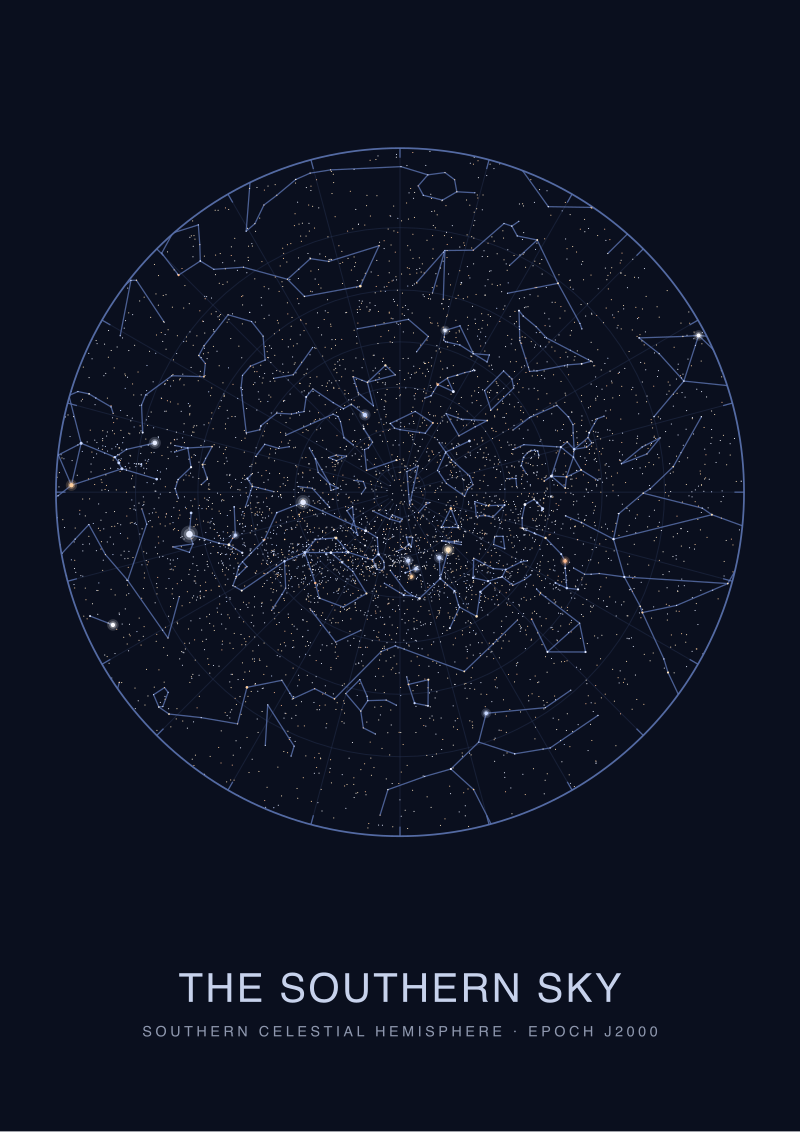 The Southern Sky
The print from this article · from €29.95
View the print →
The Southern Sky
The print from this article · from €29.95
View the print →
The Southern Declination Problem: What -69.71° Forces the Frame to Do
The pattern in this second failure mode is that Miaplacidus prints are often framed as if the star were a generic mid-latitude object, when its declination of -69.71721 degrees imposes serious constraints on what the frame can honestly show. A declination that far south means Miaplacidus is a circumpolar star for observers south of roughly the twentieth parallel south and is invisible for observers north of roughly the twentieth parallel north. That is a hard geographic fact, and it decides two things about the print: what projection is defensible, and what horizon reference — if any — belongs in the composition.
A chart that pretends its subject is visible from where the reader lives has begun by lying about the sky.
Consider the projection question first. A standard equatorial projection, of the sort most northern star charts use, distorts the region around declination -69 significantly. Anything within twenty degrees of a celestial pole gets stretched sideways in cylindrical projections and compressed radially in stereographic ones. A Miaplacidus chart drawn on the same projection template as a Ursa Major chart will misrepresent the true angular relationship between Miaplacidus and its neighbours in Carina. The honest choice for a subject at -69.71721 is a south polar stereographic centred on the south celestial pole, or a gnomonic projection tightly framed on Carina itself. Either preserves the local geometry the reader needs to recognise the sky they are actually looking at. Neither is the default in most template libraries, which is why so many Miaplacidus prints inherit a projection designed for something else.
The second consequence is that the frame cannot casually include a horizon line without specifying whose horizon. A star at -69.71 has no meaningful horizon for a Berlin reader; it never rises. For a reader in Santiago or Cape Town or Perth, it never sets. Any horizon annotation on a Miaplacidus print is therefore a commitment to a specific latitude, and the responsible thing is to say which. We generally decline to draw one at all unless the print has been commissioned for a specific observing location, because a horizon that belongs to no one is worse than no horizon.
The declination number does one more thing that is easy to miss. It fixes the star's small circle of diurnal motion — the tight loop it traces around the south celestial pole every twenty-four hours. That loop has a radius of roughly twenty degrees. On a chart, this means Miaplacidus should never be drawn as if it were embedded in a landscape of comparably positioned equatorial stars; its behaviour on the sphere is fundamentally different, and a chart that respects the declination will feel different from a chart that treats the number as a mere y-coordinate.
Right Ascension 9.22h and the Quiet Choice of Where the Map Begins
The pattern here is subtler and, for that reason, the one we see violated most often. Right ascension is the celestial equivalent of longitude, measured in hours rather than degrees because it corresponds to Earth's rotation, and Miaplacidus sits at 9.22004 hours. That number tells the chartmaker where in the annual sky Miaplacidus reaches its highest point above the horizon, and it therefore tells the chartmaker when the star can be usefully observed and framed against a seasonal reference. A right ascension near 9 hours places the star's peak visibility, from southern-hemisphere latitudes, in the months when the local evening sky faces that sector — roughly the late southern-hemisphere summer and early autumn.
This matters for the print in a way that most template-driven studios never confront. If a Miaplacidus chart is commissioned as a date-specific keepsake — a birthday, an anniversary, a night someone wants to remember — then the right ascension decides whether the star was even meaningfully in the sky on that date, and if so, in which direction. A print that shows Miaplacidus high overhead on a date when the star was in fact below the horizon or lost in daylight is a decorative object pretending to be a document. We check the right ascension against the requested date before we accept the commission, and we redirect the reader to a different star if the arithmetic does not work.
The quieter choice the right ascension forces is where the map's central meridian falls. A chart of Carina that centres its meridian at 9.22 hours places Miaplacidus on the axis of symmetry of the composition, which reads as intentional and settled. A chart that centres the meridian at some other value — because the template was built for a different region and no one bothered to shift it — places Miaplacidus off-axis, which reads as accidental even when the surrounding stars are correct. Very few readers can articulate why one composition feels centred and the other does not, but almost all readers can feel it. The right ascension is the piece of information that decides which experience the reader has.
There is a broader point folded into this. Right ascension is measured from a specific reference direction on the sky — the vernal equinox — and that reference drifts slowly because of precession. HYG v41 records the value 9.22004 for a specific catalogue epoch. A chartmaker who uses that number without knowing the epoch is quoting from a document without reading the citation. For prints intended as long-lived objects, we note the epoch alongside the coordinates in the marginalia, because the coordinates are only meaningful in the context of when they were measured.
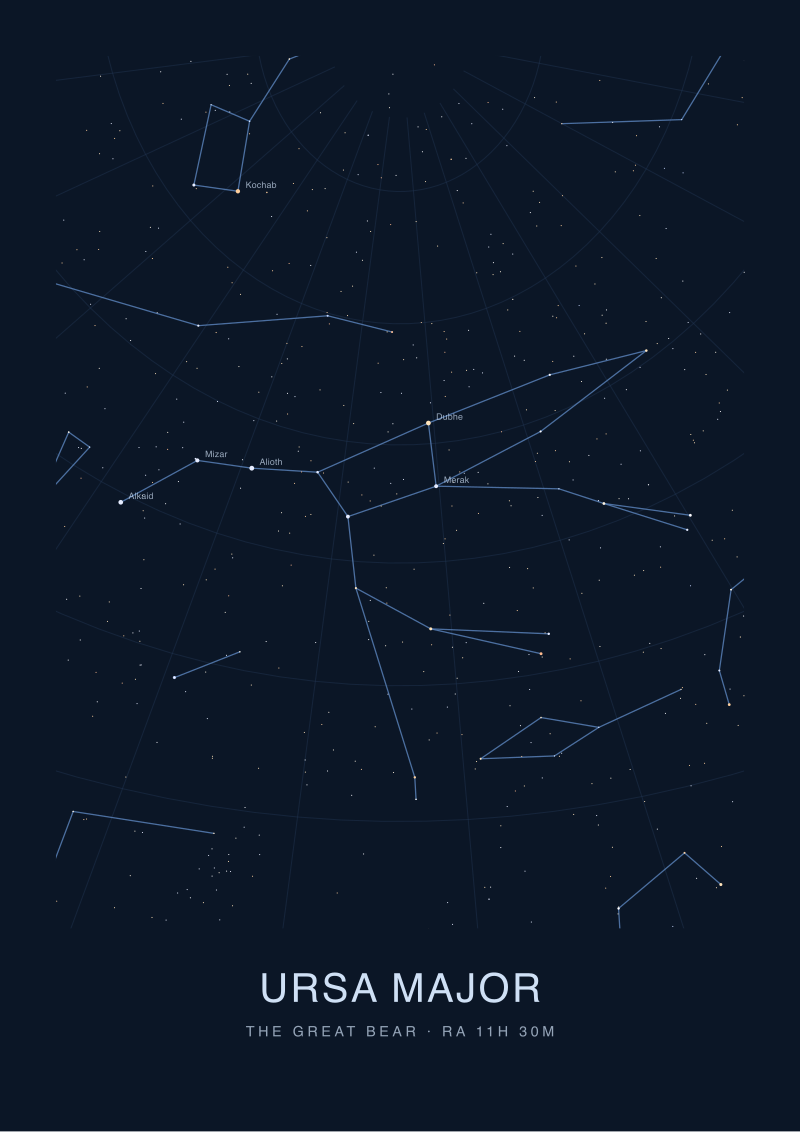 Ursa Major
The print from this article · from €29.95
View the print →
Ursa Major
The print from this article · from €29.95
View the print →
So What Do You Actually Do
If you are commissioning a Miaplacidus print — from us or from anyone — the practical thing you can do is ask the studio three questions before any drawing begins. Ask what catalogue the star's position and magnitude come from and what the epoch is. Ask how the dot size scales with magnitude and what the anchor star is for the scale. Ask what projection the map uses and why that projection was chosen for a subject at declination -69.71. The answers do not need to be technical; a competent chartmaker will be able to give plain-language responses to all three. A studio that hesitates on any of them is a studio that has not thought about the star, only about the print.
If you are drawing a Miaplacidus chart yourself, the discipline is to write the three numbers at the top of the page before you sketch anything. Magnitude 1.67. Declination -69.71721. Right ascension 9.22004. Then decide, in that order, how much ink the dot gets, where the frame's polar reference sits, and where the central meridian falls. Every other decision — typography, border, colour, paper — is downstream, and if any of those downstream decisions requires you to override one of the three numbers, the downstream decision is wrong. This sounds austere, and it is, but the austerity is what separates a star map from a poster of a star.
The one number to carry away from this piece is 1.67. That is the magnitude that decides whether Miaplacidus is drawn as a passenger inside Carina or as the reason Carina appears on the paper. It is the number that most template-driven studios quietly ignore, and it is the number that, once respected, changes everything about how the finished chart reads. If you look at a Miaplacidus print and cannot tell at a glance that this star is brighter than most of what surrounds it, the chart has failed at the one measurement that matters most. The rest of the craft — the projection, the meridian, the epoch note in the margin — is what makes the chart honest. The magnitude is what makes it a portrait.
From the collection
New charts and 10% off your first print.
One email now with your code. No noise after.