At the plotting table this week we had two winter stars pinned under the ruler and a customer waiting on a verdict. Rigel, in Orion, sitting at right ascension 5.2423 hours and declination −8.20164 degrees, apparent magnitude 0.18 from the HYG v41 catalogue. Procyon, in Canis Minor, at 7.65503 hours and +5.22499 degrees, magnitude 0.40. Half a magnitude between them, roughly thirty-six degrees of sky, and one lives just below the celestial equator while the other sits just above it. The question was which one deserved the print. The honest answer took longer than the arithmetic.
The customer had assumed we would pick the brighter one. That is what most people assume, because most people were taught to read the sky as a leaderboard. It is not a leaderboard. It is a document, and a document is chosen for what it argues, not for which entry has the highest number.
We plotted both, side by side, at the same scale. We stared at them for the better part of an afternoon. Then we wrote back.
The Numbers on the Table Before We Draw Anything
Half a magnitude does not sound like much until you remember what the magnitude scale is doing under the hood. It is logarithmic, inverted, and calibrated so that a difference of five steps corresponds to a brightness ratio of exactly one hundred. Rigel at 0.18 and Procyon at 0.40 are separated by 0.22 magnitudes, which works out to Rigel appearing roughly twenty-two percent brighter to a dark-adapted eye. Twenty-two percent is real, but it is not the kind of gap that decides a composition. It is the kind of gap that disappears the moment a thin cloud drifts through the field.
The positions are more interesting than the brightness, because the positions are what a chart actually plots. Rigel sits at 5.2423 hours of right ascension and −8.20164 degrees of declination, which places it in the northern part of Orion's frame from a northern-hemisphere viewpoint but below the celestial equator in absolute terms. Procyon sits at 7.65503 hours and +5.22499 degrees, roughly thirty-six degrees of sky further east along the ecliptic band and just above the equator. Between them, the coordinate grid crosses the zero line. That crossing matters.
For a viewer at forty degrees north, both stars rise in the east, cross the southern sky, and set in the west, but they do not share an arc. Rigel rides lower, its path tilted southward by its negative declination. Procyon rides slightly higher, its arc lifted by its positive one. Over a full winter night, they trace two nearly parallel curves separated by about thirteen and a half degrees of altitude at the meridian. On a chart, that separation reads as vertical distance, and vertical distance on a star map is what gives the composition its weight.
A print with Rigel at its centre puts the celestial equator above the frame's middle, which pushes Orion up into the visual weight and leaves the lower half of the print to Lepus, Columba, and the beginning of Eridanus. A print with Procyon at its centre does the opposite: the equator drops below middle, Canis Minor and Gemini crowd the upper half, and the lower half opens toward Monoceros and the eastern edge of the winter Milky Way. The same two stars, plotted at the same scale, produce two entirely different documents. That is not a matter of taste. That is a consequence of where the equator falls.
None of this shows up in a brightness comparison. None of this shows up in the customer's original question. It only shows up once you have both charts pinned to the table under the same light.
Rigel Anchors a Constellation; Procyon Anchors a Sightline
Rigel is not a solo act. It is one of the four bright corners of Orion, arguably the most immediately recognisable figure in the entire IAU constellation system. When Rigel appears on a chart, Orion appears with it, and Orion is a complete piece of visual language: the belt of three, the sword hanging below, the shoulders of Betelgeuse and Bellatrix answering the feet of Rigel and Saiph. The eye does not stop at Rigel. It reads Rigel as one word in a sentence the rest of the constellation is speaking.
That is a gift and a constraint. A Rigel-centred chart is really an Orion chart with Rigel labelled larger than the others. The composition already has its argument written for it. The chartmaker's job is mostly restraint: choose the frame, decide how much of Lepus and Eridanus to admit, decide whether the Orion Nebula gets its own callout or dissolves into the sword. The star does not do the work of the composition. The constellation does. Rigel just happens to be the brightest handle by which the constellation is grasped.
Procyon does not have this. Canis Minor is one of the smallest constellations in the sky, essentially two stars in a line with Procyon at one end and Gomeisa at the other. As a figure it is barely a figure. It survives in the IAU system because it has always survived, because Ptolemy included it, because the Greeks had a story about the little dog running behind the hunter. On its own, Canis Minor is a footnote.
But Procyon is not on its own on a chart. Procyon anchors the eastern vertex of what modern observers call the Winter Triangle, a large asterism formed with Sirius to the south and Betelgeuse to the northwest. It also sits on the sightline that runs from Orion's shoulder through Gemini and out toward the winter Milky Way. A chart built around Procyon is not a chart of Canis Minor. It is a chart of a junction: the place where several visual axes cross, where the eye can travel in four directions without leaving the frame.
This is a fundamentally different kind of print. The Rigel chart tells a story. The Procyon chart draws a map. The Rigel chart has a subject. The Procyon chart has a network. Both are legitimate. Neither is superior in the abstract. But they are not interchangeable, and the choice between them is not decided by which star wins the brightness contest.
The old Arabic naming heritage puts a finer edge on this. Rigel comes from *rijl al-jawza*, the foot of the giant, a name that only makes sense if the giant is already understood. Procyon means *before the dog*, a Greek label that only makes sense if you know Sirius rises after it. Both stars, in their oldest names, are relational: they refer outward to something else. But Rigel refers to a body, and Procyon refers to a moment. That difference is old, and it survives into the way a chartmaker frames each one today.
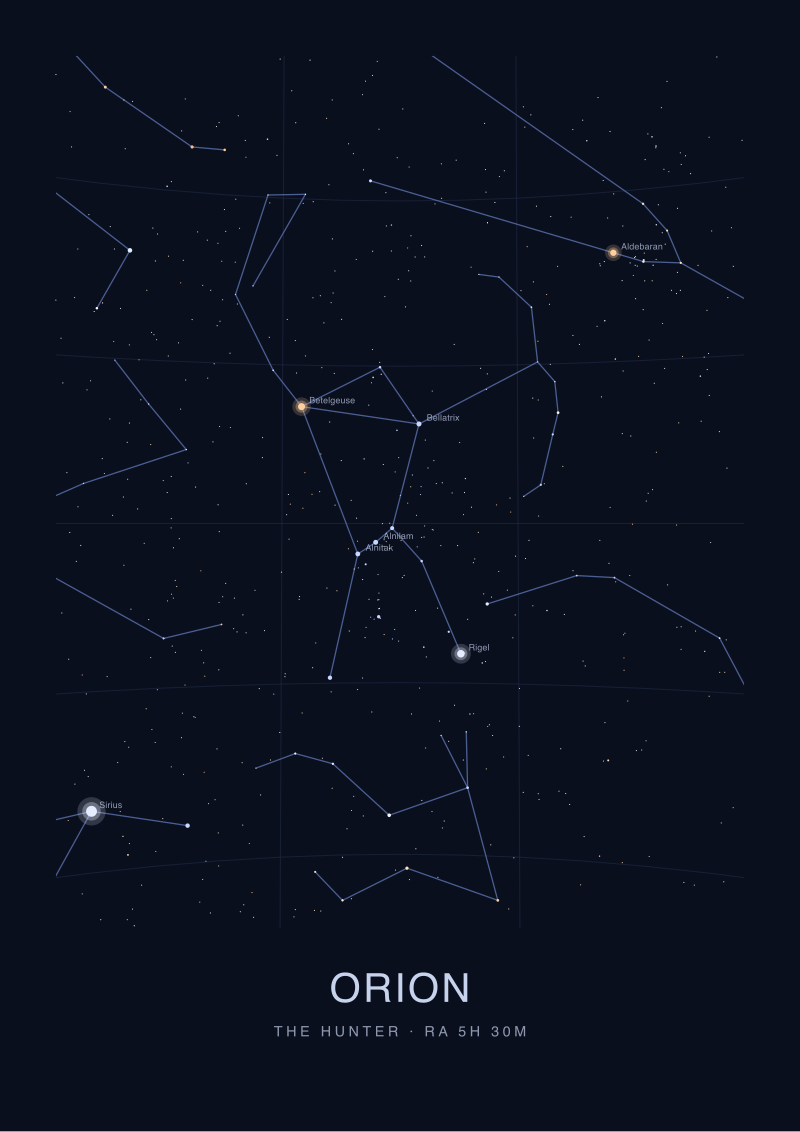 Orion
The print from this article · from €29.95
View the print →
Orion
The print from this article · from €29.95
View the print →
The Print That Belongs on Your Wall Is Not the Brighter One
Here is what we told the customer. If the wall you are decorating is one you sit near, one you look at while thinking, a wall that will be read slowly over years, take the Procyon chart. Its composition rewards return visits. The Winter Triangle appears only if you learn to see it. The sightlines through Gemini toward the Milky Way become visible only after the print has been in the room long enough that your eye stops registering the brightest label and starts tracing the fainter connective tissue. A network reveals itself over time. A subject exhausts itself faster.
If the wall you are decorating is one people see rather than study — a wall for guests, a wall for first impressions, a wall where the print has one chance to be understood — take the Rigel chart. Orion is legible from across a room. The belt reads at ten feet. The four corners frame the eye before the eye has decided to look. A composition that already has its argument written into it is a composition that survives being glanced at, and most walls, honestly, are glanced at more than they are studied.
That is the split. It has nothing to do with 0.18 versus 0.40. It has nothing to do with which star the catalogue prints first. It has to do with what the chart is being asked to do in the room, and how patient its viewer is going to be.
We printed both, in the end. The customer took the Procyon chart for the study and the Rigel chart for the entryway. That was probably always the correct answer, and we should have proposed it earlier. When we build the next round of winter-sky prints for the shop, both will be in the catalogue as separate documents rather than as competitors, because they were never really competing in the first place. If you want to see them side by side, they will live at /shop/ under the winter-sky group, plotted from the same HYG v41 positions we started this piece with.
This started as a request to declare a winner between two stars. It turned into a note about what star maps are actually for. Somewhere between the plotting table and the reply email, the question stopped being about magnitudes and started being about walls and viewers and the kind of attention a document is going to receive. That is usually where the honest answer lives, and it is almost never where the customer thought to look.
FAQ
Which star is actually brighter, Rigel or Procyon?
Rigel, by 0.22 magnitudes. In the HYG v41 catalogue Rigel is listed at apparent magnitude 0.18 and Procyon at 0.40. Because the magnitude scale is logarithmic, that gap corresponds to Rigel appearing roughly twenty-two percent brighter to the eye. It is a real difference but a small one — well inside the range that atmospheric conditions and light pollution can erase on any given night. For chart-composition purposes it is essentially a wash.
Can I see both stars from the same latitude on the same night?
Yes, from anywhere between roughly sixty degrees north and sixty degrees south, both stars are above the horizon simultaneously during the northern winter. Rigel sits at declination −8.20164 degrees and Procyon at +5.22499 degrees, so both cross the meridian well clear of the horizon for temperate observers. From the far northern latitudes Rigel rides low; from the far southern latitudes Procyon rides low. Neither is polar and neither hides entirely.
Why does the celestial equator matter for choosing a star map?
Because the equator crossing between the two positions determines how the composition balances on the page. Rigel is south of the equator and Procyon is north of it, so a chart centred on either star places the equator on the opposite side of centre. This shifts the visual weight of the map — which constellations sit above the middle, which sit below, how much sky opens up toward the horizon edges. Two prints, same scale, entirely different documents.
Is Procyon part of a well-known constellation?
Procyon is the brightest star in Canis Minor, which is one of the smallest constellations in the IAU system — essentially two stars in a short line. On its own, Canis Minor is minor. But Procyon is more commonly encountered as one vertex of the Winter Triangle asterism, alongside two other bright winter stars. Most star maps that include Procyon are really using it as a junction point rather than as the emblem of its own constellation.
Does the Rigel print show all of Orion?
That is a framing choice made by the chartmaker, not a fixed property of the star. A print centred on Rigel at a wide field will include the full figure of Orion — belt, sword, both shoulders, both feet — plus neighbouring constellations like Lepus below and parts of Eridanus to the west. A tighter frame can isolate the lower half of Orion around Rigel and the belt. We usually recommend the wider composition because Orion reads as a complete figure and cropping it reduces the print's legibility.
Are the positions in the article precise enough for actual observation?
The positions cited — 5.2423 hours right ascension and −8.20164 degrees declination for Rigel, 7.65503 hours and +5.22499 degrees for Procyon — come from the HYG v41 catalogue and are more than precise enough for any naked-eye or binocular use, and adequate for most amateur telescopes at wide field. For high-precision astrometry or long-exposure imaging, observers typically use current epoch coordinates that account for precession and proper motion, but for chart plotting and general locating, HYG positions are the standard reference we use in the studio.
Do the two stars have anything to do with the zodiac?
No. Neither Rigel nor Procyon lies in the zodiacal band. The zodiac is a coordinate strip roughly eight degrees on either side of the ecliptic, containing the constellations the Sun passes through over the year. Rigel and Procyon are winter stars visible during the night, well outside that strip. They have no role in the zodiac system, and neither does any other star we plot — the zodiac is a coordinate geometry, not a personality framework.
Which one would you actually put on a wall, if forced to pick one?
Procyon, but only just, and only for a wall you sit near. The composition rewards slow reading in a way the Rigel print does not, because the Rigel print delivers Orion on the first glance and has less to reveal on the tenth. For a wall that is looked at rather than studied — an entryway, a hallway, a room for guests — Rigel wins by default because Orion is legible at distance. The correct answer for most homes is both, hung in different rooms.
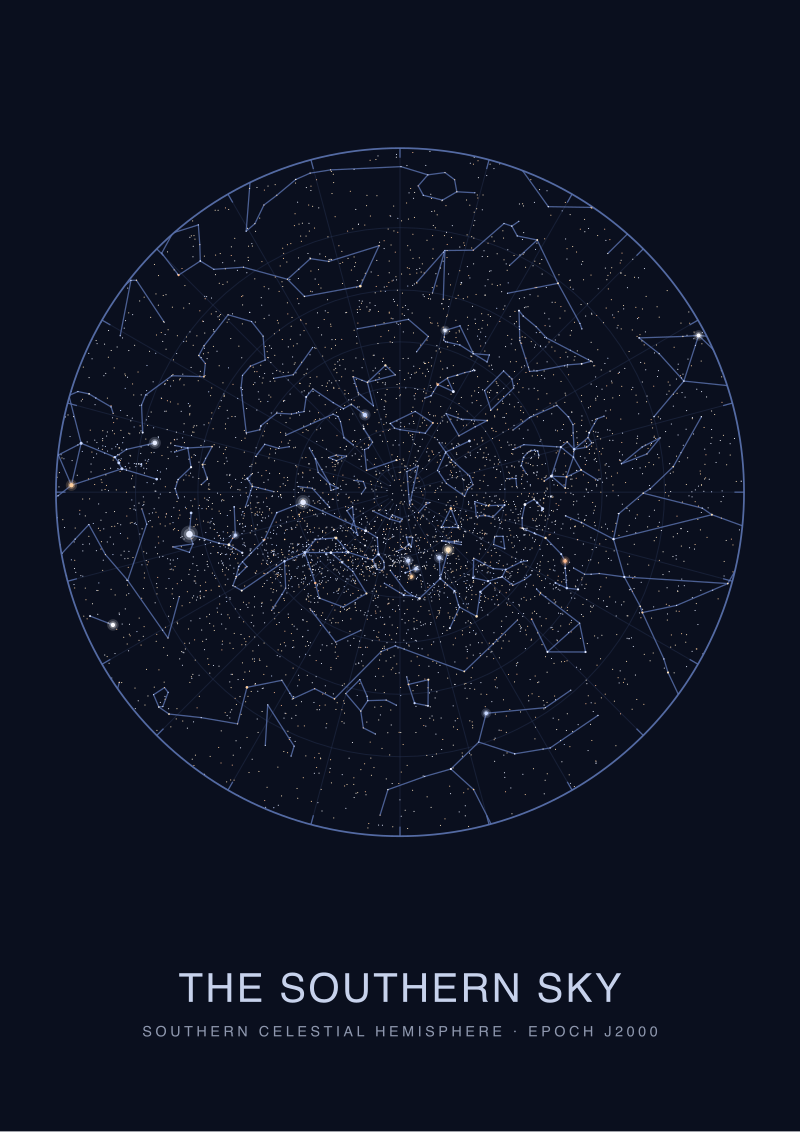 The Southern Sky
The print from this article · from €29.95
View the print →
The Southern Sky
The print from this article · from €29.95
View the print →
From the collection
New charts and 10% off your first print.
One email now with your code. No noise after.