Procyon sits at right ascension 7.65503 hours and declination +5.22499 degrees, apparent magnitude 0.4, catalogued in HYG v41 as the anchor star of Canis Minor. Most readers of a star map see a bright dot with a label and move on. Chartmakers see four decisions layered on top of each other: where the dot goes, how large it is drawn, what shorthand marks the constellation it belongs to, and what the map deliberately refuses to say about it. This piece reads the Procyon chart the way the studio drafts it — decision by decision, before the ink lands.
The Pattern of Reading Procyon as a Point, Not a Story
A pattern we keep seeing in the mail we get about star map prints: readers ask what Procyon *means* before they ask what it *is on the sheet*. The chart, drawn honestly, refuses to answer the first question and answers the second in four moves. Procyon is a point. It has coordinates, it has a brightness, and it lives inside a constellation stub. That is the entire surface. Anything else the reader reads into the dot is imported from outside the map.
This is not pedantry; it is what the draft actually contains. The HYG v41 catalogue row for this star is a coordinate pair, a magnitude, and a constellation code — CMi, Canis Minor. There is no myth column, no dedication field, no personality attribute. The chartmaker who begins with the row and ends with the ink is drawing exactly what the row asserts and nothing more. The picture is honest in proportion to how tightly the ink tracks the row.
The reason this matters at the drafting table is that every additional adornment — a rayed star icon, a decorative wreath, a curved connector to another star — is a claim the underlying data does not support. A single-row catalogue entry can legitimately produce a dot, a label, and a constellation abbreviation. It cannot legitimately produce a story, because the story is not in the row. Studios that treat the chart as a story-carrier drift toward decoration; studios that treat it as a projection of the row stay accurate. The Procyon map, at its best, is a projection of one row and its neighbours.
The Pattern of Coordinates That Anchor the Dot to the Sky
The pattern here is simpler than it looks: right ascension and declination are the two numbers, and every other decision on the chart depends on them being drawn correctly. Procyon's right ascension of 7.65503 hours places it slightly past the seventh hour circle east of the vernal equinox point; its declination of +5.22499 degrees places it just above the celestial equator, in the northern sky but only barely so. Those two numbers, together, fix the dot to within a fraction of a degree of where the star actually is on any given night.
Right ascension is time-of-day-shaped by convention, measured in hours rather than degrees. Seven and roughly two-thirds hours means the star crosses the meridian about seven and two-thirds hours after the vernal equinox point does. On a rectangular chart projected in equatorial coordinates, this locks Procyon to a vertical grid line about 7.655 units along the horizontal axis, where the axis runs from 0 to 24. The chart's horizontal scale is not a distance in the ordinary sense; it is a rotation of the sky. A reader who understands that reads the coordinate axis as a clock face laid on the sky, not as a ruler.
Declination is the more forgiving of the two numbers for a chartmaker to draw. At +5.22499 degrees, Procyon is close enough to the celestial equator that the projection distortion — the way any flat map of a curved sky stretches shapes near the poles — is negligible. On a standard equatorial cylindrical projection, Procyon's dot lands almost exactly where a naive plot would put it, without the shape-warping corrections that dominate charts of, say, Ursa Minor. This is why Procyon is a friendly star to chart: it sits in the projection's honest zone, and the ink lands where the arithmetic says it should. A print that gets Procyon's position visibly wrong is a print with a projection error, not a catalogue error.
The Pattern of Magnitude Deciding How Big the Dot Is Drawn
The pattern most readers never articulate but always respond to: on a star map, the dot for a brighter star is larger, and that size is a decision, not a photograph. Procyon's apparent magnitude of 0.4 is the number that decides how much ink the dot gets. In the magnitude system, lower numbers mean brighter stars, and the scale runs backwards on purpose — a magnitude 0 star is roughly two and a half times brighter than a magnitude 1, roughly a hundred times brighter than a magnitude 5. Procyon at 0.4 sits inside the small handful of stars that anchor a naked-eye chart. It is a first-magnitude object in the loose sense of that phrase.
Studios encode magnitude with dot diameter using a step scale, usually assigning discrete sizes to magnitude bins rather than a continuous function. A common draft rule: everything from magnitude −1.5 to 0.5 gets the largest dot, everything from 0.5 to 1.5 gets the next size down, and so on until the faintest visible stars on the print get the smallest dot the ink can support without losing to the paper texture. Procyon at 0.4 sits at the top of the scale — it gets the largest dot the chart uses for a stellar point. On a well-drafted map, it should be visibly the same weight as Sirius, Vega, or Capella on the same sheet, because it belongs to their brightness class within the granularity of the step scale.
The magnitude scale runs backwards, which means the brightest star on the chart is the one nearest to zero, and the honest cartographer draws that fact rather than arguing with it.
The reason the step scale is a step scale, and not a continuous mapping from magnitude to diameter, is that human eyes read discrete size categories on a chart much more reliably than they compare continuous diameters. A dot that is 1.17 times larger than another dot reads as the same size; a dot that is one bin larger reads as clearly brighter. This is a design fact, not a data fact, and it is where the chartmaker's judgement most obviously enters the picture. The magnitude number is inherited from HYG v41. The dot size is a rendering choice made by the studio, disciplined by the number but not identical to it. Procyon's dot on our sheet is the number 0.4 projected through a step-scale rule we can name and defend.
The Pattern of the Constellation Stub Around a Single Bright Star
The pattern that governs the last decision on the sheet: the lines that fan out from Procyon are not features of the sky. They are the studio's shorthand for the constellation Procyon belongs to. The HYG v41 row places Procyon in CMi — Canis Minor, the Little Dog — one of the eighty-eight constellations of the IAU system. Canis Minor is small, both in the number of catalogued stars it contains at naked-eye brightness and in the sky area the IAU assigns to its boundaries. The constellation stub on a Procyon map is correspondingly short.
There is no universal, canonical set of connector lines for the constellations. Different star atlases draw the figures differently, and the IAU's own contribution is only the boundary polygon — the region of sky assigned to Canis Minor — not the stick figure inside it. When the studio draws a two-star line from Procyon to Gomeisa, we are following one common tradition, not enforcing a fact. Another mapmaker might connect the same two stars with a different aesthetic; a third might refuse to draw the line at all and let Procyon stand alone with its constellation label. The stub is a convention, and a print that treats the stub as physics is misrepresenting what a constellation is.
Canis Minor, seen this way, is a compact case study in the whole question. The constellation is a boundary polygon inherited from a 1930 committee decision by the IAU. It is a name — Little Dog — inherited from a Greek tradition that saw two dogs behind Orion. It is a stick figure — the connector between Procyon and Gomeisa — inherited from centuries of atlas-making. None of these is the star. The star is the row: coordinates, magnitude, catalogue reference. The chart carries the star at its centre and the conventions around it, and a careful reader sees the difference. The map does not lie about which is which, provided it is drawn by someone who knows the layers are separate.
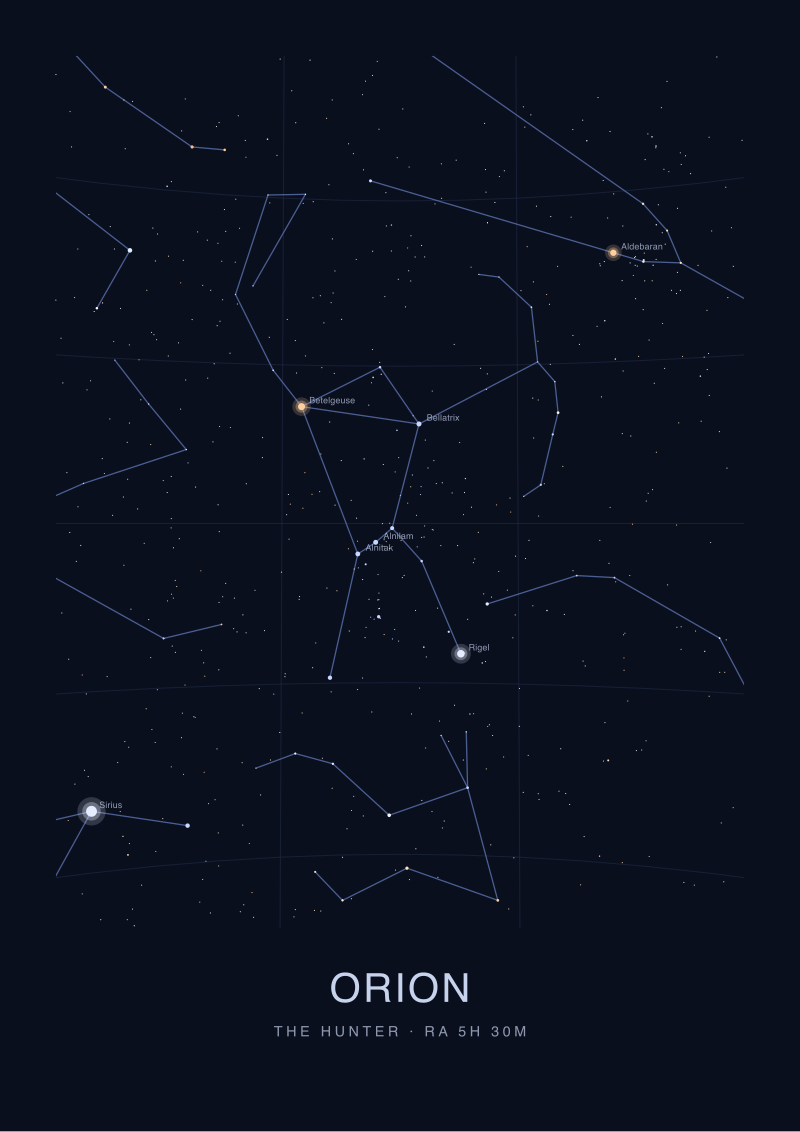 Orion
The print from this article · from €29.95
View the print →
Orion
The print from this article · from €29.95
View the print →
So What Do You Actually Do
Read the Procyon chart in the order the studio drafts it. Find the dot first: it is the largest one in Canis Minor, because magnitude 0.4 anchors the constellation. Trace the coordinate grid to it: about 7.65 hours along the right-ascension axis, just above the celestial equator by about five degrees. Notice the step-scale weight of the dot compared to Sirius, Betelgeuse, Rigel elsewhere on the same sheet — Procyon should sit in the top-brightness bin with them. Then, and only then, follow the stub line to Gomeisa and see the compact figure of Canis Minor as a drawn convention rather than a shape in the sky.
If you own a Procyon print from the studio, or are considering one from our shop at /shop/, use it the way we drafted it. Hold it up against the sky on a winter evening when Canis Minor is high. Confirm the position, confirm the brightness class relative to Procyon's neighbours, and let the stub line become a mnemonic rather than a claim about physics. The chart is a translation of the HYG v41 row into ink; the sky above is the row itself. When the two agree, the print has done its job.
The final move, and the hardest one, is refusing to import meaning that the chart does not carry. Procyon is not a personality. It is not a portent. It is a bright point of light whose apparent magnitude, coordinates, and constellation membership are recorded, and whose deeper physical facts — distance, luminosity, binarity, temperature — sit in catalogues our chart does not draw from. Read what is on the paper. The paper is honest about what it knows.
FAQ
Why is Procyon's dot drawn larger than most other stars in Canis Minor?
Procyon's apparent magnitude of 0.4 places it in the brightest bin the chart's step scale uses. Every other star in Canis Minor is dimmer, so it gets a smaller dot by the same rule. The size difference on the sheet is a rendering of magnitude, not artistic emphasis. A chart that drew every star in Canis Minor at the same size would be dishonestly flattening the sky.
What do the coordinates 7.65503 hours and +5.22499 degrees actually mean?
The first number is right ascension, measured in hours along the celestial equator, which runs from 0 to 24. The second is declination, measured in degrees above or below the celestial equator, running from −90 to +90. Together they specify a point on the celestial sphere the same way latitude and longitude specify a point on Earth. Procyon's pair places it just east of the seventh-hour meridian and just above the equator.
Why does the magnitude scale run backwards, with brighter stars getting lower numbers?
The scale descends from a system Hipparchus used in the second century BCE, where the brightest naked-eye stars were "first magnitude" and the faintest were "sixth". When astronomers formalised the scale in the nineteenth century, they preserved the direction rather than reversing it, and defined it so that a five-magnitude step equals exactly a factor of one hundred in brightness. A magnitude 0.4 star is therefore roughly one hundred times brighter than a magnitude 5.4 star.
Are the lines connecting Procyon to nearby stars a real feature of the sky?
No. Constellation figures are drafting conventions, not features of the sky. The IAU's official contribution to Canis Minor is only the boundary polygon that assigns a region of sky to the constellation. The stick figure — the connector between Procyon and Gomeisa — is inherited from atlas-making tradition, and different chartmakers draw it slightly differently. The stars are real; the line is ink.
Is Procyon in the zodiac or does it carry astrological meaning?
Procyon lies at declination +5.22 degrees, well outside the ecliptic band the zodiac traces. It is not a zodiacal star. More importantly, the zodiac itself is a coordinate band used to measure the Sun's apparent path through the year, not a personality system. Sky Atlas does not attribute astrological meaning to any star, Procyon included. The chart carries coordinates, magnitude, and constellation membership; anything beyond that is imported from outside the map.
What does the catalogue reference HYG v41 tell me about the star?
HYG is a compiled star catalogue that merges data from the Hipparcos, Yale Bright Star, and Gliese catalogues into a single reference table. Version 41 is the release the studio's current maps draft from. When a Sky Atlas print cites HYG v41 as the source, it means the position and magnitude of every star on the sheet was pulled from that specific compilation, not invented or approximated. It is the receipt behind the ink.
Why is Canis Minor drawn as such a small figure compared to Orion nearby?
Canis Minor is one of the smallest of the eighty-eight IAU constellations both in sky area and in the number of naked-eye stars it contains. The compact figure on the chart reflects that. Orion, next door, is a large constellation dense with bright stars, so its stub line spans a much greater arc of sky. The chart draws each constellation at the size the IAU boundary and the catalogue give it, not at a size chosen for visual balance.
Can the same Procyon chart be used from the southern hemisphere?
Yes, with a caveat. Procyon's declination of +5.22 degrees puts it just above the celestial equator, so it rises for observers well into the southern hemisphere — anywhere north of about 84 degrees south latitude. From a southern site, however, the star appears in the northern sky and the constellation figure appears inverted compared to the northern-hemisphere view. The chart is the same; the orientation the reader holds it in is different.
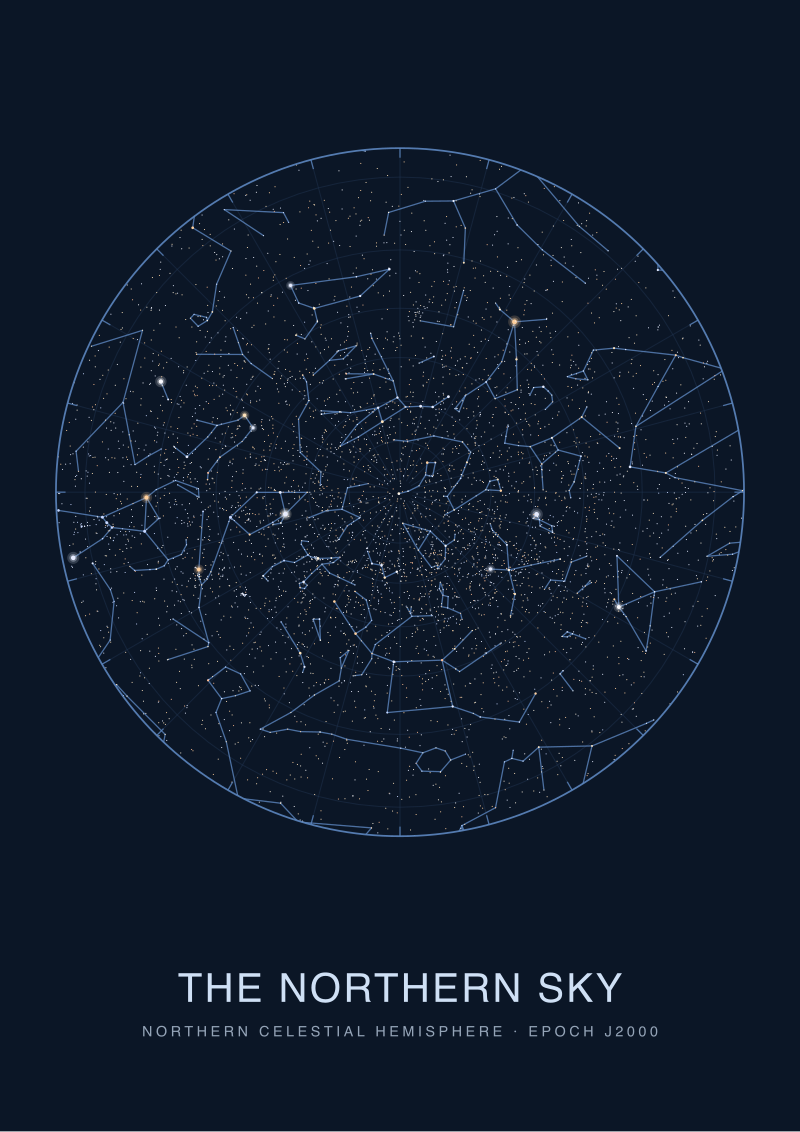 The Northern Sky
The print from this article · from €29.95
View the print →
The Northern Sky
The print from this article · from €29.95
View the print →
From the collection
New charts and 10% off your first print.
One email now with your code. No noise after.