Mirfak at magnitude 1.79 is the better star-map subject for any buyer living above roughly 40° north latitude, despite Kaus Australis carrying the identical brightness value on the same HYG v41 catalogue line. Hear us out. Most cartographers treat the pair as interchangeable — same apparent magnitude, same eligibility for the hero position on a chart. That framing collapses the moment declination enters the equation. Mirfak sits at +49.86°. Kaus Australis sits at −34.38°. One is above the horizon nightly for most of the buyer market. The other is not. We will defend the verdict below.
The steel-man against us is straightforward. Kaus Australis anchors the handle of the Sagittarius teapot, which sits inside the densest naked-eye region of the entire Milky Way. As a compositional subject it is arguably richer than Mirfak's neighborhood. A print of the Sagittarius field carries the galactic core through the frame, star fields behind star fields, the sort of density that photographs and charts both reward. If the reader lives at −20° latitude or below, or if the print is destined for a room whose occupant lived twenty years in the southern hemisphere, that argument wins. Our verdict is a default, not a universal. The rest of this piece is a defense of when the default applies and how to know when it does not.
Declination Is the Only Question That Actually Matters
Apparent magnitude is a scalar. Declination is the coordinate that decides whether the scalar ever meets a human eye. Mirfak's declination of +49.86° places it inside the circumpolar cap for any observer above +40° latitude — that is, above roughly the line running from Madrid through New York to Beijing. From those latitudes, Mirfak never sets. It rotates around the celestial pole on a nightly circle and is available every clear evening of the year, positioned differently by season but always up there.
Kaus Australis at −34.38° declination is the mirror case. From +40° north, Kaus Australis rises to a maximum altitude of roughly 15° above the southern horizon at culmination, and only during the summer months when Sagittarius is on the meridian at reasonable evening hours. Fifteen degrees means haze, means trees, means the neighbor's roof. It means a star that spends most of the year invisible and, when technically up, is buried in the atmospheric muck that thickens dramatically below 20°. A magnitude 1.79 star at 10° altitude is not perceived as magnitude 1.79. Atmospheric extinction at that altitude subtracts roughly half a magnitude, sometimes more depending on humidity and aerosols. The catalogue number and the observed number diverge.
This is what we mean when we say declination is the only question that matters for a wall print. A star map is a document of a sky the buyer can, in principle, walk outside and confirm. If they cannot walk outside and confirm it, the print stops being a chart and starts being decoration. Decoration is a legitimate purpose, but it is not the purpose most cartography buyers actually want when they order a star map. They want the map above the desk to correspond to the ceiling above the roof.
Mirfak Sits Inside the Perseus Field, Not Beside It
There is a second reason the northern hemisphere buyer wins twice with Mirfak: the star is not alone. It anchors the Alpha Persei Cluster, one of the visually richest open clusters in the sky and a naked-eye object under moderately dark conditions. On a plate, the region around RA 3.4 hours and declination +49.86° draws as a soft ribbon of associated stars — the moving group that shares Mirfak's proper motion through the galaxy. A cartographer plotting Mirfak inherits that ribbon whether or not they wanted it.
The compositional consequence is that Mirfak-centered prints have a natural secondary weight. The eye lands on the magnitude 1.79 anchor, then travels along the cluster arc toward the northeast, into the Double Cluster region of Perseus, then across to Cassiopeia. The Perseus-Cassiopeia axis is one of the sky's most legible chartable arcs for the northern winter observer. Every stop along that arc is a real thing an owner of the print can find, first with the finger on the paper and then with the eye on the sky.
Kaus Australis, by contrast, functions as a corner of the teapot asterism. It is structurally load-bearing but visually subordinate. A print centered on Kaus Australis has to decide whether it is a Sagittarius chart (in which case the teapot dominates and Kaus Australis becomes one of eight stars) or a Kaus Australis portrait (in which case the star is asked to carry the whole frame despite lacking a cluster halo). Both compositional choices are defensible. Neither is as forgiving to a cartographer as Mirfak's built-in ribbon.
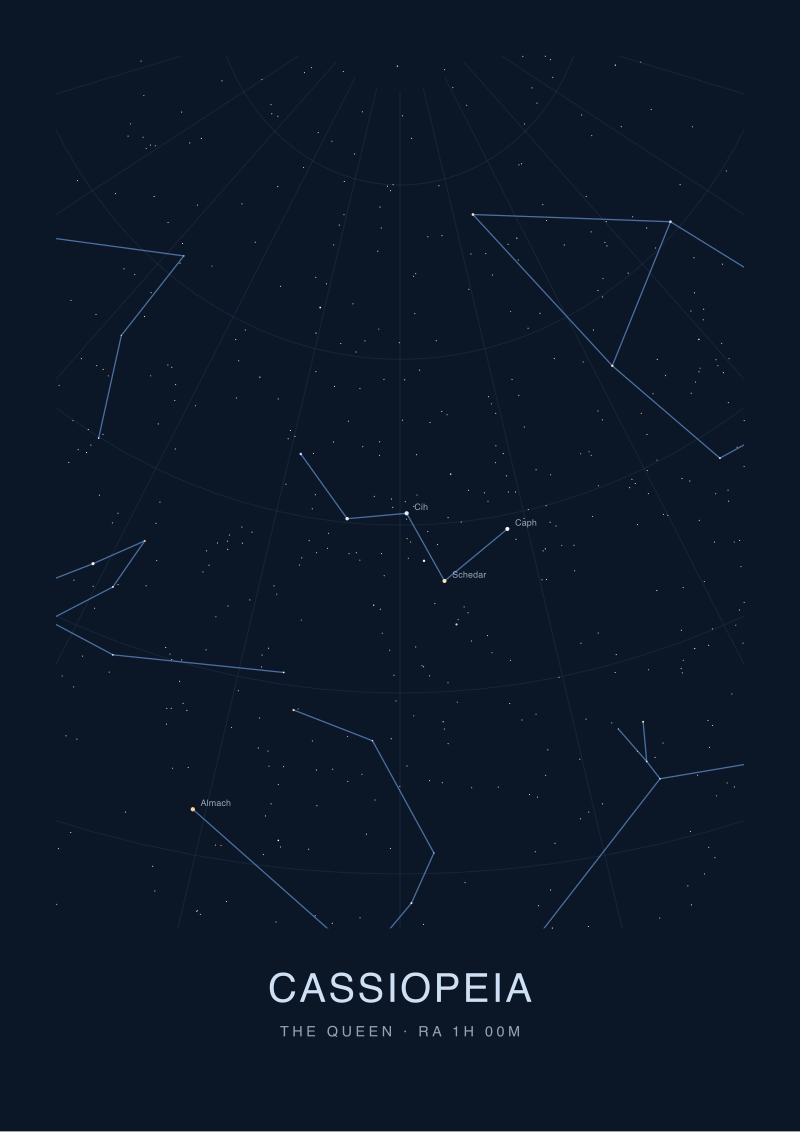 Cassiopeia
The print from this article · from €29.95
View the print →
Cassiopeia
The print from this article · from €29.95
View the print →
The Southern-Sky Argument Deserves an Honest Answer
If the buyer lives at −20° latitude or below, the entire argument above inverts. Kaus Australis rises to zenith or near-zenith at Sydney, Buenos Aires, Cape Town, Auckland. Mirfak, at +49.86° declination, is either permanently below the horizon (from anywhere south of −40°) or scrapes just above the northern horizon in visible haze (from between −20° and −40°). For that buyer, Mirfak is the star that does not exist above their roof, and Kaus Australis is the one that culminates overhead in June and July with the galactic core spilling across the sky behind it.
The southern hemisphere is a smaller cartography market than the northern by an order of magnitude — this is a demographic fact, not a preference — but it is not zero, and it is not a market that should be sold a Perseus print because a northern cartographer defaulted. The honest posture for a studio is to ask where the print is going before printing it. When the destination is south, Kaus Australis wins by exactly the same declination-driven logic that makes Mirfak win in the north. The mechanism is symmetric.
There is also a third case: the traveller. A print bought as a memory of a specific latitude — a honeymoon in Patagonia, a childhood in Nairobi, a year spent working in Chile — should be plotted for that latitude regardless of where the print will eventually hang. Star maps of remembered skies are a different product than star maps of current skies. Both are legitimate; only the first is location-independent.
| Dimension | Mirfak (Perseus) | Kaus Australis (Sagittarius) |
|---|---|---|
| Apparent magnitude (HYG v41) | 1.79 | 1.79 |
| Right ascension | 3.405 h | 18.403 h |
| Declination | +49.86° | −34.38° |
| Circumpolar above | +40.14° N | +55.62° S |
| Never rises below | −40.14° S | +55.62° N |
| Max altitude from +40° N | 80° (culmination) | ~15° (culmination) |
| Max altitude from −34° S | ~5° (culmination) | 90° (zenith) |
| Peak evening season (N hemisphere) | Nov–Feb | Jun–Aug |
| Notable associated feature | Alpha Persei moving group | Sagittarius teapot handle, galactic core backdrop |
Same Magnitude Prints Differently at Different Latitudes
The subtlest point in this whole comparison, and the one most often skipped, is that identical catalogue magnitudes do not translate to identical visual weight on a chart the observer can verify. Two 1.79-magnitude stars in a HYG line-item are equally bright in the abstract. Two 1.79-magnitude stars in a lived sky are not, because atmospheric extinction is a function of altitude, and altitude is a function of declination and latitude.
For an observer at +45° north on a typical clear night, Mirfak passes near the zenith at culmination and loses less than 0.1 magnitude to extinction — call it an observed 1.85. Kaus Australis, from the same balcony, culminates at 10° altitude if it culminates at all, and the atmospheric column at 10° is roughly 5.5 times the column at zenith. Extinction at that altitude runs half a magnitude to a full magnitude depending on conditions, so the observed value drops to 2.3 or dimmer. A star chart that plots both at identical brightness — because both catalogue values are 1.79 — is not lying, but it is describing a sky the reader does not have.
The cartographer's job is to plot the catalogue faithfully and to let the buyer know which sky the catalogue matches. This is why the "which star map to choose" question is not answerable from the numbers alone. Two identical numbers, two opposite outcomes, and the deciding variable — where the print will hang — sits outside the catalogue entirely. Any studio that answers the question without asking that variable first is either guessing or defaulting to the larger market, which is what we have been doing throughout this article and what we are being transparent about doing.
What You Should Actually Do
If the print is destined for a wall between +30° and +70° north latitude, order Mirfak. The star is up every clear night of the year, it culminates high enough that a chart of its field describes a sky the owner can actually verify, and its position inside the Alpha Persei cluster gives the composition a natural secondary weight that Kaus Australis cannot provide from its structural role in Sagittarius. Ask the studio for a Perseus-region plot centered on Mirfak with the moving group rendered as a subordinate constellation of dots — that treatment reads as a real chart, not a graphic. Our own catalogue at /shop/ carries this configuration; other studios can be briefed the same way.
If the print is destined for a wall south of the equator, or is being bought as a memory of a specific southern latitude, order Kaus Australis instead and specify a Sagittarius-field composition that includes the teapot and the galactic core context. If the destination latitude is between −20° north and +30° north — the tropics — either star is legitimately observable at the right season, and the choice reduces to which region of sky the buyer would rather look at, which is a matter of taste rather than cartography. When taste is the deciding vote, ask the buyer to describe their favorite summer versus favorite winter sky and print whichever one they answer more warmly. That answer is the real specification.
FAQ
Why does declination matter more than magnitude for choosing a star map?
Apparent magnitude tells you how bright a star is in the abstract; declination tells you whether the star ever appears in a sky the buyer can walk outside and verify. Mirfak at +49.86° declination is circumpolar above +40° north latitude, meaning it is up every night of the year. Kaus Australis at −34.38° declination barely clears the horizon from the same location, and only in summer. A chart of a star the buyer cannot see is decoration, not cartography.
Is Mirfak actually brighter than Kaus Australis?
No. Both stars are listed at apparent magnitude 1.79 in the HYG v41 catalogue — the same brightness value on the same catalogue line. What differs is not intrinsic brightness but observed brightness from a given latitude, which changes because of atmospheric extinction. A star at 10° altitude passes through roughly 5.5 times more atmosphere than a star at the zenith, and loses meaningful brightness to that column. The catalogue number is honest; the sky is not always cooperative.
What is the Alpha Persei moving group and why is it relevant to a Mirfak print?
The Alpha Persei moving group is an open cluster of stars that share Mirfak's motion through the galaxy, spread across a few degrees of the Perseus constellation around the star. On a chart plotted at reasonable scale, the cluster renders as a soft ribbon of secondary dots around the primary anchor, giving the composition natural depth. Cartographically it is a gift — Mirfak-centered prints inherit visual complexity without the cartographer having to invent it.
From what latitude can I see Kaus Australis well?
Kaus Australis culminates at a workable altitude — above 30°, where atmospheric extinction stops dominating — for observers south of roughly +25° north latitude. It reaches zenith or near-zenith for observers between −20° and −50° south. From the mid-northern hemisphere (Madrid, New York, Beijing), the star exists but sits too low in the summer southern sky to be observed with any comfort. From southern Australia, South Africa or southern South America, it is one of the brightest overhead stars during their winter months.
What season is best for a Mirfak-centered chart?
Mirfak is technically visible from northern latitudes every night of the year, but it culminates highest — meaning it sits closest to the zenith at a reasonable evening hour — from late autumn through early winter. From November through February, Mirfak is high in the northeast to overhead during the evening from most of the northern hemisphere, which is when the Alpha Persei cluster is easiest to trace with binoculars or the eye. A chart bought as a winter gift lines up naturally with the sky the recipient will actually see.
Can I have a chart that shows both stars on the same map?
Yes, but the composition is difficult. The two stars sit almost exactly opposite in right ascension (3.4 hours versus 18.4 hours) and roughly 84 degrees apart in declination. A single chart showing both requires either an all-sky projection, which flattens both regions into small elements, or a two-panel layout treating them as separate scenes. Neither reads as elegantly as a single-hemisphere print. Buyers who want both usually order two charts and hang them as a pair.
Does the choice change for someone at the equator?
Between −20° south and +30° north latitude, both stars pass through workable altitudes at some point in the year — Mirfak from October through March, Kaus Australis from May through September. Neither is circumpolar and neither is invisible. For the equatorial buyer, the declination argument that dominates the temperate latitudes weakens considerably, and the choice reduces to which region of sky the buyer feels closer to. That is a matter of personal association, not cartography.
Is one of these stars culturally more significant than the other?
Both carry deep naming heritage. Mirfak comes from the Arabic phrase for the elbow of Perseus, part of the Ptolemaic constellation system carried through Islamic astronomy into the modern IAU catalogue. Kaus Australis comes from the Arabic word for bow (kaus) with the Latin australis for southern, marking the southern end of the archer's bow in Sagittarius. Neither has a stronger mythological weight in the sense a chart buyer would notice — the difference is which constellation's stories the buyer wants on the wall.
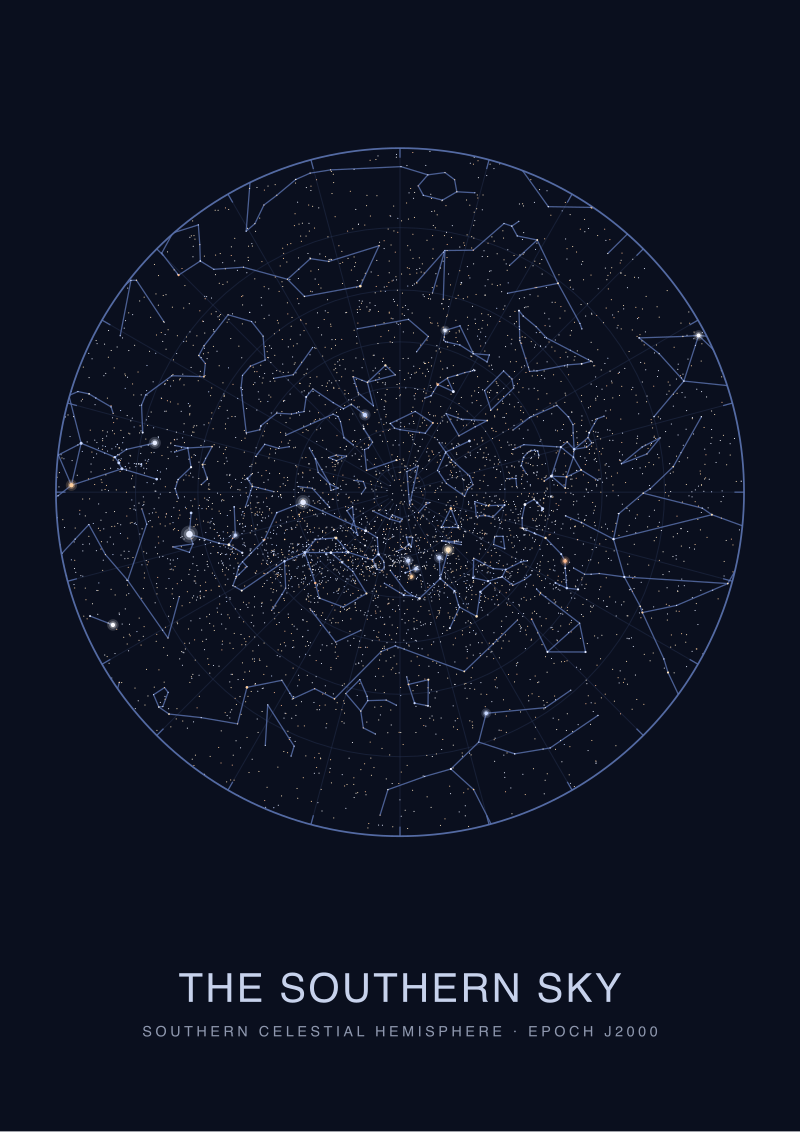 The Southern Sky
The print from this article · from €29.95
View the print →
The Southern Sky
The print from this article · from €29.95
View the print →
From the collection
New charts and 10% off your first print.
One email now with your code. No noise after.