Magnitude 1.79. Right ascension 18.40287 hours. Declination minus 34.38462 degrees. Catalogue: HYG v41. Four numbers, and a star map is already half drawn. Kaus Australis — the southern anchor of the archer's bow in Sagittarius — is one of the sky's brighter fixed points, and every mark a chartmaker puts on the page corresponds to one of those figures or a decision made about it. This article decomposes the drawing. The dot size, the placement, the label typography, the constellation frame around it: each layer of a chart is a discrete choice, and each choice can be read backwards to the data that generated it.
The Coordinates: 18.40287h RA, -34.38462° Dec, and Why the Decimals Matter
Every star on a chart has to land somewhere, and the somewhere is a pair of numbers. Right ascension for Kaus Australis, from the HYG v41 catalogue, is 18.40287 hours. Declination is minus 34.38462 degrees. Written the way an observer prefers to read the sky, that is roughly 18h 24m 10s of right ascension and 34° 23' 05" south of the celestial equator. Both notations describe the same point; the decimal form is what the chartmaker's software receives, and the sexagesimal form is what a reader looking at an eyepiece scale can compare against.
Right ascension runs eastwards around the sky in hours, minutes and seconds because it was defined to mirror sidereal time. Twenty-four hours of right ascension is a full circle, so one hour equals fifteen degrees. Kaus Australis, at 18.40287 hours, sits deep in the third quadrant of the sky as measured from the vernal equinox — the northern-hemisphere summer sky, though its declination will pull it firmly into the south.
Declination is the sky's latitude. Zero is the celestial equator, plus ninety is the north celestial pole, minus ninety is the south. At minus 34.38462 degrees, Kaus Australis is a decidedly southern object. From London it never rises. From Cape Town it passes almost overhead. From Rio de Janeiro it is a high summer star; from Chicago, a low horizon-hugger that mostly stays lost in the atmospheric murk.
Why do the decimals matter to the drawing? Because a chart is a projection, and projections are unforgiving. Round the right ascension from 18.40287 to 18.4 hours and the star shifts by 10.3 seconds of time, which is over two arcminutes on the sky — enough, at a chart scale of one degree per centimetre, to slip the dot off the intended asterism line. Precision at the coordinate stage is not fussiness; it is what stops the archer's bow from bending in the wrong place. Chartmakers keep the full HYG decimals in the source file and only round at render time, once the projection and paper size are chosen.
Coordinates also drift. Precession swings the celestial pole around a slow 25,800-year circle, which means the numbers printed today are numbers for a specific epoch — typically J2000.0. In a chart dated 2050 or 2100, the same star will carry slightly different figures, and a careful legend says so.
The Dot: How Magnitude 1.79 Becomes Ink on Paper
The dot is where the drawing begins to feel like a drawing. Kaus Australis has an apparent magnitude of 1.79. That single number decides how much ink the star gets.
Magnitude runs backwards. Lower numbers are brighter; higher numbers are fainter. The scale is logarithmic, tuned so that a step of five magnitudes corresponds to a factor of one hundred in brightness. A single magnitude step is therefore about 2.512 times, the fifth root of a hundred. Magnitude 1.79 is bright: brighter than the mid-magnitude stars that fill in an asterism, dim only when set beside the small handful of first-magnitude luminaries. On a moonless southern night, it is one of the stars the eye picks up first when it turns toward Sagittarius.
A chartmaker converts that number into an ink dot by choosing a scaling law. The simplest is linear in magnitude: dot diameter equals a base size minus a fixed increment per magnitude. More considered charts scale dot area to logarithmic brightness, so the disc on paper corresponds to how much light the eye actually receives. Others cap the dot at a maximum diameter so the brightest stars do not blot out their neighbours. At 1.79, Kaus Australis lands near — but not at — the top of most scales. It will read as a large filled disc, distinctly heavier than the fifth- and sixth-magnitude field stars that surround it, but visibly smaller than a zero- or negative-magnitude anchor like Vega or Sirius.
The choice of ceiling matters. On a chart tuned for naked-eye stargazing, Kaus Australis may be plotted at the same dot size as a magnitude 1.2 or magnitude 0.8 star, because the eye at that brightness cannot tell them apart anyway. On a chart tuned for photographic reference, the dots grow proportionally and the 1.79 becomes visibly smaller than a magnitude 1.0. Two charts of the same patch of sky, both truthful, can look meaningfully different in this respect. A legend that spells out the magnitude-to-dot mapping — a small key showing filled discs labelled 0, 1, 2, 3, 4, 5 — turns the drawing back into data any reader can decode.
Ink itself carries information. Pure black gives maximum contrast for a print destined to be read at arm's length. A very dark grey — around eighty percent — softens the busy fields near the Milky Way and stops magnitude 1.79 from feeling aggressive. When a Sagittarius chart is dominated by dense star clouds, this small choice is what separates a page you can read from a page that reads you.
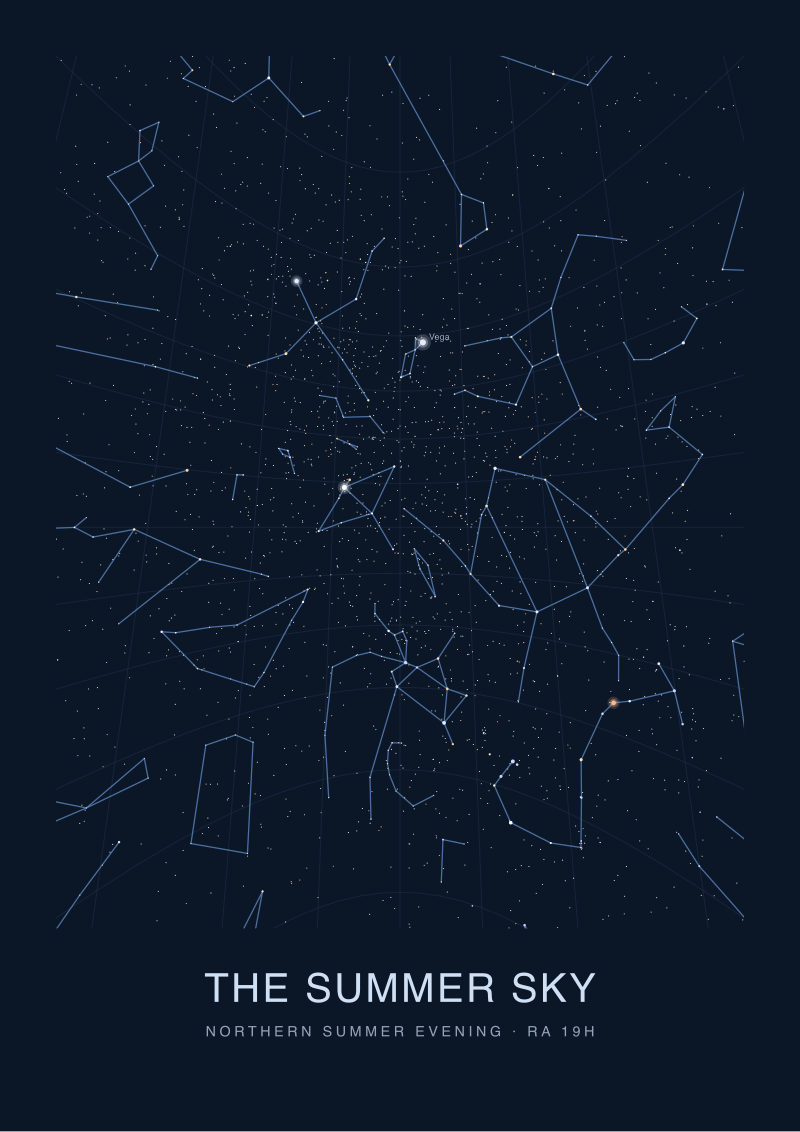 The Summer Sky
The print from this article · from €29.95
View the print →
The Summer Sky
The print from this article · from €29.95
View the print →
The Label: Typography, Bayer Letters, and the Arabic Root
A dot without a name is a coordinate. A dot with a name is a star. Labelling Kaus Australis on a chart involves three decisions: which name to use, in what typeface, and at what position relative to the dot.
The proper name Kaus Australis is a hybrid of two traditions. "Kaus" descends from the Arabic qaws, meaning bow — the star sits at the southernmost tip of Sagittarius's drawn bow. "Australis" is Latin for southern, marking it against the other bow-related stars Kaus Media and Kaus Borealis (middle and northern respectively). The Arabic root reflects the medieval flow of astronomical knowledge through Baghdad and Andalusia; the Latin qualifier reflects the later European habit of pinning each star in a mythological figure to a coordinate role. A chart that uses the proper name is telling the reader: this is the star with a story attached.
Alternatively, and more often on technical charts, the star carries a Bayer designation — a Greek letter tied to its constellation. Kaus Australis is Epsilon Sagittarii, the epsilon of the archer. Johann Bayer's 1603 Uranometria set the convention: Greek letters in order of brightness (approximately) within each constellation. On a chart, "ε Sgr" is compact, culturally neutral, and unambiguous. On a chart aimed at readers who know the sky by feel, "Kaus Australis" is warmer and more legible from a distance.
Typography carries its own signal. Italic serifs — a light Garamond, a Caslon Italic — are the traditional star-label convention, going back to the copperplate engraved charts of the seventeenth and eighteenth centuries. Sans-serif labels are the modern software default; they win on legibility at small sizes but cost the page some of its inherited grammar. Roman uppercase, spaced widely, tends to be reserved for constellation names, not stars, so that a reader can scan for the frame first and the individual stars second.
Placement is a small craft in itself. The label should not touch the dot, should not cross a constellation line, and — where possible — should sit on the side of the dot that is emptiest. For Kaus Australis, the dense Sagittarius Milky Way to the north-east means the label is almost always tucked to the south or west, where it can breathe. A chartmaker who lets labels collide is a chartmaker who has stopped reading their own page.
The Context: Sagittarius as a Frame, Not a Backdrop
Kaus Australis does not sit on a chart alone. It sits inside Sagittarius, one of the eighty-eight constellations formally ratified by the International Astronomical Union in 1930. Those constellations are more than pictures. Each is a defined region of the celestial sphere with hard boundaries — lines of right ascension and declination that divide the whole sky, without overlap or gap. Every point in the sky belongs to exactly one constellation, and Kaus Australis belongs to Sagittarius.
On the chart, the frame usually appears in three ways: as a boundary polygon, as an asterism line, and as a name. The boundary polygon is a thin outer line following the IAU divisions. Its job is to answer the reader's question of what belongs to what; it is usually rendered faintly enough that it never competes with stars. The asterism line — heavier, more expressive — connects the bright stars into the recognisable figure. In Sagittarius, the popular "teapot" asterism links eight bright stars into a spouted vessel; Kaus Australis, epsilon, sits at the bottom-left corner, forming the base of the teapot's spout and the toe of the archer's bow.
The name of the constellation, set apart in its own typographic register, tells the reader which region of the sky they are in without having to trace boundaries themselves. In classical charts it may be accompanied by an engraved figure — a mythological archer drawn over the stars — though modern editorial charts almost always omit the figure, trusting the asterism line and the label to do the work.
Sagittarius carries an extra load that a chartmaker must plan around. It lies in the direction of the galactic centre. The Milky Way runs through it as a dense band of stars, dust lanes, and famous deep-sky objects. Any chart of this constellation has to negotiate the visual noise of that band — either by rendering the Milky Way as a soft grey wash, by dimming the field-star magnitude cutoff, or by increasing the ink weight of the anchor stars so they hold their own against the crowd. Kaus Australis, at magnitude 1.79, has enough visual weight to survive that treatment. Fainter stars in the same field may not.
A star map that ignores the frame reduces the sky to a scatter of dots. A star map that treats the frame as backdrop lets it dominate. The good chart uses the frame as a container: it argues that this star belongs to this figure, in this region, and lets both the individual point and the collective shape be read together.
What the Reader Sees vs What the Chartmaker Encoded
A finished chart of Kaus Australis is a small, quiet object. A dot, a label, a line to its neighbours in the bow, a constellation boundary somewhere on the periphery, a legend on the margin. The reader takes it in in a few seconds. What they are actually looking at is the compressed output of every decision described above.
They see a dot; they are reading magnitude 1.79 filtered through a scaling law and an ink weight. They see a name; they are reading a choice between the Arabic-rooted proper name and the Bayer letter, a choice of typeface with three centuries of convention behind it, a choice of placement negotiated against neighbouring labels. They see a position on the page; they are reading right ascension 18.40287 hours and declination minus 34.38462 degrees, run through a projection that flattens the celestial sphere onto a rectangle, at a specific epoch, at a specific scale, with a specific centre. They see a constellation shape; they are reading an IAU boundary polygon, a traditional asterism line, and the accumulated agreement of thousands of years of naming.
Reading a chart backwards this way is the chartmaker's discipline. It is the reason the numbers stay in the source file at full precision, the reason the legend is not decoration, the reason a good chart of one star is never really about one star — it is a compressed statement about the whole set of choices that made the drawing possible. When our studio prints a Sagittarius plate for the shop, the file behind the paper contains the same four figures we opened with, unchanged: 1.79, 18.40287, -34.38462, HYG v41. Everything else is craft.
That is what a detail on a star map means. Not an ornament. A decision, tied to a number, that a reader with the legend can trace all the way home.
From the collection
New charts and 10% off your first print.
One email now with your code. No noise after.