Consider this a flowchart in prose. Denebola sits at right ascension 11.81766 hours and declination +14.57206 degrees, magnitude 2.14, catalogued in HYG v41 as the tail star of Leo. Those four numbers decide almost every mark our cartographers put on the sheet — grid orientation, dot diameter, label offset, framing choice. Before we draw, we ask the reader three questions, because the same star produces three legitimate charts depending on the answers. We will route you through each fork, then hand you the map of combinations. The sky does not change. The drawing does.
Question 1: Do You Know Where Denebola Sits on the Celestial Grid?
This is the first fork because it decides which grid we print underneath the stars, and the grid is not decoration. It is the coordinate system the chart is quoting. Denebola's HYG v41 record gives right ascension 11.81766 hours and declination +14.57206 degrees. Converted to the sexagesimal form most atlases still use, that is 11h 49m 03.6s of RA and +14° 34' 19" of Dec. If you already know what those two numbers mean, we draw one chart. If you do not, we draw another.
If Yes
You want the coordinate ticks visible and labelled. On our sheet, right ascension runs across the top and bottom edges in hours and minutes, increasing right-to-left because the sky rotates the opposite way to a paper map. Declination climbs the left and right edges in degrees. We put a minor tick every 5 minutes of RA and every 1° of Dec, a major tick every 30 minutes of RA and every 5° of Dec. Denebola falls between the 11h 45m and 11h 50m minor ticks on the RA axis, and just below the +15° major tick on the Dec axis. The reader who can read those numbers can, in principle, reproduce the point without our dot at all — which is exactly the standard a chart is trying to meet.
We also draw the ecliptic as a thin dashed curve. At Denebola's longitude the ecliptic crosses roughly +6° declination, so the star sits about 8.5° above it. That gap is the reason Denebola is the last Leo star the Moon and planets ever occult in modern practice — a chart that shows the ecliptic explains that gap without a caption.
If No
We suppress the coordinate labels, keep a very faint grid as background texture, and use the constellation figure as your primary wayfinding. Denebola gets drawn where the tail of Leo would end if you traced the classical figure — down and to the east of the Sickle asterism that forms the lion's head and mane. The point stays in the same absolute position on the sheet as in the labelled version, because paper does not lie about geometry. Only the reading key changes. This is the chart we print when the reader is standing outside with a red flashlight and does not want to compute anything. We add one printed cue near the bottom: "Denebola, tail of Leo, mag 2.14." That is the minimum vocabulary needed to find it.
Question 2: Can You Read the Magnitude Dot for a 2.14 Star?
The dot has a size. The size means something. Magnitude is the astronomer's brightness scale, and — famously — it goes backwards: smaller numbers are brighter. Denebola's HYG-catalogued apparent magnitude is 2.14. That number determines the diameter of the mark on the page, and the way it slots into a legend the reader has to trust.
If Yes
You want the full graded scale in the corner of the sheet. Our house convention runs from magnitude −1.5 (the mark size we would use for Sirius, off this chart) through 6.5 (the human eye's naked-sky limit under dark conditions). Each half-magnitude step changes the dot diameter by a fixed multiplier so that a magnitude 1 star reads unambiguously larger than a magnitude 2 star, which reads unambiguously larger than a magnitude 3 star. On this sheet, Denebola at 2.14 lands one clean size step below Regulus in the same constellation figure, and roughly the same size as the dot we would print for Deneb at magnitude 1.25 — no, that is a mistake worth catching. Deneb at 1.25 is brighter and gets a visibly larger dot than Denebola at 2.14. The reader who can read the legend will spot that difference at a glance across a two-constellation chart, and that is the point of the legend existing.
We also mark spectral colour with a subtle tint. Denebola is catalogued as an A-class star and prints as a cool white; the eye at the eyepiece will not resolve the tint, but the chart is not the eyepiece. The chart is a reference document, and it should record what the star is, not only where.
If No
We collapse the scale. Three dot sizes only: bright (magnitude 0 and brighter), medium (magnitude 1 to 3), faint (magnitude 3 to 5, our print floor). Denebola at 2.14 lands squarely in the medium bucket. The reader is not asked to distinguish 2.14 from 2.6; the reader is asked to see that Denebola is one of Leo's four principal stars, alongside Regulus, Algieba and Zosma, and less prominent than Regulus. This is a chart that trades precision for scannability, and it is the right choice for wall prints, teaching handouts, and any context where the reader will not have a legend within arm's reach.
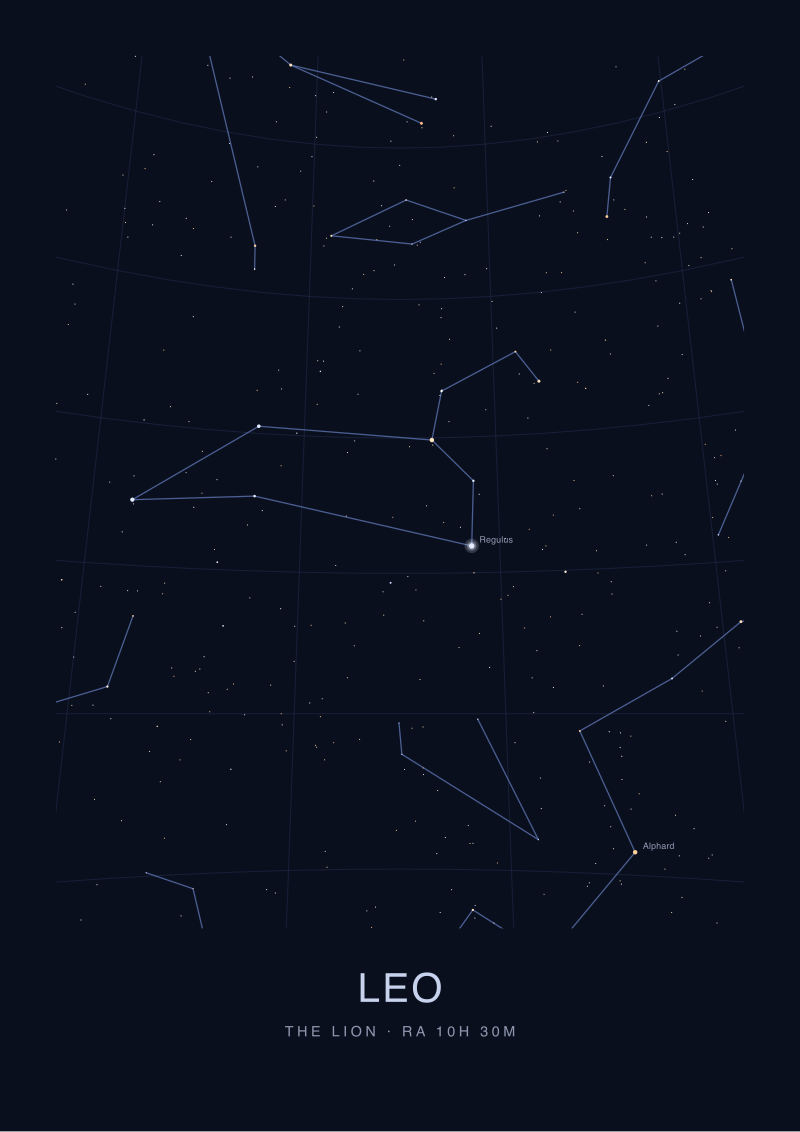 Leo
The print from this article · from €29.95
View the print →
Leo
The print from this article · from €29.95
View the print →
Question 3: Do You Want the Chart Centered on Denebola, or on Leo?
This is the framing question and it changes the sheet more than the previous two combined. Centering decides what is at the middle of the page, what falls near the edges, and — critically — which projection we use. A chart tight on a single star handles a small patch of sky, so a tangent-plane projection stays essentially distortion-free. A chart wide enough to hold a whole constellation begins to feel the curvature of the sky and needs a projection that acknowledges it.
If Yes (centered on Denebola)
Denebola goes at the middle of the sheet. Our default zoom for a single-star chart is a 10° by 10° field. At Denebola's declination that puts the frame from roughly RA 11h 09m to 12h 29m and Dec +9.5° to +19.5°. The star sits alone in a mostly quiet patch — the tail end of Leo is not a busy neighbourhood — with the galaxy pair M65 and M66 falling into the lower-left corner of the frame at their catalogued positions of RA 11h 19m and Dec +13° roughly. Our cartographers use a gnomonic projection at this scale, because straight lines on the paper correspond to great-circle arcs on the sky, which is what you want if you are pointing a telescope by dead reckoning.
The label for Denebola sits to the upper-right of the dot at a 4-point offset — always upper-right for the primary subject, always at the same offset, so a reader who returns to our charts learns the convention and stops hunting.
If No (centered on Leo)
Leo as a figure spans about 30° of sky end to end, and asks for a stereographic or Aitoff-style projection when the frame gets that wide. Denebola no longer sits in the middle; it sits on the eastern edge of the constellation figure, opposite Regulus in the west. This is the chart that tells a story: the Sickle on one side, the Triangle of Denebola-Zosma-Chertan on the other, and the long body between them. Denebola's magnitude 2.14 dot is neither the largest nor the smallest on this sheet, which is exactly the visual argument the chart is making — that Leo is a constellation of several near-equal stars rather than one dominant one and its supporting cast.
We keep the ecliptic drawn in for both framings, but on the Leo-wide chart it becomes a defining feature: you can see the ecliptic sweeping through the constellation's belly, and the reader who has ever heard "Leo is a zodiac sign" understands, without a paragraph of explanation, what that means geometrically. The zodiac is a coordinate band. Leo happens to straddle it. Denebola happens to sit above it.
If You Answered Everything: The Chart That Comes Out
Here is the map from your three answers to the sheet we print. Read across; the recommendation is what our press actually produces.
| Q1: Read grid? | Q2: Read magnitude scale? | Q3: Center on Denebola? | Recommendation |
|---|---|---|---|
| Yes | Yes | Yes | Precision single-star chart: labelled grid, graded 8-tier magnitude scale, 10° gnomonic frame, M65/M66 in corner. |
| Yes | Yes | No | Constellation reference chart: labelled grid, graded magnitude scale, 30° stereographic frame, Denebola on east edge. |
| Yes | No | Yes | Field-use chart: labelled grid for coordinates, 3-tier dot sizing, 10° frame — for planning a night, not for the field. |
| Yes | No | No | Teaching chart with coordinates: labelled grid, 3-tier dots, full Leo figure with ecliptic — best classroom sheet. |
| No | Yes | Yes | Enthusiast portrait: no grid labels, full magnitude legend, 10° frame around Denebola — the star as subject. |
| No | Yes | No | Wall print with legend: figure-led framing, full magnitude scale, 30° Leo panorama — the constellation as subject. |
| No | No | Yes | Naked-eye finder: figure-led, 3-tier dots, tight on Denebola with the tail of Leo pointing in. Red-flashlight friendly. |
| No | No | No | Poster chart: pure figure, 3-tier dots, whole Leo, minimal type — the version that hangs in a hallway. |
The eight rows are not eight products. They are eight legitimate readings of the same star at the same position at the same magnitude, and the whole point of asking the questions is that the studio does not have to guess which reading you need. Every mark on every version above is anchored in the same HYG v41 record: RA 11.81766, Dec +14.57206, magnitude 2.14, constellation Leo. What changes is what the reader is being asked to do with those numbers — measure them, learn them, ignore them, or simply live under them.
If you want to see how these decisions land on paper, the Leo prints in our /shop/ collection are the wall-print row above, in the final combination — no grid labels, three-tier dot sizes, full constellation, minimal type. Everything else is drafted the same way in the studio and produced on request.
FAQ
What is Denebola's exact position on a star chart?
Denebola sits at right ascension 11.81766 hours and declination +14.57206 degrees, per HYG v41. Converted to the sexagesimal form printed on most modern charts, that is 11h 49m 03.6s of RA and +14° 34' 19" of Dec. Any properly drawn chart of Leo will put its magnitude 2.14 dot at that coordinate pair. If a chart's grid disagrees with those numbers by more than a minor tick, the projection is either misaligned or the epoch is different from the standard J2000 the catalogue uses.
Why is Denebola drawn smaller than Regulus on most Leo charts?
Because it is fainter. Regulus is Leo's brightest star at first magnitude; Denebola is catalogued in HYG v41 at magnitude 2.14, roughly one full magnitude step down. On the astronomer's scale, each magnitude step is a fixed brightness ratio, and every honest star chart translates that ratio into dot diameter. The size difference is not artistic emphasis on the lion's head — it is quantitative reporting of what the eye actually sees under a clear sky.
What does the ecliptic line near Denebola mean on a chart?
The ecliptic is the apparent yearly path of the Sun across the sky, and by extension the band the Moon and planets stay close to. Charts that include it draw it as a dashed curve. Near Denebola, it crosses roughly +6° declination, which puts Denebola about 8.5° north of the line. That gap is why Denebola, unlike Regulus in the same constellation, is never occulted by the Moon under normal conditions — a geometric fact the chart shows without needing to say it.
Why do star charts print right ascension increasing right-to-left?
Because a chart is a top-down mirror of the sky above your head. When you face south from the northern hemisphere, east is on your left and west is on your right, and the sky rotates east-to-west overhead. To make the paper agree with what the reader sees when they hold it up, RA — which increases eastward — has to run leftward on the sheet. This is a convention as old as printed star atlases, and it is why beginners sometimes read the axis backwards on their first attempt.
Does Denebola belong to the zodiac?
Denebola lies within the constellation Leo, which is one of the twelve zodiacal constellations under the classical scheme, but the star itself sits about 8.5° north of the ecliptic — the line the Sun, Moon and planets actually track. So it is a star in a zodiacal constellation without ever being crossed by a planet. The zodiac is a coordinate band on the sky, not a personality system; a chart that draws the ecliptic makes Denebola's position relative to that band literally visible.
What does HYG v41 mean in a star chart's source note?
HYG is a merged public star catalogue combining the Hipparcos, Yale Bright Star and Gliese catalogues, and v41 is a specific released version of that merge. When a chart cites it, the cartographer is naming their source for every star's position and magnitude — so that a reader who wants to check a coordinate has a fixed reference to open. It is the star-cartography equivalent of citing the edition of a dictionary.
Why do some charts show three dot sizes and others show eight?
Because the number of sizes reflects how much precision the chart expects its reader to use. A three-tier scale — bright, medium, faint — is scannable across a room and correct at the level of "which stars form the figure." An eight-tier scale rewards a reader who wants to know that Denebola at 2.14 is dimmer than Algieba but brighter than Chertan. Neither is wrong. They are targeted at different uses of the same sheet.
Watch three things when reading any Denebola chart
First, whether the RA/Dec grid is labelled or suppressed — that tells you if the chart expects coordinate literacy. Second, whether the magnitude legend has three tiers or a graded scale — that tells you the precision the cartographer is claiming. Third, whether Denebola sits in the middle of the sheet or on the eastern edge of a wider Leo frame — that tells you whether the star or the constellation is the subject. Those three signals decode almost any Leo chart in under a minute.
From the collection
New charts and 10% off your first print.
One email now with your code. No noise after.