Think of this piece as a flowchart pinned to the drafting board. Before we ink a single star, we ask the plate three questions, and the answers route the whole chart. Phecda sits in Ursa Major at right ascension 11.89717 hours and declination +53.69476 degrees, catalogued in HYG v41 at apparent magnitude 2.41. Those three numbers — one identity, one brightness, one address — are what a star map is actually built from. We will ask you the same three questions the drafting table asks us, and by the end you will know exactly what every mark on a Phecda plate is telling you.
Question 1: Do You Know Which Star on the Plate Is Phecda?
This is the first fork because a star map is not a photograph. It is a labelled argument. Before we decide anything about ink weight, symbol size, or legend, we need to know whether the reader can already locate Phecda inside its constellation. Ursa Major has hundreds of catalogued stars in the same plate area, and the seven bright ones the eye connects into the Big Dipper are only the tip of the visible list. On our drafting sheet, Phecda is the star sitting at the inner-lower corner of the Dipper's bowl — the bottom-of-bowl corner nearest the handle. It is the star a line drawn from Merak through Dubhe would eventually miss, because Phecda is on the opposite side of the bowl. Knowing which of the seven it is changes how much scaffolding the chart has to carry.
If Yes
If you can already point at Phecda on a Dipper without hesitation, the plate opens up to you. We can drop the diagram-heavy training legend and let the star itself do more of the work: a small filled disc calibrated to its 2.41 magnitude, a hairline stroke back to the bowl edge, and the Greek-letter label γ (Gamma Ursae Majoris) as its Bayer designation. The plate we draw for the confident reader has a lighter grid because the reader is orienting off the constellation figure, not the coordinate mesh. Everything you see printed near Phecda — the small tick indicating its declination on the northern edge of the plate, the light dotted line running back to the celestial equator — is redundancy the confident reader can ignore without losing the star. On the studio's plates, we still print those marks because the map has to survive being read by someone who does not know the sky yet. But you, in this branch, are reading them as decoration.
If No
If you cannot point at Phecda yet, the plate does more of the lifting, and it is worth walking through what the marks are doing for you. Start with the Dipper's bowl as a quadrilateral. The two stars on the side away from the handle are Dubhe (top) and Merak (bottom); the two stars on the handle side of the bowl are Megrez (top) and Phecda (bottom). Phecda is that fourth corner — bottom-inner. On our plate, that star is drawn as a filled disc slightly larger than the surrounding field stars, because at magnitude 2.41 it belongs to the brightest tier we would ever draw at full weight. Around it you will see a faint dashed line following the bowl figure back to Megrez and forward to Merak. That figure line is a cartographer's convention: it exists on the chart, not in the sky. The stars do not know they are a bowl. The chart is telling you which stars the tradition has chosen to connect.
Question 2: Do You Understand What Magnitude 2.41 Buys on the Page?
This fork matters because magnitude is the single input that decides how big the star's disc gets on the printed plate, and getting the scale wrong is how amateur charts end up looking like a scattering of dots with no depth. The apparent magnitude scale runs backwards — a star of magnitude 1 is brighter than a star of magnitude 2, which is brighter than a star of magnitude 3, and so on. Each step of one magnitude corresponds to roughly a factor of 2.5 in brightness. Phecda's 2.41 means it sits solidly in the second-magnitude class: bright enough to be a naming star, dimmer than the reference first-magnitude anchors that dominate their constellations. On the plate, that translates into a specific disc diameter, and understanding why is the difference between reading the map and being told by it.
If Yes
If you already read magnitude fluently, look at how our Phecda disc compares to its neighbours in the Dipper. Every disc on our plates is drawn from the same magnitude-to-diameter curve, which means the ratio of Phecda's disc to Dubhe's disc, or to Alkaid's disc at the tip of the handle, is a legible statement about brightness. The reader who understands the scale sees at a glance which star in the figure is brightest, second-brightest, and so on, without needing to squint at magnitude labels. This is why we do not print the number 2.41 next to Phecda on every chart. On the cleanest editions of our plates, magnitudes appear only in the legend and the catalogue key. The disc itself is the number. If the disc is the number, and the number is 2.41, then what you are looking at on the chart is a star drawn about one-and-a-half visual notches smaller than the largest disc on the plate — a mid-tier bright star, held to its correct place on the brightness ladder.
If No
If magnitude is still a scale you are learning, the trick is to remember three anchors. Magnitude 0 is where you find Vega, roughly. Magnitude 1 is the tier of the very brightest named stars, like Aldebaran. Magnitude 6 is the traditional limit of the unaided human eye under a dark sky. Phecda's 2.41 sits about a quarter of the way down that ladder from the brightest stars toward the naked-eye limit. On our plate, the disc we draw for it is noticeably smaller than the disc we draw for the brightest star on the same page, and noticeably larger than the discs for background stars around magnitude 4 or 5. If you compare Phecda's disc to a background star of magnitude 4, the surface area of the printed dot is roughly six times smaller for the fainter star. That ratio is not decorative. It is the chart trying to tell you honestly what the sky looks like when you look up.
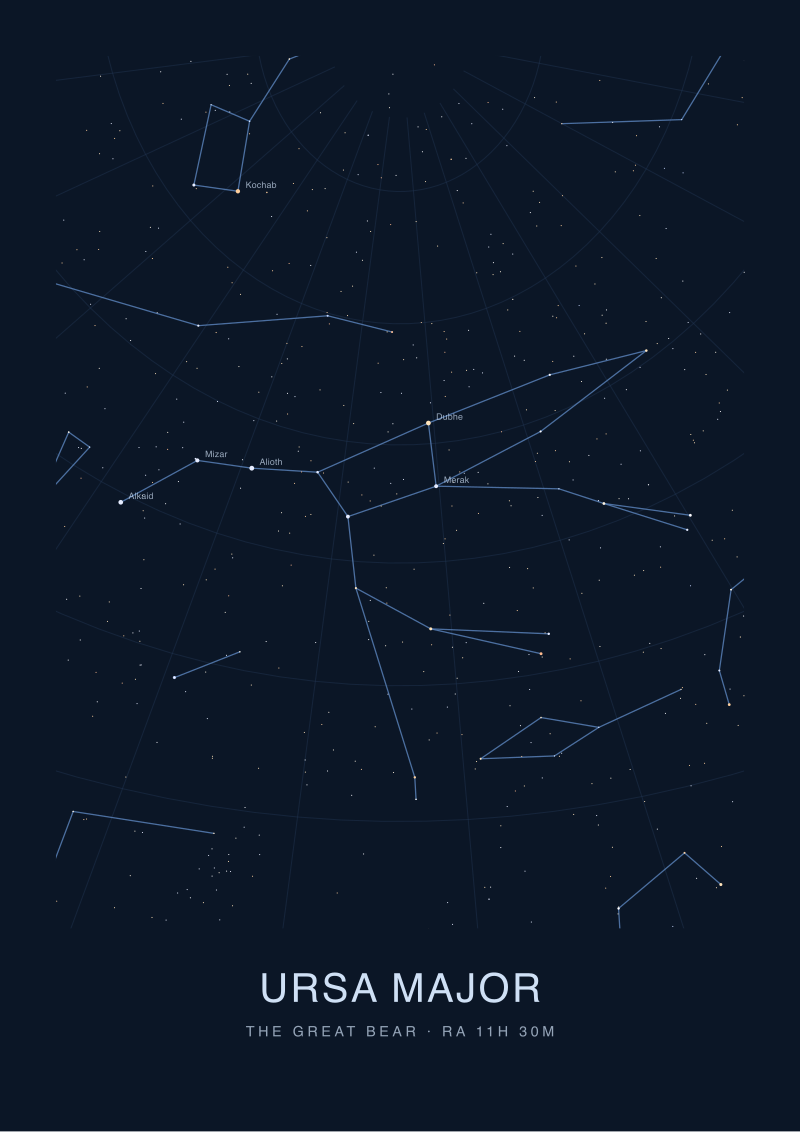 Ursa Major
The print from this article · from €29.95
View the print →
Ursa Major
The print from this article · from €29.95
View the print →
Question 3: Do You Read the Coordinates as Sky, or as Grid?
Right ascension 11.89717 hours and declination +53.69476 degrees. Two numbers. They are the star's postal address on the celestial sphere. On the plate we draw, those two numbers land in a very specific place — the intersection of a particular vertical meridian and a particular horizontal parallel. But how you read that intersection depends on whether you experience the plate as sky (a slice of the dome above your head) or as grid (a printed coordinate system). Both readings are correct. They are just different tools. A chart worth pinning up has to serve both.
If Yes
If you read coordinates as sky, you already know that right ascension is measured eastward along the celestial equator in hours, minutes and seconds, and declination is measured north or south of the celestial equator in degrees. Phecda's RA of 11.89717 hours places it about eleven hours and fifty-four minutes east of the vernal equinox, meaning it crosses the local meridian a little before Zero UT reaches the same longitude — a spring-evening star in the northern hemisphere. Its declination of +53.69 degrees puts it well north of the equator, comfortably inside the circumpolar cap for observers north of about latitude +36 degrees. On the plate, we mark that address with a hairline crosshair only in the drafting file. In the finished print, the coordinate is not drawn as a cross at all: it is implied by the position of the star inside the surrounding grid lines. If you read coordinates as sky, that implicit crosshair is enough. You know where the star lives.
If No
If you read coordinates as grid, the RA and Dec numbers are still doing work for you — they are what allows two different charts, made by two different studios, to agree on where the star is. On our Phecda plate, you will see a light grey grid: vertical lines every one hour of right ascension, horizontal lines every ten degrees of declination. Phecda falls between the eleven-hour and twelve-hour meridians, closer to twelve, and between the +50 and +60 degree parallels, closer to +50 than to +60. That intersection is where the disc sits. If you learned coordinates as grid — as a map projection, as an X and Y — this is exactly what you would do to plot the star on graph paper. The grid also warns you that this is a projection, not the sky itself. Near the pole, the meridians squeeze together; near the equator, they spread out. A well-drawn plate makes that distortion visible so you never confuse the printed page with the dome.
If You Answered Everything: The Recap Table
Once you have routed through all three questions, the answer map is deterministic. The plate you get, and the way it reads, depends on the combination of your answers. The table below is the flowchart resolved. Read it as: given your three Yes/No answers, this is the chart that is going to serve you best.
| Q1: Locate Phecda? | Q2: Read magnitude? | Q3: Read coordinates as sky? | Recommendation |
|---|---|---|---|
| Yes | Yes | Yes | Use the minimalist plate: light grid, no labels, disc alone tells brightness. |
| Yes | Yes | No | Add the labelled grid; disc-and-figure carry the reading, grid confirms position. |
| Yes | No | Yes | Add the magnitude legend; you know the sky but need the disc scale spelled out. |
| Yes | No | No | Add both the magnitude legend and the labelled grid; figure alone anchors you. |
| No | Yes | Yes | Add the figure-line overlay; you read brightness and sky, but need the bowl drawn. |
| No | Yes | No | Add the figure-line overlay and the labelled grid; two scaffolds, one plate. |
| No | No | Yes | Use the teaching plate: figure lines, magnitude legend, coordinate cues in sky terms. |
| No | No | No | Use the full-scaffold plate: figure, magnitudes, labelled grid, and coordinate key. |
The table is not a marketing chart. It is a diagnostic. Every row is a real plate we would draw differently, because the reader is doing a different job in front of the paper. This is why our studio's Ursa Major prints in the /shop/ are not a single design: each is calibrated to a specific reading level, and each treats Phecda's three numbers — the identity, the magnitude 2.41, the address at RA 11.89717 / Dec +53.69476 — as the non-negotiable anchors around which the plate is drawn.
Magnitude 2.41. That is the number that should change how you look at a Phecda plate — and the decision it should route is smaller than it sounds. When you next pick up a star map of the Big Dipper, the question is not which chart is prettiest. It is which chart draws its second-magnitude disc honestly, at the correct ratio to the first-magnitude anchors around it. A plate that gets 2.41 right will get the rest of the sky right. A plate that flattens the scale is not a map. It is decoration. The math is closed.
FAQ
What is Phecda's official designation and where does the name come from?
Phecda is Gamma Ursae Majoris in the Bayer catalogue and is listed in HYG v41 with the coordinates and magnitude used throughout this article. The proper name derives from the Arabic naming heritage that supplied so many bright-star names in the western tradition, referring to the thigh of the bear. We treat that as lore, told as lore: the tradition named it, and the IAU has since endorsed the name for cataloguing. The catalogue identity, not the etymology, is what a chart is built on.
Why is magnitude 2.41 considered "bright" when higher numbers usually mean bigger?
The apparent magnitude scale runs backwards on purpose, as a historical inheritance from Hipparchus. Lower numbers denote brighter stars, and each step of one magnitude corresponds to about a factor of 2.5 in brightness. Magnitude 2.41 places Phecda in the second-magnitude tier, well within naked-eye range under any sky and comfortably brighter than the average background star we would draw on the same plate. The scale is counter-intuitive, but it is the scale every chart uses.
Can I see Phecda from the southern hemisphere?
Phecda's declination of +53.69 degrees puts it deep in the northern celestial hemisphere, which limits its visibility from far southern latitudes. Observers north of roughly latitude +36 degrees see it as circumpolar — it never sets. Observers between the equator and about latitude −36 degrees can still catch it low in the northern sky during the appropriate season, but the further south you go, the shorter the window and the closer to the horizon it stays. Below about latitude −36 degrees, it does not clear the horizon at all.
How does Phecda relate to the other stars of the Big Dipper on a chart?
Phecda is one of the four bowl stars, positioned at the inner-lower corner of the bowl — the corner adjacent to Megrez, where the handle meets the bowl. On a chart, the figure line drawn around the Dipper connects Phecda to Merak on one side and Megrez on the other. That figure is a cartographic convention, not a physical grouping; the seven Dipper stars are at very different distances from Earth and are not gravitationally bound in the shape the eye sees.
What do the numbers RA 11.89717 and Dec +53.69476 actually mean?
Right ascension is the celestial equivalent of longitude, measured eastward from the vernal equinox in hours, minutes and seconds. Declination is the celestial equivalent of latitude, measured in degrees north or south of the celestial equator. Together they fix a star's address on the sky's coordinate grid. Phecda's coordinates, taken from HYG v41, are what every professional star chart uses to place its disc on the plate — the same numbers, regardless of the studio.
Is Phecda's brightness constant over time?
For the purposes of an atlas plate, yes: the apparent magnitude of 2.41 recorded in HYG v41 is the working value, and Phecda is not a headline variable star whose brightness fluctuates in ways a chart would need to warn readers about. Small changes over long periods happen for many stars, but they are below the threshold at which a printed disc size would change. A chart drawn today and one drawn a decade from now will treat Phecda's magnitude as effectively the same number.
Why do star maps sometimes label Phecda as Phad or Phekda?
Transliterations from the Arabic naming heritage into Latin script produced several accepted spellings, and older atlases used variants like Phad or Phekda. The International Astronomical Union eventually settled on Phecda as the standardised proper name for γ Ursae Majoris, which is why modern chart legends and catalogues converge on it. Older prints that use the variants are not wrong — they are simply from a period before the naming committee closed the file.
Does the astrological zodiac have anything to do with Phecda?
No. Phecda sits in Ursa Major, which is a northern constellation nowhere near the ecliptic band that the zodiac tradition uses. The zodiac itself is a coordinate band across the sky where the Sun, Moon and planets appear to travel — not a personality system, and not a claim about the stars within it. Phecda is a real star with a real catalogue entry, and its map is drawn from astronomical measurements, not astrological interpretation.
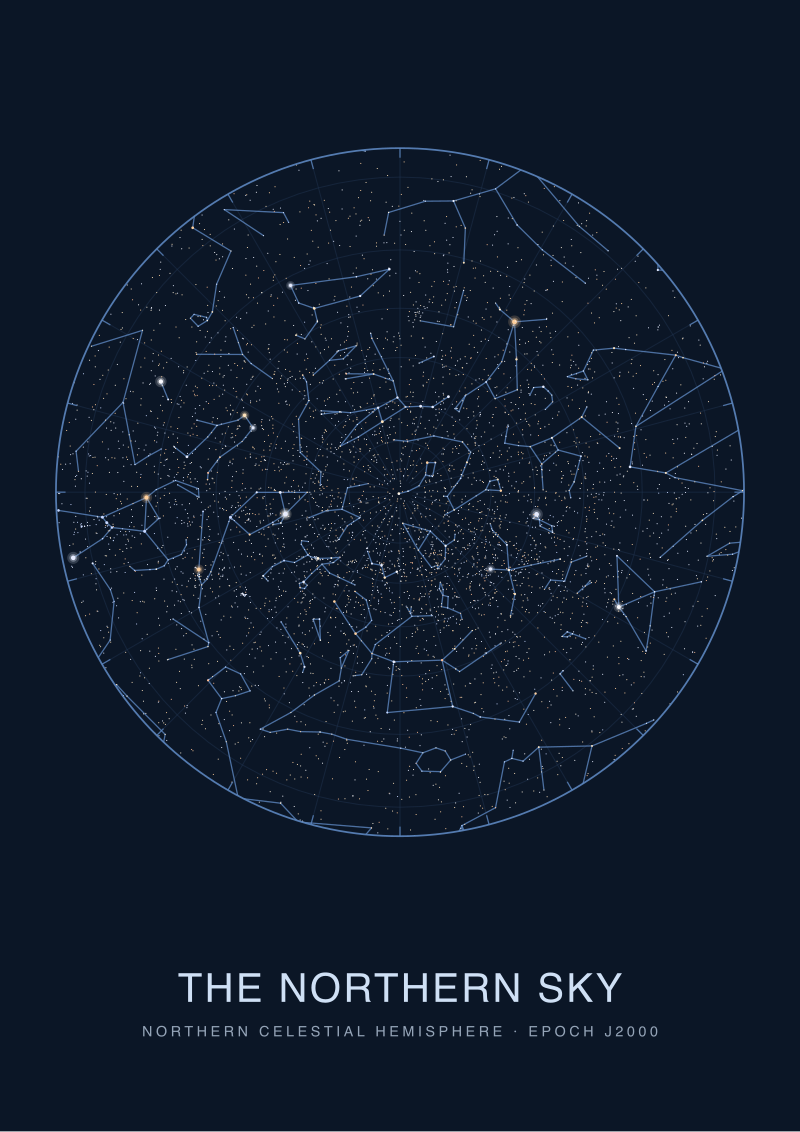 The Northern Sky
The print from this article · from €29.95
View the print →
The Northern Sky
The print from this article · from €29.95
View the print →
From the collection
New charts and 10% off your first print.
One email now with your code. No noise after.