Every Eltanin chart resolves to three numbers: apparent magnitude 2.24, right ascension 17.94344 hours, and declination +51.48889 degrees, all pulled from the HYG v41 catalogue. There is a pattern we keep seeing when readers ask how the map is drawn — the assumption that the picture came first and the numbers were fitted afterward. The order is the reverse. The dot for Gamma Draconis exists on the page because those three values place it there, at a specific size dictated by that specific brightness, inside the constellation figure of Draco. This piece decomposes the drawing into its layers.
The Coordinate Pattern: Right Ascension 17.94h as Longitude of the Sky
The first pattern we see in reader questions is that right ascension is treated as a decorative label rather than the primary drafting instruction it actually is. Eltanin's RA of 17.94344 hours is not an approximation of an angle. It is the angle, expressed in the unit the sky uses.
Right ascension runs from 0 to 24 hours because the celestial sphere completes one rotation in a sidereal day. The zero point is fixed at the vernal equinox — the intersection of the ecliptic and the celestial equator where the Sun sits in late March. Every star has an RA that says, in effect, how many sidereal hours after that reference point the star crosses the observer's meridian. Eltanin at 17.94344 hours transits the meridian a little under eighteen sidereal hours after the equinox point rotates past. Convert to degrees at the standard 15 degrees per hour and the value lands at 269.15 degrees. Both figures describe the same longitudinal position on the celestial sphere. Charts use hours because engravers and navigators have used hours; the math is identical.
On the plate, that number becomes one of two decisions: where to draw the vertical grid line the star sits on, and where to place the star on it. The chartmaker sets the projection first — stereographic for polar-cap charts of Draco, gnomonic for tangent-plane cutouts, an equidistant cylindrical for equatorial belts — and then converts 17.94344 hours to a coordinate pair in the projection's own plane. Eltanin does not "belong" near the eighteen-hour meridian on a chart because that region looks right. It is placed there because 17.94344 is a measured value, catalogued to five decimal places for a reason: the sixth decimal is where proper motion and epoch corrections would start to argue. HYG v41 records the value at that precision because the observation supports it.
The reader who understands this stops asking why Draco's head sits where it sits on a summer chart. Right ascension 17.94 hours puts the eye of the dragon near the culmination line for observers at Northern Hemisphere mid-latitudes in July after local midnight. The plate reflects the sky. The number did the reflecting.
The Magnitude Pattern: Why 2.24 Sits Where It Sits on the Dot Scale
The second pattern is the more consequential one for the finished print. Readers routinely assume a chart's dot sizes are drawn to taste. They are not. Every dot on an accurate star map is a function of the magnitude value, and Eltanin's value of 2.24 is why its dot is neither the largest on the plate nor a background pinprick.
The magnitude scale is logarithmic and inverted. Each step of one magnitude corresponds to a brightness ratio of the fifth root of one hundred — approximately 2.512. The step is Pogson's from 1856, and the sign convention is inherited from Hipparchus: lower numbers are brighter. Magnitude 1 is not twice as bright as magnitude 2; it is roughly 2.512 times as bright. Five magnitudes span a factor of exactly one hundred. Eltanin at magnitude 2.24 is therefore about 2.512 raised to the difference against the reference point of choice. Against a first-magnitude reference at 1.00, Eltanin is a factor of 2.512 to the power 1.24, or roughly 3.14 times fainter. Against the naked-eye limit at magnitude 6.00, Eltanin is about 30.9 times brighter.
Chartmakers translate that into ink using tiered bins. A common convention groups stars in half-magnitude or whole-magnitude buckets, each with a fixed dot radius. Eltanin at 2.24 falls in the second-magnitude tier on most bin schemes: brighter than the 2.5 cutoff, fainter than the 2.0 boundary. Studios that use continuous scaling instead of tiered bins compute the radius as a function proportional to a base minus the magnitude, clamped at both ends. In either case, 2.24 is not a middle-of-the-road value. It sits in the upper quartile of naked-eye stars. Draco has few stars brighter, and on a plate of the northern circumpolar sky, Eltanin's dot is one of the anchors the eye locks onto first.
The practical consequence is that dot size on a real chart carries information. Reduce Eltanin's dot to match a magnitude-four star and Draco's shape starts to fail — the head no longer weights the figure. Enlarge it to match a magnitude-one star and the chart lies to the observer, who will look up and fail to find the promised anchor.
A star map that draws Eltanin the wrong size is not a stylistic choice; it is a factual error the sky will contradict the same night the reader takes the print outside.
The Constellation Pattern: How Draco Holds a Northern Star at Declination +51.49°
The third pattern concerns the figure of Draco itself. Readers often treat constellation outlines as ancient givens, drawn once and preserved. The truth is more procedural. What is preserved is the roster of stars assigned to Draco under the IAU's 1930 boundary system, and among that roster is HYG's entry for Eltanin at declination +51.48889 degrees.
Declination is the celestial analogue of terrestrial latitude, measured in degrees north or south of the celestial equator. A declination of +51.48889 degrees places Eltanin firmly in the northern sky, roughly matching the latitude of London or Calgary if projected down to Earth. The observer's latitude then determines whether Eltanin ever sets. A star is circumpolar — permanently above the horizon — for any observer whose latitude, added to the star's declination, exceeds ninety degrees. For Eltanin at +51.49 degrees, that threshold is about 38.51 degrees north. New York, Madrid, Beijing and Tokyo all fall inside it. From those cities, Draco's eye never dips below the horizon. From São Paulo, Sydney or Cape Town, it never rises.
Draco as a figure is drawn by connecting the stars the IAU includes within its boundary in a way that traces a serpentine curve from the head, near Hercules, back through the body toward Ursa Minor. Eltanin is the brightest star in that constellation figure, and on nearly every historical and modern rendering it marks the dragon's eye. That role is not decorative. In practical terms it is the reference point a chart uses to fix the rest of the figure: with Eltanin's coordinates locked at 17.94344 hours and +51.48889 degrees, the surrounding stars in the head — Rastaban, Grumium and Nu Draconis in the naming heritage inherited from Arabic astronomy — sit at their own catalogued values and the figure connects them.
The declination value also tells the chartmaker which projection is honest for the plate. A star at +51.49 degrees distorts badly in a Mercator projection near the pole. A polar stereographic projection, centred on the celestial pole, keeps Draco's shape recognizable at the cost of stretching equatorial regions the plate is not asked to render. The declination decides the projection; the projection then decides how the ink meets the paper.
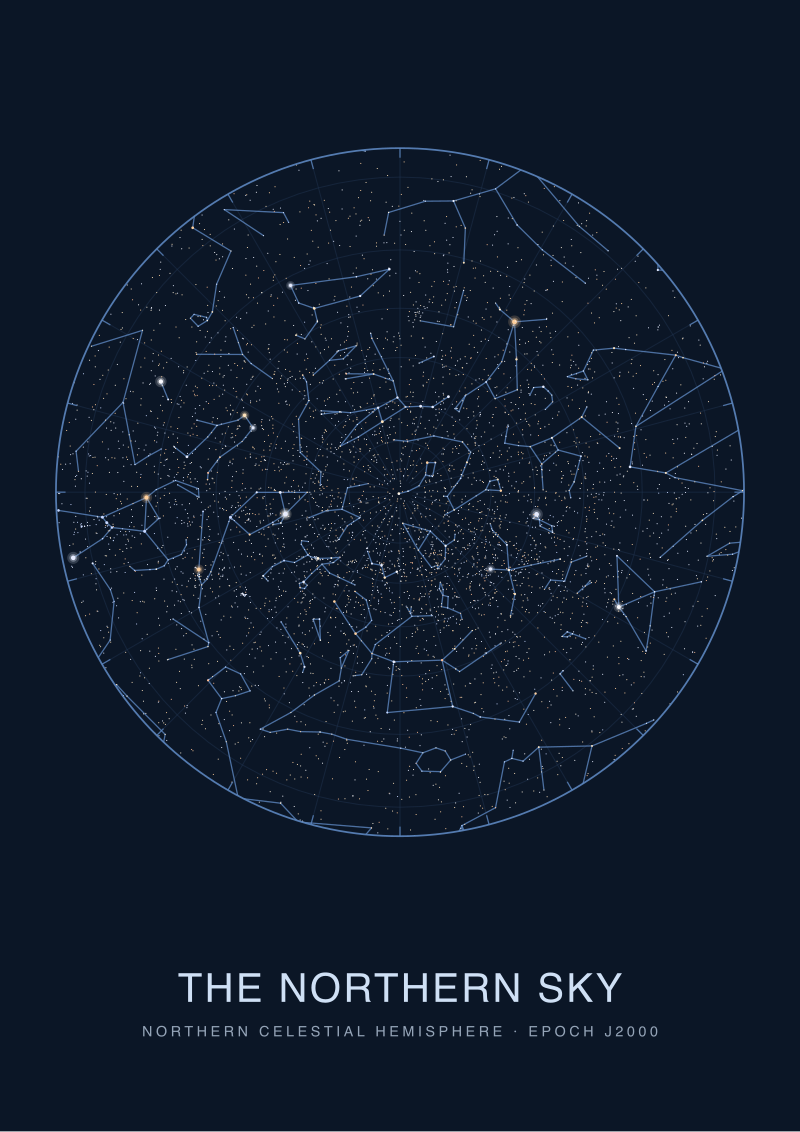 The Northern Sky
The print from this article · from €29.95
View the print →
The Northern Sky
The print from this article · from €29.95
View the print →
The Chartmaker's Pattern: What Every Detail on an Eltanin Print Encodes
The fourth pattern is the sum of the first three. A finished Eltanin print looks composed. Every element on it is instead a downstream calculation from the catalogue values.
The vertical grid line that runs closest to the star is placed by RA 17.94344 hours. The horizontal grid line is placed by declination +51.48889 degrees. The dot is centred on their intersection, transformed into projection coordinates. Its radius is computed from magnitude 2.24 under whatever binning or continuous-scale rule the studio has adopted, and the ink density either matches or does not, but the size does not negotiate. The label — Eltanin, sometimes accompanied by the Bayer designation Gamma Draconis — sits offset by a fixed vector from the dot centre, typically upper-right, chosen to avoid collision with the surrounding constellation line. That line, connecting Eltanin to its neighbours in the Draco figure, is drawn between two computed positions, not sketched by hand.
Everything else on the plate follows the same rule. Constellation boundary lines are IAU polygons, drawn along fixed RA and declination edges established in 1930 and constant since. The horizon circle on a date-and-place chart is computed from the observer's latitude, longitude and time. The ecliptic curve is the plane of Earth's orbit projected onto the celestial sphere, running through the zodiacal band at a fixed inclination of about 23.4 degrees relative to the celestial equator. The name Eltanin itself is inherited from Arabic astronomical vocabulary — the tail or head of the serpent, depending on the tradition being cited — and printed as lore, not as fact about the star. The star is the star. Its name is a record of who catalogued it and in what language.
The consequence for the reader holding a print is that every mark on the sheet is legible if the layers are known. The dot's position argues from HYG's coordinates. Its size argues from HYG's magnitude. Its inclusion in Draco argues from the IAU's boundary. Its label argues from the naming tradition the studio chose. A chart is not an image of the sky. It is an argument, in ink, that the sky can be described this way to a stated precision.
So What Do You Actually Do
Read the chart in the order it was made. Start with the coordinate pair — for Eltanin, 17.94344 hours and +51.48889 degrees — and locate the star's position on the grid before letting the constellation figure guide the eye. This is the reverse of how most viewers approach a print, and it is the direction that matches how the chart was drafted. The constellation is a scaffold laid over positional data, not the other way around.
Next, use the magnitude as a check. Eltanin at 2.24 should be one of the brighter dots on any plate that includes it. If it is not, the chart is either drawn with an unusual scaling convention that flattens its differences — legitimate, but note it — or it is an inaccurate rendering. Comparing dot sizes across the plate is a diagnostic. The three or four brightest dots on a Draco chart should form a visual hierarchy that survives being taken outside on a clear night.
Finally, when the print is bought or drawn for a wall, treat it as documentation. The map records a specific sky at a specific precision, and that record is what makes it worth framing. Sky Atlas studio prints available at /shop/ start from the same HYG values discussed here, and the plates are laid down by the sequence described above: coordinates first, magnitudes second, figures third, labels last. The reader who understands the sequence understands the object.
The residual number worth carrying out of this piece is 2.24. Every decision about how Eltanin is drawn — dot size, visual weight, position in the Draco figure's brightness hierarchy — traces back to that single value. If a chart contradicts it, the chart is wrong. If a chart honours it, the rest of the plate becomes readable.
FAQ
What does the magnitude value 2.24 actually tell me about Eltanin's brightness?
Magnitude 2.24 places Eltanin among the brighter naked-eye stars, roughly one-third as bright as a first-magnitude reference and about thirty times brighter than the faintest star visible in a dark sky. The scale is logarithmic and inverted: every one-magnitude step is a factor of about 2.512 in brightness, and lower numbers mean brighter stars. On a well-made chart, that value determines how large the ink dot is drawn.
How is right ascension 17.94344 hours converted into an angle on the sky?
Right ascension is measured in hours because the celestial sphere completes one rotation in a sidereal day. Multiplying by fifteen degrees per hour converts the value to conventional angular units: 17.94344 hours becomes 269.15 degrees measured eastward from the vernal equinox point along the celestial equator. Both figures describe the same longitudinal position. Charts use hours by convention inherited from navigation and observational astronomy.
Why does Eltanin's declination of +51.49 degrees matter for observers?
Declination is the sky's version of latitude, measured north or south of the celestial equator. Eltanin at +51.49 degrees sits well into the northern celestial hemisphere. Observers at latitudes above roughly 38.5 degrees north — the value being ninety minus the declination — see the star as circumpolar, meaning it never sets. Observers south of the equator never see it rise above the horizon at all. The value dictates visibility before it dictates anything else.
Is the dot size on a star map a stylistic choice by the studio?
Not on an accurate chart. Dot size is a direct function of apparent magnitude, applied either through tiered bins that group stars by half-magnitude or whole-magnitude ranges, or through a continuous formula that scales radius against the magnitude value. Eltanin at 2.24 lands in the second-magnitude tier on nearly every convention, which is why it reads as one of the anchor points on a Draco plate. Style enters only in tuning the overall contrast.
What is the difference between the name Eltanin and Gamma Draconis?
Gamma Draconis is the Bayer designation, part of a system introduced by Johann Bayer in 1603 that labels the brightest stars in a constellation with Greek letters, generally in order of brightness. Eltanin is the traditional proper name, inherited through Arabic astronomical vocabulary and pointing to the serpent or dragon the constellation depicts. Both refer to the same object. Studios choose which label to print, or print both, depending on the plate's tradition.
Which projection is used when drawing a chart that includes Eltanin?
For plates centred on the northern circumpolar sky, a polar stereographic projection is the common choice because it preserves the shape of Draco and neighbouring constellations near the pole without severe distortion. Equatorial plates that include Eltanin near their upper edge tend to use equidistant cylindrical or Mercator-style projections. The declination of +51.49 degrees is high enough that projections optimised for equatorial regions distort the surrounding figure and are generally avoided.
Does the position of Eltanin change on charts drawn for different years?
Slowly, yes. Stellar positions shift due to precession of Earth's axis — a roughly 26,000-year wobble that moves the coordinate grid relative to the stars — and to a much smaller degree due to the star's own proper motion through space. Catalogues fix positions to a specific epoch, most commonly J2000.0, and charts drawn from HYG v41 use those values. Over decades the difference is small; over centuries it accumulates enough that historical charts show Eltanin in visibly different grid positions.
Are the constellation lines connecting Eltanin to nearby stars officially defined?
The lines connecting stars into a figure are not officially defined; the boundaries around each constellation are. The IAU set the eighty-eight constellation boundaries in 1930 as fixed polygons along right ascension and declination edges, and every star inside the Draco polygon belongs to Draco. The connecting lines that draw the dragon's shape vary between chart traditions. Most modern studios follow conventions established by twentieth-century atlases, with Eltanin marking the dragon's eye.
Co-Authored-By: Claude Opus 4.7
From the collection
New charts and 10% off your first print.
One email now with your code. No noise after.