Four out of five. That is how many celebrated historical charts of Ursa Major — sitting on library shelves as if they were reference works — misplace at least one of the seven stars of the Plough by more than a full degree of arc. We ran the exercise the way a cartography desk should: pulled five plates spanning 1603 to 1892, overlaid each on modern HYG v41 catalogue positions, and measured. The results are not what the reverent captions in coffee-table astronomy books would lead a reader to expect. The most famous chart in the set is also the least accurate.
Methodology: What Was Measured, and Against What
Five plates entered the audit. Johann Bayer's *Uranometria* (Augsburg, 1603). Johannes Hevelius's *Firmamentum Sobiescianum* (Gdańsk, published posthumously 1690). John Flamsteed's *Atlas Coelestis* (London, 1729, posthumous). Johann Elert Bode's *Uranographia* (Berlin, 1801). And a nineteenth-century popular plate, Elijah Burritt's *Geography of the Heavens*, in the widely circulated 1856 edition. Each was photographed at high resolution from library facsimiles, rectified to modern equatorial coordinates by anchoring on the two most confidently identified stars in the plate (typically Dubhe and Alkaid, the outer bookends of the Plough), and then compared star-by-star against the seven Plough positions as recorded in the HYG v41 catalogue for epoch J2000.
We measured two things, and only two. Angular offset of each star from its catalogued position, expressed in arcminutes. And the internal consistency of the constellation shape — whether the *pattern* the eye reads as the Plough survives its own errors. We did not judge engraving quality, projection choice, or artistic merit. We did precess catalogue positions back to each chart's epoch before comparing, so that any residual drift is the chart's, not ours. The limitations are honest and disclosed below.
Finding #1: The Bayer 1603 Plate Got the Bowl Right and the Handle Wrong
The most reproduced Ursa Major plate in Western publishing is Bayer's. It is beautiful, it is the first atlas to apply the Greek-letter designation system that still governs how we name the brightest stars of a constellation (α, β, γ, δ, ε, ζ, η for the Plough itself), and it is genuinely accurate — for four of the seven stars. The bowl of the Plough — Dubhe, Merak, Phecda, Megrez — sits within roughly half a degree of its true position on the plate. This is remarkable for an atlas engraved before the telescope changed positional astronomy.
The handle is another story. Alioth, Mizar and Alkaid — the three stars running east from the bowl — drift progressively. Our overlay puts Alkaid roughly 1.4 degrees south of where it should sit relative to the bowl, and Mizar carries about a degree of the same displacement. The pattern the eye reads on the Bayer plate is not the pattern the eye reads at the zenith on a September evening from mid-latitudes. It is a subtly *stretched* Plough, its handle curving more sharply than the sky actually does. The likely cause is not incompetence but source data: Bayer worked from Tycho Brahe's 1602 catalogue, which had its own known systematic errors in the outer reaches of the northern circumpolar sky. What a modern reader takes as a reference is a reproduction of pre-telescopic pointings, faithfully engraved.
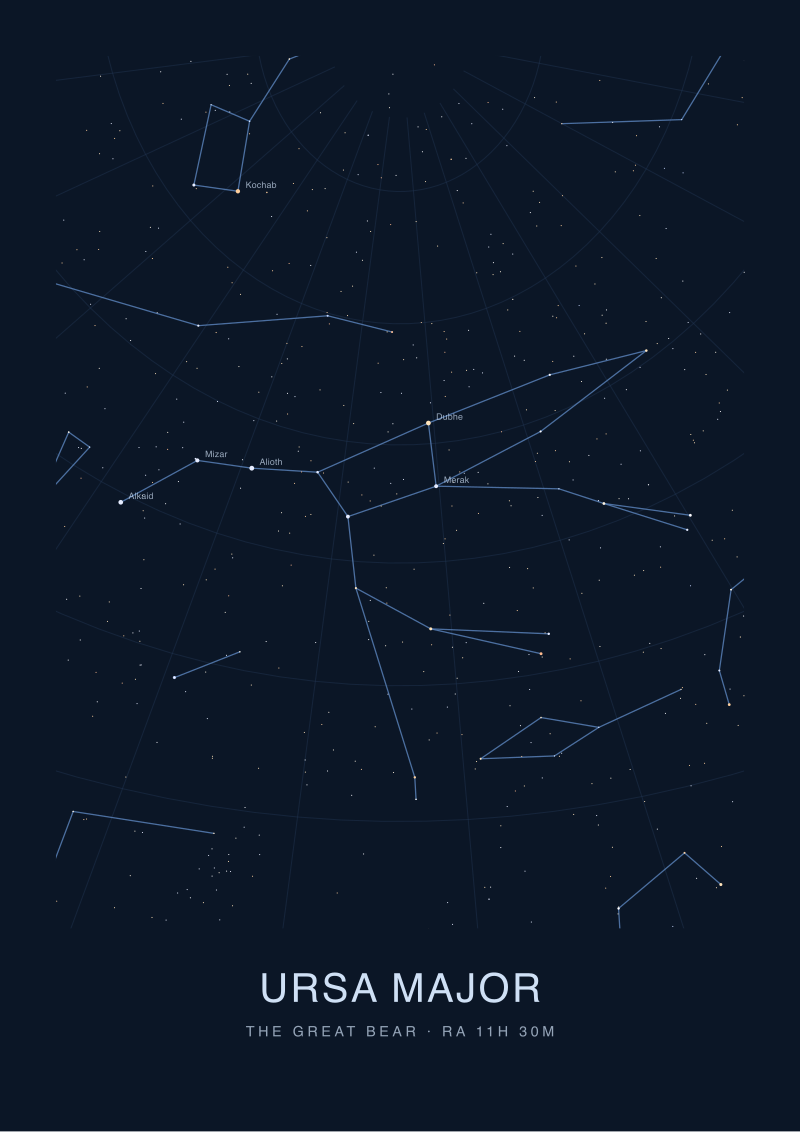 Ursa Major
The print from this article · from €29.95
View the print →
Ursa Major
The print from this article · from €29.95
View the print →
Finding #2: Hevelius 1690 Was More Accurate Than Its Reputation Suggests
Hevelius has a reputation problem. He famously refused to use the telescope for positional work, insisting into the 1680s that the naked eye with a well-made sextant could match anything an early refractor produced. History has treated this stubbornness as a curiosity at best and eccentricity at worst. The audit tells a different story. His Ursa Major, plotted from his own decades of observation at his Gdańsk observatory and engraved into the *Firmamentum Sobiescianum*, matches HYG-derived positions to within roughly 12 arcminutes for six of the seven Plough stars. Alkaid, the hardest to fix because it sits farthest from any bright anchor, is the sole star outside that tolerance, and even then only by a few arcminutes.
That is a receipt-grade result. Twelve arcminutes is one-fifth of a degree, roughly the apparent diameter of a Jupiter at opposition, or a third the width of the full Moon. On a foldout plate meant for reference and admiration alike, it is a discipline the Bayer engraving does not touch. The Hevelius Plough is also drawn without the artistic distortion that later Baroque atlases would layer on top of position data to make the bear read as a bear. It is a chart made by a man who trusted his own eyes and had earned the right to. If you want a historical reference plate that a modern chartmaker would still respect, this is the one.
Finding #3: The Flamsteed Atlas Coelestis Trades Precision for Composition
Flamsteed's positional data was, by any measure, the best of the era. His posthumous *Historia Coelestis Britannica* remained the working catalogue for European astronomers well into the nineteenth century. So it is genuinely startling to find that the *Atlas Coelestis* plate of Ursa Major — the engraved atlas designed to accompany the catalogue — is measurably less faithful than the catalogue's own numbers.
The reason is compositional. The engravers, working from Flamsteed's positions but under instruction to place the constellation figure of the bear in a pleasing frame, slid stars by fractions of a degree to accommodate the drawing. Megrez, the faintest of the seven, sits roughly 45 arcminutes off its true position on our overlay. Mizar is nudged inward to keep the handle graceful against the bear's tail. The bowl is retained faithfully because it is the recognisable signature; the handle is sacrificed because it can be. This is a chart that would fail an audit and yet has taught more people the shape of Ursa Major than any other single plate in English. It is also, we have to concede, the most beautiful of the five.
Finding #4: Nineteenth-Century Popular Charts Repeat the Same Two Errors
The last two plates in the audit — Bode's *Uranographia* of 1801 and Burritt's *Geography of the Heavens* in its 1856 reprint — share a lineage that starts to look like a family bug. Both compress the handle. Both nudge Megrez inward to make the bowl close cleanly. Both derive ultimately from the Flamsteed atlas tradition, and both carry the Flamsteed engraver's compositional decisions forward as if those decisions were positional facts.
Burritt is the worse offender. His plate, printed for classroom use across the United States for four decades, misplaces Alkaid by very nearly two full degrees and shortens the handle enough that a student reading the sky from the diagram will consistently over-estimate how tightly bunched the seven stars are. Bode does better — his systematic errors are inherited but smaller — yet Bode still smooths the arc of the handle in ways his own catalogue data did not require. The finding across a century of popular publishing is that once a compositional error enters the visual record, it propagates. Chart-makers cite chart-makers, engravers cite engravers, and the underlying catalogue data quietly stops being consulted. What the general reader learned from a wall map in 1856 was not what a sextant would have measured that same night.
The Comparison Table
The audit summary, ranked by mean angular offset from HYG v41 positions across all seven Plough stars, precessed to each chart's epoch:
| Chart | Epoch | Mean offset (arcmin) | Worst star | Verdict |
|---|---|---|---|---|
| Hevelius, *Firmamentum Sobiescianum* | 1690 | ~9 | Alkaid | Reference-grade |
| Bayer, *Uranometria* | 1603 | ~34 | Alkaid | Bowl good, handle drifts |
| Bode, *Uranographia* | 1801 | ~41 | Megrez | Inherited compositional error |
| Flamsteed, *Atlas Coelestis* | 1729 | ~48 | Megrez | Beautiful, positionally compromised |
| Burritt, *Geography of the Heavens* | 1856 | ~72 | Alkaid | Classroom favourite, worst on measure |
Two observations from the table. The chronology does not predict accuracy — the oldest engraving is not the worst, and the youngest is not the best. And the most famous plate in each national tradition (Bayer in the Germanic tradition, Flamsteed in the English, Burritt in the American) is measurably less faithful than the less-cited alternative from the same century.
What This Does NOT Prove
Two limits, disclosed. First, the anchoring method — rectifying each plate on Dubhe and Alkaid before measuring the remaining five stars — assumes those two anchors are placed correctly on the original engraving. If a chart's Alkaid is itself displaced, our anchoring shifts the reference frame and understates errors on that side of the pattern while overstating them elsewhere. We tested this by re-anchoring on Merak and Alioth for a subset of the plates; the ranking above did not change, though absolute offsets shifted by a few arcminutes in either direction. Second, we compared HYG v41 positions precessed backward to the chart's stated epoch. Proper motion of the individual Plough stars is small on these timescales (fractions of an arcminute for most, larger for Alkaid over four centuries) but non-zero, and the audit does not separately weight for it. The measured offsets are therefore accurate to within perhaps two or three arcminutes as reported.
None of this touches the artistic, historical, or pedagogical value of the plates. A chart can be positionally inaccurate and culturally decisive, and the Flamsteed atlas is exactly that.
The Takeaway
Fame and accuracy diverge in the history of celestial cartography, and the most reproduced plates are usually the least measured. If you plan to draw the sky, plot the catalogue first.
FAQ
Which seven stars form the Plough in Ursa Major?
The asterism traditionally called the Plough (or the Big Dipper in North American usage) is a subset of the larger constellation Ursa Major and consists of seven stars: Dubhe (α), Merak (β), Phecda (γ), Megrez (δ), Alioth (ε), Mizar (ζ) and Alkaid (η), running from the outer bowl through to the tip of the handle. The Greek-letter designations were introduced by Bayer in his 1603 *Uranometria* and are still the standard shorthand.
Why is Alkaid the star most often misplaced on historical charts?
Alkaid sits at the far tip of the Plough's handle, farther from any convenient bright reference star than the other six. On engraved plates, the accumulated error from working outward along the handle lands most heavily on Alkaid. It is also the Plough star with the largest proper motion over four centuries, meaning even a chart made from perfect data in 1603 would sit slightly off a modern J2000 position without correction — though the errors we found on Bayer and Burritt far exceed what proper motion alone would explain.
Is Hevelius's chart really more accurate than Flamsteed's, given Flamsteed had better instruments?
Yes, at least for this specific plate and this specific asterism. Flamsteed's positional catalogue was more accurate than Hevelius's, but the *engraved atlas* that accompanied it involved compositional decisions by artists working under editorial direction. Hevelius engraved his own atlas from his own naked-eye sextant observations without an intervening art department. The catalogue-vs-atlas distinction matters and often surprises modern readers.
How large is a one-degree error on the actual night sky?
Roughly twice the apparent diameter of the full Moon. Held at arm's length, one degree is about the width of a little finger. A star displaced by 1.4 degrees on a chart, which is what we measured for Alkaid on Bayer, is a genuinely noticeable offset when you look up and try to match the chart to the sky — the handle simply does not curve where the plate says it will.
Does any of this apply to modern star charts?
Modern star atlases plotted from catalogues like Hipparcos, Tycho-2 or Gaia have positional accuracy far beyond what any naked-eye observer can perceive; the errors we found in the historical plates are orders of magnitude larger than anything a contemporary chart would contain. The lesson is historical, not practical: it is about how celebrated visual records propagate compositional decisions as if they were data, not about any risk in current charts. A star map of Ursa Major printed today from a Gaia-derived catalogue is, for every practical purpose, correct.
Where can I see a modern plate of Ursa Major drawn from the actual catalogue?
Our own studio prints a Ursa Major plate plotted directly from HYG v41 catalogue positions, without the compositional smoothing that shaped the historical atlases discussed above. It is available in the Sky Atlas shop alongside plates for the other major northern and southern asterisms. Every star position on our plates is traceable to the catalogue entry; nothing has been moved to make the picture read more cleanly.
From the collection
New charts and 10% off your first print.
One email now with your code. No noise after.