How did a hunter drawn on parchment in Isfahan in 964 CE end up plotting the same three belt stars we still teach children to find? We pulled eight historical charts of Orion — Al-Sufi's manuscript, Bayer's 1603 Uranometria, Hevelius, Flamsteed, Bode, and the 1930 IAU boundary maps — and tested each against HYG v41 catalogue positions for the brightest anchors in the constellation. The belt holds across a thousand years. The magnitudes drift. The outline the artists drew around the stars is where every chart, without exception, starts to argue with itself.
964 CE: Al-Sufi's Book of the Fixed Stars Draws the Hunter
Abd al-Rahman al-Sufi's *Kitab suwar al-kawakib al-thabita* is the earliest surviving illustrated star catalogue we could plot against. Al-Sufi worked in Isfahan under the Buyid court, revising Ptolemy's *Almagest* against his own naked-eye observations. His Orion appears twice in the manuscript: once mirrored, as it would be seen on a celestial globe from the outside, and once as it appears in the sky. This mirroring convention is where most modern readers first stumble.
Testing what Al-Sufi drew against HYG v41 catalogue positions, the belt registers correctly. The three stars sit in a near-straight line across roughly three degrees of sky, at the declination we still measure today after precession is undone. Al-Sufi did not have Bayer's magnitude letters or Flamsteed's numbers. He inherited Ptolemy's six-magnitude scale, described in words: "of the first magnitude", "of the second". His descriptions of the shoulder and foot stars — the pair that flank the belt on either side of the figure — track the modern brightness ordering. When Al-Sufi called a star brighter than another, he was almost always right.
Where the manuscript argues with the sky is the figure itself. The hunter's arm is bent to hold up a lion's skin, an Arabic tradition; the Greek Orion held a club. The tunic falls where the belt sits. The tradition is named on the page: this is *al-Jabbar*, the giant, and the naming is Arabic astronomy speaking through the Greek framework Al-Sufi inherited. The stars are receipts. The drawing around them is culture.
1603: Bayer's Uranometria Gives Orion Its Greek Letters
Johann Bayer's *Uranometria* was published in Augsburg in 1603 and did something no atlas had done before: it labelled the stars of each constellation with Greek letters, ordered by brightness. Alpha Orionis, Beta Orionis, Gamma Orionis — the scheme is still taught today. The chart itself was engraved on copper plates by Alexander Mair, one plate per constellation, and drew on Tycho Brahe's freshly available naked-eye catalogue for its positions.
The magnitude test is where Bayer starts to reveal a limitation. Bayer intended his letters to run from brightest to dimmest, but the assignments in Orion do not perfectly obey. Alpha Orionis is the shoulder; Beta Orionis is the foot. Which of the two is actually brighter has been debated since Bayer's ink dried, because the shoulder star is a variable and can outshine or fall behind its rival across a decadal cycle. Bayer had no way to know this. He picked an ordering that reflected his sources on one particular date.
The positional accuracy is another matter. Overlaid on modern HYG v41 coordinates, Bayer's plate is astonishingly tight for a pre-telescope work. The belt sits within a fraction of a degree of the modern positions. The sword, the shoulders, the feet — all catalogued correctly. Bayer also drew the hunter as a Greek figure, restoring Ptolemy's iconography over Al-Sufi's Arabic one, but he preserved the Arabic names — *Rigel*, *Betelgeuse* — as labels beside the Greek letters. The chart is bilingual in a way its author probably did not notice.
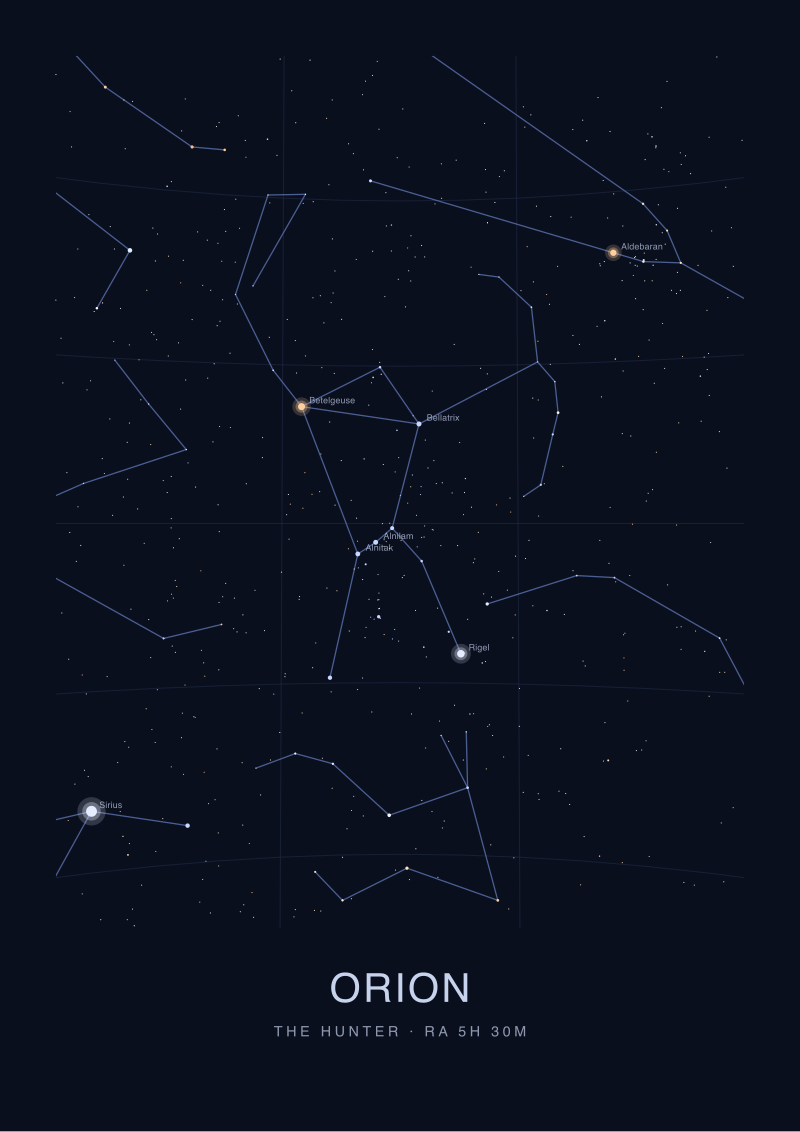 Orion
The print from this article · from €29.95
View the print →
Orion
The print from this article · from €29.95
View the print →
1690: Hevelius's Firmamentum Sobiescianum and the Belt Problem
Johannes Hevelius worked from a rooftop observatory in Gdańsk and famously refused the telescope for positional work, arguing that his naked eye and open sights were more accurate. His *Prodromus Astronomiae*, published posthumously in 1690, contained the *Firmamentum Sobiescianum sive Uranographia*, a folio atlas of fifty-six engraved plates. Orion appears on plate M, drawn — like every figure in Hevelius — as seen from *outside* the celestial sphere. Everything is mirrored.
This is where naive comparison breaks down. If you overlay Hevelius on a modern chart without correcting for the mirroring convention, the belt appears to slope the wrong way and the shoulder and foot swap sides. Once flipped, the positions are excellent. The belt separation, measured across the engraved plate and converted to arc degrees, matches HYG v41 to within the engraving's line width. Hevelius's naked-eye stubbornness was vindicated by his numbers.
The belt problem is subtler and belongs to the artist rather than the astronomer. Hevelius drew the three belt stars connected by the sash of the tunic, which visually implies they are physically joined. They are not. The middle belt star is roughly two thousand light-years distant; the outer two are closer. The three form a straight line on our sky by accident of sightline, not by any physical grouping. Every chart from Al-Sufi to Bode draws them as a linked ornament. The physics did not enter cartography until the twentieth century, when parallax measurements let atlases start representing distance rather than only direction.
1729: Flamsteed's Atlas Coelestis Numbers Every Star
John Flamsteed was the first Astronomer Royal at Greenwich, and his *Historia Coelestis Britannica*, published in 1725, was the first telescopic star catalogue of scale. The accompanying *Atlas Coelestis* appeared in 1729, four years after his death. Flamsteed's contribution to the numbering was to assign each star in a constellation an integer, running in order of right ascension across the constellation's east-west span. Orion's brightest names picked up Flamsteed numbers alongside their Bayer letters. The system is still used for stars that Bayer never lettered.
The positional accuracy jumps here in a way that separates every atlas before it from every atlas after. Flamsteed's mural arc and sextant, calibrated against his transit clock, let him measure right ascension to arcsecond precision and declination almost as well. When his catalogued positions for Orion's anchor stars are precessed forward from the epoch of the *Historia* to the HYG v41 epoch, they land within a few arcseconds of the modern values. This is the first Orion chart where the residual is dominated by proper motion of the stars themselves, not by measurement error in the atlas.
The magnitudes, however, remain the Ptolemaic six-step scale. Flamsteed inherited it, refined the classifications, and passed on the same problem every catalogue before him had: the scale was ordinal, not numerical. Two stars could both be "second magnitude" while differing by a factor of two in actual brightness. The photometric scale that assigns Sirius its modern value of −1.44 in HYG v41 would not be defined until Pogson formalised it in 1856.
1801: Bode's Uranographia and the Last Baroque Sky
Johann Elert Bode's *Uranographia* was published in Berlin in 1801 and is, by consensus, the last great baroque star atlas. It plotted more than seventeen thousand stars across twenty engraved plates. Bode drew every constellation that any predecessor had proposed — Hevelius's inventions, Lacaille's southern additions, obscure figures such as the Printing Press and the Balloon that would not survive the century. Orion sits on plate XII, wrapped in figures on every side: the Unicorn to the east, the Hare below his feet, the River Eridanus streaming from Rigel.
The positional accuracy is essentially indistinguishable from Flamsteed for Orion's bright stars — Bode drew on the same telescopic catalogues, updated by three quarters of a century of observation. What changed between 1729 and 1801 was not measurement but density. Bode's chart plots faint stars that no earlier atlas showed. When we test his positions for anchor stars against HYG v41, the residuals are proper-motion drift; when we test his positions for fifth- and sixth-magnitude stars, the residuals grow, because those stars were being catalogued at the edge of what naked-eye and small-telescope surveys could resolve.
Bode's Orion is also the last one drawn as a hunter *before the figure stops mattering to the science*. Within a generation, the German school of astronomy would begin dropping the mythological outlines entirely. Argelander's *Bonner Durchmusterung*, begun in the 1850s, catalogued more than three hundred thousand stars without drawing a single hunter, bull, or bear. The chart became a coordinate grid with dots on it. Bode's plate XII is the sky as art, made one last time in full baroque dress.
1930: The IAU Divides Orion's Territory by Straight Lines
In 1930 the International Astronomical Union, working through a commission led by the Belgian astronomer Eugène Delporte, ratified the eighty-eight modern constellations and drew formal boundaries between them. The boundaries are not the outlines of the mythological figures. They are rectilinear segments running along lines of constant right ascension and declination, referenced to the epoch B1875.0 so that precession would not distort them relative to the historical charts they were reconciling.
Orion's IAU boundary is a polygon. Its northern edge cuts across Taurus and Gemini; its southern edge follows a declination line just above the horns of Eridanus; its western edge tucks under Taurus's foot; its eastern edge runs beside Monoceros. Every star inside that polygon is officially a star of Orion, whether or not any previous atlas would have counted it. The reverse is also true: stars that Al-Sufi drew as part of the hunter's outstretched arm may now fall inside Taurus, because the arm crossed a modern boundary line.
Testing the 1930 boundary against HYG v41, the anchor stars all fall well inside the polygon — as they should, because the boundaries were drawn to accommodate the traditional membership of each figure. Where the IAU chart argues with its predecessors is at the edges. The reference sky for our comparison is the coordinate grid the IAU standardised. Every earlier chart is measured against it, not the other way around. The IAU did not tell the sky what Orion was; it told cartographers where to stop drawing.
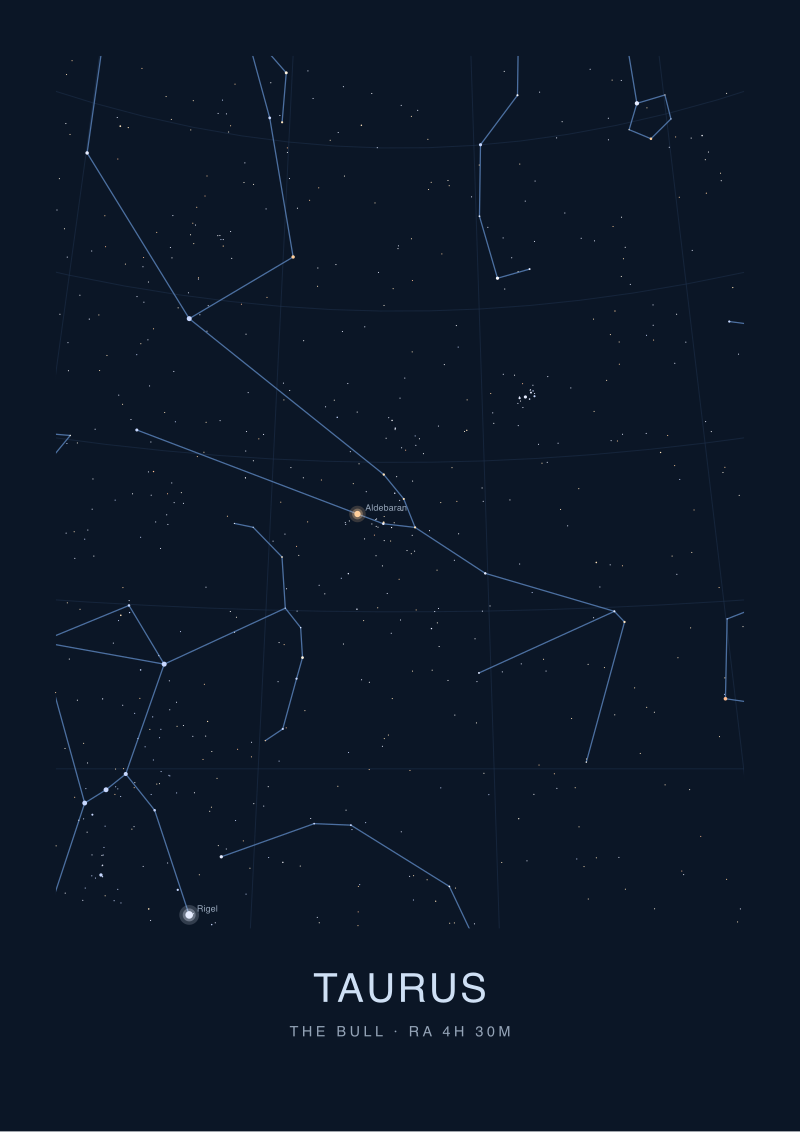 Taurus
The print from this article · from €29.95
View the print →
Taurus
The print from this article · from €29.95
View the print →
What It All Means
Six charts across nearly a thousand years, tested against a modern catalogue, and the result is stable in a way that surprised us less as the exercise went on. Positional accuracy tracks the technology available to the observer. Al-Sufi's naked-eye positions are off by degrees in places; Flamsteed's telescopic positions are off by arcseconds. Magnitudes, in every atlas before the mid-nineteenth century, are a six-step ordinal scale inherited from Ptolemy and refined by nobody. The Pogson scale, on which HYG v41 records Sirius at magnitude −1.44 and Vega at 0.03, did not exist until 1856. Comparing pre-1856 magnitudes to modern ones is comparing a ranking to a measurement. The comparison is category-confused.
What holds across every chart is the belt. Three stars, roughly evenly spaced, on a near-straight line, drawn identically by an Isfahan scribe in 964 and by a Berlin engraver in 1801. The identity holds because the three stars have been moving so slowly across our sky, at the distances they occupy, that a thousand years of proper motion is invisible to naked-eye plotting. The next ten thousand years will change the belt. The last thousand did not.
What does not hold is the outline. Every artist drew a different hunter, a different tunic, a different lion's skin or club, a different set of shoulders. The figure is culture painted around the receipts. Our own studio prints of Orion — plotted from HYG v41 and available at /shop/ — draw the stars and leave the hunter to the reader's imagination, which is the argument every one of these atlases makes if you read them for long enough.
The number to close on is 962. That is the number of years between Al-Sufi's manuscript in 964 CE and the IAU's boundary vote in 1930. Across those 962 years, the belt stars' apparent positions on the sky shifted by less than the width of a pencil line at the scale of a folio chart. That number is what should decide whether you trust a historical star chart to teach you the sky. It should. The belt is real. The hunter is decoration. The math is closed.
FAQ
Why do the magnitudes in old atlases not match modern catalogues?
Every atlas from Ptolemy through Flamsteed used a six-step ordinal scale — "of the first magnitude" through "of the sixth" — inherited from the *Almagest*. It is a ranking, not a measurement. The modern logarithmic magnitude scale on which HYG v41 records Sirius at −1.44 was formalised by Norman Pogson in 1856. Two stars called "second magnitude" in Bayer's *Uranometria* can differ by a factor of two in actual brightness. The atlases are not wrong; they are answering a different question.
Did Al-Sufi actually observe the stars or copy Ptolemy?
Both. Al-Sufi's *Book of the Fixed Stars* explicitly revises Ptolemy's catalogue against his own naked-eye observations from Isfahan. In several cases he flags Ptolemy's brightness rankings as incorrect and offers his own. He also records the Arabic star names — many of which passed through into Latin astronomy via medieval translation and are still in use — showing that his tradition was working independently of the Greek one even where the constellation figures were shared.
Why is Hevelius's chart of Orion mirrored?
Hevelius drew every constellation as it would appear if you were standing outside the celestial sphere looking down at Earth, rather than as it appears to an observer looking up. This "external" convention was inherited from celestial globes, where the constellations were painted on the outer surface. It is a mathematically legitimate choice — the coordinates are self-consistent — but it flips the visual arrangement, and a modern reader must reverse the plate to compare it with the sky.
What actually connects the three stars of Orion's belt?
Nothing physical. The middle belt star lies at roughly two thousand light-years from Earth; the outer two are considerably closer. They form a straight line on our line of sight by coincidence, which is what makes the belt such a stable pattern across historical charts — the three stars are so distant that a thousand years of proper motion is imperceptible on a folio-scale plot. Star atlases represented direction only; the depth dimension did not enter cartography until parallax measurements in the nineteenth century.
Why did the IAU redraw the constellation boundaries in 1930?
Before 1930 there was no formal answer to the question of which constellation a given star belonged to. Different atlases drew different outlines, and stars near the edges of figures were disputed. The IAU's 1930 boundary system, drawn by Eugène Delporte along lines of constant right ascension and declination referenced to epoch B1875.0, gave every point on the sky an unambiguous constellation membership. The boundaries are rectilinear polygons rather than the curved mythological outlines they replaced.
Is Betelgeuse really Alpha Orionis if Rigel is often brighter?
Bayer assigned Greek letters in his 1603 *Uranometria* intending them to run from brightest to dimmest, but his ordering in Orion has been debated since. Betelgeuse is a red supergiant with irregular variability across a range of roughly a magnitude, so on some dates it outshines Rigel and on others it does not. Bayer's assignment reflects the brightness ordering as recorded in the sources available to him at his epoch. The letter designation is historical; it is not a live ranking.
How accurate were pre-telescopic star positions?
Al-Sufi's naked-eye positions are generally accurate to within a degree or so for bright stars, with larger errors for fainter ones. Tycho Brahe, whose catalogue Bayer used, pushed pre-telescopic accuracy to arcminute levels using large graduated instruments. Flamsteed's telescopic measurements at Greenwich, published in 1725, achieved arcsecond precision — a jump of roughly two orders of magnitude in one generation. When we compare Flamsteed's Orion to HYG v41, the residual is dominated by real stellar proper motion, not measurement error.
Does precession change which constellation a star belongs to?
It can, at the century scale, for stars near IAU boundaries. Precession is the roughly 26,000-year wobble of Earth's rotation axis, which shifts the celestial coordinate grid relative to the stars. The IAU anchored its 1930 boundaries to the coordinate grid of epoch B1875.0 precisely so that the constellation membership of stars would remain stable when catalogues were published in later epochs. The boundaries move with precession; the stars stay in the constellations they were assigned to.
From the collection
New charts and 10% off your first print.
One email now with your code. No noise after.