The southern sky is not the northern sky flipped upside down. Hear me out. The most repeated sentence in casual stargazing writing — that observers below the equator simply see the same constellations inverted — is the tidy answer, and it is wrong in a way that costs new southern observers real nights of confusion. Canopus, the second-brightest star in the entire sky at apparent magnitude -0.62, sits at declination -52.7 degrees in the HYG catalogue. No amount of standing on your head in Berlin will show it to you. Ever. That is not a rotation of a shared sky. That is a different sky.
We have spent months tracing where the "upside down" line comes from. It appears in travel columns, in the intro paragraphs of budget planetarium apps, in more than one otherwise careful astronomy explainer aimed at children. The line survives because it is half-true, and half-true is the hardest kind of wrong to kill. What follows is the receipt.
The Upside-Down Story Is the Scam, and Declination Is the Receipt
Every star has a declination, and declination is a coordinate the same way latitude is a coordinate on Earth. Project the equator outward onto the sky and you get the celestial equator, at declination zero. Stars north of it carry positive declinations up to +90 degrees at the north celestial pole; stars south of it carry negative declinations down to -90 at the south celestial pole. This is not lore. It is the address system astronomers actually use to point telescopes.
The horizon rule follows from a single line of geometry. From latitude φ in the northern hemisphere, a star is permanently below your horizon if its declination is more negative than -(90 - φ). Berlin sits at roughly 52.5 degrees north. That means every star with declination below -37.5 degrees is, from Berlin, a star that does not exist. It never rises. It is not "hidden behind buildings." It is behind the Earth. Forever.
Now look at the catalogue. Canopus, in the constellation Carina, sits at declination -52.7 degrees. From Berlin, from Paris, from London, from anywhere north of roughly 37.3 degrees latitude, Canopus is a star you will read about but never see. It is the second-brightest fixed point in the entire night sky and most Europeans will die without a single photon of it having reached their eye. Rigil Kentaurus — the brighter of the two components of the Alpha Centauri system, magnitude -0.01, our closest stellar neighbour — sits deeper still at declination -60.83 degrees. That star is invisible from anywhere north of about 29.2 degrees latitude. Cairo can catch it low. New York cannot see it at all. Tokyo cannot see it. Madrid cannot see it.
Compare the same rule going the other way. Vega, the pale sapphire of Lyra at magnitude 0.03, sits at declination +38.78 degrees. It is invisible only from observers south of about -51.2 degrees latitude — a strip of Earth that includes the southern tip of Patagonia, the Falklands, the very bottom of New Zealand's South Island, and Antarctica. Sydney sees Vega. Cape Town sees Vega. São Paulo sees Vega. Capella at +45.99 is a harder case for the deep south, disappearing below roughly -44 degrees latitude, which erases it from Ushuaia but leaves it available across most of the populated southern hemisphere.
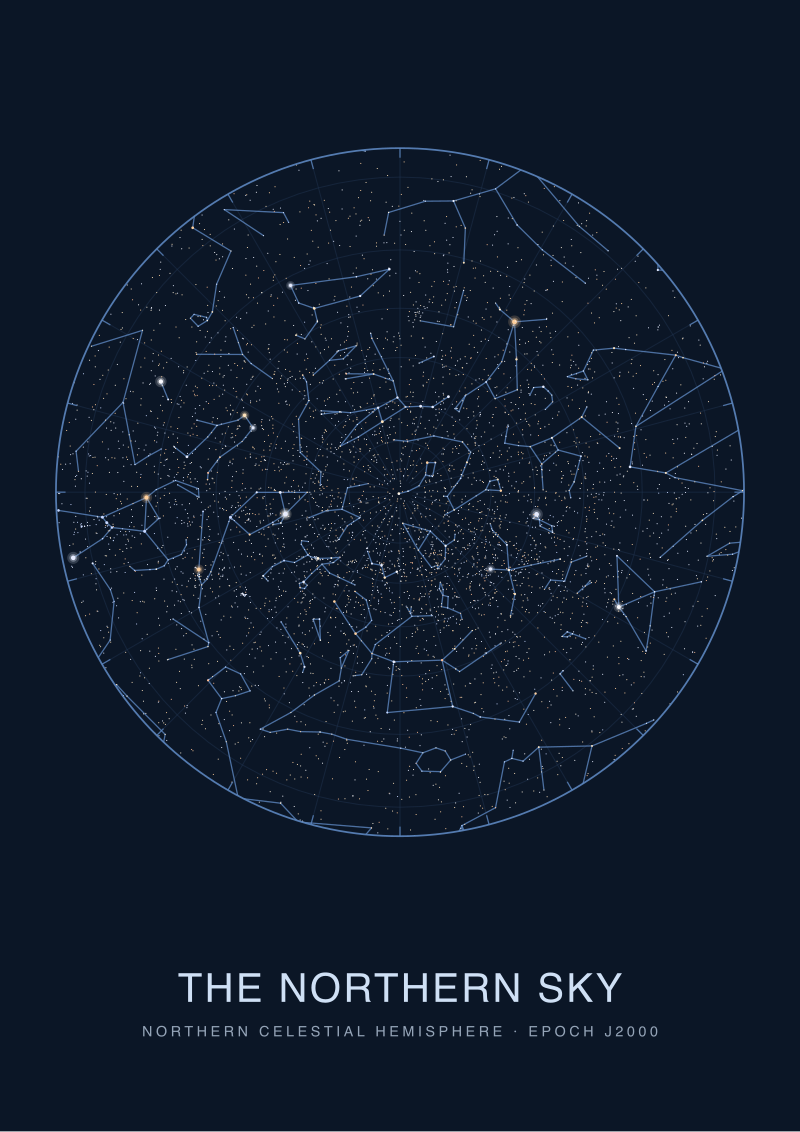
So the asymmetry is not aesthetic. It is not a rotation. Southerners get to see almost everything the north sees, plus a large sky the north can never reach. The north gives up nothing except the far southern circumpolar cap, and then only completely near the equator and above. A Melburnian and a Berliner do not share a sky and rotate it in their heads. The Berliner is missing pages of the catalogue that the Melburnian was born looking at. Declination is the receipt for which pages are missing.
Familiar Stars Do Rotate, and That Rotation Fools People Into Thinking Everything Does
The reason the upside-down myth persists is that it is not entirely made up. There is a real optical effect at its core, and the effect is dramatic enough on the stars everyone recognises that it gets over-generalised into a rule about the whole sky. Consider Sirius, in Canis Major, magnitude -1.44 at declination -16.72 degrees. Sirius is close enough to the celestial equator that it is visible from essentially anywhere humans live, from Reykjavik down to Ushuaia. The star is genuinely shared.
But how it looks in the sky is not shared at all. A Bostonian sees Sirius rise in the southeast and swing across the southern sky. A Sydneysider sees Sirius rise in the northeast and swing across the northern sky. Because the observer's up is defined by their local zenith, and the two zeniths point in opposite directions relative to the celestial sphere, the constellation Orion — which contains Sirius's stellar neighbour Betelgeuse and which most people can identify — really does appear flipped. Orion's belt still runs the same line through space, but the hunter's shoulders and feet swap in the visual field. In the north, Betelgeuse is upper-left; in the south, it is lower-right. Photographers of the sky know this in their bones. Casual stargazers extrapolate it into a universal rule.
The extrapolation fails because it papers over two entirely different phenomena. One is a rotation of the horizon frame — how a shared star pattern appears to a differently-oriented observer. The other is an outright exclusion — stars that are on one side of the celestial sphere and simply cannot clear one hemisphere's horizon. Orion inverting is the first. Canopus being invisible from Europe is the second. They coexist in the same sky, and the language of "upside down" collapses them into a single tidy sentence that gets one of them badly wrong.
There is a subtler layer too, which any observer who has actually tried this at latitude will confirm. Even for the stars a northerner can technically see from far southern latitudes, the experience is not remotely equivalent. Arcturus, that pumpkin-orange giant of Boötes at magnitude -0.05 and declination +19.18 degrees, is high overhead across the northern middle latitudes. From Melbourne, Arcturus sits low in the north, dimmed by the atmosphere, competing with light pollution near the horizon. It is technically visible. It is not the same star as the one a New Englander watches climb the June sky. The northern sky, seen from the south, is a rumour of itself. The southern sky, seen from the north, is often not there at all.
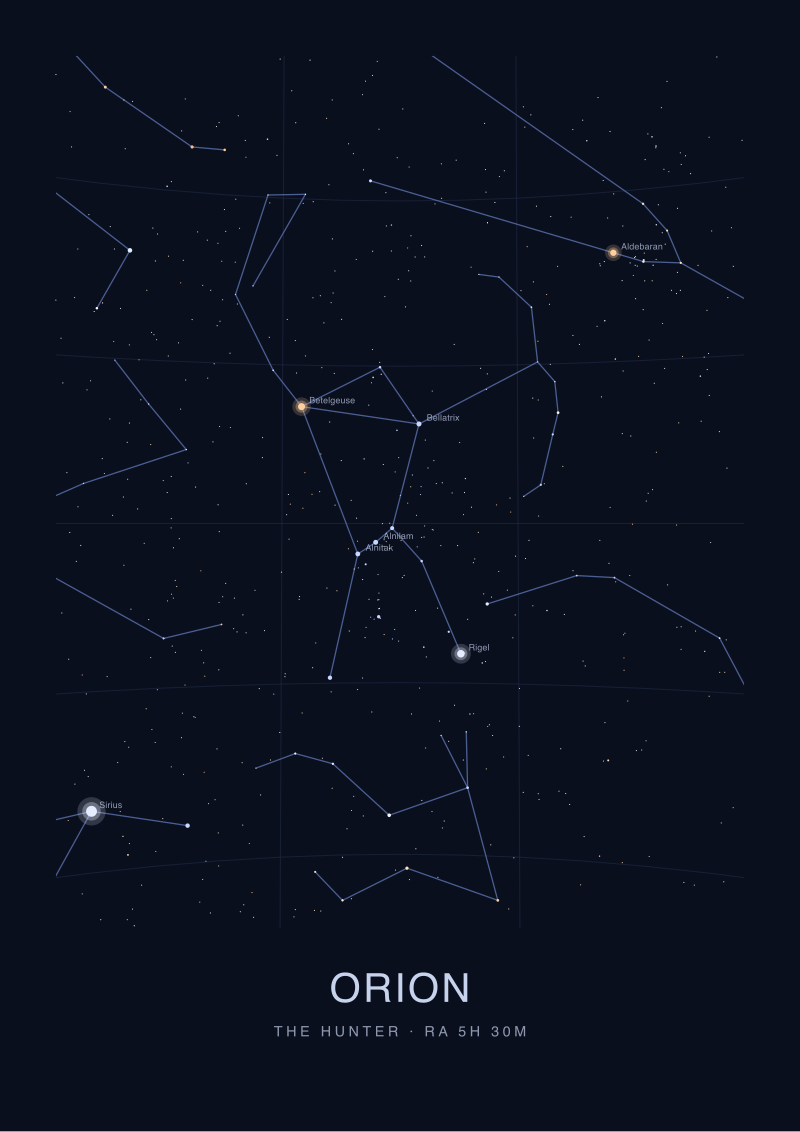 Orion
The print from this article · from €29.95
View the print →
Orion
The print from this article · from €29.95
View the print →
The Constellations Southerners Actually Own Were Drawn Late, by Different Hands
The final and least-told piece of the answer is not about geometry. It is about who was standing where, with what instruments, at what date, when the maps were drawn. The eighty-eight constellations the International Astronomical Union adopted in 1930 are not one tradition. They are two catalogues laid on top of each other with visible seams.
The northern set is essentially the forty-eight constellations Ptolemy listed in the Almagest in the second century, inheriting figures the Babylonians and Egyptians and Greeks had been telling stories about for millennia. Alexandria, where Ptolemy worked, sits at roughly 31 degrees north. Below declination -60 or so, Alexandria's horizon simply blocked the sky. The constellations of the deep south did not have Greek names because Greek astronomers had never seen the stars in them. On medieval European celestial globes, the region below the horizon of the Mediterranean appears as a blank cap — a literal, physical hole in the map where no myth had been drawn because no observer had been present to draw it.
The names that fill that hole are recent and secular. In the 1590s, the Dutch navigators Pieter Dirkszoon Keyser and Frederick de Houtman, working from a ship in the East Indies, catalogued the southern stars and grouped them into twelve new constellations that later mapmakers took up. In the 1750s, the French astronomer Nicolas-Louis de Lacaille, observing from the Cape of Good Hope, added another fourteen. Lacaille's names give the game away. He called them Microscopium, Telescopium, Octans, Antlia — the microscope, the telescope, the octant, the air pump. Not gods. Not heroes. Enlightenment laboratory instruments, projected onto a sky he was inventorying with a small refractor at the tip of Africa. Carina, the constellation that holds Canopus, is a fragment of an older Lacaille construction called Argo Navis, the ship — broken by later astronomers into its keel, sails, and stern. Centaurus, holding Rigil Kentaurus, is one of the rare southern figures that does trace back to antiquity, because the northern edge of the constellation was visible from Mediterranean latitudes even if its brightest star was not.
None of this is the whole map either. Aboriginal Australian traditions had been reading these same stars for tens of thousands of years, most famously in the Emu in the Sky, a figure drawn not from bright points of light but from the dark dust lanes of the Milky Way that stretch from the Coalsack near Crux across the summer sky. Polynesian navigators used southern stars as latitude markers to cross open ocean, in map-systems that had nothing to do with Greek animals or French instruments. Māori astronomy names the great celestial river Te Waka o Tama-rereti and reads seasons off stars that European charts labelled with Latin abbreviations. To say the southern constellations are "the northern ones upside down" is to erase all of this, to pretend a sky was empty before Europeans arrived to name it, and to compress into a rotation what is in fact a hemisphere-wide difference of astronomical history.
This started as a piece about horizon geometry — the simple arithmetic that keeps Canopus below the European skyline — and it turned, in the writing, into a piece about who was standing where when the star charts got drawn. Both explanations are the same explanation, told from opposite ends. The southern sky contains stars the north cannot see, and it contains figures the north did not invent, precisely because the physical geometry of the Earth kept two sets of observers apart long enough for two different star-reading cultures to take root. When we plot Canopus at -52.7 degrees on a chart at the studio, we are not drawing a mirror of anything. We are drawing a country. The northern sky is a different country. The border between them is the horizon of whoever is holding the pen.
FAQ
Why can I never see Canopus from Europe no matter what season it is?
Canopus sits at declination -52.7 degrees in the HYG catalogue, which places it permanently below the horizon for any observer north of roughly 37.3 degrees latitude. That line runs south of Athens and roughly through Sicily. Everywhere north of it — Paris, London, Berlin, Moscow, all of Scandinavia, most of the continental United States — the Earth itself blocks the line of sight. Season does not matter, because circumpolar exclusion is a geometric fact of your latitude, not a seasonal one.
Does Orion actually look upside down from the southern hemisphere?
Yes, but only in the specific sense that its horizon-relative orientation is inverted. Sirius and the belt stars are close enough to the celestial equator that the constellation is visible from nearly everywhere on Earth, but the observer's "up" is defined by their local zenith, which points in opposite directions in the two hemispheres. Southern observers therefore see Betelgeuse below the belt and Rigel above, which is why Australian stargazers sometimes call the shape the Saucepan rather than a hunter.
What is declination, in plain terms?
Declination is the sky's equivalent of latitude. The celestial equator, at zero degrees declination, is the projection of Earth's equator onto the sky. Stars north of it have positive declinations up to +90 at the north celestial pole; stars south of it have negative declinations down to -90. The value is fixed for each star on human timescales, and it decides, together with your latitude, whether a star ever rises above your horizon.
Are the southern and northern celestial poles marked by equally bright stars?
No, and this asymmetry is one of the sky's genuine oddities. The north celestial pole sits close to Polaris in Ursa Minor, a modestly bright star at magnitude 2. The south celestial pole has no comparable marker — the closest naked-eye star is Sigma Octantis, so faint that most casual observers cannot find it from suburban skies. Southern navigators historically used the long axis of the Southern Cross and the pointer stars of Centaurus to triangulate the pole instead.
Why do so many southern constellations have names like Microscope and Air Pump?
Because they were named in the mid-1700s by the French astronomer Lacaille, who observed the southern sky from the Cape of Good Hope during the Enlightenment. Ptolemy's ancient catalogue could not include stars below the horizon of Alexandria, so the deep south was a blank on European charts for over a millennium. When Europeans finally mapped it, they filled the gap with contemporary instruments — telescope, microscope, octant, air pump — rather than reaching back for mythological figures.
Can I see the Southern Cross from anywhere in the northern hemisphere?
Only from low latitudes. The brightest stars of Crux sit around declination -60 degrees, which means the constellation is technically visible from latitudes below roughly 25 or 26 degrees north, and only just above the southern horizon at that. Hawaii, southern Florida, southern India, and the southern edge of the Sahara can catch it. From anywhere further north, including most of the continental United States and all of Europe, Crux is permanently below the horizon.
Is Alpha Centauri, the closest star system to the Sun, visible from the northern hemisphere?
Rigil Kentaurus, the brighter component of the Alpha Centauri system, sits at declination -60.83 degrees. That places it permanently below the horizon for observers north of roughly 29.2 degrees latitude. Cairo and the southern United States can glimpse it low in the sky; anywhere further north it does not rise at all. The nearest stellar system to Earth is, for most people who read English-language astronomy, an object they can only see by traveling south.
If northern and southern skies are so different, is there any part of the sky both hemispheres genuinely share?
Yes — the band roughly within thirty degrees of the celestial equator is visible, at least seasonally, from most of both hemispheres. Sirius at declination -16.7 degrees is the clearest example: it is a shared bright star, appearing in northern winter and southern summer. Orion, most of the zodiacal constellations, and much of the Milky Way's central bulge fall in this shared belt. Beyond it, in either direction, the skies part ways.
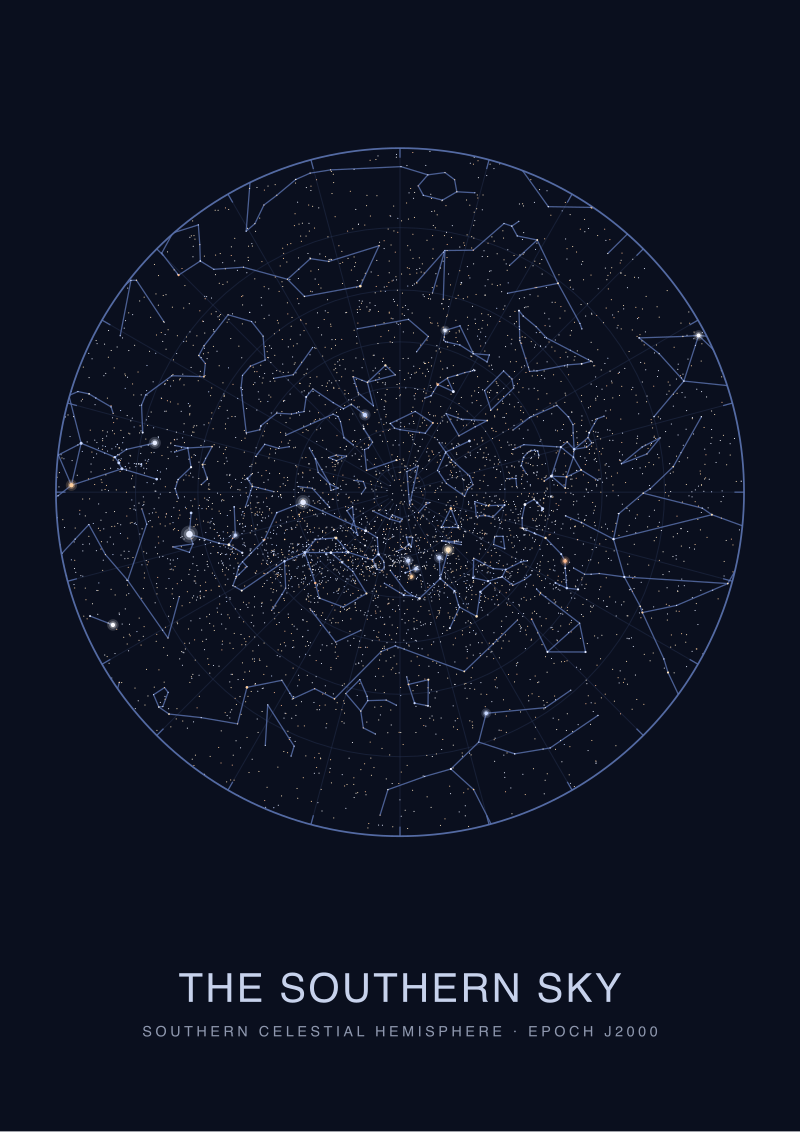 The Southern Sky
The print from this article · from €29.95
View the print →
The Southern Sky
The print from this article · from €29.95
View the print →
From the collection
New charts and 10% off your first print.
One email now with your code. No noise after.