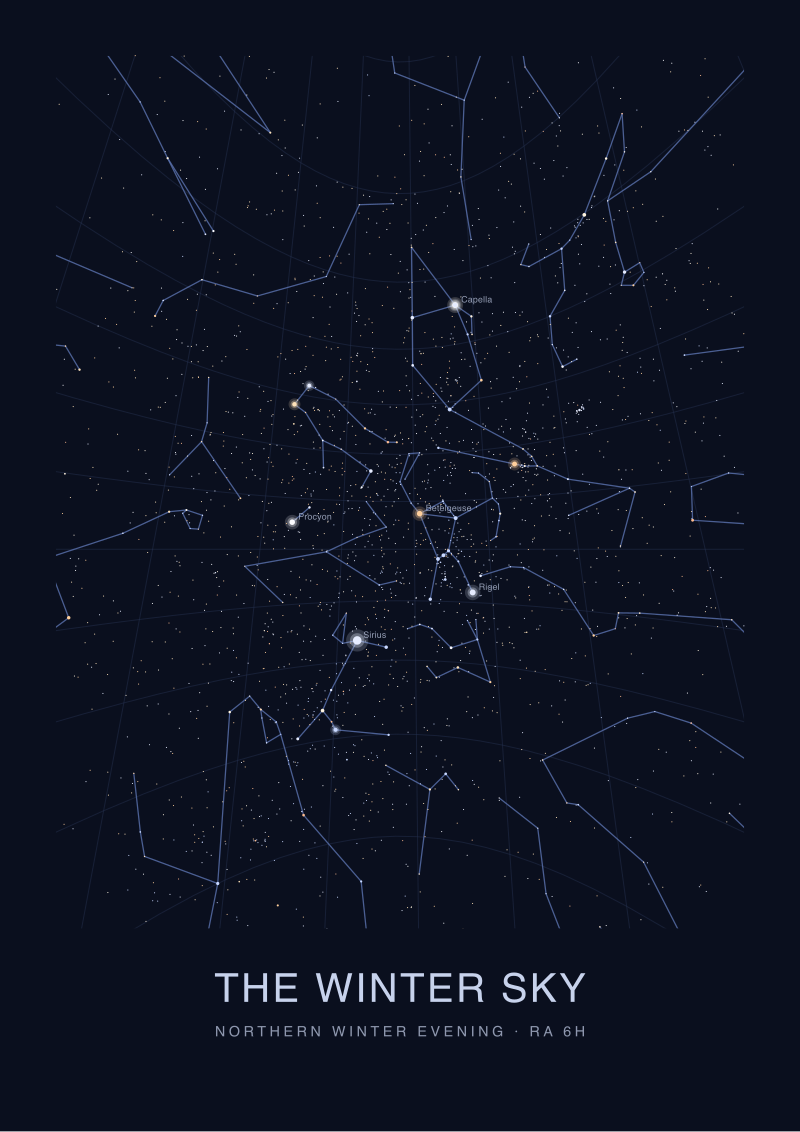
Most winter constellation guides fail the moment the reader steps outside. They assume dark skies, clear horizons, a viewer who already knows Polaris, and stars that behave the same at 42°N as they do at 30°N. They do not. Sirius sits at declination −16.71°, which decides whether it clears a suburban rooftop or hides behind it. Capella at +45.99° decides whether it ever sets below the horizon at all. Instead of another chart, this is a flowchart written in prose. Three questions follow. The answers route each reader to a specific sky — the one actually visible tonight from where they are standing, not the idealized dome on the poster.
Question 1: How Dark Is the Sky Above the Roof?
This is the question every guide skips and every reader silently fails. A city sky and a countryside sky are not the same sky with a filter; they are two different catalogues of what is visible. A star at magnitude 0 punches through most suburban light domes. A star at magnitude 3 does not. The magnitude scale runs backwards, which is a whole separate quarrel — smaller number, brighter star — so Sirius at −1.44 is the brightest fixed star in the entire sky, and Capella at 0.08 is the sixth. Both of those clear almost any light pollution short of a stadium parking lot. The dim connective tissue of a constellation — the third and fourth magnitude stars that make Orion look like a hunter rather than three dots — does not.
The honest test is not "can I see stars?" It is "can I see the Milky Way overhead?" If the answer is no, you are working with a magnitude-2 sky at best. Plan for it. Do not plan for the poster.
If Yes — the sky is dark
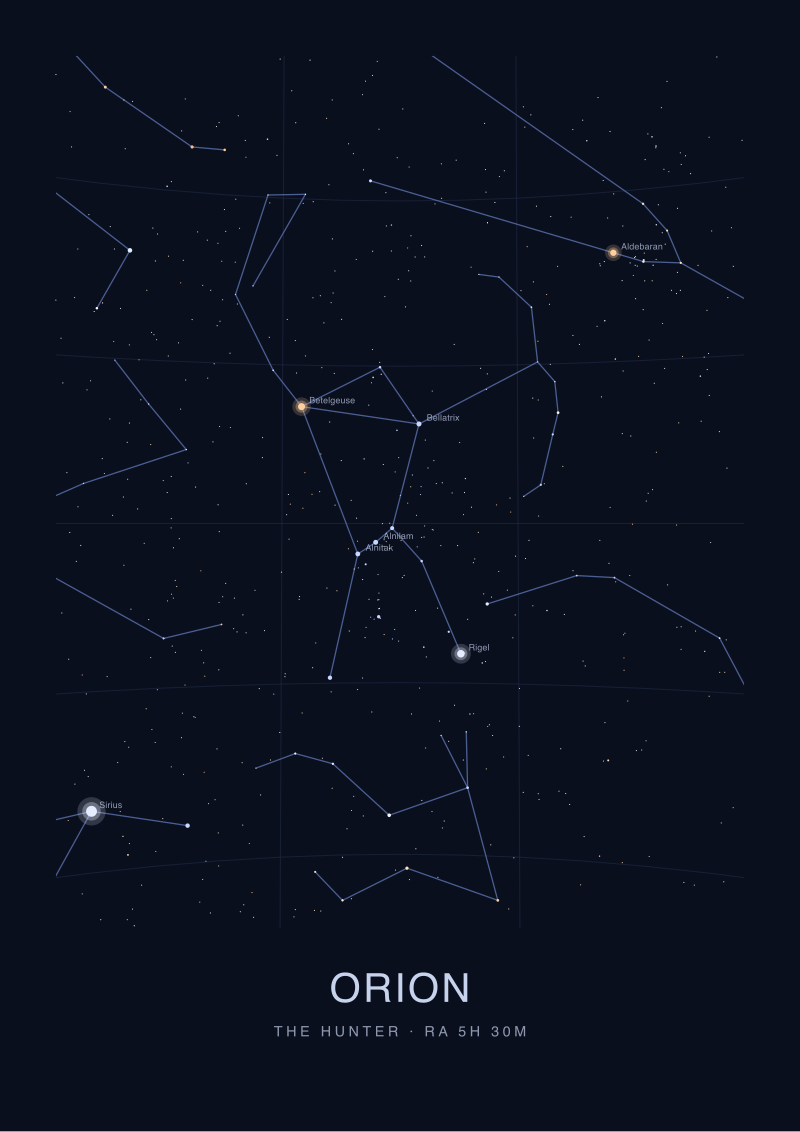
You have the full winter catalogue available. Orion's belt reads as three ordered stars, not a blur. The Hyades, the V-shape that anchors Taurus, resolves into individual points. The Pleiades count out to six or seven with unaided eyes, which is the traditional threshold. Under this sky you can teach yourself constellations by their shapes. The old star-lore names — the Arabic-heritage naming layer, the Greek myth layer — start to make sense because you can actually trace the figures. Start with Orion because it is the anchor of the whole northern winter sky. Every other winter constellation is found by drawing a line from Orion to it.
If No — the sky is a suburban wash
You have roughly five to eight stars to work with. Treat this as an asset, not a defeat. When the sky is bright you cannot get lost, because the connective tissue is invisible and only the bright stars remain. Sirius at magnitude −1.44 will be the brightest thing in the sky that is not a plane or a planet. Capella at magnitude 0.08 will hold the northeast. Orion's three belt stars survive most light pollution. Everything else — the Pleiades, the fainter Auriga stars, the wing of Perseus — is gone. Do not chase them; they are not there. The survival move is to learn the four or five bright anchors cold, then use a chart only when a rural night gives you the rest.
Question 2: How Far North Is the Viewer, Really?
Latitude is the second silent variable. A star's declination — its celestial latitude — decides how high it climbs above the horizon. Subtract the star's declination from 90° and then subtract your own latitude to get the star's highest altitude at meridian crossing. This sounds like homework. It is the reason two people with the same "winter constellation guide" open in the same tab see two different skies.
Sirius, at declination −16.71°, climbs to about 42° above the southern horizon for a viewer at 30°N — a comfortable altitude, well clear of most rooflines. For a viewer at 55°N, Sirius peaks at just over 18°. That is behind the neighbor's tree. Same star, same night, same guide article — completely different experience. Meanwhile Capella at declination +45.99° is circumpolar for anyone north of about 44°N: it literally never sets. For a viewer in Miami it grazes low in the north and disappears for part of the year.
Any guide that does not mention this is writing for one imaginary reader at 42°N — traditionally the latitude of the northeast US corridor — and quietly leaving everyone else to squint.
If Yes — the viewer is at 45°N or higher
Capella is your friend. It sits nearly overhead in mid-winter and it does not go away. Use it as the fixed anchor for the northern half of the sky, not Polaris — Polaris is too dim in a city and too high overhead in a truly northern latitude to be a comfortable pointer. Watch for the low horizon problem instead: Sirius will hug the southern horizon and spend most of the night getting eaten by trees, buildings, and atmospheric extinction. Below about 20° altitude, a star loses roughly a full magnitude to the thick air near the horizon. Sirius at magnitude −1.44 still survives that penalty. Almost nothing else in the southern winter sky does. The Canopus problem is worse — at declination −52.69° it never rises at all above about 37°N. If a guide mentions Canopus as a northern winter target, close the tab.
If No — the viewer is south of 40°N
You have inherited the good version of the winter sky. Sirius climbs high, Orion crosses near the zenith, and the whole southern winter arc opens up. The tradeoff is Capella. It is still there, still magnitude 0.08, but it sits lower in the north and it sets earlier in the night as the season advances. Use Orion overhead as the anchor and treat the north as a supporting cast rather than a fixed frame. Do not attempt to see Canopus from anywhere in the continental United States except the southern tip of Florida and southern Texas; even there it is a low southern horizon object visible for a narrow window in late winter. Rigil Kentaurus, at declination −60.83°, is not on your menu at all. It is a southern hemisphere object. Guides that list it under "winter stars" are not writing for the northern hemisphere. Move on.
 Orion
The print from this article · from €29.95
View the print →
Orion
The print from this article · from €29.95
View the print →
Question 3: Is the Viewing Window Before Midnight or After?
Constellations do not sit still. The sky wheels roughly 15° per hour, which means the difference between an 8 pm winter sky and a 2 am winter sky is a full quarter of the celestial dome — a completely different set of dominant constellations. Guides that say "in winter, look for Orion in the south" are describing a specific two-hour window and pretending it is the season. In early winter Orion rises in the east after dinner and takes hours to climb. In late winter Orion is already high at dusk and setting by midnight. Time-of-night is not a detail. It is the third routing question.
There is a second reason this matters. If you are viewing in the small hours after midnight, you begin to see the spring sky arriving. Arcturus, at magnitude −0.05, rises in the northeast during the late winter pre-dawn hours. It is technically a spring star, but a February observer at 3 am is already seeing it. If your guide does not warn you that Arcturus is not part of the winter sky proper but will be visible in your window, you will misidentify it. It is the fourth-brightest fixed star and it does not care about the calendar.
If Yes — viewing before midnight
You have the classic winter sky. Orion dominates the south or southeast depending on the month, the belt oriented from upper-left to lower-right for a northern viewer. Sirius follows Orion up from the east-southeast. Capella is high in the northeast or overhead depending on your latitude. This is the sky the posters draw. It is real, it just is not the only one. Under this window, resist the urge to chase constellations that are technically "up" but low near the horizon — they are drowning in atmospheric extinction and light dome. Work with what is above 30° altitude and let the rest wait.
If No — viewing after midnight
You are on the transition sky. Orion is already tilting toward the west and beginning to set. Sirius follows it down. Capella swings toward the northwest. Rising in the east: Arcturus, and further into the pre-dawn, the spring constellations. This is the most useful sky for anyone learning the wheel of the year, because in a single session you see one season handing off to the next. It is also the sky most guides refuse to describe, because it does not fit the tidy four-season framing. If you are up at 3 am in February and you see a bright orange-tinged star climbing in the east, that is Arcturus at magnitude −0.05, and you are watching the spring sky announce itself two months early.
If You Answered Everything: The Routing Table
| Q1: Sky Dark? | Q2: Latitude ≥ 45°N? | Q3: Before Midnight? | Recommendation |
|---|---|---|---|
| Yes | Yes | Yes | Full winter catalogue overhead: Orion as anchor, Capella nearly at zenith, Sirius low southern climb. |
| Yes | Yes | No | Watch the handoff: Orion setting west, Arcturus rising east, Capella swinging northwest. Best learning sky. |
| Yes | No | Yes | Classic poster sky: Orion high south, Sirius clear of horizon extinction, Capella lower northeast anchor. |
| Yes | No | No | Orion tilts west, Sirius follows down, Arcturus rises. Southern latitudes see this transition earlier. |
| No | Yes | Yes | Four anchors only: Capella overhead, Sirius low south, Orion's belt, Betelgeuse. Skip the fainter cast. |
| No | Yes | No | Capella northwest, Sirius setting, Arcturus rising. Bright-star-only sky; do not chase Pleiades. |
| No | No | Yes | Sirius dominates south, Orion belt visible, Capella northeast. Everything under magnitude 2 is gone. |
| No | No | No | Sirius low west, Arcturus low east, Capella dim north. Bright-anchor sky in transition; brief window. |
The table is a starting router, not a verdict. Two viewers with the same three answers will still see different skies depending on which direction their apartment building blocks, whether their winter is currently in a high-pressure clear stretch, and how patient they are with letting eyes dark-adapt for the twenty full minutes it takes. But if you have been staring at a generic star chart wondering why nothing matches, the answer is almost always that the chart was drawn for a viewer who is not you, at a time that is not now, under a sky you do not have. A chart plotted for your specific latitude, date range, and horizon — the kind we print and sell at /shop/ — solves this once, on paper, and then stays solved. The routing table above solves it tonight, for free, in your head.
 The Winter Sky
The print from this article · from €29.95
View the print →
The Winter Sky
The print from this article · from €29.95
View the print →
FAQ
What is the single brightest star visible in the northern winter sky?
Sirius, in the constellation Canis Major, at apparent magnitude −1.44. It is the brightest fixed star in the entire night sky from any location on Earth, not just winter and not just the northern hemisphere. In northern winter it rises in the east-southeast a few hours after Orion and follows the hunter across the southern sky. From most of the continental United States it stays relatively low in the south, which is why atmospheric turbulence often makes it appear to flash multiple colors — that is the air, not the star.
Why does Capella never set in the sky where I live?
Capella sits at declination +45.99°, meaning it circles the celestial pole at that angular distance. For any observer at a latitude of roughly 44°N or higher, Capella never dips below the horizon — it is what astronomers call circumpolar. That includes most of the northern United States, all of Canada except the extreme south, the UK, Scandinavia, and northern Europe. It swings between overhead in mid-winter evenings and low in the north during summer nights, but it is always somewhere in the sky.
Is Canopus part of the northern winter sky?
No. Canopus sits at declination −52.69°, which is deep in the southern celestial hemisphere. From anywhere north of about 37°N latitude, Canopus never rises above the horizon at all. From the southern edge of the continental US it appears very briefly and very low in the south. Any northern-hemisphere winter guide that lists Canopus as a target is either recycling a southern-hemisphere article or was written without checking declinations. It is at magnitude −0.62 — the second brightest star in the sky — but that brightness is unreachable from the northern latitudes.
Why is Arcturus showing up in my winter sky if it is a spring star?
Because the sky rotates. Arcturus, at magnitude −0.05, technically belongs to the spring evening sky, when it rises after sunset and dominates the east. But in late winter — particularly February and early March — Arcturus rises in the northeast around midnight, and any observer viewing in the small hours before dawn will see it climbing. This is the sky handing off from one season to the next in real time. It is not a mistake in your chart; it is the wheel of the year turning.
Is the zodiac useful for finding constellations in winter?
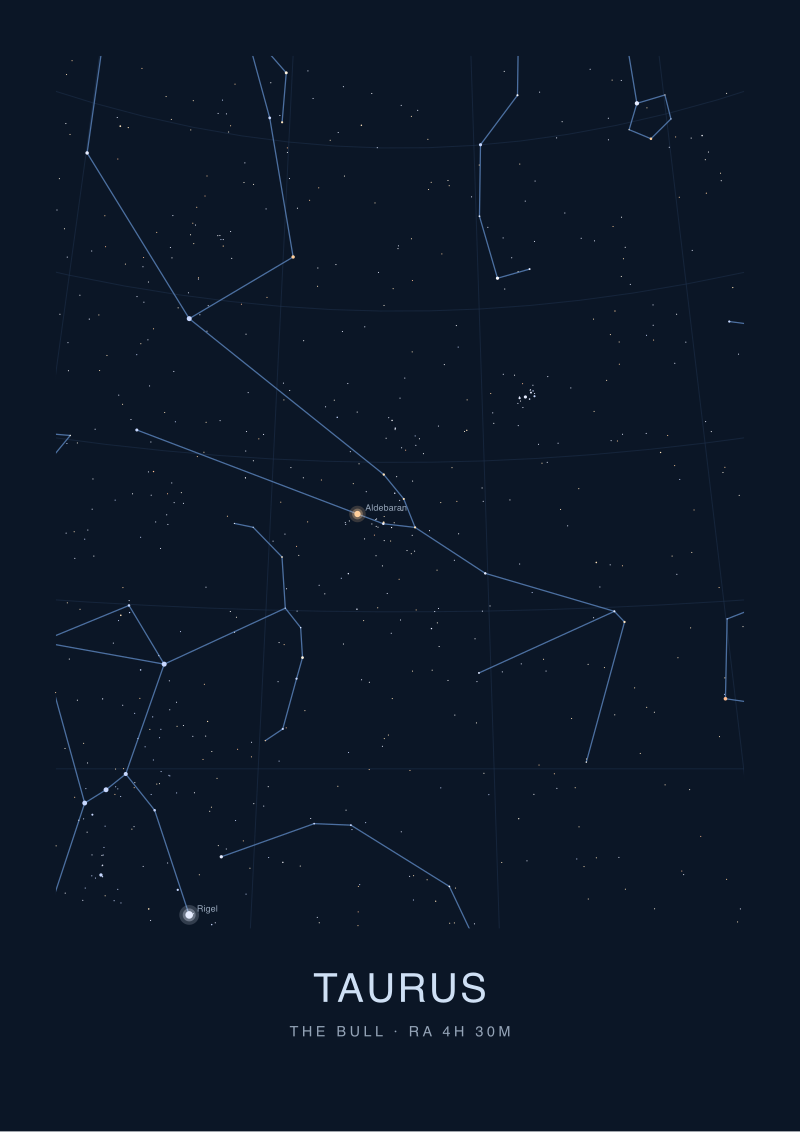
The zodiac is a coordinate band, not a personality system. It is the strip of sky the sun, moon, and planets travel through, which happens to intersect twelve constellations of very different sizes and prominences. For winter northern observers, the useful zodiac constellations are Taurus, Gemini, and Cancer — none of them dominate the way Orion does, but Taurus in particular is a classic winter anchor with the Hyades V and the Pleiades cluster. The rest of the zodiac in winter is either below the horizon or lost in twilight.
How does light pollution actually change what I can see?
It raises the effective magnitude limit of the sky. A truly dark rural sky lets an unaided eye reach roughly magnitude 6, meaning roughly 6,000 stars are theoretically visible across the whole sky at once. A suburban sky cuts that to about magnitude 4, which drops the count by roughly ten times. An inner-city sky is closer to magnitude 2 or 3, meaning perhaps 100–200 stars total. Constellations do not disappear evenly; the bright anchor stars survive and the connective tissue vanishes, which is why familiar shapes stop looking familiar under light pollution.
Why does the magnitude scale run backwards?
It is a two-thousand-year-old inheritance from the Greek astronomer Hipparchus, who ranked stars from "first magnitude" (brightest) to "sixth magnitude" (faintest). When 19th-century astronomers formalized the scale mathematically, they preserved the direction rather than reverse two millennia of literature. The result is a scale where lower numbers mean brighter stars, negative numbers mean the very brightest, and each step of 1 magnitude corresponds to a factor of about 2.5 in brightness. It is confusing, it will remain confusing, and every working chartmaker has simply memorized it.
Do I need a telescope to identify winter constellations?
No, and for learning the constellations, a telescope actively gets in the way. Constellations are shapes drawn between stars that are visible to the unaided eye, at magnitude 4 or brighter. A telescope narrows the field of view to a fraction of a degree, which is the opposite of what you want when learning a shape that spans 20° or 30° of sky. Binoculars — specifically 7×50 or 10×50 — are the useful upgrade, because they hold a wide enough field to see whole constellations at once while pulling in another magnitude or two of faint connective stars.
From the collection
New charts and 10% off your first print.
One email now with your code. No noise after.