Rigil Kentaurus sits at declination minus sixty degrees, fifty minutes. That is the number we pull first when a reader asks where the Southern Cross is, because Alpha Centauri and its companion — the pointers every southern chart draws beside Crux — occupy the same deep-southern band of sky. A star at that declination stays permanently below the horizon for anyone north of roughly latitude twenty-nine north. Miami, Cairo, Shanghai: never. Havana, Karachi, Hong Kong: a fingernail of it, low, briefly, and only in the right months. Everything above thirty-five degrees north loses it outright. The Southern Cross is not hidden. It is filed under a latitude you may not live at.
What the Numbers Actually Say
The arithmetic of a star's visibility is unromantic and exact. Take a star's declination — its angular distance north or south of the celestial equator — and add it to your own latitude. If the sum exceeds ninety degrees, the star clears your horizon at some point in the day. If it does not, the star is permanently below your horizon and no amount of clear sky, altitude or patience will change that.
Rigil Kentaurus — Alpha Centauri, the brighter of the two pointer stars beside Crux — carries a declination of minus sixty degrees, fifty minutes according to HYG v41. Its apparent magnitude is minus zero point zero one, which places it in the small handful of stars bright enough to punch through twilight and thin cloud. That brightness is why it functions as a pointer at all: a reader who cannot yet find Crux can find Alpha Centauri, and then follow the line the two pointers draw toward the small kite of the Cross.
The declination arithmetic gives us the visibility band. A star at declination minus sixty-one is above the horizon for any observer south of latitude twenty-nine north. That is a generous ceiling, and it is why the pointers technically graze the horizon from places like Havana at latitude twenty-three north, from Muscat at twenty-three, from Karachi at twenty-five. But grazing the horizon is not the same as being visible. A star sitting one or two degrees above the horizon competes with haze, city light, hills, buildings, and the thicker column of atmosphere that light must travel through at low altitudes. Practical visibility begins closer to ten degrees of altitude. That constraint pushes the useful northern limit for Crux down toward the tropics.
South of the equator, the picture inverts. From Nairobi at latitude one south, Crux is a low but reliable southern feature. From Rio de Janeiro at twenty-three south, it climbs comfortably. From Sydney at thirty-four south, it is close to overhead in the late-autumn evening sky. And from anywhere south of about latitude thirty-four south — Melbourne, Wellington, Cape Town, the southern half of Argentina and Chile — Crux is circumpolar. It never sets. It rotates around the south celestial pole in a slow nightly wheel and is available on every clear night of every month.
The best evening viewing in the southern hemisphere concentrates from March through June, when Crux stands high in the sky after nightfall rather than requiring an early-hours vigil. In the northern tropics, the window is narrower — roughly April and May — because the constellation must transit the meridian during the hours when it is also dark enough to see.
What Nobody Mentions
Two features of the southern sky trip up almost every first-time observer, and both belong in a chartmaker's briefing rather than a travel blog.
The first is the False Cross. Roughly twenty degrees west of the true Southern Cross sits a diamond of four stars in Carina and Vela that resembles Crux at a glance. It is larger, its stars are fainter, and its shape is more diffuse — but on a hazy night, or from a northern observer who has never seen either, the False Cross reliably fools the eye. Charts that print both constellations at the same scale help. Charts that isolate Crux without its neighbours do not. This is where catalogue magnitude earns its keep: the four stars of Crux are notably brighter than the four stars of the False Cross, and a reader who trusts the number rather than the shape will get it right on the second attempt.
The second is the pointers themselves. Alpha Centauri and Beta Centauri — Rigil Kentaurus at magnitude minus zero point zero one and its neighbour a shade dimmer — sit east of Crux and form a bright, unmistakable pair. Draw a line from Beta to Alpha, then continue in the same direction, and you land on Crux. This is the standard identification method used by southern navigators for centuries, and it works because the pointers are among the brightest stars in that quadrant of sky. Without them, Crux is harder to isolate than its reputation suggests. It is small. Its shape is more kite than cross. And Sirius, at magnitude minus one point four four in Canis Major, sits far enough north on the sky (declination minus sixteen point seven) to be a distraction rather than a guide — a much brighter star that pulls the eye in the wrong direction.
Maps mislead here in a specific way. They flatten the sky into a page, and they draw Crux at whatever size the layout allows. A reader arrives at a southern latitude with the mental image of a large, prominent cross and instead finds a compact figure roughly the width of a fist held at arm's length. The pointers do more work than the constellation itself. The lore that grew around Crux — Māori, Aboriginal Australian, southern-hemisphere European navigation traditions — treats it as a fixed reference precisely because the pointers make it findable, not because the shape is dominant.
There is also the question of what "south" the Cross indicates. Crux does not sit on the south celestial pole the way Polaris nearly does on the north. The long axis of the Cross points toward the pole, and a rough approximation of true south on the horizon can be read by extending that axis four and a half times its length and dropping straight down. This is a navigational trick, not a precise instrument, and it drifts with the season and the hour. But it works well enough that generations of southern-ocean sailors did not need anything more precise.
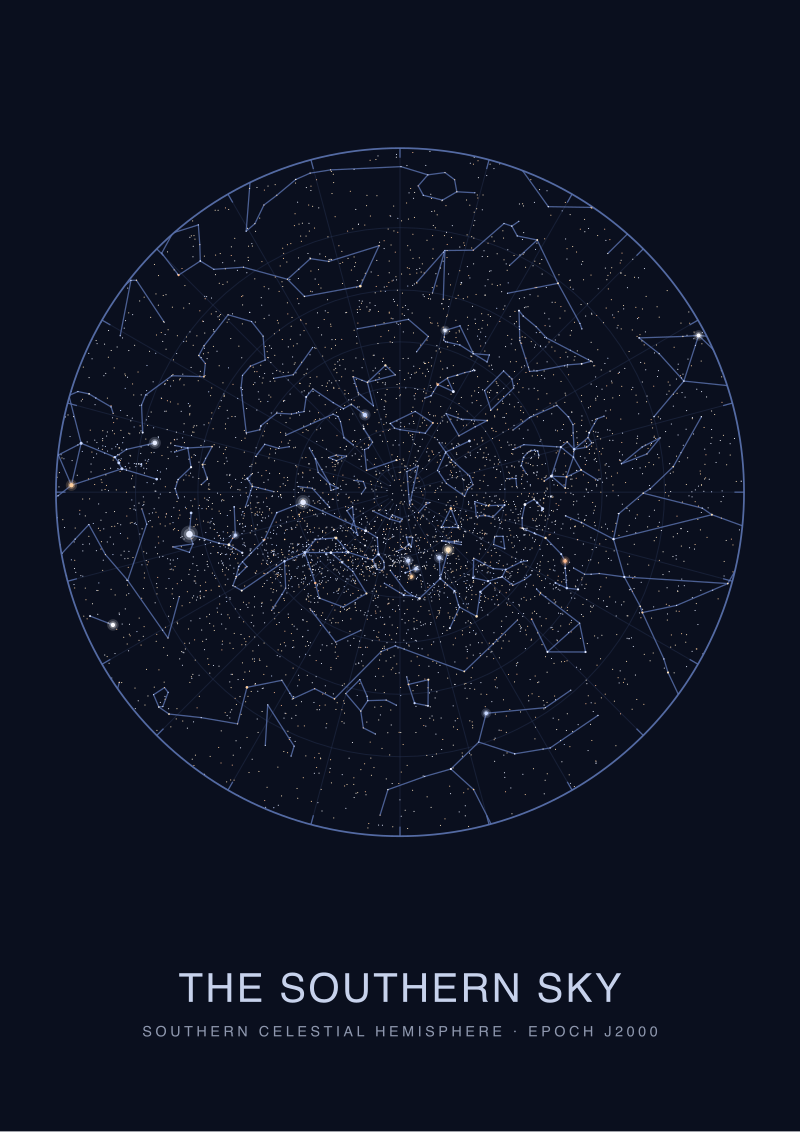 The Southern Sky
The print from this article · from €29.95
View the print →
The Southern Sky
The print from this article · from €29.95
View the print →
The Real Cost
Every location on the planet pays a latitude tax on what it can see. Working through the cost concretely, for four representative cities, shows what the numbers mean at ground level.
From Sydney at latitude thirty-four degrees south, Crux is circumpolar and the pointers are circumpolar with it. There is no season in which the constellation is unavailable. In the late-autumn evening sky — April, May, early June — Crux sits high in the south after sunset, and Alpha Centauri at magnitude minus zero point zero one is one of the brightest points on the whole hemisphere. This is the reference case. Every other description in this section measures what is lost against Sydney's baseline.
From Nairobi at latitude one degree south, Crux is above the horizon for the majority of the night year-round, but the geometry is different. Rather than wheeling near the zenith, the constellation traces a lower arc across the southern sky. Peak evening visibility runs April through June, when Crux transits the meridian during dark hours. The pointers work exactly as they do further south — the line from Beta to Alpha to Crux is the same line — but a Nairobi observer sees the whole southern circumpolar cap tilted onto its side. The Southern Cross reads more like a compass mark on the southern horizon than an overhead feature. This is what most tropical observers actually experience, and it is worth calibrating expectations to.
From Havana at latitude twenty-three degrees north, the story changes. Alpha Centauri technically clears the horizon, but only just — its maximum altitude is a handful of degrees above true south, achieved briefly around the meridian transit in April and May. Crux itself, whose brightest star Acrux sits at declination minus sixty-three, is even lower. What a Havana reader actually sees, on a clear night in late April with an unobstructed southern horizon and no city light, is the top of the Cross scraping over the sea. Buildings, hills, haze — any of these will erase it. This is the observational floor: geometrically visible, practically difficult.
From anywhere above latitude thirty-five north — Cairo, Athens, Charleston, Los Angeles — the arithmetic simply refuses. Rigil Kentaurus and Crux stay permanently below the horizon. The night sky in these places is dominated by different bright stars: Arcturus at magnitude minus zero point zero five in Boötes, high in the northern summer; Vega at zero point zero three in Lyra, near the zenith through the same season; Capella at zero point zero eight in Auriga, prominent through winter evenings. These are the northern hemisphere's answer to Alpha Centauri. They are catalogued in the same list of the sky's brightest stars, and they occupy the sky a northern observer has actually been given. Wanting Crux from Cairo is wanting a constellation filed under someone else's latitude.
The cost of chasing it, then, is a plane ticket south. There is no northern viewpoint, no telescope, no technique that pulls a star above the horizon when the geometry has ruled it out. Every star chart that promises Crux to a New York reader in some particular month is either wrong or is quietly relying on the reader not looking closely at the declination number.
If You Only Remember One Thing
Latitude decides Crux. If you live south of about thirty-four degrees south, the Southern Cross is a permanent feature of your night sky and the pointers are with it every clear night. If you live in the tropics, both hemispheres, Crux is a seasonal southern-horizon feature best seen from April through June. If you live north of about latitude twenty-nine north, you will not see it at all — not with equipment, not with patience, not with the right month.
Everything else — the False Cross confusion, the small size of the true Cross, the way the pointers do most of the identification work — is craft. The single hard boundary is the horizon line drawn by your own latitude. That line moves only if you do.
This piece did not cover precession, which will slowly shift Crux's declination over millennia and eventually make it visible from latitudes that cannot see it today. It did not cover the southern Milky Way's dark nebulae — the Coalsack sits inside Crux and is a subject in its own right. And it did not cover the deep history of how Crux was catalogued separately from Centaurus in the sixteenth century, when European navigators finally sailed far enough south to draw it. Each of those belongs in its own chart. If you would like the sky of a specific latitude and date plotted as a print, that is what our shop is for.
FAQ
At what latitude does the Southern Cross become visible year-round?
Roughly latitude thirty-four degrees south and further south. From that band — Sydney, Melbourne, Cape Town, most of New Zealand, southern Argentina and Chile — Crux is circumpolar, meaning it never sets. It rotates around the south celestial pole every night and is available whenever the sky is clear. Above that latitude, in the tropics and equatorial belt, the constellation is above the horizon for most of the night but only high enough for easy viewing during specific months.
Can the Southern Cross be seen from any part of the United States?
No practical part. Rigil Kentaurus at declination minus sixty degrees, fifty minutes and the stars of Crux itself sit deep enough south that even the southernmost tip of Florida, at roughly latitude twenty-four to twenty-five north, gets only the pointers briefly grazing the horizon in April and May, and Crux itself is below or on the horizon line. Hawaii at latitude nineteen to twenty-two north does better and sees the constellation low in the southern sky during the same months. Everywhere else in the continental US, no.
When is the best time of year to see Crux from the southern hemisphere?
For most southern-hemisphere observers, April, May and June offer the best evening viewing. During those months, the constellation transits the meridian — its highest point in the sky — during the hours after sunset rather than in the pre-dawn. For circumpolar latitudes further south, Crux is technically visible every clear night of the year, but its position rotates through the night, so the practical viewing hour depends on the season.
What are the pointer stars, and why do they matter?
Alpha Centauri (Rigil Kentaurus) at magnitude minus zero point zero one and Beta Centauri (Hadar), slightly dimmer, sit east of Crux and form a bright pair that is easier to spot than the Cross itself. Draw a line from Beta through Alpha and continue in the same direction — you arrive at Crux. Southern navigators have used this method for centuries because Crux is smaller and less prominent than its reputation suggests, and the pointers do the practical work of finding it.
How do I tell the Southern Cross from the False Cross?
The False Cross sits about twenty degrees west of the true Crux and is made up of four stars in Carina and Vela. It is larger, more diffuse, and its stars are visibly fainter than the four stars of the true Cross. The tell is brightness: Crux's stars are among the brighter points in that region of sky, while the False Cross reads as a softer, spread-out diamond. Using the pointer stars to confirm the identification removes any ambiguity.
Does the Southern Cross point exactly south?
Not exactly, but usefully close. The long axis of Crux points toward the south celestial pole. Extending that axis about four and a half times its length and dropping straight down to the horizon gives a rough approximation of true south. This is a navigational method, not a precision instrument — it works well enough that centuries of southern-ocean sailors relied on it, but it is not equivalent to the way Polaris marks north within about one degree.
Why does the Southern Cross look so small compared to pictures?
Because most pictures are printed at scales that exaggerate it. Crux is roughly the width of a fist held at arm's length — compact, not sprawling. Star charts that isolate the constellation on a page make it look larger than it appears against the whole vault of sky. The first-time observer's most common reaction is that the real thing is smaller than expected. This is another reason the pointer stars matter: they anchor the identification when the shape alone is easy to miss.
Is Crux the same as the constellation on the Australian and New Zealand flags?
Yes. The five stars on both national flags depict Crux — four for the main kite shape plus Epsilon Crucis, a fifth, dimmer star inside the figure. Several other southern-hemisphere flags and coats of arms use the same constellation, including Brazil, Papua New Guinea and Samoa. The constellation's visibility from those latitudes made it a natural symbol; a northern-hemisphere nation could not have chosen it because its citizens could not see it.
From the collection
New charts and 10% off your first print.
One email now with your code. No noise after.