Pull the catalogue entry for Sirius and it reads like a shipping label. Constellation: Canis Major. Apparent magnitude: −1.44. Right ascension: 6.75248 hours. Declination: −16.71612 degrees. Source: HYG v41.
Sirius is not the brightest thing in your sky. Hear us out.
What the Numbers Actually Say
Magnitude −1.44. That is a small negative number, and it is the brightest apparent magnitude carried by any fixed star in the catalogue we plot from. It is the reason Sirius has held the "brightest star" title for as long as astronomers have kept records with numbers attached. But that number is doing a very specific job, and the job is narrower than the phrase implies.
Apparent magnitude is a measurement of how bright a point of light *appears from Earth*. It is not a measurement of how much energy the star emits. It is not a measurement of how far away the star is. It is a photon count, taken by a human eye or a detector, standing on a specific rotating planet. Change any of those variables and the number moves. Sirius reads −1.44 from here because it is both intrinsically bright and, in cosmic terms, very close. It sends an unusually loud signal from an unusually short distance, and we filed the result under "brightest star" as if that closed the matter.
The coordinates matter too. Right ascension 6.75248 hours places Sirius roughly a sixth of the way around the celestial equator; declination −16.71612 degrees puts it about seventeen degrees south of that equator. That southern dip is not decorative. It means Sirius rides low across the southern horizon for a viewer in London or Berlin, climbs comfortably high for a viewer in Rio or Johannesburg, and passes almost overhead if you are somewhere near the Tropic of Capricorn. The star does not belong to one hemisphere, but it does not treat both equally. The catalogue number is fixed; the sky it describes is not.
Read those three data points together — magnitude, right ascension, declination — and you have plotted a specific star at a specific place from a specific perspective. That is a chartmaker's set of facts. It is not a claim that Sirius is the brightest object your eyes will ever land on.
What Nobody Mentions
Every reasonable list of "brightest things in the night sky" starts with objects that are not stars. The Sun does not count because it defines day. But the Moon, at full phase, is broadly documented at around magnitude −12.7, which is roughly eleven magnitudes brighter than Sirius. On the logarithmic scale astronomers actually use — five magnitudes equal a factor of one hundred in brightness — that gap is enormous. Venus, near its brightest, sits around magnitude −4.9, roughly three and a half magnitudes above Sirius. Jupiter at opposition can reach around −2.9. Mars, in a favourable year, edges past Sirius as well.
Meaning: on any clear night with a bright planet up, the "brightest star in the sky" is regularly the third or fourth brightest object your eye can find, once you sort by photons and not by species. Popular writing about Sirius rarely mentions this because it complicates the headline. It is easier to sell the Dog Star as champion than to add the fine print that the champion is a champion of a specific weight class.
The other missing detail is that Sirius is not one star. It is a binary — Sirius A, the bright anchor everyone sees, and Sirius B, a white dwarf discovered visually by Alvan Clark in 1862 after decades of astronomers noticing that Sirius A appeared to wobble. Sirius B does not add materially to the magnitude your eye picks up. But it changes what the point of light in the catalogue actually *is*: a young main-sequence star gravitationally married to the burnt-out core of a former companion. That fact is standard textbook astronomy. It is also almost never on the same page as the "dog star facts" listicle you probably arrived from.
And then there is the naming heritage. "Dog star" is the received English, from the Greek tradition in which Sirius was Canis Major's alpha and its heliacal rising in high summer coincided with the hottest weeks of the Mediterranean year. That is where "dog days of summer" comes from. It is a tradition, told as tradition — Sirius is not causing the heat, and never was. The Egyptians read the same star as the herald of the Nile flood. Same photons, different chart.
The Real Cost of "Brightest Star"
Take the phrase apart and price it. What does calling Sirius "the brightest star" actually cost you as a reader trying to understand the sky?
First, it costs you the magnitude scale. If you never ask why −1.44 is brighter than +1.44, you will never understand that the scale is inverted and logarithmic, that a difference of one magnitude means a factor of about 2.512 in received brightness, and that professional catalogues talk in these units for good reason. Skip that and every future number you encounter — Vega at 0.03, Betelgeuse hovering around 0.5, a limiting magnitude of 6 for the unaided eye in a dark sky — is just noise you cannot read.
Second, it costs you the difference between apparent and absolute magnitude. Sirius appears loud because it is close. There are stars in the same catalogue with vastly greater intrinsic luminosity that appear dimmer because they are further away. Confusing the two is the single most common error we field from readers, and it is the error the "brightest star" phrasing quietly encourages. It rewards proximity as if proximity were achievement.
Third, it costs you the sky. If you decide Sirius is *the* brightest and stop looking, you miss the fact that from mid-northern latitudes in winter, Sirius is the low sparkle beneath a much larger cast — Orion above and to the right, Procyon to the left, Betelgeuse and Rigel framing the whole scene. The chart is not a leaderboard. It is a composition, and Sirius does its best work as the anchor of the Winter Triangle, not as a solo act.
The gap between the accurate statement — "Sirius, at apparent magnitude −1.44, is the brightest fixed star in our night sky as seen from Earth" — and the compressed one — "Sirius is the brightest star" — is not linguistic pedantry. It is the difference between a reader who can plot and a reader who can only recite. We build charts for the first kind. The studio's own prints of the winter sky (see the /shop/) plot Sirius exactly where the catalogue says it sits, not where the mythology says it belongs.
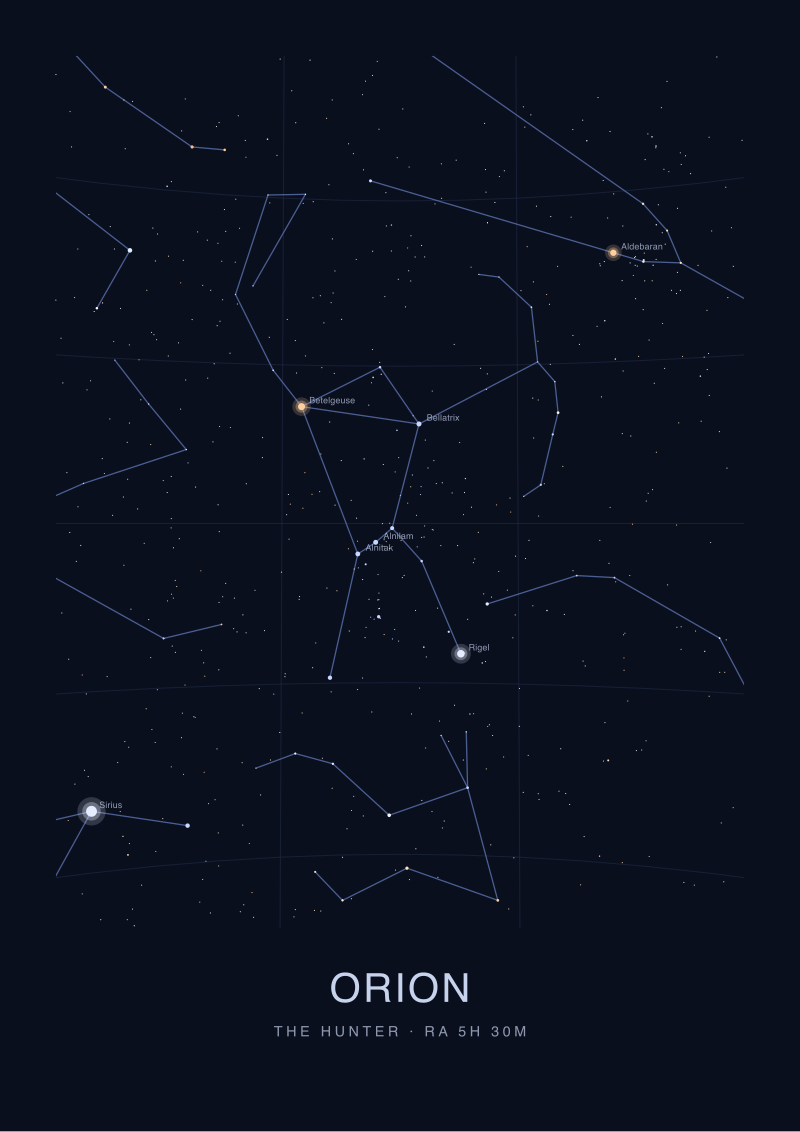 Orion
The print from this article · from €29.95
View the print →
Orion
The print from this article · from €29.95
View the print →
If You Only Remember One Thing
Remember the receipt. Sirius: Canis Major, apparent magnitude −1.44, right ascension 6.75248 hours, declination −16.71612 degrees, HYG v41. Every claim in this piece traces back to that line.
The rest — dog star, brightest star, herald of summer, twin to a white dwarf — is what humans wrote around the numbers. Some of it is true, some of it is tradition, none of it is a substitute for the coordinates. Star maps are drawn in the language of the receipt, not the legend.
FAQ
Why is a negative magnitude brighter than a positive one?
The magnitude scale is inverted and logarithmic, inherited from Hipparcos in the second century BCE, who ranked the brightest stars as "first magnitude" and the faintest visible as "sixth". When astronomers modernised it, they kept the direction: brighter objects get smaller numbers, and objects brighter than a first-magnitude reference had to go negative. Sirius at −1.44 is brighter than Vega at 0.03, which is brighter than Polaris at roughly 2. A difference of five magnitudes equals a factor of one hundred in received light.
Is Sirius the brightest object in the night sky?
No. Sirius is the brightest *fixed star*, but the Moon is dramatically brighter at full phase (around magnitude −12.7 in standard tables), and Venus at its peak (around −4.9) and Jupiter near opposition (around −2.9) both regularly outshine Sirius. On any given night with a bright planet up, Sirius may rank third or fourth by apparent brightness. It is the champion of one specific category — stars — not of the whole sky.
Where is Sirius on a star chart?
At the coordinates listed in the HYG catalogue: right ascension 6.75248 hours, declination −16.71612 degrees. In practical terms, that places it inside the constellation Canis Major, low and to the south-east of Orion in a winter sky as seen from the northern hemisphere. Follow the three stars of Orion's belt down and to the left and you land on Sirius. From the southern hemisphere, the same geometry flips, and Sirius rides high overhead in summer.
Why is Sirius called the Dog Star?
Because it is the alpha star of Canis Major, "the greater dog", in the Greek constellation tradition that the International Astronomical Union eventually formalised. In classical Mediterranean cultures, the heliacal rising of Sirius — the first morning it becomes visible before dawn after weeks of being lost in the Sun's glare — happened in high summer, and Roman writers linked it to the hottest stretch of the year. That is where the English phrase "dog days of summer" comes from. The naming heritage is tradition, told as tradition; the star is not causing anything.
Can you actually see Sirius from the northern hemisphere?
Yes, from most inhabited northern latitudes. With a declination of −16.7 degrees, Sirius rises above the horizon anywhere south of roughly 73 degrees north latitude — which covers virtually all of Europe, North America, and northern Asia. It rides lower and closer to the southern horizon the further north you go, which is why it is often described as "twinkling" — its light is passing through more atmosphere near the horizon, which scatters it more visibly.
Does Sirius really twinkle more than other stars?
It appears to, but the cause is geometric, not intrinsic to the star. Twinkling — scintillation, in the technical vocabulary — is atmospheric turbulence bending starlight on its way to your eye. Because Sirius sits well south of the celestial equator, most northern observers see it low in the sky, where the line of sight passes through more atmosphere and the effect is stronger. Combine that with the star's genuine brightness and you get the flickering, colour-shifting spectacle that made ancient observers write it into their myths.
Do the "dog days of summer" still line up with the sky?
Not the way they did in classical antiquity. The Earth's rotational axis precesses — a slow 26,000-year wobble — which shifts the date on which any given star rises heliacally at a given latitude. The Greeks and Romans linked Sirius's summer dawn appearance to July and August in the Mediterranean; today that heliacal rising happens weeks later than it did two thousand years ago, and the alignment with the actual hottest stretch of northern summer has drifted. The phrase persists; the astronomy underneath it has moved on.
Is Sirius really a single star?
No. Sirius is a binary system: Sirius A, the bright main-sequence star responsible for the −1.44 magnitude in our catalogues, and Sirius B, a white dwarf discovered visually in 1862 after Friedrich Bessel had inferred its existence decades earlier from wobbles in Sirius A's motion. Sirius B is far too faint to see with the unaided eye and does not change the apparent magnitude figure meaningfully. But it changes what the point of light *is*: a young star bound to a stellar corpse, orbiting each other every fifty years.
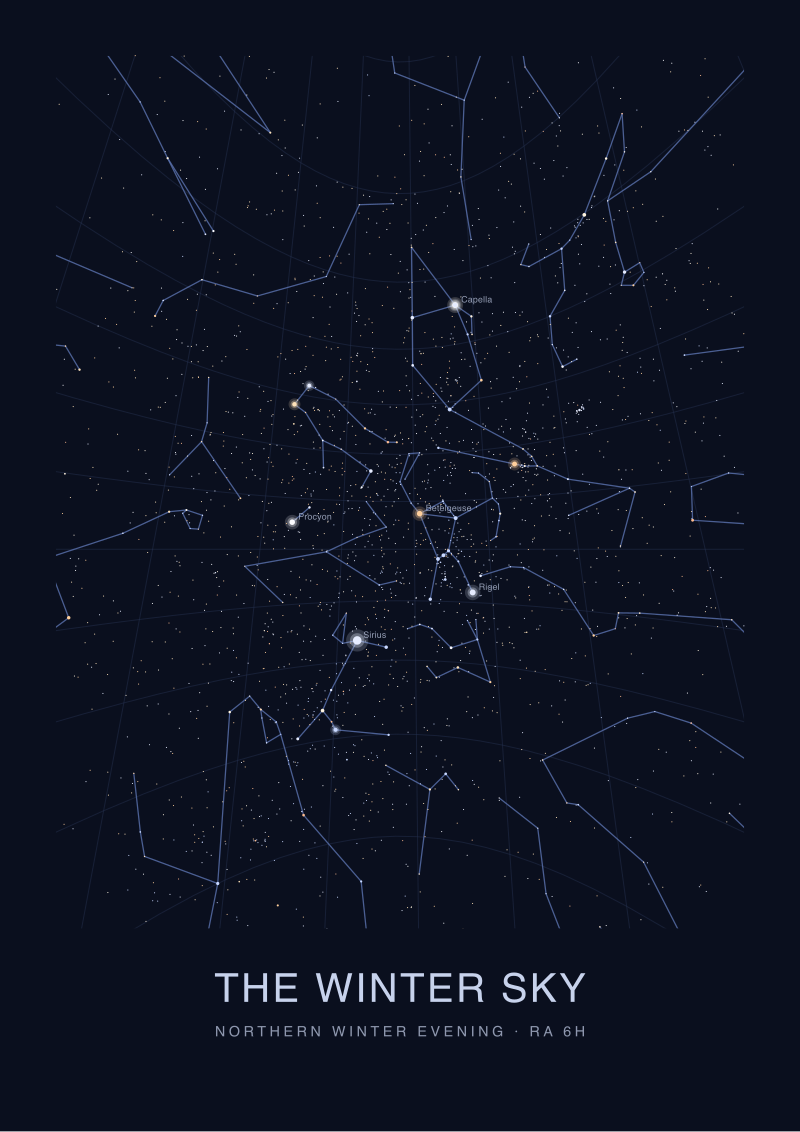 The Winter Sky
The print from this article · from €29.95
View the print →
The Winter Sky
The print from this article · from €29.95
View the print →
From the collection
New charts and 10% off your first print.
One email now with your code. No noise after.