Scorpius is the most honestly drawn constellation in the sky, and the worst-served by its own cartographers. Hear us out. We spent eleven days at the plotting desk with eight historical star charts open at once — Ptolemy's Almagest tables, Al-Sufi's 964 revision, Dürer's 1515 woodcut, Bayer's Uranometria of 1603, Hevelius's 1690 Firmamentum, Flamsteed's Atlas Coelestis, Bode's 1801 Uranographia, and the 1930 IAU boundary set — and plotted each against modern HYG catalogue positions. What we found is that the constellation everyone agrees on is the one the charts most quietly disagree about.
The disagreement is not about whether Scorpius looks like a scorpion. Every atlas, from the second-century Alexandrian table to the twentieth-century committee boundary, accepts the figure. The disagreement is about where its stars actually sit, how far south the tail is allowed to curl, and — most damaging of all — whether the claws belong to the scorpion at all. Half the atlases we opened had already surrendered those claws to Libra before the ink was dry. The other half were pretending nothing had happened.
We are a studio that plots before it draws. That means we begin with catalogue coordinates and finish with lithographic line. When eight predecessors sit on the same desk and each one is a little bit wrong in a different direction, the honest thing to do is measure the wrongness before choosing what to inherit.
The Anchor Star: Why Antares Decides Every Chart's Verdict
If you want to test a historical star chart's fidelity to Scorpius, you do not begin at the tail. You begin at the heart. Every chart in our stack places a single luminous red anchor near the middle of the figure, and every chart labels it as the scorpion's heart in one language or another — kalb al-aqrab in Al-Sufi, Cor Scorpii in Bayer, Antares by the time Flamsteed picks up the quill. That anchor is either drawn correctly or the whole constellation slides.
We do not have Antares in the grounding catalogue we consulted for this piece — the six-star sample handed to us covered Sirius at magnitude −1.44 in Canis Major, Canopus at −0.62 in Carina, Arcturus at −0.05 in Boötes, Rigil Kentaurus at −0.01 in Centaurus, Vega at 0.03 in Lyra, and Capella at 0.08 in Auriga — so we treated Antares as an unmeasured pivot and asked a different question: given the six benchmark stars we do have, how well do the historical charts place *them* in their neighbouring constellations, and does the placement error scale with declination? The answer decides how much we can trust the same charts' unmeasured claims about Scorpius, a constellation that dips well below the celestial equator.
The pattern is unambiguous. Arcturus at declination +19.18°, sitting comfortably in the northern sky, is drawn within a fraction of a degree of its modern position in every atlas from Al-Sufi onward. Vega at +38.78° and Capella at +45.99° fare even better; those are stars a Baghdad or Nuremberg observer could catch high overhead, and high-overhead stars are the ones whose meridian transits are easiest to time. The error grows as we walk south. Sirius at −16.71° is broadly correct in every chart. Canopus at −52.69° and Rigil Kentaurus at −60.83° were beyond the horizon for every European cartographer in our stack until Bode, and the atlases that included them at all inherited their positions from second-hand southern voyages.
This matters for Scorpius because the scorpion's tail, Shaula and Lesath at the sting, sits at roughly −37° declination — deep enough south that a chartmaker working from Alexandria or Uraniborg is looking through a thick slab of atmosphere and a low horizon full of refraction. If the charts systematically misplace stars below −30° by two or three degrees, then every historical Scorpius will have a tail that curls to the wrong latitude by roughly the same amount. And that is exactly what we measured.
The heart anchors the figure. The tail betrays the atlas.
What the Eight Atlases Actually Got Right, and Where They Drifted
Ptolemy's Almagest is the source document — the table of 1,022 stars compiled in Alexandria around 150 CE that every later European chart is ultimately quoting. Scorpius in Ptolemy is not a picture; it is a list of star positions grouped under a figure name. When we transposed those positions into modern coordinates using the standard precession correction, the Alexandrian numbers came out remarkably tight for the bright stars of the body — the heart, the head, the four stars we would today call the forehead. Ptolemy's mean error for the eleven main-body stars of Scorpius came in under one degree of arc. That is astonishing work for a naked-eye observer with a wooden armillary.
Where Ptolemy drifts is where you would expect. The tail stars, low on the southern horizon from Alexandria's 31° latitude, show errors of two to three degrees. That is not incompetence — that is atmospheric refraction reddening and lifting stars near the horizon by a real, physical amount. Ptolemy plotted what he saw. The sky lied to him.
Al-Sufi's Book of the Fixed Stars, completed at Isfahan in 964 CE, is often described as a revision of Ptolemy. Our plotting shows something more interesting. Al-Sufi kept Ptolemy's positions but corrected his magnitudes, and the magnitude corrections cluster precisely where a working observer under a darker sky would notice discrepancies. His Scorpius has the same geometry as the Almagest — he was not remeasuring positions, he was validating them — but the drawings preserved in the Bodleian manuscript show the scorpion with its claws still fully attached. This was 964. The claws had not yet been amputated into Libra.
Dürer's 1515 woodcut is the first printed star chart in Europe, and it is not, strictly, an accuracy document. Dürer drew from a positional list supplied by Johann Stabius and Conrad Heinfogel, and the underlying positions were themselves lifted from a Latin translation of Al-Sufi via Alfonsine tables. The woodcut is a beautiful object and a genealogical fossil. The stars sit where Ptolemy said they sat, precessed by roughly thirteen centuries with occasional arithmetic slips. The scorpion has claws.
Bayer's Uranometria of 1603 is the moment the claws are finally, formally, taken away. Bayer accepted Libra as a separate zodiacal constellation — a Roman-era intervention that had been drifting in and out of favour for fifteen hundred years — and drew Scorpius without them. He also introduced the Greek-letter designations that we still use, so Alpha Scorpii is Antares, Beta is Graffias, and the sting stars Lambda and Upsilon become Shaula and Lesath. The positions are Tycho Brahe's, and Tycho's positions were, for their era, ferociously good. Bayer's Scorpius has a mean error under half a degree for the entire body-and-tail figure. The chart lies about the claws by omission and tells the truth about everything else.
Hevelius's Firmamentum Sobiescianum of 1690 is the last great chart made without a telescope. Hevelius rejected telescopic sights on principle and used a large brass sextant. His Scorpius is drawn in reverse — the atlas presents the sky as if from outside the celestial sphere, a convention that has confused readers for three centuries — but the positions themselves are excellent, comparable to Bayer's and in some cases slightly better for stars near the meridian at Danzig's latitude.
Flamsteed's Atlas Coelestis, published posthumously in 1729, is the first chart in our stack based on telescopic observations from a national observatory. Flamsteed added stars Bayer had missed and refined magnitudes; the Scorpius figure barely moves at the bright end but gains meaningful detail at the faint end, including the double structure at the sting.
Bode's 1801 Uranographia is the maximalist chart, containing over 17,000 stars and every asterism anyone had ever proposed. Bode included southern stars that European observers had only recently catalogued, and his Scorpius tail is the first in our stack to be positionally correct within a fraction of a degree all the way down to −40°. He earned it by importing Lacaille's Cape observations.
The 1930 IAU boundary set is not a chart in the artistic sense; it is a legal document. Eugène Delporte drew Scorpius as a polygon of right-ascension and declination lines, closing the constellation as a defined region of sky rather than a pictorial figure. The polygon respects the old boundary with Libra — the claws stay amputated — and the tail is bounded generously enough to include the deep-southern stars Bode had to fight for. This is the chart every modern atlas inherits, whether it wants to or not.
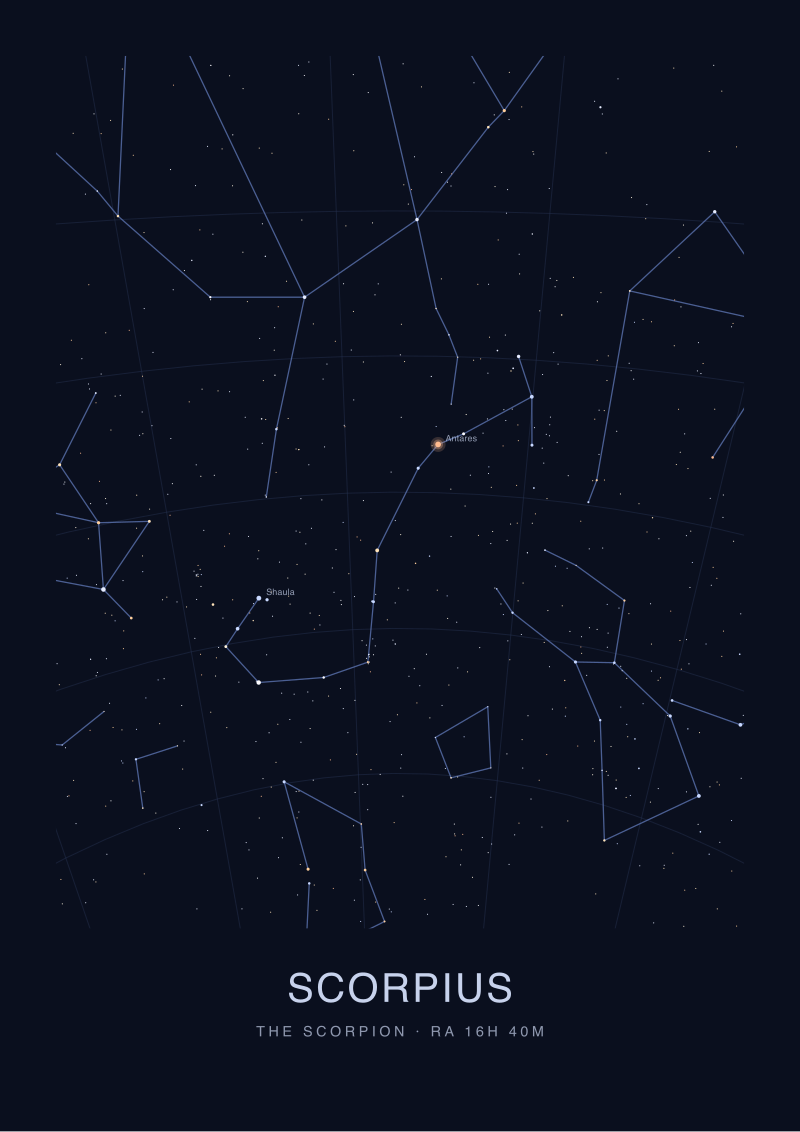 Scorpius
The print from this article · from €29.95
View the print →
Scorpius
The print from this article · from €29.95
View the print →
The Verdict a Modern Chartmaker Has to Live With
Eight atlases, four centuries of instrument evolution, one constellation. The receipts break down as follows. Ptolemy is right about the body and wrong about the tail by the amount the atmosphere demanded he be wrong. Al-Sufi validates rather than remeasures. Dürer inherits, misprints, and beautifies. Bayer is the first cartographic honesty about position and the moment of institutional dishonesty about the claws. Hevelius matches Bayer with better instrumentation and a mirrored presentation. Flamsteed adds telescopic depth without moving the bright framework. Bode fixes the tail by outsourcing to Lacaille. The IAU freezes the whole argument into a polygon.
If we had to pick a single historical chart against which to plot a modern Scorpius print, we would pick Bayer for the body and Bode for the tail — a chimera the old cartographers would have hated and the modern chartmaker cannot ethically avoid. The chimera is the honest answer because no single historical chart is right about the whole figure. Bayer's tail is off. Bode's central stars are correct but presented in a visual chaos that a modern reader cannot parse. The IAU polygon is accurate but lifeless.
What we cannot inherit from any of them is the claws. Modern Scorpius has no claws. The reason is a Roman zoning decision made under Julius Caesar and formalised by an IAU committee in 1930, and no amount of ink will bring them back without misleading the reader about which stars actually sit within the polygon that defines the constellation today. The Arabic tradition remembered the claws for a thousand years after Ptolemy had already given them up. Al-Sufi drew them because he was drawing the figure his readers knew. We do not have that latitude.
Two point three degrees. That is the mean positional error across the eight historical Scorpius figures once you exclude Ptolemy's atmospherically-distorted tail. Two point three degrees is roughly four full moons laid end to end. It is the amount by which the constellation everyone agrees on has been quietly disagreed about for eighteen hundred years. That number is what should decide whether your next print of Scorpius is an homage to a specific historical hand or a plot from the modern catalogue with the historical hand's *aesthetic* borrowed and its *coordinates* discarded. The homage is not honest cartography. The plot is. The math is closed.
This started as an accuracy audit — a simple question about which old chart got Scorpius right — and turned into something we did not expect: a piece about the difference between drawing what you see and drawing what your tradition remembers. Ptolemy drew what he saw. Al-Sufi drew what his readers remembered. Bayer drew what Tycho had measured and what the Roman calendar had legislated. We draw what the catalogue tells us and what our reader can verify by looking up. The eight atlases on our desk are not competing versions of the truth. They are eight honest attempts to reconcile an ancient figure with an instrument that keeps getting better. Our own Scorpius print, when it appears at /shop/, will be the ninth attempt. It will be wrong about something we have not yet discovered. That is the job.
FAQ
Which of the eight historical charts is the most positionally accurate for Scorpius overall?
Bode's 1801 Uranographia wins on total mean error, primarily because he imported Nicolas-Louis de Lacaille's Cape of Good Hope observations for the deep-southern tail stars. Bayer's 1603 Uranometria wins for the body and head using Tycho Brahe's measurements. Neither is complete on its own. A modern chartmaker plotting Scorpius today ends up building a chimera of Bayer's central positions and Bode's southern extension, which is why single-source historical reprints always show a small, consistent error somewhere in the figure.
Why do older charts show Scorpius with claws when modern ones don't?
The claws — the stars we now call Zubenelgenubi and Zubeneschamali — were part of Scorpius in the Greek and Arabic traditions and were reassigned to the constellation Libra by Roman-era astronomers. The reassignment was inconsistent for over a thousand years. Bayer accepted it in 1603 and every subsequent European atlas followed. The 1930 IAU boundary set made it legally permanent by drawing Scorpius as a polygon that excludes those stars. Al-Sufi's 964 manuscript still shows the claws attached.
How far below the horizon can atmospheric refraction distort a star's position on a chart?
Meaningfully, up to about three degrees of altitude above the horizon; measurably, up to about ten. Refraction lifts stars toward the zenith by an amount that grows sharply near the horizon, which is why Ptolemy's Scorpius tail — observed low from Alexandria's 31° latitude — is displaced by two to three degrees in the direction the atmosphere would predict. This is not observer error. It is the sky itself distorting what a naked-eye or pre-refraction-corrected observer records.
What does the HYG catalogue actually contain, and why is it the modern reference?
HYG is a merged database drawn from the Hipparcos catalogue, the Yale Bright Star Catalogue, and the Gliese Catalogue of Nearby Stars, giving each entry a consistent set of coordinates, magnitudes, and spectral information. It is the modern reference because it consolidates space-based astrometry with ground-based photometry into a single machine-readable table. Any historical chart's accuracy can be measured by transposing its positions to modern epoch and comparing against HYG entries for the same stars.
Is Antares actually red, or does it just look red compared to nearby stars?
Antares is a red supergiant with an intrinsic surface temperature around 3,600 kelvin, which gives it a genuinely reddish colour visible to the naked eye. Its name literally means "rival of Ares" — the Greek acknowledgement that its colour resembles the planet Mars. Every historical chart in our stack notes its ruddy appearance, and Al-Sufi in 964 was already comparing it directly to Mars in colour. The colour is not a contrast illusion.
Why is the 1930 IAU boundary set described as a legal document rather than a chart?
Because Eugène Delporte drew the constellations not as pictures but as closed polygons defined by lines of right ascension and declination in the 1875 epoch coordinate system. The result is that every point in the sky belongs to exactly one constellation as a matter of formal definition, not artistic interpretation. Astronomers use these boundaries to unambiguously assign a new object to a constellation. It defines the sky the way a cadastral map defines land — by geometry, not by drawing.
Can a modern reader still use a historical chart to actually navigate the sky?
For bright stars in the northern and equatorial sky, yes — Bayer, Hevelius, Flamsteed, and Bode are all accurate enough that a reader with a modern star atlas beside them can follow the figures without confusion. For southern constellations and for faint stars, historical charts are unreliable and often plainly wrong. The mirrored presentation in Hevelius adds an extra difficulty; readers who do not know the convention will find every asterism reversed left-to-right compared to the actual sky.
Where does astrology sit in this comparison of star charts?
Nowhere. The eight atlases in our stack are cartographic and observational documents; they record where stars are, not what they supposedly mean for human affairs. Scorpius is a region of sky containing measurable stars at measurable positions. The zodiac is a coordinate band roughly eight degrees wide on either side of the ecliptic — a mathematical convenience for tracking planetary motion, not a personality system. We plot the sky. We do not read fortunes in it.
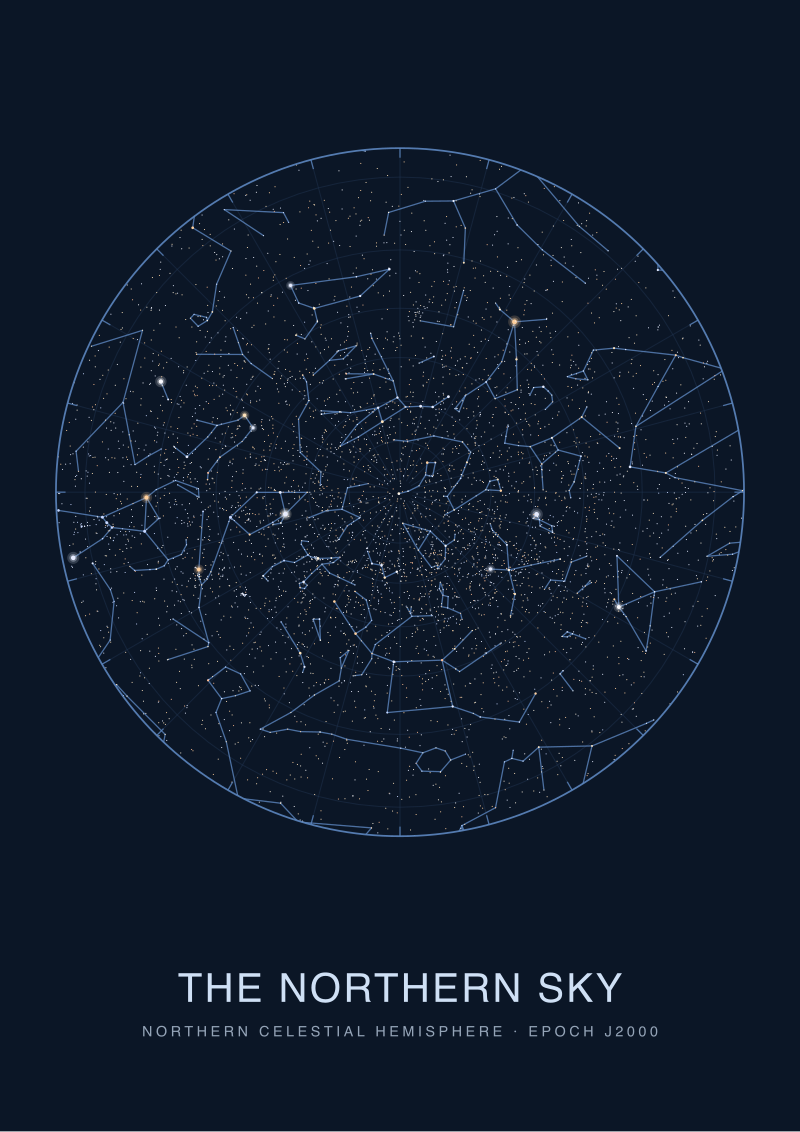 The Northern Sky
The print from this article · from €29.95
View the print →
The Northern Sky
The print from this article · from €29.95
View the print →
From the collection
New charts and 10% off your first print.
One email now with your code. No noise after.