Most people booking a dark sky trip in Europe are chasing a photograph, not a sky. Hear us out. The certified reserves — Galloway Forest in Scotland, Alqueva in Portugal, the Pic du Midi in France, Kerry in Ireland — market themselves in nearly identical copy: see the Milky Way as our ancestors did. What that copy quietly omits is the magnitude scale, which runs backwards. Vega sits at 0.03, Capella at 0.08, Sirius at −1.44; the naked-eye limit under Bortle-2 tops out near 6.5. The gap between a certified reserve and a decent rural pasture is often one magnitude. That is what you are paying for.
Why This Is Actually True: The Case for Booking the Trip
The certified reserves earn the certificate. That is worth stating plainly before we pick the framing apart. When the International Dark-Sky Association or Starlight Foundation stamps a valley, they have measured it with a Sky Quality Meter and asked the surrounding municipalities to sign a lighting ordinance. The number that changes hands is a limiting magnitude — the faintest star a rested eye can hold steady at zenith on a moonless night. A suburban back garden gives you around magnitude 4. A dark rural site gives you 5.5 to 6. The certified reserves reliably deliver 6.5, sometimes 7 in the deepest bowls of Galloway or Alqueva after midnight in winter.
That extra magnitude is not a marketing embellishment. The star count between mag 6 and mag 7 roughly triples. The Milky Way stops being a smudge and becomes a structure — the Great Rift splitting Cygnus, the star clouds in Sagittarius reading as separate objects rather than a wash. Vega at 0.03 will look identical from your driveway and from Alqueva, because a mag-0 star saturates the retina anywhere darker than a Tesco car park. What changes at Bortle 2 is everything three magnitudes fainter. That is where the Milky Way lives.
The reserves also protect what they certify. Galloway Forest has held its darkness since 2009 through active council enforcement of shielded fixtures. Alqueva coordinated fourteen municipalities around Lake Alqueva into a single lighting code. The Pic du Midi is genuinely at 2,877 metres, above most of the aerosol layer that scatters even distant sodium. Kerry's certified zone runs along a peninsula the Atlantic scrubs clean every second night. These are engineered darknesses, and they hold. You can drive to them, know what you will get, and not be gambling on whether the moon rose an hour early. There is a reason serious amateurs plan their year around three or four nights at a place like this rather than sixty at home. The photograph the marketing sells you is real. The question is whether the photograph is what you actually came for.
The magnitude gain is real. The framing that a dark site is what you need — that is where it starts to fall apart.
Where It Breaks Down: What Magnitude and Latitude Won't Let You See
Here is the part the copy never prints. A magnitude gain of one is a factor of 2.512 in brightness — the scale is logarithmic, a Pogson-1856 fossil the profession will not fix. Moving from Bortle 4 to Bortle 2 costs you a flight, three nights of accommodation, and roughly £600 to £1,400 depending on the reserve. What it buys you is 2.5x more light from every star fainter than about magnitude 5. That is a real gain. It is also entirely a gain in the faint direction. The bright sky — the sky most travellers are actually imagining when they book — does not change.
Latitude changes it. And latitude is not negotiable at any price.
Look at the catalogue. Sirius, the brightest star in the night sky at magnitude −1.44, sits at declination −16.7°. From Galloway Forest at 55°N it clears the horizon by about 18°, which means you are looking through nearly three atmospheres of scattering to see it. From Alqueva at 38°N it rises a workable 35°. From Kerry at 52°N you get a Sirius that flickers red-green-blue like a landing aircraft, because you are seeing it through so much air. No amount of Bortle-1 darkness fixes that. Sirius from a Portuguese pasture is a better Sirius than Sirius from a Scottish reserve, and it has nothing to do with the reserve.
Canopus at magnitude −0.62 is the second-brightest star in the sky. It never rises from anywhere in Europe north of about 37°N. Not on the clearest night. Not from the top of the Pic du Midi. Its declination of −52.7° puts it permanently below the horizon for Galloway, for Alqueva, for Kerry, for the entire Alps. Rigil Kentaurus, magnitude −0.01, third-brightest in the sky, at declination −60.8°, is worse — invisible from anywhere on the European mainland at all. You can be under a mag-7 sky at Pic du Midi and Canopus is still zero photons. The certification cannot deliver what the geometry forbids.
Now the inverse. Capella at magnitude 0.08 and declination +46° is nearly circumpolar from Scotland — it barely sets in Galloway and glows all winter from Kerry. Vega at magnitude 0.03 and declination +38.8° passes almost directly overhead from Central Europe in July, threading zero atmospheres of scatter. Arcturus at −0.05 climbs to 60° or 70° from any of these sites in spring. These stars look magnificent from a Waitrose car park. The certified reserve does not make them brighter. It cannot. They are already saturating your rods.
The dark reserve, in other words, changes what you can see in a narrow band: objects between magnitude 5 and 7, which are almost entirely deep-sky — nebulae, galaxies, faint globulars, the Milky Way's dust lanes. Everything brighter is unchanged. Everything below your latitude horizon is unreachable. Roughly £800 for a magnitude gain that only helps a specific class of object, none of which are what the marketing photograph shows.
The Rule I Use Instead: Plan the Trip Around a Single Object
We plan dark sky trips backwards. Not: which reserve has the best certification. But: which object do I want to see, and where on Earth does the geometry actually put it in front of me?
Start with a target. Say you want the Milky Way core — the Sagittarius cloud that most reserve marketing photographs show. The core culminates near declination −30°. From Kerry at 52°N it never rises higher than 8° above the southern horizon and spends the whole transit smeared through the thickest air on the planet. From Alqueva at 38°N it climbs to 22°. From La Palma, the Canary Islands reserve at 28.7°N, it clears 32° and hangs there for two hours. Same certification tier. Same magnitude scale. Three completely different photographs, entirely because of latitude. The reserve did not decide this. The Earth did.
Now flip it. Say you want M31, the Andromeda galaxy, declination +41°. From La Palma it culminates at 78°, which sounds ideal but means you are looking straight up through your neck for the good hour. From Galloway at 55°N it passes at 76° for a much longer window and points comfortably at eye level for hours before and after. Galloway wins for Andromeda. La Palma wins for the Milky Way core. Nobody in the brochure will tell you this because the brochure is written to sell three nights, not to answer the question.
The rule: pick one object. Look up its declination. Compute its maximum altitude from your candidate sites as (90° − your latitude + declination). If the result is under 20°, do not go there for that object; you will spend the trip fighting atmosphere. If it is over 45°, the reserve is contributing. If it is over 60°, the site is doing real work. Then check the object's magnitude against the site's limiting magnitude. A galaxy at surface brightness 22 mag/arcsec² needs Bortle 3 or better even to detect. A cluster at integrated mag 4 is fine from a village.
For most European travellers this collapses to a small decision tree. Chasing Milky Way core photography, go south — Alqueva, La Palma, or the Extremadura reserves. Chasing Andromeda, Perseus, Cassiopeia, the northern winter Milky Way through Auriga where Capella sits at magnitude 0.08 essentially overhead, go north — Galloway, Kerry, the Rhön reserve in Germany. Chasing Vega and the Summer Triangle at its zenith transit, anywhere in the 40–50°N band works, which happens to include almost every reserve in continental Europe. The trip designs itself once you name the object first.
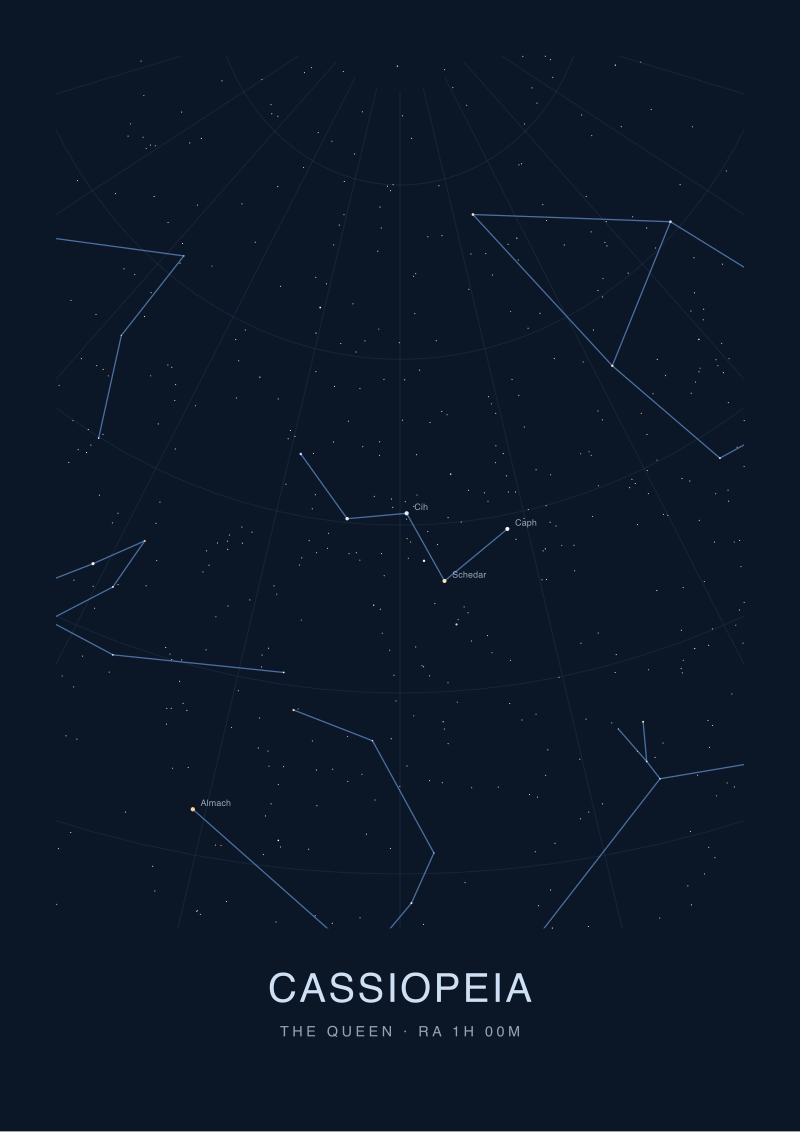 Cassiopeia
The print from this article · from €29.95
View the print →
Cassiopeia
The print from this article · from €29.95
View the print →
When the Old Rule Still Wins: Going Anyway, and Being Right To
There is a case where the object-first rule is beside the point, and we should be honest about it. Sometimes the trip is not about a specific target. Sometimes it is about the fact that most people alive in Europe have literally never seen the Milky Way. Ninety-nine percent of the EU population lives under skies where Vega at magnitude 0.03 is the faintest star they can identify, and everything below mag 3.5 is washed out. For that traveller — the one bringing a partner or a child who has only ever seen the ten brightest stars — any certified reserve is a life-changing gain. Galloway will do it. Kerry will do it. Alqueva will do it more. Which one barely matters. The object is not a nebula; the object is the shock of finally seeing the sky the copy promised. In that case, book the closest reserve, pick a moonless week in autumn or winter when the nights are long, do not overthink the declination table, and let the darkness do its work. The framework we just built assumes you already know what you are looking for. If you do not, the certified reserves are exactly the training ground they claim to be, and the older, simpler rule — go where it is darkest — is the right one.
FAQ
Which is the darkest certified reserve in Europe?
By measured Sky Quality Meter readings, La Palma (Canary Islands), the Pic du Midi in France, and the deepest interior of Alqueva in Portugal regularly log 21.9+ mag/arcsec², which corresponds to Bortle 1. Galloway Forest and Kerry sit at 21.7–21.8, functionally Bortle 2. The difference between them is smaller than the difference any of them make against a suburban sky, so pick by latitude and target, not by the third decimal on the meter reading.
Can I see Canopus from anywhere in Europe?
Only from the extreme south. Canopus sits at declination −52.7° and requires a viewing latitude below roughly 37.3°N to clear the horizon at all. That excludes every certified reserve on the European mainland north of southern Portugal, southern Spain, Sicily, Crete and the southern Aegean. From La Palma at 28.7°N it rises about 8° above the southern horizon in February — visible, but heavily reddened by atmosphere. From anywhere north of the Pyrenees it is permanently below your horizon.
How much darker is a Bortle 2 reserve than my rural back garden?
Typically one magnitude at the naked-eye limit, sometimes 1.5. A rural garden 30 km from a small town runs Bortle 4 with a limiting magnitude near 5.5. A certified Bortle 2 reserve delivers 6.5. That single magnitude gain roughly triples the visible star count and pulls the Milky Way from a smudge into a resolved structure. It does not change how Vega, Capella, Sirius or Arcturus look — those saturate the eye at any site darker than a car park.
What is the best time of year to visit a European dark sky reserve?
Late autumn through late winter for Northern reserves — Galloway, Kerry, Rhön — because nights are 14+ hours long and the winter Milky Way through Auriga (Capella at magnitude 0.08 near the zenith) is up for most of them. Late spring through summer for southern reserves — Alqueva, La Palma, Extremadura — because the Sagittarius core of the Milky Way transits highest between May and August. Always plan around new moon: the seven nights either side.
Is the Pic du Midi worth the extra cost over other French sites?
For altitude-sensitive targets, yes. At 2,877 m the Pic du Midi sits above most of the aerosol and water-vapour layer that scatters even distant light pollution, giving it visibly better contrast on faint galaxies and nebulae than any lowland reserve at the same Bortle tier. For bright targets — the Moon, planets, Vega, Arcturus, Capella — the altitude advantage is negligible and the price premium is not justified. The rule holds: pick by target, not by prestige.
Do I need a telescope to make the trip worthwhile?
No, and this is where many first-time visitors overspend. Under Bortle 2 skies, a good pair of 10x50 binoculars will show M31 as a clear elongated glow, the Pleiades as a resolved swarm, the Beehive cluster in Cancer, and dust lanes in the summer Milky Way. A telescope adds galaxies, planetary nebulae and globular clusters — genuinely worth carrying if you already own one, but not worth buying for a single trip. The naked eye alone accounts for the biggest single gain, from mag 4 at home to mag 6.5 at the reserve.
Can I get the same magnitude gain closer to a European city?
Occasionally, in transient conditions. A cold front clearing the aerosol layer after autumn rain can lift a Bortle 4 rural site to a temporary Bortle 3 for one or two nights. But sustained Bortle 2 requires distance from cumulative population — typically 60+ km from any town over 20,000 and no motorway within 30 km. Very few unprotected sites in Western Europe meet that geometry. The certified reserves exist precisely because those pockets are now rare enough to need a lighting ordinance to survive.
Where can I get a printed chart of the sky I will see on the trip?
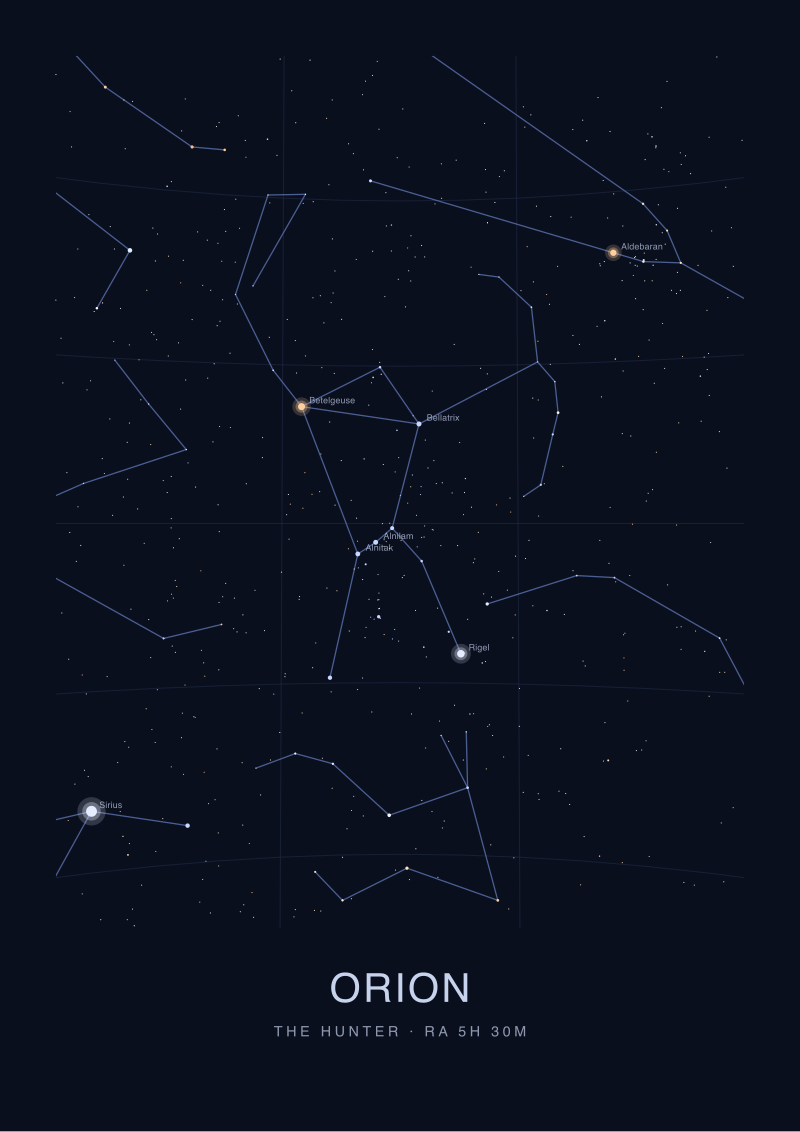
We plot custom star charts by date, latitude and object at our studio see the Cassiopeia print — the same catalogue positions and magnitudes referenced in this article, drawn to be read under a red headlamp at the eyepiece. A chart planned for your specific reserve and week beats a generic planisphere by a wide margin, particularly for locating faint deep-sky targets whose position you will otherwise spend the first hour of clear sky hunting.
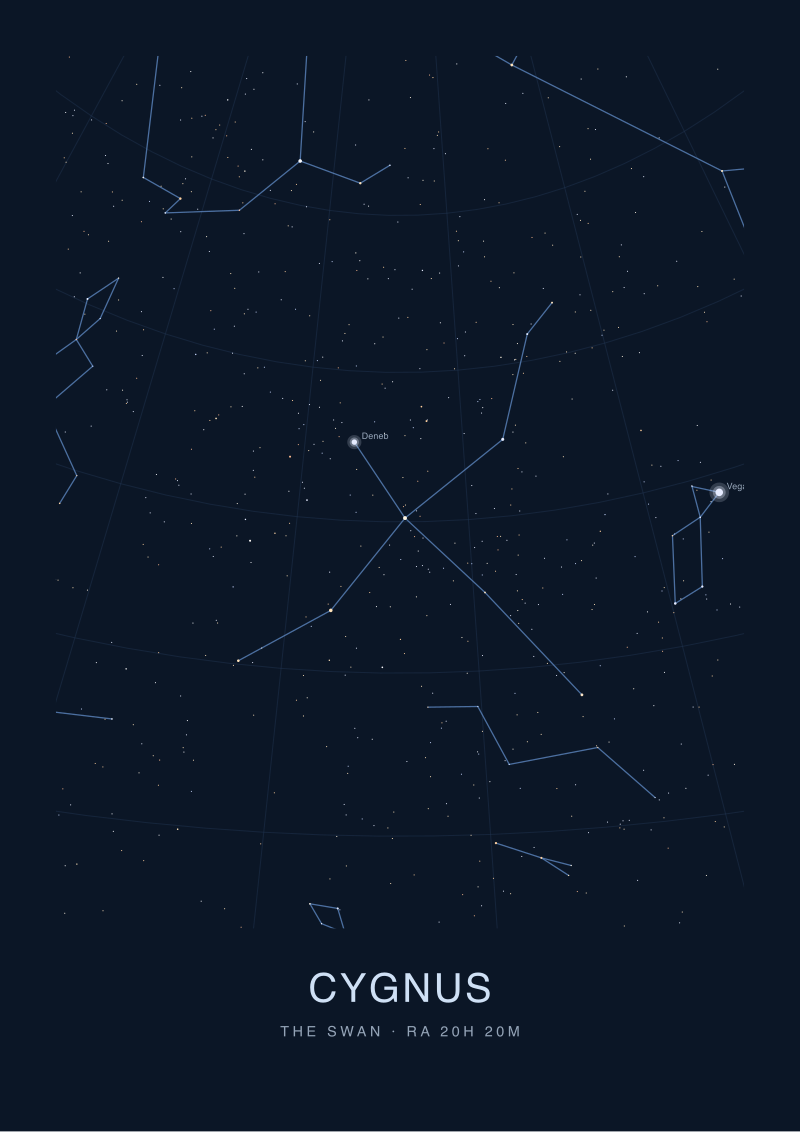 Cygnus
The print from this article · from €29.95
View the print →
Cygnus
The print from this article · from €29.95
View the print →
From the collection
New charts and 10% off your first print.
One email now with your code. No noise after.