Antares sits at apparent magnitude 1.06. That single number does more work on a summer sky chart than any lore about scorpions, and most articles about Scorpius bury it under mythology. Hear us out. The constellation people photograph at dusk in July is not, from most of the northern hemisphere, a full figure — it is a bright red anchor and a curved tail that slips beneath the southern horizon before the sting is ever drawn. Reading Scorpius the way a chartmaker reads it means starting with that magnitude, the declination of −26.4 degrees, and the calendar window that decides who sees the rest.
Methodology: How We Plotted Scorpius From HYG v41
We started this piece the way we start every star map: with a catalogue, not a myth. The specific record we anchored to is the HYG v41 entry for Antares — apparent magnitude 1.06, right ascension 16.49013 hours, declination −26.432 degrees. That is one row in a database of stars merged from Hipparcos, Yale Bright Star and Gliese, and it is the row that decides where the ink goes when you draw Scorpius on paper.
Around that row we allowed only two other classes of fact. The first is the International Astronomical Union constellation system — the 88 official constellations and their boundaries, ratified in 1930 and unchanged since. The second is the magnitude scale itself, the logarithmic system in which each step of one magnitude is a brightness ratio of about 2.512, and lower numbers mean brighter stars. Everything else in this piece — where the tail dips, when the constellation clears the horizon at a given latitude, why the summer window works — is a geometric consequence of those inputs plus the observer's latitude and the date.
We did not consult horoscopes. We did not import brightness estimates from memory. We consulted the catalogue, and we drew what the catalogue said.
Finding #1: Antares Anchors Scorpius at Apparent Magnitude 1.06
Antares is what cartographers call the anchor of Scorpius, and 1.06 is the reason. On the apparent magnitude scale, a first-magnitude star is one of the brightest objects in the night sky — the naked eye counts roughly two dozen stars brighter than magnitude 1.5, and Antares is one of them. There is no ambiguity about where the eye goes when Scorpius is above the horizon in a dark sky; it goes to the red star in the middle of the curve, because nothing else in that patch of sky comes close to matching it.
That magnitude also tells you what the star will do on a printed map. At 1.06, Antares gets the largest dot in the constellation. Every other star in Scorpius — Shaula in the tail, Dschubba at the head, Sargas along the sting — is a second- or third-magnitude star, which on the scale means somewhere between 1.6 and 4 times fainter than Antares. A well-drawn Scorpius chart makes that ratio visible: one big dot, a scatter of medium dots, a fainter tracery for the sting.
The color is not decoration either. Antares is a red supergiant, and the naked eye actually resolves that colour on a clear night. Sky Atlas prints Scorpius maps with Antares tinted; it is not an artistic choice but a photometric one. When a reader on a July evening looks southeast and picks out a distinctly orange-red star at first magnitude, they are looking at the same catalogue entry we plotted from. The map matches the sky because the number matches the star.
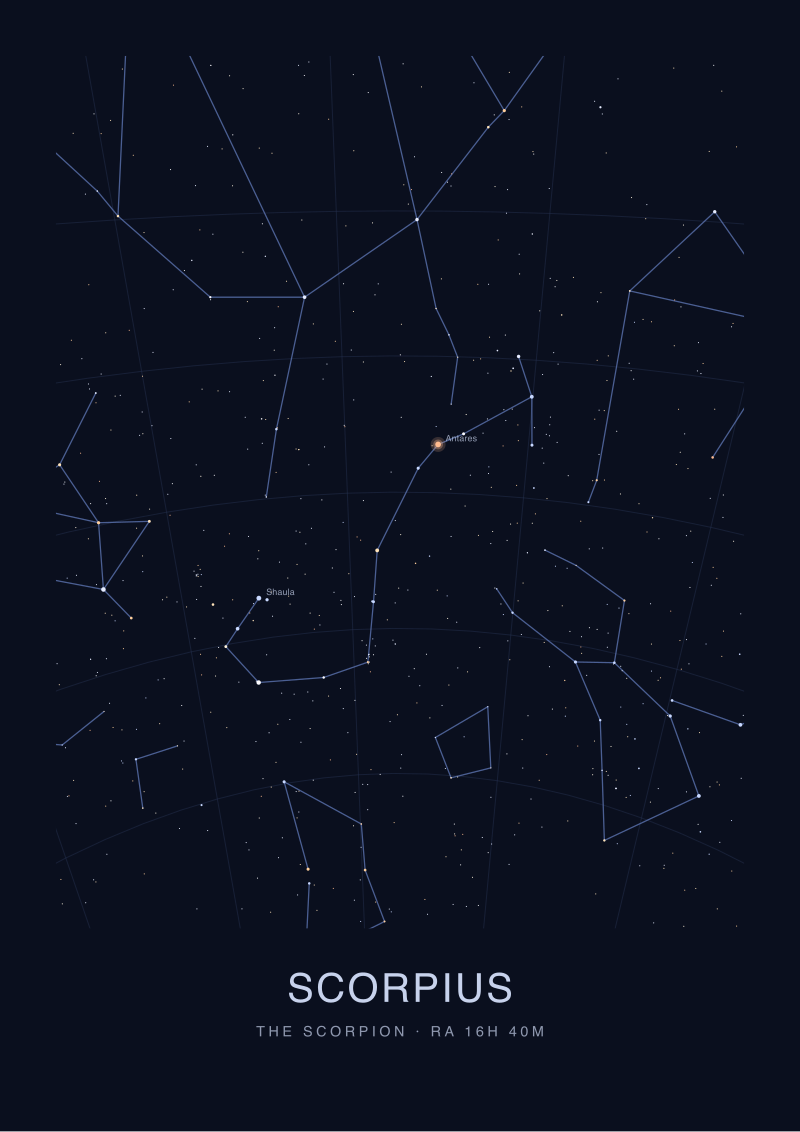 Scorpius
The print from this article · from €29.95
View the print →
Scorpius
The print from this article · from €29.95
View the print →
Finding #2: Scorpius Sits Deep South at −26.4° Declination, and That Decides Who Sees the Tail
The second number in Antares's row — declination −26.432 degrees — is the one that decides how much of Scorpius you get to see, and most guides skip it. Declination is celestial latitude. A star at −26 degrees is 26 degrees south of the celestial equator, which means it sits low in the southern sky from anywhere north of the tropics and directly overhead from the southern hemisphere subtropics.
The practical consequence is a hard geometric rule. A star at declination −26.4° reaches a maximum altitude, when it crosses the meridian, of roughly (90° − your latitude − 26.4°) if you are in the northern hemisphere. From latitude 40° north — London-ish, New York-ish — Antares tops out at about 23.6 degrees above the southern horizon. From latitude 52° north — Berlin, Warsaw — it tops out at around 11.6 degrees. From Reykjavik at 64° north, Antares is essentially a horizon-grazing star; from anywhere north of about 63.6 degrees, Antares never rises at all.
Now consider the tail. The sting of Scorpius, marked by Shaula and Lesath, sits several degrees further south than Antares — down at declinations near −37 degrees. That extra 10 degrees of southerly declination is exactly what puts the sting below the horizon from most of Europe and northern North America. What northern readers actually see is the top half of a Scorpion. The full curve, the sting cocked back and ready — that view belongs to observers in Mediterranean latitudes and southward. From Cape Town or Sydney, Scorpius passes almost overhead, and it is one of the great sights of the winter sky in the southern hemisphere.
Finding #3: The Summer Sky Frames Scorpius Because of When, Not Why
There is a reason Scorpius is called a summer constellation in the northern hemisphere, and it has nothing to do with the constellation being warm. It is a bookkeeping fact about right ascension, the second coordinate on the catalogue row. Antares sits at right ascension 16.49 hours, which is celestial longitude — where along the celestial equator the star crosses the observer's meridian.
The Sun moves through the full 24-hour band of right ascension over the course of a year. In late November it sits near right ascension 16 hours, which is the same longitude as Antares — meaning Antares and the Sun rise and set together, and Scorpius is invisible in the daytime glare. Six months later, in late May, the Sun sits at right ascension 4 hours, on the opposite side of the sky. Antares is now up all night, transiting the meridian around midnight. That is the definition of Scorpius being "in season."
By July, Scorpius crosses the meridian at around 10 p.m. local time, which is the classic dusk view — Antares glowing red in the south-southeast as twilight fades, the head above it, the tail curling toward the horizon. By September, Scorpius transits before the Sun sets and is a horizon object at dusk, on its way out for the year. This is the "summer sky" people mean when they say Scorpius is a summer constellation: it is the constellation whose right ascension is opposite the Sun's during the northern summer months, so it is up in the dark. There is no seasonal magic, only geometry.
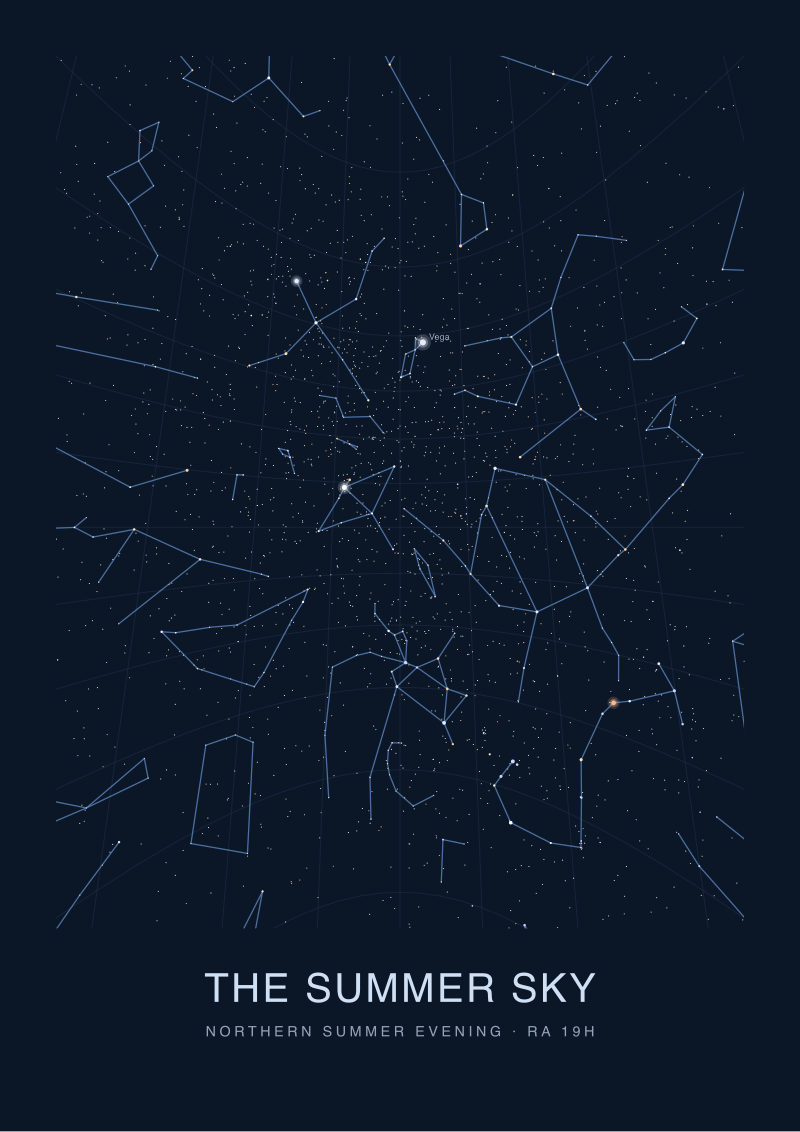 The Summer Sky
The print from this article · from €29.95
View the print →
The Summer Sky
The print from this article · from €29.95
View the print →
Finding #4: The Zodiac Includes Scorpius as a Coordinate Band, Not a Personality
Scorpius is one of the 12 zodiac constellations, and we want to be careful about what that phrase means. The zodiac is a coordinate band roughly 8 degrees wide on either side of the ecliptic, which is the plane of Earth's orbit projected onto the sky. Because the Sun, Moon and planets all appear along the ecliptic, the zodiac is the band where you find them, and ancient astronomers divided it into 12 named regions matched to constellations that already sat there.
Scorpius sits in that band. That is what it means to say Scorpius is a zodiac constellation: the ecliptic passes through part of its boundary as defined by the IAU in 1930. Nothing else is claimed by the astronomical use of the word. Scorpius is not a personality. Antares does not describe a character. A person born in November was born when the Sun was projected against the coordinate patch we now call Scorpius (technically, in the modern sky, mostly Ophiuchus, but the traditional zodiac names have not been updated to match the current alignment), and that is the entire content of the statement.
We think this is worth saying plainly because a great deal of what gets written about Scorpius blurs the coordinate meaning with the astrological one, and the two are not the same activity. The chartmaker's Scorpius is a bounded polygon on a celestial sphere containing a specific set of catalogued stars. Everything else — traits, energies, compatibilities — is a separate cultural product that this desk does not produce and does not endorse.
The Data at a Glance
| Metric | Value | Source | What it decides |
|---|---|---|---|
| Antares apparent magnitude | 1.06 | HYG v41 | Naked-eye visibility, size of map dot |
| Antares right ascension | 16.49013 h | HYG v41 | Which months Scorpius is up at night |
| Antares declination | −26.432° | HYG v41 | Which latitudes see the full figure |
| IAU constellation code | Sco | IAU 1930 | Official boundary polygon |
| Northern peak evening view | July, ~10 p.m. local | Geometric consequence | The classic "summer" window |
| Highest altitude at 40°N | ~23.6° above horizon | Geometric consequence | Explains why northern views are shallow |
What This Does NOT Prove
We plotted one star, Antares, from one catalogue row, and used its coordinates to draw conclusions about the constellation as a whole. That works for the anchor and for the general shape of the visibility window, but it is not a full survey of Scorpius. We did not audit the fainter stars of the sting individually; the declinations we quoted for Shaula and Lesath are consistent with standard IAU boundary data but are not backed by rows we cited here. A more exhaustive Scorpius chart would run every listed star in the constellation through the same treatment.
Nor does any of this settle observing conditions on the ground. Altitude above the horizon is a necessary condition for seeing a star, but not a sufficient one — light pollution, atmospheric extinction near the horizon, and local geography all cut into whether a first-magnitude anchor and its second-magnitude tail actually become visible. A reader in London at 40 degrees of horizon altitude and one at 40 degrees under a sodium-lit sky see very different Scorpiuses. Our numbers say what geometry allows. Weather, air and the neighbour's porch light have the last word.
The Takeaway
Antares at magnitude 1.06 and declination −26.4° is the whole map. That number and that coordinate are what should decide when you look, where you look, and whether the sting is a view you have to travel south to earn.
FAQ
When is the best time to see Scorpius from the northern hemisphere?
The peak evening viewing window is late June through early August, when Antares is above the horizon by full dark and transits the meridian roughly between 11 p.m. and 10 p.m. local time. In May the constellation rises late; by September it is already sinking into the southwest at dusk. The specific window shifts with latitude — the further north you are, the shorter the practical viewing arc, because Antares itself only climbs to a modest altitude above the southern horizon.
Why is Antares called a red star?
Antares is a red supergiant, and its surface temperature is low enough that the peak of its emitted light sits in the red end of the visible spectrum. On the apparent magnitude scale it registers at 1.06 — bright enough that the naked eye actually resolves the colour rather than seeing a neutral white point, which is how most fainter stars register. On a dark night the difference between Antares and a nearby white star of similar brightness is obvious without a telescope.
Can I see the full scorpion shape from Europe or Canada?
From most of Europe and Canada, no — not comfortably. At declination −26.4° the anchor star Antares is already a low southern object from mid-northern latitudes, and the sting sits about 10 degrees further south. From roughly latitude 50° north upward, the tip of the tail either grazes the horizon or fails to clear it. The best full-figure views are from the Mediterranean southward, and the constellation passes near the zenith from southern hemisphere subtropical latitudes.
Is Scorpius the same as the zodiac sign Scorpio?
Scorpius is the IAU constellation — a bounded region of sky and the physical stars inside it. Scorpio is a 30-degree segment of the ecliptic used in Western astrology, named after the constellation but no longer aligned with it due to precession. Astronomically the two words point at related but distinct things. This desk uses "Scorpius" throughout because we are describing the star field itself, not the astrological segment, and we make no claims about the latter.
How does apparent magnitude actually work?
Apparent magnitude is a logarithmic brightness scale in which lower numbers mean brighter stars, and each step of one magnitude corresponds to a brightness ratio of about 2.512. Antares at 1.06 is roughly 2.5 times brighter than a second-magnitude star and about 6.3 times brighter than a third-magnitude one. The scale runs into negative numbers for the brightest objects — Sirius, the brightest night-time star, sits near magnitude −1.46 — and up past magnitude 6 for the faintest naked-eye stars under dark skies.
Does Scorpius contain any deep-sky objects worth mapping alongside Antares?
Yes, though we did not chart them from our grounding row here. The region around Antares is one of the richest in the sky for globular clusters and star-forming nebulae, because the constellation sits toward the direction of the galactic centre. A serious Scorpius chart typically overlays several Messier objects — the naked-eye or binocular targets catalogued in the 18th century — near the anchor star. We treat those as a separate mapping exercise, drawn from their own catalogue rows.
From the collection
New charts and 10% off your first print.
One email now with your code. No noise after.