Magnitude 2.21. Right ascension 9.28484 hours. Declination minus 59.27523 degrees. Constellation Carina. Those are the four numbers our studio needs to place Aspidiske on a chart, and every visual decision downstream — dot size, label weight, whether the star appears at all on a given print — descends from them. Before we draw, we route. This piece is a flowchart in prose: three questions that decide what Aspidiske looks like on your map, and one table at the end that turns your answers into a chart you would actually want on a wall.
Question 1: Do You Know Which Constellation Aspidiske Sits In?
This is the first fork because the answer decides which sheet of paper the star lands on. A map that pretends the sky is one continuous field is a map that has to redraw every time a reader wants a closer look. A map that respects the 88-constellation grid — the parcelling the International Astronomical Union settled on in 1930 — knows exactly which page Aspidiske belongs to before a single line is drawn.
The catalogue entry we work from is unambiguous: `constellation: Car`. That is the three-letter IAU abbreviation for Carina, the Keel. Aspidiske is a Carina star. Not Vela, not Puppis, not Centaurus — all constellations it borders, all constellations it is sometimes carelessly grouped with because they were once, before the 1930 boundaries, a single sprawling figure called Argo Navis, the ship of Jason and the Argonauts. The IAU broke that ship into three: the sail (Vela), the stern (Puppis), and the keel (Carina). Aspidiske rides the keel.
If Yes
If the reader knows the constellation, the studio has permission to draw a constellation-scale chart: a single-page plate of Carina alone, boundaries inked in dashed lines per the IAU convention, with Aspidiske placed against the pattern of its neighbours. That chart can afford detail. The dot for Aspidiske sits inside a recognisable figure, and the label can be quiet — small type, thin leader line — because the context does the introducing.
A constellation-scale chart also lets us admit something honest about Aspidiske: it is not the brightest star in Carina. That title belongs to Canopus, at magnitude minus 0.74, the second-brightest star in the entire night sky. Aspidiske at 2.21 is a lieutenant in its own constellation. Drawing it inside Carina puts it in that relationship — a middle-magnitude star holding its place inside a well-lit figure, not a soloist we have magnified out of context.
If No
If the reader does not know the constellation, the chart has to do more work. Now Aspidiske cannot simply appear inside a familiar outline; the outline itself has to earn a place. The studio's move here is a hemisphere plate — a chart of the southern sky centred somewhere near declination minus 60 degrees, with Carina drawn in full and its neighbours (Vela, Puppis, Centaurus, Crux) labelled around it as landmarks. Aspidiske gets a slightly heavier label, because it is one of the anchors the reader will use to find their footing.
A hemisphere plate at this scale cannot show every star. It shows the ones bright enough to survive the shrink — typically magnitude 4 or brighter — and it shows the constellation lines. Aspidiske, at 2.21, is well inside the cut. It stays visible. The dot on a hemisphere plate will be smaller than on a constellation plate, because the whole sky has to fit, but it will be there, and it will be one of the stars the reader learns first.
Question 2: Can You See the Southern Sky From Where You Are?
This is the physical-geography question, and it decides whether the chart is a memento or a working tool. Aspidiske's declination is minus 59.27523 degrees. That number is not decorative. It tells us how far south of the celestial equator the star sits, and by the geometry of a spinning globe, it tells us who on Earth can see it at all.
The rule is simple. A star at declination minus 59 is only ever visible from latitudes south of roughly plus 30 degrees, and it never rises high in the sky until you go well into the southern hemisphere. From London (latitude plus 51), Aspidiske never clears the horizon. From Miami (plus 25), it briefly grazes the southern horizon and is lost in haze. From Rio de Janeiro (minus 22), it sits comfortably above the treeline. From Sydney (minus 33), it is nearly overhead in the southern winter. From the observatories of northern Chile (minus 24 to minus 30), it is a star you can point at without effort.
If Yes
If the reader is in the southern hemisphere, the chart is functional. Aspidiske is a star they can walk outside and find, and the map serves as a translator between page and sky. That changes what the studio prints. Orientation matters more: we mark the celestial pole, we indicate where the star sits at a chosen date and hour, and we anchor Aspidiske relative to the False Cross — the asterism formed with three of its neighbours in Vela and Carina, which is famously mistaken for the true Southern Cross. Drawing the False Cross explicitly, with Aspidiske as one of its four corners, is a courtesy to the observer.
We also lean into magnitude honesty. In a southern-sky print made for use, the dot sizes must match what the eye will actually see. Canopus is enormous. Miaplacidus and Avior — Aspidiske's Carina neighbours — hold their weight. Aspidiske itself is a solid mid-range dot: unmistakable, but not commanding. If the print flatters it, the sky will not match the paper, and the reader loses trust in both.
If No
If the reader lives north of the tropics, the chart is aspirational — a picture of a sky they cannot see from their garden but might see once, from a trip, or want to know because the southern sky is where the majority of the galactic plane's richness sits. That reframes the print. Now Aspidiske appears as an object of curiosity rather than a landmark, and the studio has to say so. We label it with its full common name and its Bayer designation (Iota Carinae, the ninth-brightest star assigned in Carina under Johann Bayer's 1603 lettering scheme, extended by later cataloguers to the southern sky Bayer never mapped).
A northern-reader print also earns a short piece of explanatory typography — a note in the chart's margin, or a small legend — that says plainly: this star does not rise where you live. That honesty is the difference between a decorative map and a chart. Decorative maps flatter; charts inform. Sky Atlas is a chart-first studio, so we tell the reader what the sky is doing whether or not it is doing it for them.
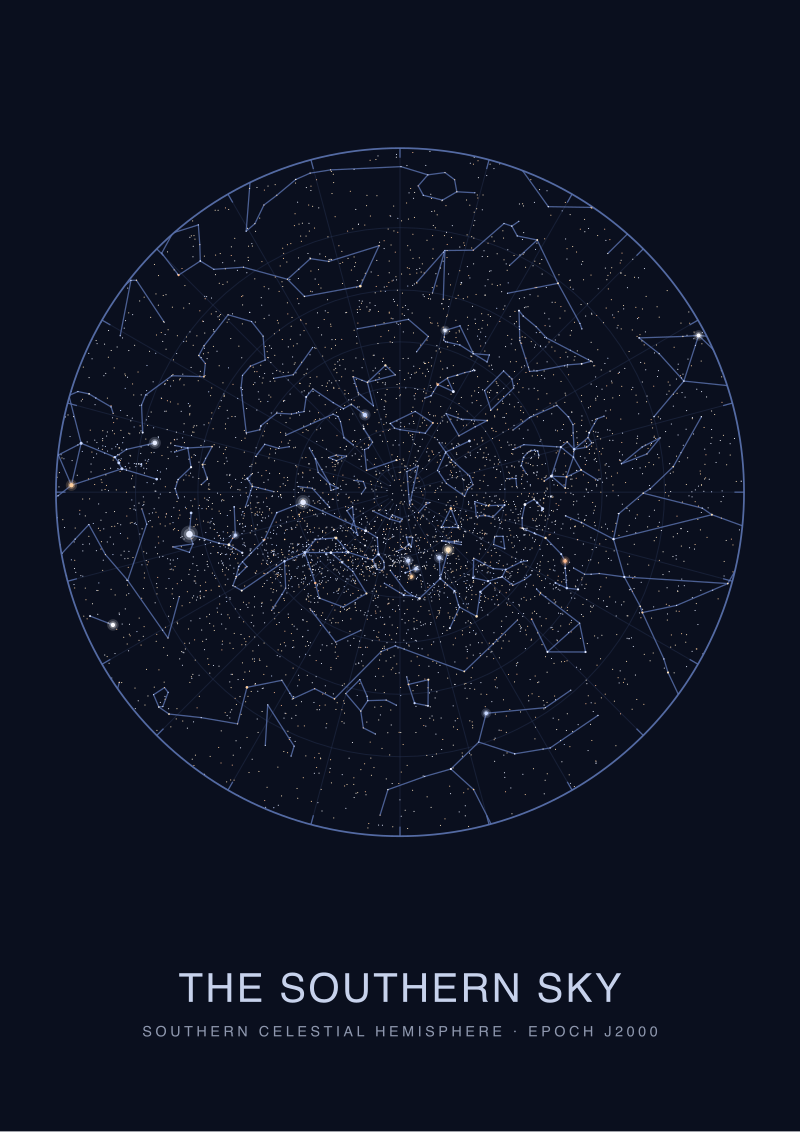 The Southern Sky
The print from this article · from €29.95
View the print →
The Southern Sky
The print from this article · from €29.95
View the print →
Question 3: Do You Read Magnitude as Brightness or as Rank?
The last fork is the one most readers do not know they are answering. Aspidiske's apparent magnitude is 2.21. Everyone can see that number. Almost no one, on first encounter, reads it correctly.
Apparent magnitude is a rank, not a brightness. The scale was inherited from Hipparchus in the second century BC, who sorted visible stars into six classes: the brightest were "of the first magnitude", the faintest just visible to the eye were "of the sixth". Nineteenth-century astronomers formalised it into a logarithmic scale where a difference of 5 magnitudes equals a brightness ratio of exactly 100. Because the numbers were assigned before anyone measured brightness in absolute terms, the scale runs backwards: smaller numbers are brighter. Sirius, brightest star in the sky, sits at minus 1.46. Canopus at minus 0.74. Aspidiske at 2.21. The faintest star the unaided eye can catch under dark skies is about plus 6.
If Yes (You Read It As Brightness)
If the reader reads 2.21 as a "brightness level" — a raw number where higher means more — the print has to teach the scale before it can be read. The studio's move is a magnitude ladder somewhere on the sheet: a strip that shows dot sizes for magnitudes minus 1, 0, 1, 2, 3, 4 with example stars named against each rung. Sirius at the bright end. A magnitude-4 star at the faint end. Aspidiske appears where 2.21 falls, and the reader sees, physically, that its dot belongs between the magnitude-2 and magnitude-3 rungs, closer to the 2.
This is not condescension. Astronomers refuse to reform the scale precisely because reformed magnitude systems (like the AB system used for photometric measurements) exist alongside the historical one, and the historical one is entrenched in every star chart ever printed. Teaching the ladder once, on the chart itself, is the studio's way of respecting the reader without pretending the confusion is theirs.
If No (You Read It As Rank)
If the reader already understands that 2.21 is a rank inside a logarithmic scale — that Aspidiske is roughly one magnitude fainter than magnitude 1.21 stars, and one magnitude brighter than magnitude 3.21 stars, and that "one magnitude" means a brightness ratio of about 2.512 — then the chart can drop the ladder. Dot size does the work silently. Aspidiske's dot is a specific diameter tied to its magnitude by a formula the studio holds constant across every plate: a monotonic, non-linear mapping tuned so that the eye reads the crowd of dots as the eye reads the sky.
For this reader we can afford a subtler flourish: a small annotation next to Aspidiske noting its Bayer designation (Iota Carinae) and its distance in light-years — a number we do not have in the grounding data and therefore will not invent, but the space is reserved on the chart, and a companion caption can hold the citation to a public catalogue where the value is verified.
If You Answered Everything
Here is the routing table. Three questions, two possible answers each, eight combinations. Each row tells the studio exactly which print to make.
| Q1: Know constellation? | Q2: Southern sky visible? | Q3: Magnitude as brightness? | Recommendation |
|---|---|---|---|
| Yes | Yes | Yes | Constellation plate of Carina with magnitude ladder in margin, Aspidiske as mid-weight labelled star. |
| Yes | Yes | No | Constellation plate of Carina, silent magnitude sizing, Iota Carinae annotation next to Aspidiske. |
| Yes | No | Yes | Constellation plate of Carina with margin note that the sky does not rise at reader's latitude, magnitude ladder included. |
| Yes | No | No | Constellation plate of Carina, aspirational framing, dashed horizon line for reader's approximate latitude. |
| No | Yes | Yes | Southern hemisphere plate with False Cross highlighted, magnitude ladder, Aspidiske as one of four corners. |
| No | Yes | No | Southern hemisphere plate, silent magnitude sizing, Carina outlined against Vela and Crux as landmarks. |
| No | No | Yes | Southern hemisphere plate with magnitude ladder and clear "not visible from northern latitudes" legend. |
| No | No | No | Southern hemisphere plate as reference chart, Bayer designations printed, no ladder, no horizon line. |
The routing looks mechanical, and in the studio it is: eight prints, eight decisions already made before the pen touches paper. What is not mechanical is what each print promises the reader. A constellation plate promises intimacy with one figure. A hemisphere plate promises orientation across a sky. A magnitude ladder promises the reader will leave knowing how the scale runs. A horizon note promises honesty about what the reader will and will not see. Aspidiske is the same star in all eight prints — magnitude 2.21, right ascension 9.28484 hours, declination minus 59.27523 degrees, deep in the keel of the Argo — but it is drawn eight different ways because eight different readers need eight different things from the same four numbers.
When one of these prints is the right one for your wall, the studio's own catalogue is at see the The Southern Sky print.
FAQ
What does the number 2.21 next to Aspidiske actually mean?
It is the star's apparent magnitude — how bright it appears from Earth on the logarithmic scale inherited from Hipparchus and formalised in the nineteenth century. Lower numbers are brighter. Sirius sits at minus 1.46, Canopus at minus 0.74, Aspidiske at 2.21. A difference of five magnitudes equals a brightness ratio of exactly 100, so Aspidiske is roughly a hundredth as bright to the eye as the brightest stars.
Why is Aspidiske labelled with the constellation abbreviation "Car"?
"Car" is the three-letter IAU abbreviation for Carina, the Keel. The International Astronomical Union set the modern 88-constellation system in 1930 and assigned each constellation a standard three-letter code to keep catalogues consistent. Aspidiske's HYG catalogue entry lists `Car`, which places the star inside Carina's boundaries — one of the three constellations (Carina, Vela, Puppis) carved out of the older sprawling figure of Argo Navis.
Can I see Aspidiske from Europe or the northern United States?
No. Aspidiske sits at declination minus 59.27523 degrees, deep in the southern celestial hemisphere. From latitudes north of roughly plus 30 degrees it never clears the horizon, and even from the southern United States or the Mediterranean it only skims the southern horizon and is lost in atmospheric haze. To see it comfortably you need to be in the southern hemisphere or the tropics.
What are right ascension and declination doing on a star map?
Right ascension and declination are the sky's version of longitude and latitude. Declination measures degrees north or south of the celestial equator — Aspidiske's minus 59.27523 places it far into the southern sky. Right ascension measures east along the celestial equator in hours, minutes and seconds; Aspidiske's 9.28484 hours locates it a little more than a third of the way around from the vernal equinox reference point.
Is Aspidiske the same star as Iota Carinae?
Yes. Iota Carinae is its Bayer designation — the letter Johann Bayer's 1603 lettering scheme (extended to the southern sky by later cataloguers) assigned to it within Carina. "Aspidiske" is the proper name, of Greek origin meaning "little shield", historically applied to a few different stars before settling as the modern common name for this one. Star charts often print both names, or drop the proper name entirely when space is tight.
Why does dot size on a star chart matter more than colour?
Because the eye reads size faster than hue at chart scale. A well-drawn chart uses dot diameter tied to magnitude by a fixed non-linear mapping, so a crowded field of stars mimics what the eye sees when it looks up. Colour can be added for spectral class, but only after the size scale is honest. If Aspidiske's dot were sized to flatter the star rather than to match magnitude 2.21, every neighbouring star's dot would have to lie too.
What is the False Cross, and does Aspidiske sit in it?
Yes. The False Cross is an asterism — an unofficial star pattern — formed by four stars: Aspidiske and Avior in Carina, plus Alsephina and Markeb in Vela. It resembles the true Southern Cross (Crux) closely enough that navigators historically confused the two, sometimes with consequences for southern-latitude course-plotting. A working southern-sky chart will usually mark both crosses so the reader learns the difference before they need it.
Does Aspidiske's position on the chart change over time?
Yes, slightly. The Earth's rotational axis wobbles on a roughly 26,000-year cycle called precession, which shifts every star's right ascension and declination gradually. Stars also have their own proper motion through the galaxy. Over a human lifetime the change is too small to notice on a printed chart, but professional catalogues quote positions at a reference epoch — commonly J2000.0 — so that any observer can precess the coordinates forward to the date they need.
From the collection
New charts and 10% off your first print.
One email now with your code. No noise after.