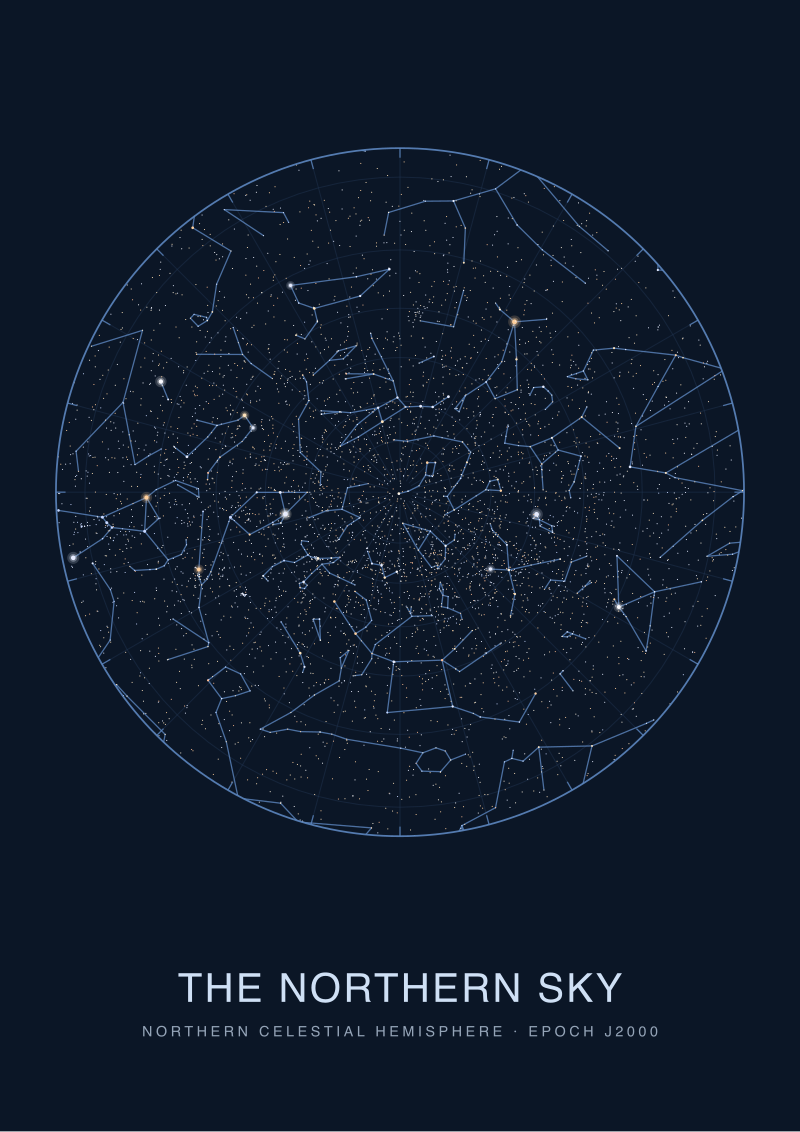
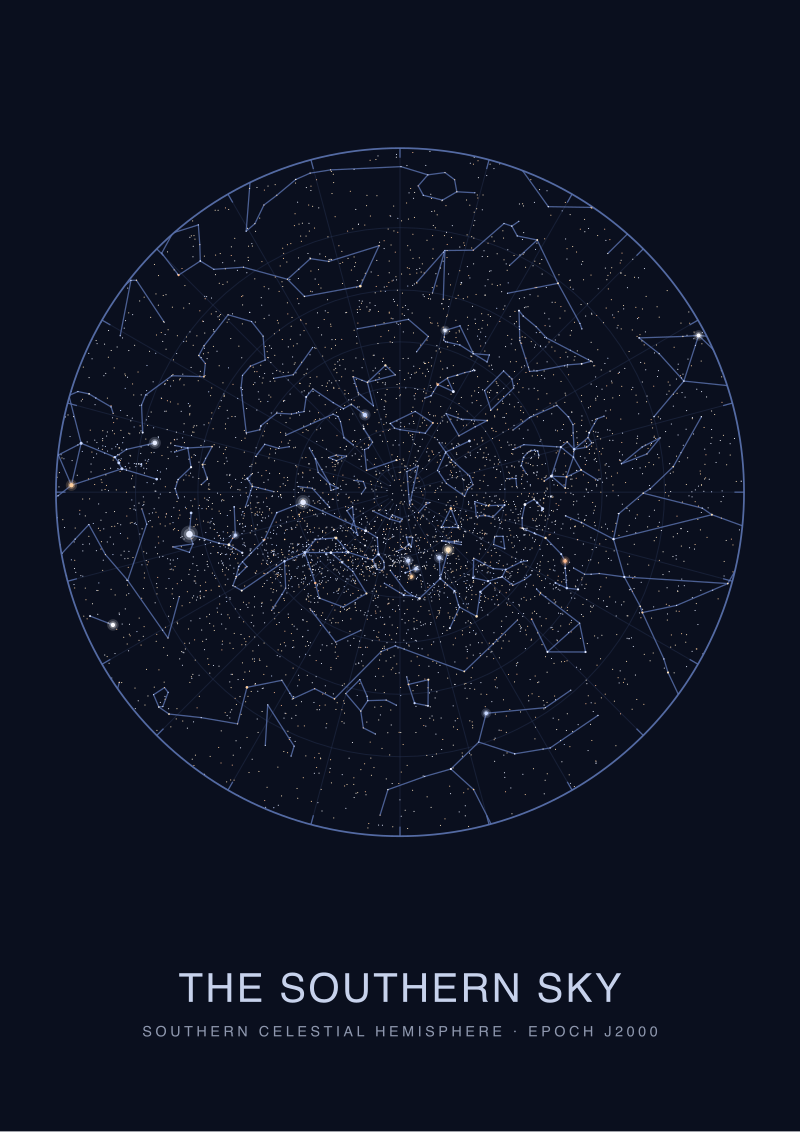
How did a question as simple as "which stars are the brightest" take two thousand years to answer? The short version, from the HYG v41 catalogue our studio plots from: Sirius at magnitude -1.44 in Canis Major, Canopus at -0.62 in Carina, Arcturus at -0.05 in Boötes, Rigil Kentaurus at -0.01 in Centaurus, Vega at 0.03 in Lyra, Capella at 0.08 in Auriga. Six numbers. Every popular article recommends you memorize them as a list. That recommendation is wrong, and the reason it is wrong is a story that starts in 129 BCE and does not finish until 1997.
129 BCE: Hipparchus Invents the Magnitude Scale and Gets the Direction Wrong Forever
Walk into any planetarium gift shop and you will find a poster of the brightest stars arranged in a tidy descending list. What that poster does not tell you is that the numbers on it run the wrong way. Sirius is "first magnitude" and faint stars are "sixth magnitude", meaning smaller numbers mean brighter objects. A reader encountering the scale for the first time usually assumes a typo. There is no typo. There is a Greek astronomer on the island of Rhodes, around 129 BCE, cataloguing roughly 850 stars and sorting them into six bins by eye.
Hipparchus called the brightest stars he could see "of the first magnitude" — in the sense of first rank, most important. The faintest smudges at the edge of unaided vision went into the sixth. Nothing about his scheme was mathematical; it was a librarian's ranking. He had no instrument capable of measuring the light arriving from Sirius versus the light from Vega. He had a dark Aegean sky and an opinion.
The chartmaker's lesson here is that every catalogue is a snapshot of what the catalogue-maker could do. Our six brightest — Sirius, Canopus, Arcturus, Rigil Kentaurus, Vega, Capella — would have been "first magnitude" to Hipparchus with no finer distinction among them. The idea that Sirius is roughly a magnitude brighter than Vega, which it is, was not available as a fact in 129 BCE. It was available as an impression. The scale that eventually quantified that impression inherited the inverted direction because Ptolemy preserved Hipparchus in the Almagest and nobody wanted to renumber the sky after the Greeks.
1603: Johann Bayer Publishes Uranometria and Freezes Sirius at the Top
Fast-forward seventeen hundred years. In Augsburg, in 1603, a Bavarian lawyer named Johann Bayer prints a star atlas called *Uranometria*. It is the first serious attempt to chart the sky including the southern constellations that European navigators had been reporting from the Cape of Good Hope and the Spice Islands. Bayer labels the stars within each constellation with Greek letters — Alpha Canis Majoris, Beta Canis Majoris, and so on — roughly in order of brightness.
Here is where the top of our list gets locked in editorially even though the measurements were still a long way off. Bayer makes Sirius Alpha Canis Majoris. He makes Canopus Alpha Carinae. Arcturus becomes Alpha Boötis. Vega becomes Alpha Lyrae. Capella becomes Alpha Aurigae. Rigil Kentaurus becomes Alpha Centauri — which is why that star is still routinely called Alpha Cen even though its proper name is older than Bayer's atlas. Six stars, six Alphas. The identity of the brightest fixed star in each of those constellations was settled by naked-eye consensus and a Bavarian engraver.
What Bayer did not have was any way to put Sirius and Canopus on the same scale as each other. From Augsburg at 48° north, Canopus never clears the horizon. He catalogued it on the authority of Dutch navigators who had seen it from near the equator. So the brightest star in the entire sky as our catalogue reports it, Sirius at -1.44, and the second-brightest, Canopus at -0.62, were in 1603 known as "very bright" and "the one the Dutch keep writing about". The ordering was correct. The gap was not quantified. Our modern HYG v41 numbers show that gap to be about 0.82 magnitudes — meaning Sirius delivers roughly twice the light flux of Canopus to the eye. That is a receipt Bayer could not have written.
1856: Norman Pogson Fixes the Math and Pins Vega as the Zero Point
The problem with Hipparchus's six bins is that human vision is logarithmic. The nervous system compresses a huge dynamic range of brightness into a comfortable perceptual signal, which is why we can walk from noon sunlight into a candlelit room without pain. By the mid-1800s astronomers armed with photometers had figured out that a Hipparchan "first magnitude" star delivered roughly one hundred times the light flux of a "sixth magnitude" one — five magnitudes of difference, a factor of 100 in energy.
In 1856, an English astronomer named Norman Pogson, working at Oxford, proposed formalising this. He defined one magnitude step as the fifth root of 100 — approximately 2.512 — and anchored the scale to Vega as magnitude 0.0. Every subsequent brightness measurement would be a ratio against Vega. Pogson's ratio is the reason magnitudes can run negative: a star brighter than Vega gets a number below zero. That is the sole reason Sirius is -1.44 and Canopus is -0.62. The minus signs are not a quirk; they are Pogson's bookkeeping for stars that outshine the anchor.
Three of our six brightest sit essentially at the Pogson zero point, which is itself a tell. Arcturus at -0.05, Rigil Kentaurus at -0.01, Vega at 0.03, Capella at 0.08. Those four are so close in apparent brightness that under suburban skies the eye genuinely cannot rank them without looking twice. The HYG v41 figures confirm what careful observers had suspected for a century: these are not four stars in a stepwise ladder of brightness. They are four stars tied, within the measurement noise of 1856-era photometry, for third through sixth place.
Any article that lists them in neat descending order with no caveat is misrepresenting what the data says. The order Arcturus > Rigil Kentaurus > Vega > Capella is real; the gap between any two of them is smaller than a passing wisp of high cirrus. Pogson gave astronomy a scale precise enough to prove that most of the "brightest stars" leaderboard is a photo-finish.
1953: The Johnson-Morgan System Puts Numbers on Canopus the Southern Hemisphere Could Trust
Pogson settled how the arithmetic worked. He did not settle which wavelengths of light you were counting. A star's magnitude depends on what colour of light you measure. Vega is a hot white star, so it looks roughly the same brightness whether you count blue photons or yellow ones. Arcturus is a cool orange star, so counting only blue light makes it look dimmer than counting the full visible band. Through the first half of the twentieth century, different observatories reported different magnitudes for the same star because they were using different filters and nobody had standardized.
In 1953, Harold Johnson and William Wilson Morgan published what became the UBV photometric system — three precisely defined filter bands labelled Ultraviolet, Blue and Visual. The "V magnitude" they defined, centred around 550 nanometres, is what nearly every modern catalogue including HYG v41 reports as "apparent magnitude" unless otherwise specified. Our six numbers are V magnitudes. They are directly comparable because Johnson and Morgan made them so.
This mattered most for Canopus. Observed from the southern hemisphere, Canopus is high overhead for part of the year and reaches the zenith over much of South America, southern Africa and Australia. But most of the great nineteenth-century observatories were in the northern hemisphere, where Canopus skims the horizon or never rises. Measurements of its brightness disagreed because atmospheric absorption at low altitudes is severe and wavelength-dependent. The UBV system plus a growing network of southern observatories — particularly in South Africa and later in Chile — produced a Canopus magnitude that converged on -0.62 V. Our catalogue inherits that number. It is the single hardest-won figure in the top six, because it required an entire hemisphere of infrastructure before the northern tradition could trust the result.
Note the RA and Dec in our grounding. Canopus sits at declination -52.7°, meaning any observer north of about 37° latitude cannot see it at all. For most of recorded astronomy the second-brightest star in the sky was a rumour to half the astronomers who were trying to rank it.
1997: The Hipparcos Catalogue Settles the Order of the Top Six for Good
The last line in this story is written from orbit. The European Space Agency's Hipparcos satellite — named after the Rhodes astronomer and his original 850-star catalogue — operated from 1989 to 1993, measuring positions and brightnesses of more than a hundred thousand stars from above the atmosphere. Its final catalogue was published in 1997. Above the atmosphere there is no colour-dependent absorption, no horizon dimming, no scintillation. The brightnesses Hipparcos reported became the modern reference.
HYG v41, the catalogue our studio plots from, is a working astronomical database that merges Hipparcos measurements with later refinements. The six numbers we started with are, within rounding, what Hipparcos recorded: Sirius -1.44, Canopus -0.62, Arcturus -0.05, Rigil Kentaurus -0.01, Vega 0.03, Capella 0.08. For the first time in the two-thousand-year history of this question, the ranking is settled with no serious disagreement among catalogues.
What Hipparcos also made unambiguous is how little space separates most of the leaderboard. Sirius is in a class by itself. Canopus is clearly second. After that the race is tight: a span of 0.13 magnitudes separates third from sixth. In perceptual terms, if you look at Arcturus and then at Capella on the same clear night, your eye registers them as the same brightness. The chart-maker's instinct — plot before you draw — comes directly from this. We do not rank stars by eye on our charts. We plot their V magnitudes and let the symbol size speak.
There is also the matter of what Hipparcos did not resolve. Rigil Kentaurus — Alpha Centauri — is actually a triple star system, and the magnitude -0.01 in our catalogue is the combined light of its two bright components, Alpha Centauri A and B. Separating them requires a telescope. To the unaided eye they are a single point of light, which is why "the brightest star in Centaurus" has a single magnitude on every chart including ours. Catalogues report what the eye receives, not what the system physically is.
What It All Means: The Brightest Stars Are a Measurement Story, Not a Beauty Contest
The reason the "memorize the top six" recommendation is wrong is that the list makes brightness look like a stable, finished fact. It is not. Each of those numbers is a receipt from a specific instrument, filter and era. Sirius being brighter than Canopus is a geometric certainty — both are relatively nearby stars and the ratio is unambiguous. Arcturus being brighter than Capella by 0.13 magnitudes is a measurement result that could not have been stated with confidence before 1953 and could not have been stated to two decimal places before 1997. If the stars had been measured in a different century, the order of the tied cluster might have been reported differently; the measurements would have been "wrong" in the same way our 2026 figures will be slightly refined by future catalogues like Gaia.
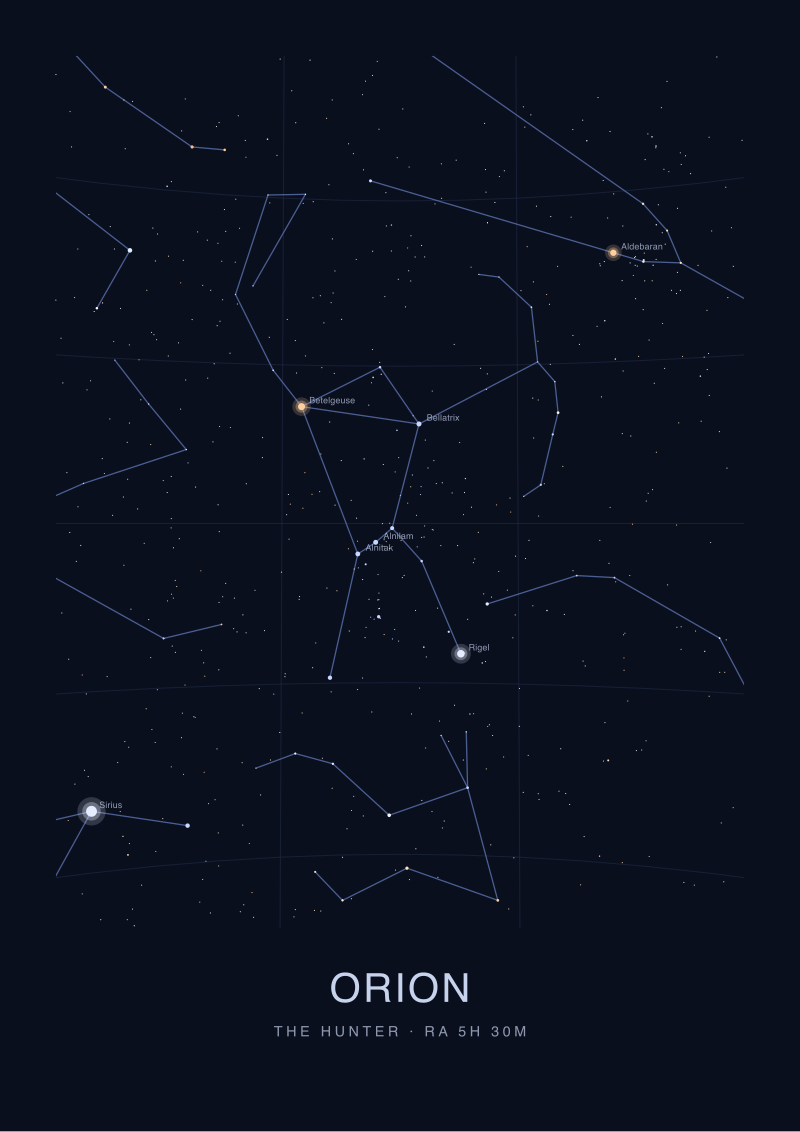
What a chartmaker does with this is draw with uncertainty built in. On our prints, Sirius is a conspicuously larger dot than Canopus. Canopus is noticeably larger than the next four. Those next four are drawn at the same size, because that is what the data says they are: a cluster tied within the resolution of the eye, separated only by the kind of precision you need an orbiting telescope to achieve. The list format hides this. The chart does not.
The question worth asking next is not "which is the brightest". That question is now closed. The question is what brightness even measures: apparent magnitude is how much light reaches us, which depends on how far away the star is and how much light it actually emits. Rigil Kentaurus looks tied for third-brightest because it is one of the closest stars to the Sun — 4.3 light years. Canopus looks second-brightest from 310 light years because it is intrinsically about fifteen thousand times more luminous than the Sun. Sirius is both close and bright. The six names in our catalogue are a leaderboard of what we see, not of what is actually there. The map of what is actually there — the absolute magnitudes, the distances, the intrinsic power of these stars — is a different chart entirely, and it is where our studio goes next.
FAQ
Why do brighter stars have smaller magnitude numbers?
Because the scale was invented in 129 BCE by Hipparchus as a ranking of importance — "first magnitude" meant first rank, not greatest value. When Norman Pogson formalised the mathematics in 1856, he preserved the inverted direction so that two millennia of catalogues would still match. The side effect is that stars brighter than Vega, the zero-point anchor, get negative numbers. Sirius at -1.44 is not an error; it is the arithmetic consequence of a Greek librarian's naming choice preserved through Ptolemy's Almagest.
Is Sirius really the brightest star in the whole sky?
Among fixed stars visible from Earth, yes. Sirius in Canis Major sits at apparent magnitude -1.44 in HYG v41, roughly 0.82 magnitudes ahead of Canopus in Carina at -0.62. That corresponds to about twice the light flux reaching the eye. The Sun, Moon and planets are much brighter but are not fixed stars. Among the stellar background that stays in roughly the same position night after night, Sirius has no rival in the catalogue.
Why can't I see Canopus from where I live?
Canopus sits at declination -52.7°, deep in the southern celestial hemisphere. Observers north of about 37° latitude never see it rise above the horizon at all; between 37° and roughly the equator it skims low in the south during winter nights. Most of Europe, Canada, Russia and the northern United States are shut out entirely. From São Paulo, Johannesburg, Sydney or Santiago it is a familiar sight — second only to Sirius in brightness, high in the sky for months at a time.
Are Arcturus, Rigil Kentaurus, Vega and Capella really tied?
Statistically close enough that the ranking is a photo-finish. Arcturus is -0.05, Rigil Kentaurus -0.01, Vega 0.03, Capella 0.08 — a span of 0.13 magnitudes across four stars. In perceptual terms the human eye cannot reliably rank them against each other on a given night. The order our catalogue reports is correct in the sense that Hipparcos measured it from orbit, but any amateur comparing them with naked eyes would struggle to produce the same order twice.
Where do the numbers in this article actually come from?
From HYG v41, a working astronomical database merging the Hipparcos satellite's 1997 catalogue with later refinements. Hipparcos operated from 1989 to 1993, measuring star brightnesses from orbit above Earth's atmosphere, which removes the colour-dependent absorption and horizon dimming that corrupted earlier ground-based measurements. The "V magnitude" we report follows the Johnson-Morgan 1953 photometric system, measuring light in a defined band centred around 550 nanometres. Every magnitude in this article is a V magnitude from that chain.
Does apparent magnitude tell me how powerful a star actually is?
No, and this is the single most common confusion. Apparent magnitude measures only how much light reaches the eye, which depends on both how luminous the star genuinely is and how far away it sits. Rigil Kentaurus appears tied for third-brightest because it is one of the Sun's nearest neighbours at 4.3 light years. Canopus appears second-brightest from 310 light years because it is intrinsically enormous. To rank stars by actual power you need absolute magnitude, which corrects for distance — a different chart and a different question.
Why is Rigil Kentaurus listed as one star when it's actually several?
Because catalogues of apparent magnitude report what the unaided eye receives, not what the physical system is. Rigil Kentaurus — Alpha Centauri — is a triple star system whose two bright components, A and B, orbit each other closely enough that the eye sees them as a single point. The magnitude -0.01 in HYG v41 is the combined V-band light of that pair. Separating them visually requires a small telescope. A third companion, Proxima Centauri, is far too faint to contribute.
Will these numbers change in the future?
Marginally. The European Space Agency's Gaia mission, which has been mapping the sky with precision far beyond Hipparcos, will refine the brightness and position of nearly every star in HYG v41 as its final data releases are processed. The order of the top six is not expected to shift — the gaps between Sirius, Canopus, and the tied cluster are too large to be rewritten by better instruments. The decimals will tighten. The ranking is, for practical purposes of chartmaking, settled.
From the collection
New charts and 10% off your first print.
One email now with your code. No noise after.