Sirius outshines the second-brightest star in the night sky by 0.82 magnitudes — a wider gap than the one separating the next four stars on the list combined. Translated into light hitting the human eye, that is roughly 2.1 times more photons from Sirius than from Canopus, its nearest rival. We ranked the six brightest stars in the HYG v41 catalogue by apparent magnitude, plotted their coordinates, and found a distribution that says more about geography and historical accident than about the stars themselves. The list is short. What it reveals about how the sky is drawn is not.
How We Ranked Them
We pulled apparent magnitudes and equatorial coordinates from HYG v41, the Astronomy Nexus compilation that consolidates Hipparcos, Yale Bright Star and Gliese data into a single reference. Apparent magnitude is the metric — how bright a star looks from Earth in the visual band — not absolute magnitude, not bolometric output, not intrinsic luminosity. A star can be more luminous than Sirius and still rank lower here because it sits farther away, is reddened by dust, or emits more of its power outside the visual band.
We rounded to two decimals as the catalogue publishes them and ranked ascending, since the magnitude scale runs backwards: smaller numbers are brighter. Variable stars complicate the picture — several of the six have measurable magnitude ranges — but we used the HYG single-epoch value rather than a mean or maximum. Multiple-star systems are ranked by their combined light, which is how a naked-eye observer sees them. The sun is excluded on the standard convention that "night sky" means after sunset.
Finding #1: Sirius Wins by a Full Magnitude
Sirius sits at apparent magnitude -1.44. Canopus, the next-brightest, sits at -0.62. The gap is 0.82 magnitudes.
The magnitude scale is logarithmic: each step of one magnitude corresponds to a brightness ratio of roughly 2.512, the fifth root of 100. A gap of 0.82 magnitudes translates to a linear brightness ratio of 2.512^0.82, or about 2.13. Sirius delivers slightly more than twice the visual flux of Canopus at the top of Earth's atmosphere. No other consecutive gap in the top six comes close: Canopus to Arcturus is 0.57 magnitudes (a ratio of 1.69), and every gap after that drops below 0.05.
| Rank | Star | Constellation | Apparent Magnitude | Gap to Next |
|---|---|---|---|---|
| 1 | Sirius | Canis Major | -1.44 | 0.82 |
| 2 | Canopus | Carina | -0.62 | 0.57 |
| 3 | Arcturus | Boötes | -0.05 | 0.04 |
| 4 | Rigil Kentaurus | Centaurus | -0.01 | 0.04 |
| 5 | Vega | Lyra | 0.03 | 0.05 |
| 6 | Capella | Auriga | 0.08 | — |
Sirius earns its rank on distance. It sits about 8.6 light years from the solar system, which is close by stellar standards; Canopus sits roughly forty times farther. Intrinsic luminosity favors Canopus by a large factor, but the inverse-square law does not care what a star is doing at home. It cares how many photons arrive.
Finding #2: The Southern Sky Owns Half the Top Six
Three of the six brightest stars have negative declinations: Sirius at -16.7°, Canopus at -52.7°, and Rigil Kentaurus at -60.8°. Three sit in the northern sky: Arcturus at +19.2°, Capella at +46.0°, and Vega at +38.8°. The split is exactly half.
That symmetry is misleading. Sirius, at -16.7°, is visible from every inhabited latitude on Earth — it rises above the horizon anywhere south of about +73°. Canopus at -52.7° never rises for observers north of roughly +37°, which excludes most of Europe, most of North America north of San Francisco, and all of Canada. Rigil Kentaurus at -60.8° is invisible from anywhere north of about +29°, which means Cairo, New Delhi and Miami sit just at the edge of its visibility.
The practical result: an observer in London sees four of the six brightest stars in the sky over the course of a year — Sirius, Arcturus, Vega and Capella. An observer in Buenos Aires sees all six but has to wait for the right seasons. The "brightest stars in the night sky" list is not a list any single observer will ever have seen in one night, and for most of the population of the northern hemisphere it never will be. This is one of the reasons historical European star atlases undercount southern constellations — Canopus and Rigil Kentaurus entered Western catalogues late, through the voyages that carried European navigators below the equator.
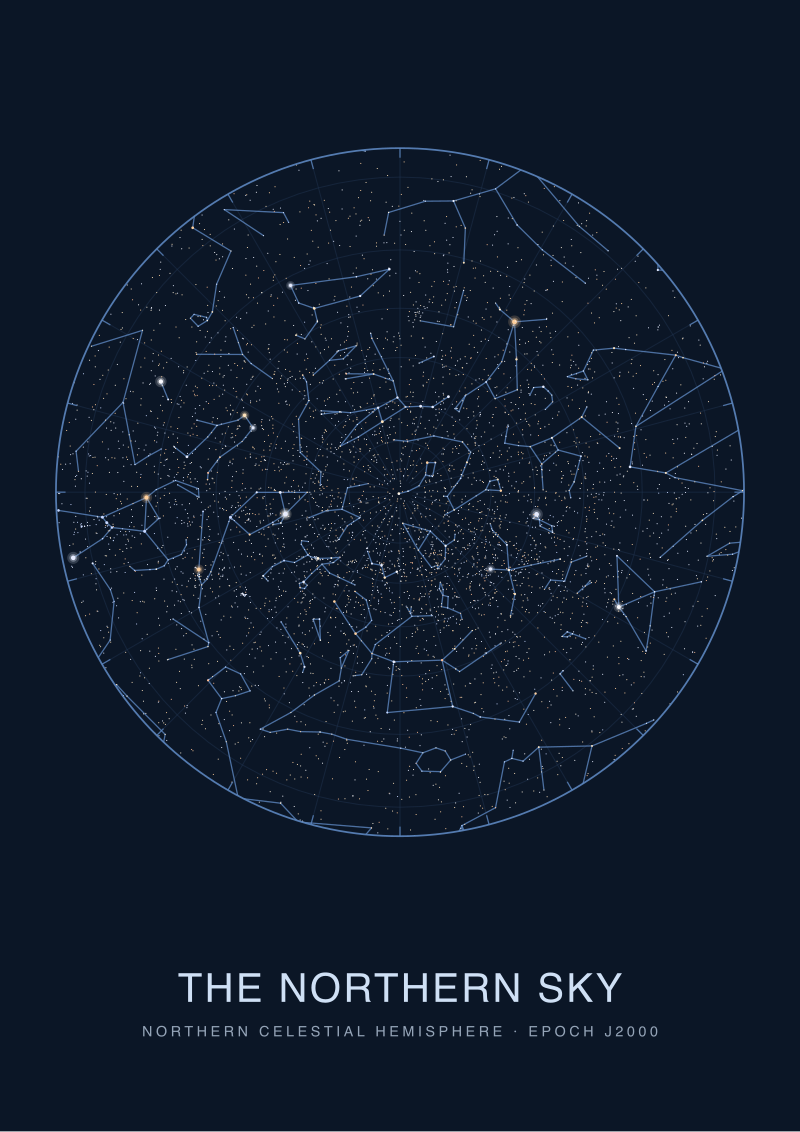 The Northern Sky
The print from this article · from €29.95
View the print →
The Northern Sky
The print from this article · from €29.95
View the print →
Finding #3: Four Stars Cluster Within 0.09 Magnitudes of Each Other
Ranks three through six span 0.13 magnitudes end to end: Arcturus at -0.05, Rigil Kentaurus at -0.01, Vega at 0.03, Capella at 0.08. Three of the four — Rigil Kentaurus, Vega and Capella — sit within 0.09 magnitudes of one another, a spread that is at the edge of what a trained naked eye can distinguish in side-by-side comparison. In practice, none of them can.
The stars are never in the sky together long enough for direct comparison, and atmospheric extinction changes their apparent magnitudes by tenths of a magnitude depending on altitude above the horizon. A star seen through two airmasses of atmosphere loses roughly 0.6 magnitudes to extinction relative to the zenith. This means the actual observed brightness order of Arcturus, Rigil Kentaurus, Vega and Capella depends more on where they sit in the observer's sky at the moment of looking than on their catalogued magnitudes.
For chart-making purposes we treat these four as functionally equivalent — the same dot size, the same visual weight on the plate. Sirius gets its own tier. Canopus gets a second tier. The four-way cluster shares a third. Any finer distinction on a printed chart would be visible only under a magnifier and would misrepresent the observer's actual experience of the sky.
Finding #4: Apparent Brightness Is Not Luminosity
The ranking above measures photon flux at Earth. It does not measure how much light each star emits. Reorder the same six stars by intrinsic luminosity and the list scrambles.
Canopus is the intrinsic outlier. Its distance — roughly 310 light years, versus Sirius at 8.6 — means the light we receive has spread across a volume of space about 1,300 times larger before reaching us. Canopus is intrinsically the most luminous of the six by a wide margin, and it still ranks second only because Sirius is close. Rigil Kentaurus is the reverse case: it is a Sun-like system at about 4.4 light years, one of the nearest stellar systems to Earth, and its rank in this list is almost entirely a distance effect. If Rigil Kentaurus sat where Canopus sits, it would be invisible to the naked eye.
Vega and Arcturus offer the middle ground. Vega is intrinsically luminous, a hot main-sequence star at about 25 light years. Arcturus is a red giant at 37 light years, cooler but larger, radiating most of its power in the red and infrared where the human eye is less sensitive. The V-band magnitude used in this ranking underweights Arcturus relative to its bolometric output. If we ranked by total energy emitted at all wavelengths, Arcturus would climb.
The ranking answers one specific question: how bright does this star look, tonight, from Earth, in visible light. Every other question about brightness — luminosity, energy output, colour-corrected magnitude, historical brightness — produces a different order.
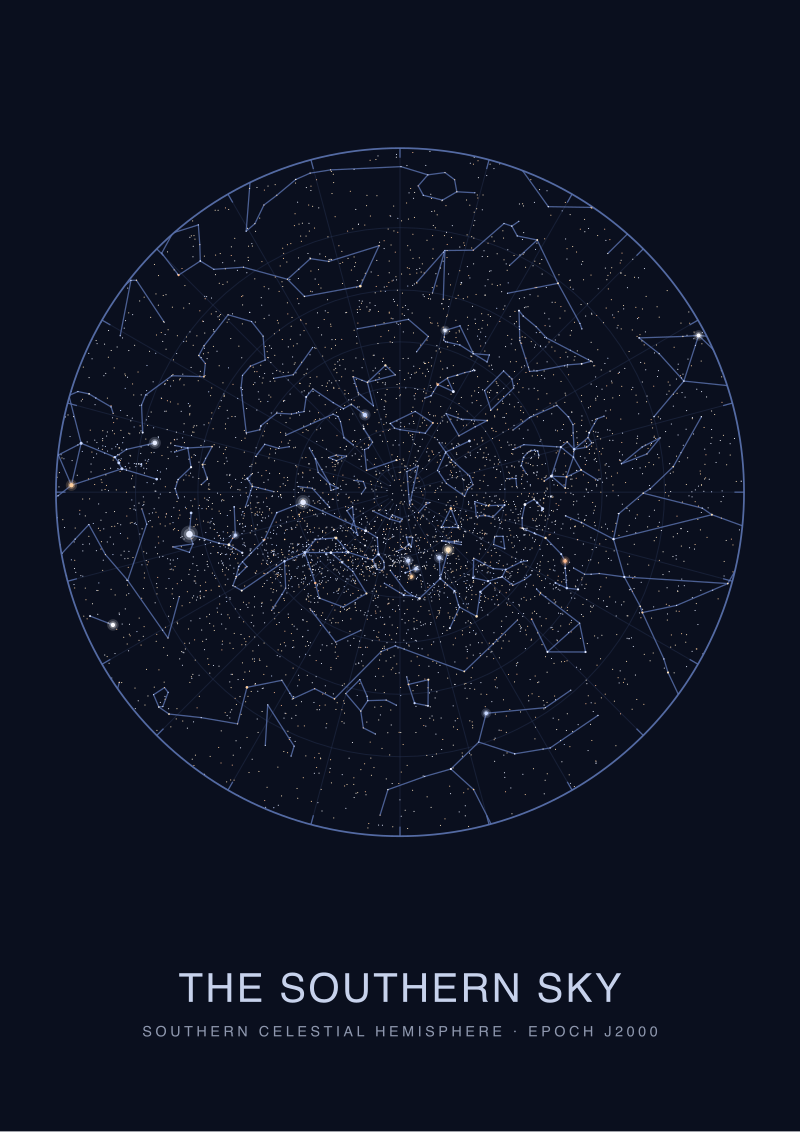 The Southern Sky
The print from this article · from €29.95
View the print →
The Southern Sky
The print from this article · from €29.95
View the print →
What This Ranking Does Not Prove
The list is a snapshot. Apparent magnitudes drift on timescales the catalogue does not resolve. Several stars on this list are variable — Rigil Kentaurus is a triple system whose combined magnitude depends on the orbital phase of its components, and Capella is itself a binary of two G-type giants whose light output varies at the sub-percent level. The single value we cite is a working number, not a fixed physical constant.
The list also excludes objects that outshine every star on it under the right conditions. Venus at greatest brilliancy reaches magnitude -4.9, brighter than Sirius by more than three magnitudes. Jupiter, Mars near opposition and Mercury at elongation can outshine Capella. We excluded planets because "star" was the question; we mention them here because the phrase "brightest object in the night sky" almost never means a star, and readers arriving at this page from that phrasing deserve to know.
The Takeaway
Six stars, one dominant, one distant giant, and four so close in brightness that atmospheric conditions decide their order on any given night. That is the entire top of the list.
FAQ
Why does Sirius look so much brighter than every other star?
Sirius sits 8.6 light years from Earth, which places it among the twenty closest stellar systems to the solar system. Its intrinsic luminosity is high — roughly 25 times the sun's — but proximity does the heavy lifting. The inverse-square law is unforgiving: cut the distance to a star in half and its apparent brightness quadruples. Sirius wins its rank by geography, not by being an unusually powerful star. Canopus emits far more light in absolute terms and still loses by 0.82 magnitudes.
Can I see all six brightest stars from where I live?
Only from the southern hemisphere, and only across multiple seasons. Observers north of about +37° latitude — which includes most of Europe, most of North America, and northern Asia — never see Canopus rise. Observers north of about +29° — Cairo, New Delhi, Houston — never see Rigil Kentaurus. From London or Berlin the accessible list is four stars: Sirius, Arcturus, Vega and Capella. Southern observers see all six but not on the same night, since they occupy different right ascensions.
Is Polaris one of the brightest stars in the sky?
No. Polaris sits at apparent magnitude 1.98, which places it outside the top forty brightest stars. Its fame comes from position, not brightness — it lies within a degree of the north celestial pole and therefore appears nearly stationary while the rest of the sky rotates around it. Navigators used it because it stays put, not because it stands out. Every star in the top six of this list is more than four times brighter than Polaris in visual flux.
Why do astronomers use a scale where brighter stars have smaller numbers?
Because the scale is older than the physics it describes. Hipparchus of Rhodes catalogued stars around 130 BCE by assigning the brightest to "first magnitude" and the faintest visible to "sixth magnitude". Nineteenth-century astronomers formalised the system as logarithmic — a five-magnitude difference equals a hundredfold brightness ratio — but kept the direction of the original ordering. Changing it now would invalidate two millennia of catalogues. Astronomers accept the awkwardness and move on.
What about the sun — where would it rank?
The sun's apparent magnitude is -26.74, brighter than Sirius by more than 25 magnitudes, which corresponds to a brightness ratio of roughly ten billion. It is excluded from lists of the brightest stars in the night sky because it defines the boundary between night and day — once the sun is above the horizon, no star on this list is visible to the naked eye. Absolute magnitude tells a different story: the sun's absolute magnitude of +4.83 places it well below all six of the ranked stars in intrinsic luminosity.
Are any of these six stars actually multiple-star systems?
Yes. Sirius is a binary — the visible Sirius A and the white dwarf Sirius B, which contributes negligibly to the combined light. Rigil Kentaurus is a triple system consisting of Alpha Centauri A, Alpha Centauri B and Proxima Centauri, with the two brighter components dominating the catalogued magnitude. Capella is a spectroscopic binary of two G-type giants of nearly equal brightness. The apparent magnitudes above reflect the combined light of the systems as observed from Earth, which is what a naked-eye observer actually perceives.
Where can I get a print showing these stars in their real positions?
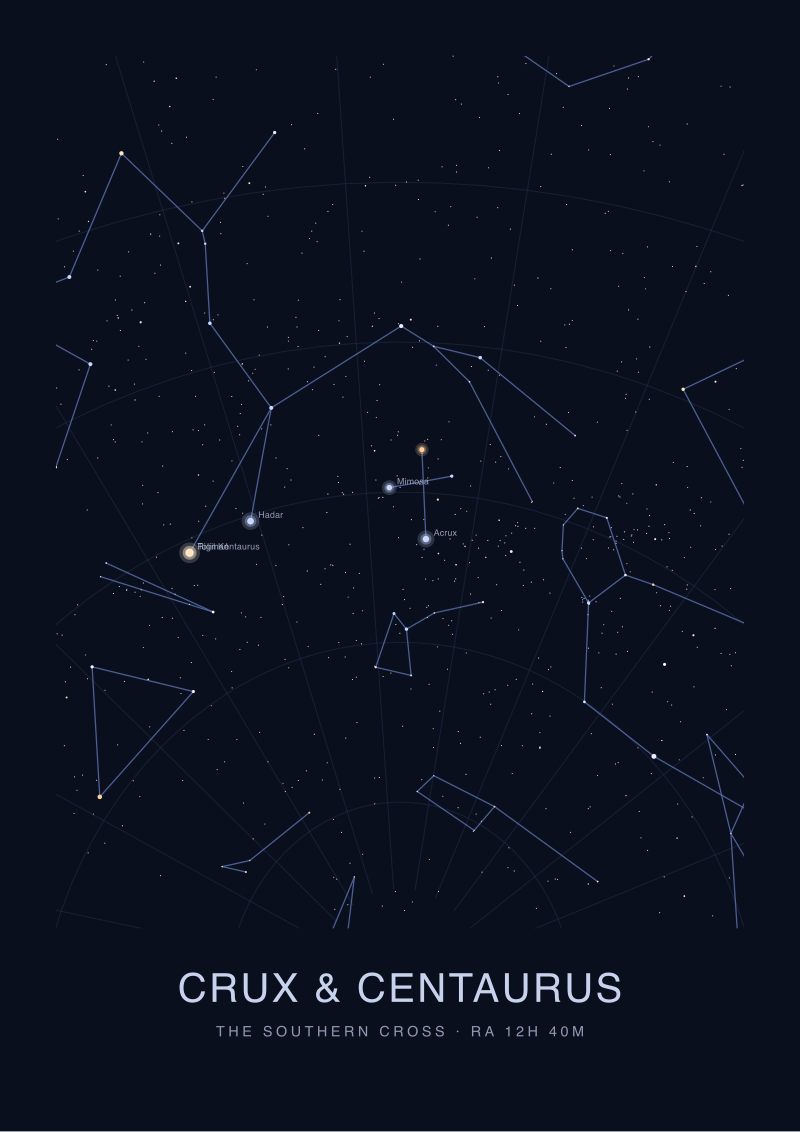
We plot the six brightest stars in their catalogue positions on several of the seasonal charts available at /shop/ — the winter chart carries Sirius and Capella, the spring chart carries Arcturus, the summer chart carries Vega, and the far-southern chart carries Canopus and Rigil Kentaurus together. Each print draws star sizes scaled to apparent magnitude, so the dominance of Sirius over its rivals reads at a glance rather than requiring a table to interpret.
From the collection
New charts and 10% off your first print.
One email now with your code. No noise after.