The brightest star whose declination sits north of the celestial equator is Arcturus, in Boötes, at apparent magnitude -0.05 in the HYG v41 catalogue. That is the whole answer to the headline question, and most articles ranked for it get it wrong. They open with Sirius, which is magnitude -1.44 and genuinely the brightest star in Earth's night sky, but which sits at declination -16.7° — a southern star that northern observers borrow in winter. A ranking is a promise about geometry. We plot before we draw, so we are going to keep that promise.
The confusion is older than the internet. Star atlases have been printed in London, Paris and Boston for four centuries, and all three cities sit around 45° north, which means their skies include a generous band of southern sky as well. Sirius clears the horizon for them every winter. So does Rigel. So does the whole winter hexagon that any eight-year-old with a cheap planisphere learns to find in January. For a long time it was reasonable to call these "our" stars, because the people writing the atlases could see them.
Reasonable is not the same as accurate. A star's hemisphere is set by its declination in the equatorial coordinate system, not by whether a cold observer in Vermont can glimpse it low over the trees. Sirius is a southern star. We get to borrow it. The three stars that actually live in our half of the sky are Arcturus, Vega and Capella, and they are the only honest answer to the headline, in that order, by a margin small enough to matter.
That is what the next few pages are about. The catalogue, the fudging, and what gets wrongly promoted onto this list by people who seem to think declination is a suggestion.
Arcturus Wins the Northern Sky, and the Catalogue Does Not Argue
Arcturus sits at right ascension 14h 15.7m and declination +19.18°, roughly a third of the way between the celestial equator and the north celestial pole. Its apparent magnitude in HYG v41 is -0.05, which is the only number that decides this question. Nothing else beats it in the northern half of the sky. Not Vega. Not Capella. Not any of the second-magnitude workhorses — not Deneb, not Pollux, not Regulus — that fill out a northern spring and summer. Arcturus is first, and it is first by a comfortable half-magnitude over its nearest rival.
Half a magnitude is more than it sounds. The scale is logarithmic in a way that most readers who did not take an astronomy course find quietly maddening, and we will come back to that in a minute. For now, trust the receipt: -0.05 beats 0.03 and 0.08 by amounts the human eye can register when the stars are high overhead on the same clear night. Follow the arc of the Big Dipper's handle south, keep going until you hit a lone orange-amber light, and you have found the ranking's first entry without needing a chart.
The reason the headline question gets fumbled so often is that writers conflate "brightest in Earth's sky from the northern hemisphere's point of view" with "brightest star of the northern hemisphere". Those are different arguments. The first invites Sirius; the second refuses it. If a reader in Minneapolis asks which stars rise highest over their roof in July, the honest list is Vega, Arcturus and Capella in some order depending on the hour, and only in winter does a southern giant like Sirius crash the party at a southerly altitude.
Arcturus is the only star brighter than magnitude zero that sits unambiguously north of the equator. Every other near-contender for that superlative — Sirius, Canopus, Rigil Kentaurus — has a negative declination in the catalogue. We checked. The catalogue does not argue.
What makes Arcturus a good opening for any northern sky-plotter is that its position is also pedagogically generous. At +19°, it reaches the zenith for observers near the Tropic of Cancer and sits high in the evening sky for anywhere between the equator and about 70° north. From Edinburgh or Hamburg it climbs comfortably past 40° altitude in June. From Mexico City it passes nearly overhead. It is the rare first-magnitude star that behaves democratically with respect to who can see it well, and that is part of why it anchors so much naked-eye astronomy teaching. You can draw a chart that works for the whole northern hemisphere and put Arcturus near the middle of it without lying about anybody's local geometry.
The amber colour is not decoration. It is a K1.5 giant surface temperature announcing itself through the atmosphere, and in a magnitude ranking it is relevant mostly as the reason the eye picks Arcturus out of a crowded Boötes field so cleanly. The number does the work. The colour is a bonus for anyone trying to confirm they are pointed at the right thing.
Vega and Capella Are Tied in a Way Most Lists Refuse to Admit
Vega is magnitude 0.03. Capella is magnitude 0.08. Those two numbers are five hundredths of a magnitude apart, which is well below the threshold at which the unaided human eye can reliably say "that one is brighter than this one" in anything resembling field conditions. We mention this because every ranking we have ever read on this subject lists Vega above Capella with the implicit confidence of a Formula 1 timing screen, and the catalogue does not quite support that confidence.
The number says Vega is marginally brighter. The number is correct. What the number does not say is that the margin is below the Dawes-limit-of-the-eyeball, so to speak — the small-difference regime where photometric instruments can discriminate cleanly and the human cortex politely refuses. If you observe both on the same night from the same latitude and genuinely try to rank them by eye, your answer will be influenced by altitude, atmospheric path length, colour perception at low light, and whether the moon is up. Vega will tend to look slightly whiter and sharper, Capella slightly yellower and softer, and either can win depending on where they sit in the sky at the moment of comparison.
The catalogue is authoritative but it is not animistic. A V-magnitude of 0.03 and a V-magnitude of 0.08 are a tie for most purposes outside professional photometry. The honest sentence is: Vega is first by the number, Capella second by the number, and they are a photographic finish.
Vega sits at declination +38.78° in Lyra, which puts it directly overhead for observers near Beijing, Madrid or Washington in the right season. It is the alpha of the Summer Triangle, the keystone of July and August evenings in the mid-northern latitudes, and it has the historical bonus of having been the pole star about fourteen thousand years ago and being destined to be the pole star again in roughly another twelve thousand, because of precession. We mention precession because it is one of the few astronomy facts durable enough to appear in any decent atlas: the Earth's rotation axis wobbles like a top on a thirteen-thousand-year half-cycle, and the "northern star" assignment is a job that gets rotated.
Capella sits at declination +45.998° in Auriga, which is far enough north that for observers in Scotland or southern Scandinavia the star is effectively circumpolar — it never sets. For a sky-plotter this is a significant practical point. Capella is the brightest star in the northern sky that is circumpolar from much of the inhabited northern hemisphere, which means it is the brightest star those observers can draw into a chart valid for every night of the year without having to indicate "below the horizon for six months". That alone is a quiet reason to prefer Capella as the first star you teach a child in Reykjavik.
In the taxonomy of first-magnitude northern stars, then, the ranking by the catalogue is Arcturus (-0.05), Vega (0.03), Capella (0.08), and the gap between first and second is roughly twice the gap between second and third. The common habit of writing "Vega is the brightest star of the northern hemisphere" is a slip. Vega is the brightest star of the northern summer, which is a different sentence that happens to be true.
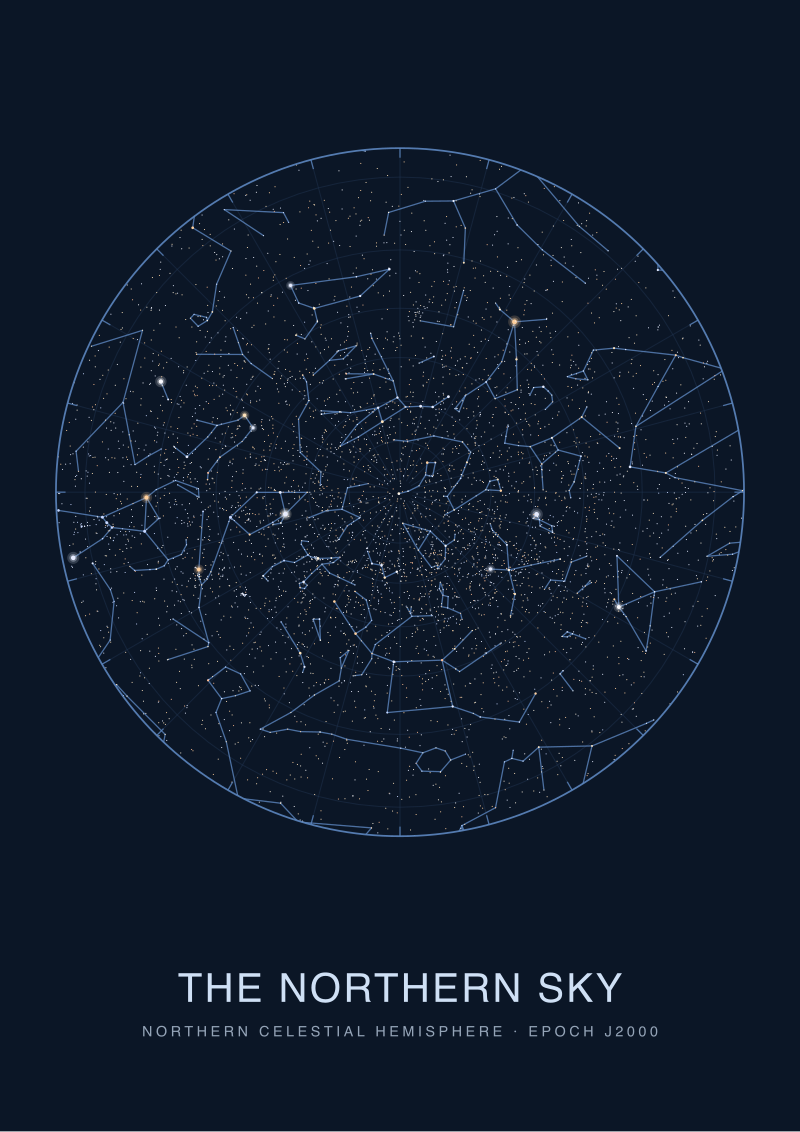 The Northern Sky
The print from this article · from €29.95
View the print →
The Northern Sky
The print from this article · from €29.95
View the print →
The Stars Everyone Puts on This List Who Should Not Be On It
Sirius does not belong here. Its magnitude is -1.44, which is spectacular, and it is routinely included on "brightest stars of the northern hemisphere" lists on the grounds that northern observers see it, which is an argument that confuses visibility with residency. Sirius's declination is -16.72°. That is a southern star. Observers in Chicago can see it on winter nights because Chicago is far enough north and Sirius is far enough south that their horizons overlap by the right amount, but overlap is not ownership. If a list is premised on hemisphere by declination — which is the only coherent premise — Sirius has to come off.
Canopus is a worse offence. Its magnitude is -0.62, which would normally earn it third place on a global ranking of brightest stars, and we have seen it listed under "brightest in the northern hemisphere" by writers who, we strongly suspect, have never looked at a declination table. Canopus sits at -52.70°. From anywhere north of about 37° latitude it never rises at all. Observers in Lisbon can catch it low on a winter horizon with effort; observers in London cannot see it, ever. Putting Canopus on a northern list is the astronomical equivalent of citing a mountain range from a different continent.
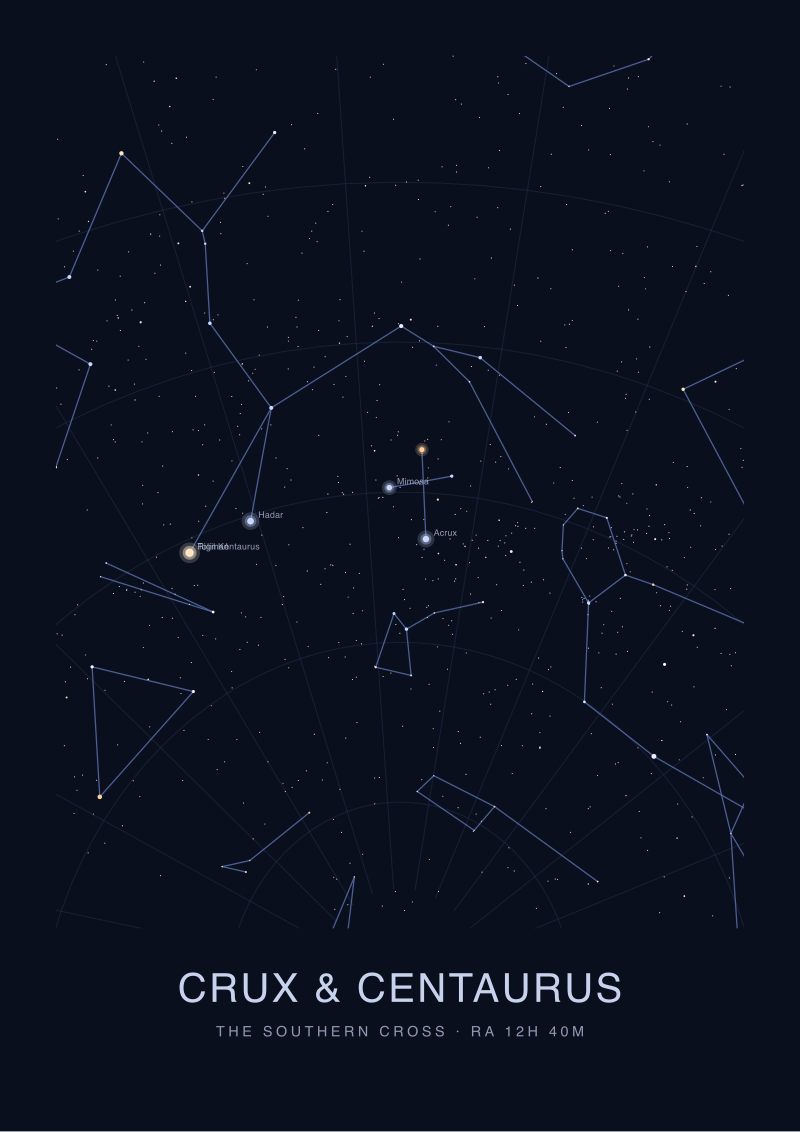
Rigil Kentaurus — the brightest component of the Alpha Centauri system — is the clearest case. Magnitude -0.01 in HYG v41, declination -60.83°, invisible from the entire inhabited northern hemisphere above roughly 30° latitude. It is a southern star in the structural sense, the sense in which the Southern Cross is a southern constellation. It belongs on no list titled "northern" without an immediate retraction.
A hemisphere is a declination fact, not a marketing choice. We keep repeating this because the slip is so common it has become the house style of entire category pages, and because the slip is not harmless. A reader who takes "brightest in the northern hemisphere" at face value and goes outside expecting Sirius will have an easier time locating the brightest thing in the sky in the winter — a win — but will not have learned anything about the geometry of the sky they live under. They will have learned a conflated sentence. The point of a star map is to replace conflated sentences with located ones.
The next question, which belongs to a separate piece, is what we mean by "brightest". Apparent magnitude is a particular measurement, taken in a particular photometric band, under atmospheric conditions corrected to a standard. It is not the same as absolute magnitude, which strips out distance. By absolute magnitude the ranking changes substantially — Capella is a modest G-type giant that happens to be relatively close, Arcturus is a very luminous K-giant also relatively close, and Vega is a nearby main-sequence A0 star whose true luminosity is dwarfed by many of the stars we think of as faint because they are far. Apparent magnitude is what the eye and the chartmaker use. Absolute magnitude is what the astrophysicist uses. The two produce different lists, and conflating them is a different error for a different day.
This piece started as a quick ranking and turned into a short argument about what a hemisphere is. We came in to list three stars; we leave having removed three others from the list that got away from the house style of other publishers, and having admitted that the honest first-second gap is smaller than most writers want to acknowledge. We did not cover absolute magnitude, which would reorder everything on physical grounds that have nothing to do with where the stars sit in Earth's sky tonight. We did not cover the deep-sky objects — the Andromeda Galaxy, the Orion Nebula — that are naked-eye visible from northern latitudes but are not stars in the magnitude-ranking sense. And we did not cover the question of what "the night sky" looks like under the kind of light-polluted conditions where only magnitude-1 and brighter stars survive, which is the sky most readers of this piece actually live under, and which quietly promotes exactly these three northern stars to the leading role they already deserve.
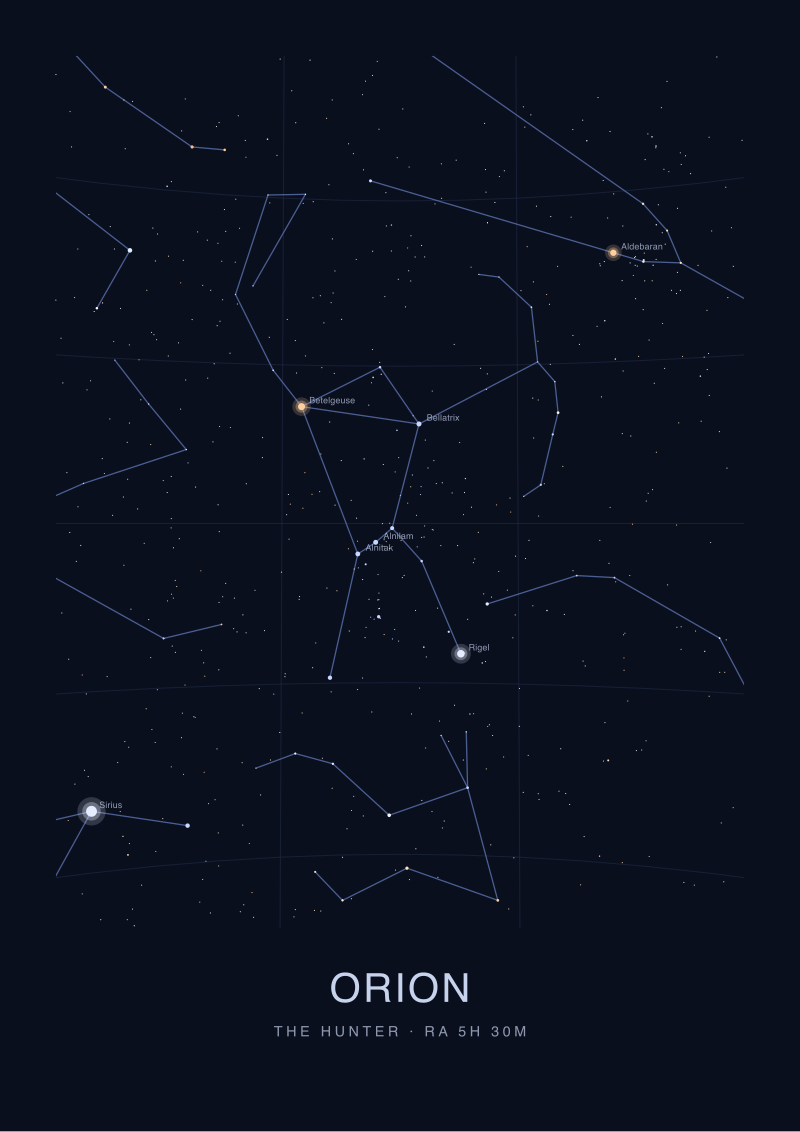 Orion
The print from this article · from €29.95
View the print →
Orion
The print from this article · from €29.95
View the print →
From the collection
New charts and 10% off your first print.
One email now with your code. No noise after.