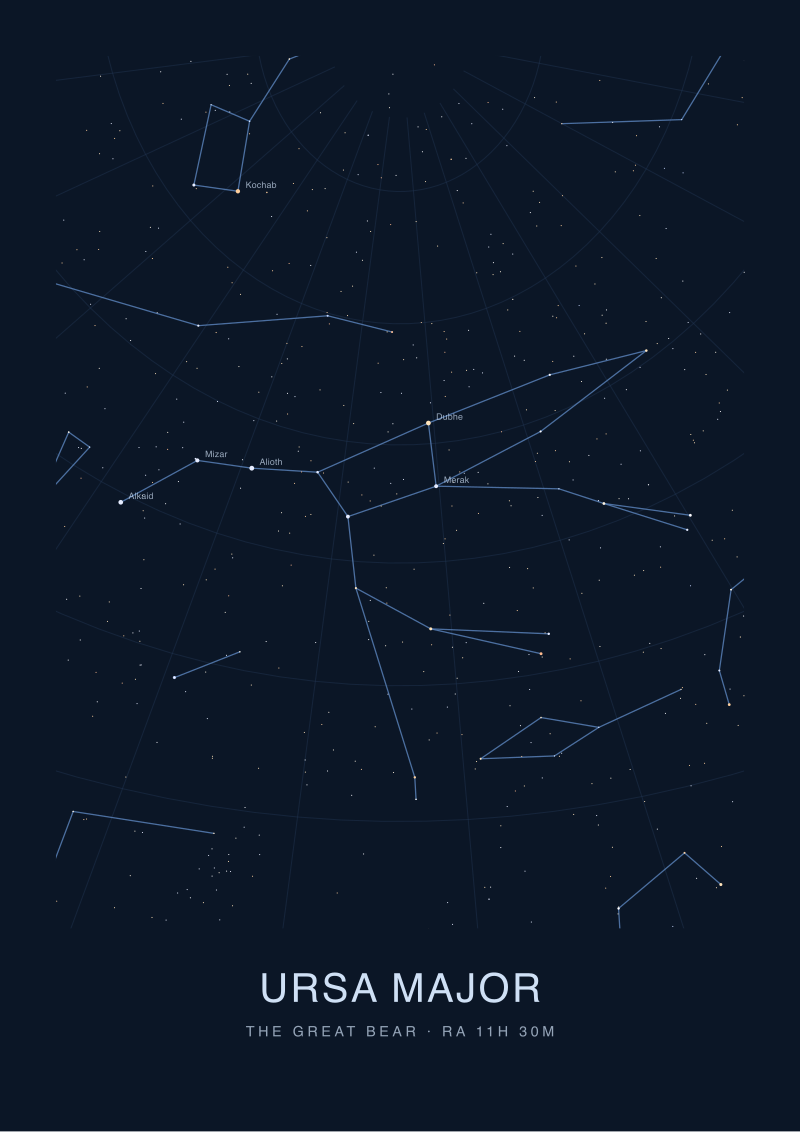
Seven stars, out of roughly 125 catalogued inside the boundary of Ursa Major, do the entire cultural work of the constellation. Seven. The Big Dipper — the Plough to the British, the Saucepan to the French, the Wagon to the Germans — is not a constellation at all. It is an asterism: a pattern the eye assembles from a fraction of the stars the International Astronomical Union assigned to the Great Bear in 1930. Every star chart we plot at Sky Atlas has to answer the same question before the ink goes down. Which line is the bear, and which line is the ladle inside it?
Methodology: What We Measured and What the HYG Catalogue Gives Us
Every claim below sits on top of the HYG stellar database (version 41), the same reference table we use to plot our print skies. HYG merges the Hipparcos catalogue, the Yale Bright Star Catalogue, and the Gliese catalogue of nearby stars into one working list with equatorial coordinates and apparent magnitudes. When this piece states a magnitude, that number came out of HYG v41. When it names a right ascension or declination, same source.
What HYG does not give us is folklore. For the mythological threads — Greek Callisto, Arabic star-name heritage, the Plough as a British farming reference — we lean on the standard public record of the IAU's 1930 constellation boundary system (the Delporte lines still in use today) and the naming traditions that survived into modern usage. Where a story is a story, we say so; the tradition gets named.
Two limits worth stating up front. First, we do not plot every star inside the Ursa Major boundary in this piece — the constellation contains hundreds of catalogued members below naked-eye visibility, and this is an editorial audit, not a full stellar census. Second, our magnitude comparisons use apparent magnitude only, the number a chartmaker actually needs. Absolute magnitude is a different argument for a different article.
Finding #1: The Big Dipper Is Seven Stars Inside a Constellation of Many More
The seven stars everyone sees are Dubhe, Merak, Phecda, Megrez, Alioth, Mizar, and Alkaid. Four form the bowl, three trace the handle. That handle-and-bowl figure is the entire visual grammar of the Plough as it has been drawn for centuries. It is also, structurally, a subset.
Ursa Major, as bounded by the IAU in 1930, is the third-largest constellation in the sky by area. The seven Dipper stars occupy only a fraction of that fenced region. Everything else — the bear's snout, its two rows of paws, the low stars that classical iconography treated as its long, unbearlike tail — is composed of members that a suburban sky will not deliver. Under moderate light pollution, the reader looking north sees the Dipper and no bear at all. Under a dark rural sky, the animal starts to assemble around it.
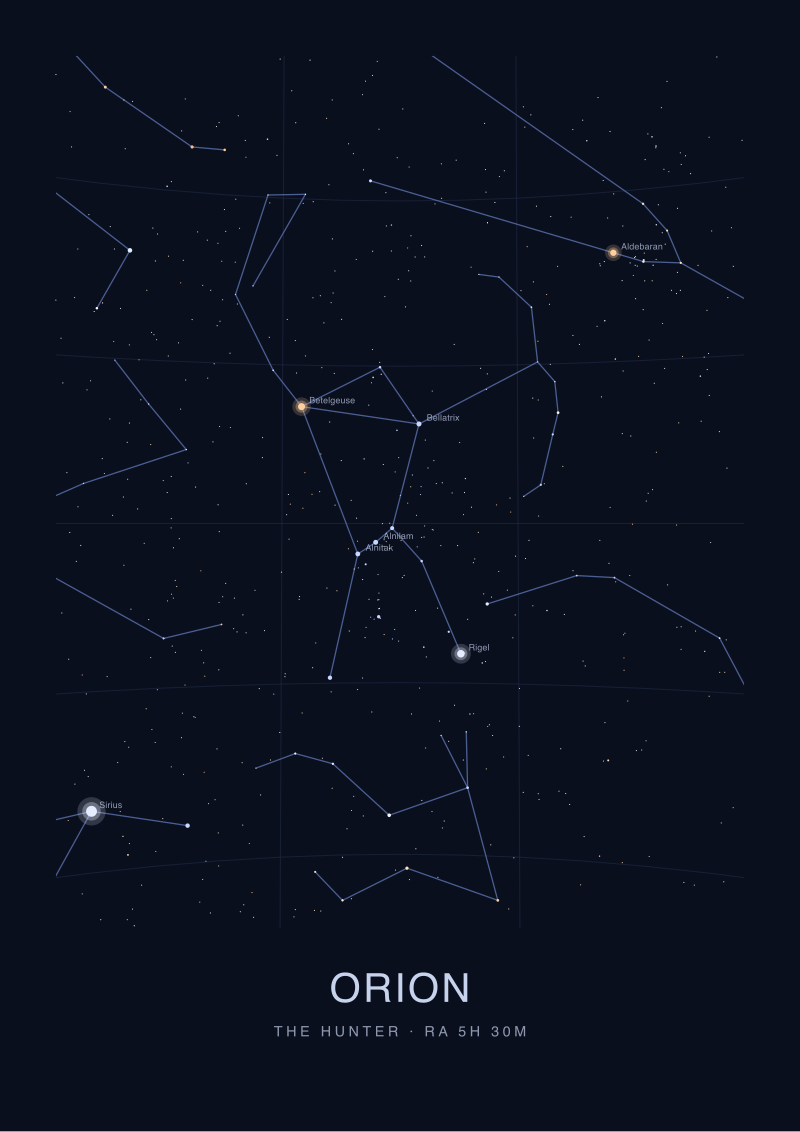
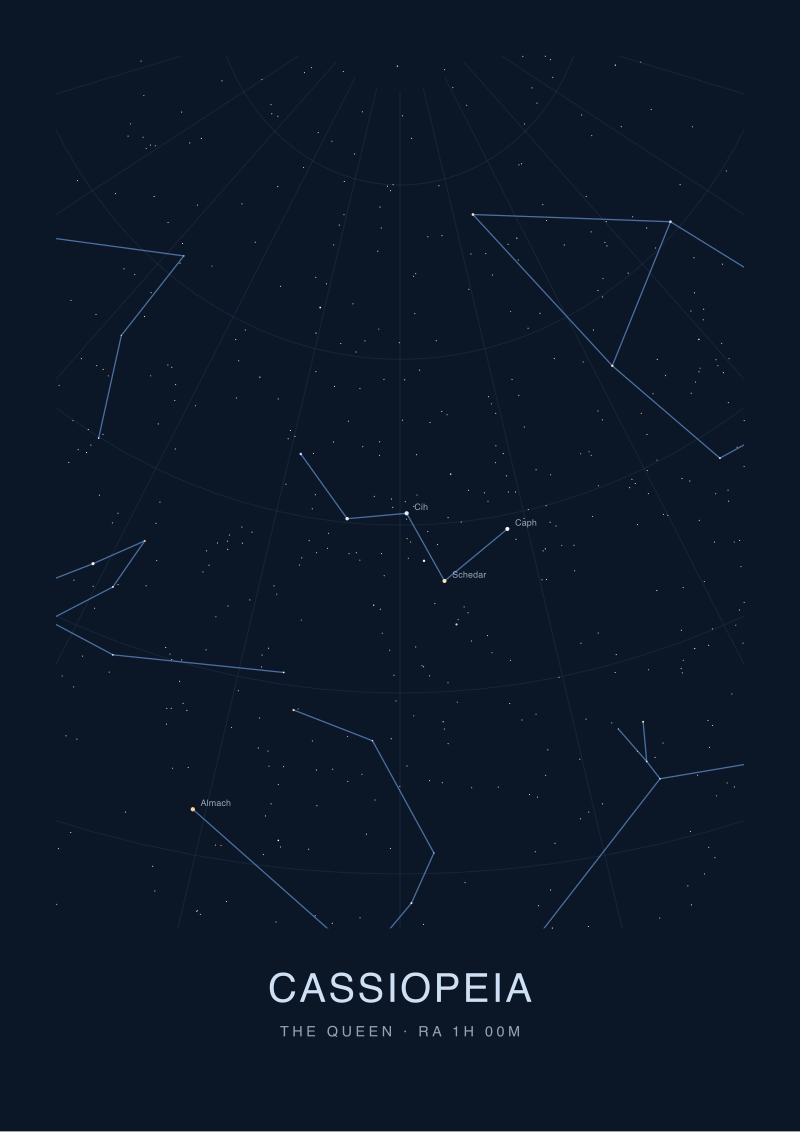
This is not a quirk of Ursa Major. It is the general rule for the northern hemisphere's most-recognised figures. What the public calls a constellation is almost always an asterism riding on top of a legally-defined region of sky. Orion has the belt-and-shoulders asterism inside a much larger Orion boundary. Cassiopeia's W is five stars inside a constellation with more. The Dipper is the cleanest example because the seven stars are unusually well-matched in brightness — they read as a single figure at a glance, which is precisely why they were named as a unit long before anyone drew the bear around them.
 Ursa Major
The print from this article · from €29.95
View the print →
Ursa Major
The print from this article · from €29.95
View the print →
Finding #2: The IAU Boundary Around Ursa Major Is a Legal Fence, Not a Drawing
In 1928, the International Astronomical Union commissioned the Belgian astronomer Eugène Delporte to draw hard boundaries around the eighty-eight recognised constellations. He published them in 1930. Those boundaries follow lines of right ascension and declination at the epoch B1875.0 — meaning they are straight in a coordinate system that no longer perfectly matches today's sky because of precession, but they still function as the official fence around every constellation.
The Ursa Major fence is not the shape of a bear. It is a jagged polygon that encloses the region of sky the bear has traditionally occupied, plus whatever adjacent field was cleaner to hand to Ursa Major than to a neighbour. A star inside that polygon belongs to Ursa Major for cataloguing purposes, regardless of whether it participates in any figure a human might draw.
This distinction matters when you plot a chart. The pointer stars Dubhe and Merak sit inside the boundary and inside the asterism. There are stars in the north-eastern corner of the boundary that sit inside Ursa Major administratively but outside anything most viewers would call the bear. A cartographer draws both: the fence in one weight of line, the figure in another. Confusing them is a beginner error and the reason so many amateur charts look wrong — they treat the asterism as the constellation and leave the rest of the boundary undrawn, which produces a bear-shaped hole in the surrounding sky.
Finding #3: Magnitude Discipline — Why the Dipper Looks Bright Next to Sirius and Vega
Every Big Dipper star sits between roughly magnitude 1.8 and 3.3 on the apparent magnitude scale — bright enough to punch through moderate light pollution, dim enough to disappear from downtown. To calibrate that band, compare it against the reference stars our HYG grounding gives us.
Sirius, in Canis Major, is magnitude −1.44. Canopus, in Carina, is −0.62. Arcturus, driving up out of Boötes, is −0.05. Rigil Kentaurus (Alpha Centauri A) sits at −0.01. Vega in Lyra is 0.03. Capella in Auriga is 0.08. Every one of those anchor stars is more than a full magnitude brighter than the brightest Dipper star. On the astronomical scale each whole step is a factor of ~2.5 in brightness, so a magnitude 1.8 Dipper star is about ten times fainter than magnitude −1.4 Sirius.
Which raises a genuine question: why does the Dipper read as one of the sky's most striking figures if none of its stars are, individually, in the top tier?
The answer is composition. The Dipper's seven stars are close in magnitude to each other, close in the sky, and arranged in a geometry — bowl plus angled handle — that the human visual system latches onto instantly. Sirius is brighter than any Dipper star, but Sirius is one dot. The Dipper is a shape. Chartmakers respect this. A print that plots Sirius correctly and the Dipper correctly, at the same visual scale, will make Sirius the loudest ink on the sheet — and the Dipper the most recognisable figure on it. Those are different jobs, and both matter.
 Orion
The print from this article · from €29.95
View the print →
Orion
The print from this article · from €29.95
View the print →
Finding #4: The Pointer Line to Polaris Is the One Piece of Sky Craft Everyone Should Learn
Extend the line from Merak through Dubhe — the two stars at the outer edge of the Dipper's bowl — about five times its own length, and you land on Polaris, the current North Star. This is not a hemisphere-specific trick. From any latitude in the northern hemisphere where the Dipper is visible, that line finds Polaris. It is the single most useful piece of sky-craft in the northern-hemisphere repertoire, and it is fifteen seconds of learning.
Two things worth understanding about it. First, Polaris is not particularly bright. It is a second-magnitude star, comparable in apparent magnitude to the mid-tier Dipper stars themselves. What makes it navigationally singular is not its brightness but its position — within roughly three-quarters of a degree of the true celestial pole. Every other star in the sky, over a night, wheels around it. Polaris barely moves.
Second, this arrangement is temporary. The Earth's rotational axis precesses over a cycle of about 26,000 years, tracing a slow circle on the celestial sphere. Polaris is our pole star now. It was not the pole star of the pyramid builders and it will not be the pole star of a distant future navigator. Vega — at magnitude 0.03, over sixty times brighter than Polaris — was closer to the celestial pole thousands of years ago and will be again. The pointer line still finds Polaris today, and will still find it for centuries. But the whole arrangement is a snapshot in a slow film. A star chart by date is doing that arithmetic; that is what "by date" means.
A Comparison Table: Constellation vs Asterism, Line by Line
The two categories get conflated constantly, so it is worth putting the distinction on a single grid.
| Attribute | Ursa Major (Constellation) | Big Dipper (Asterism) |
|---|---|---|
| Recognised by IAU | Yes — one of 88 official constellations since 1930 | No — asterisms have no official status |
| Boundary | Legally defined polygon (Delporte 1930) | No boundary; only a visual pattern |
| Star count | ~125 catalogued members inside the boundary | Exactly 7: Dubhe, Merak, Phecda, Megrez, Alioth, Mizar, Alkaid |
| Sky area rank | 3rd largest of 88 constellations | N/A — not measured that way |
| Cultural roots | Greek (Callisto myth) into Roman into IAU inheritance | Independent traditions: Plough (UK), Wagon (DE), Saucepan (FR), Drinking Gourd (US South) |
| What a chart plots | Boundary line + figure lines + all named stars | Just the seven stars and the joining lines between them |
What This Does NOT Prove
This piece has not audited the seven Dipper stars individually — Mizar in particular is a famous naked-eye double with its own history, and the physics of the loose Ursa Major moving group (which shares proper motion across five of the seven) is a separate argument that belongs in its own article. We have also not walked the reader through the fainter members inside the Ursa Major boundary that complete the bear figure under a dark sky, or the mythological threads outside the Greek tradition that read the same seven stars as a chariot, a wagon, a bier, or a boat.
Nor have we claimed the Delporte boundary is the last word on how to divide the sky. It is the working standard, and the one our charts respect. Other systems — pre-1930 constellation edges, Chinese lunar mansions, Islamic tradition's Anwā — divide the same sky by different logic, and a chartmaker choosing between them is choosing a whole editorial worldview, not just a set of lines.
The Takeaway
The constellation is the fenced region and the star census inside it; the asterism is the seven-star figure that made the region famous. A good star map draws both, in different weights of line, and never lets them be mistaken for each other.
FAQ
Is the Big Dipper the same thing as Ursa Major?
No. The Big Dipper is an asterism — a recognisable pattern of seven bright stars (Dubhe, Merak, Phecda, Megrez, Alioth, Mizar, Alkaid) that sits inside the constellation Ursa Major. Ursa Major, the Great Bear, is a much larger IAU-defined region of sky containing many more catalogued stars. The Dipper does the cultural work; the constellation is the legal fence around it. Every Big Dipper star belongs to Ursa Major, but Ursa Major contains far more than the Dipper.
Why is the Big Dipper called the Plough in Britain?
The seven-star figure has been named independently by many cultures that never spoke to each other. The British agricultural tradition read the same arrangement as a plough — the bowl is the mouldboard, the handle the beam a farmer walks behind. The French see a saucepan (la Casserole), the Germans a wagon (der Große Wagen), enslaved communities in the American South called it the Drinking Gourd. None of these are official astronomical names. The IAU recognises Ursa Major; the folk names belong to the asterism inside it.
How do you use the Big Dipper to find the North Star?
Locate the two stars at the outer edge of the Dipper's bowl — Merak at the base, Dubhe at the rim. Draw an imaginary line from Merak through Dubhe and extend it about five times the distance between the two stars, in the direction away from the bowl. You land on Polaris, a modestly bright second-magnitude star that sits within roughly three-quarters of a degree of the true celestial pole. This "pointer" trick works from any northern-hemisphere latitude where the Dipper is visible.
How bright is the Big Dipper compared to Sirius or Vega?
Not close. Every Dipper star sits between magnitude 1.8 and 3.3. For comparison, Sirius shines at −1.44 and Vega at 0.03 — both more than a full magnitude brighter than the brightest Dipper star. Since each magnitude step is a factor of roughly 2.5 in brightness, Sirius is about ten times brighter than a bright Dipper star. What makes the Dipper visually loud is not any single star but the geometry: seven stars of similar magnitude arranged in a shape the eye grasps instantly.
Will the Big Dipper always point to the North Star?
For the human timescales that matter to navigators and readers, yes — but the arrangement is not permanent. The Earth's rotational axis precesses through a slow 26,000-year circle, so the celestial pole drifts across the sky. Polaris happens to be near the pole now; thousands of years ago it was not, and thousands of years from now Vega will be closer to the pole again. The pointer line from Merak through Dubhe still finds Polaris today and will for many centuries, but a star chart drawn for the year 15,000 CE will need to redraw the pointer's destination.
Why do star maps show Ursa Major as a bear when the Dipper looks nothing like one?
Because the IAU boundary encloses more sky than the seven-star asterism uses. Under a dark rural sky, fainter stars inside the Ursa Major boundary trace out the head, snout, paws and long tail that classical iconography assigned to the Great Bear. Under moderate light pollution, those fainter stars vanish and only the Dipper survives. The bear was drawn for a dark-sky era. A modern city viewer sees the asterism; a dark-site viewer starts to see the animal the constellation was named for.
Is the Big Dipper visible from the southern hemisphere?
Only partially, and only from certain latitudes. Ursa Major is a northern constellation; the Dipper sits well north of the celestial equator. From near the equator it can be glimpsed low on the northern horizon at the right season, and from mid-southern latitudes it becomes progressively harder to see any of it. From deep southern-hemisphere latitudes it is effectively out of reach. Southern-sky navigators use the Southern Cross and its own pointer stars — Alpha and Beta Centauri — as the equivalent piece of naked-eye sky-craft.
What is the difference between an asterism and a constellation, in general?
A constellation is one of 88 officially recognised regions of sky, each with legal boundaries drawn by the IAU in 1930. An asterism is any recognisable pattern of stars that people have named, regardless of whether those stars belong to one constellation or several. The Big Dipper is an asterism inside a single constellation (Ursa Major). The Summer Triangle is an asterism whose three stars — Vega, Deneb, Altair — belong to three different constellations. Every constellation is official; asterisms are cultural.
From the collection
New charts and 10% off your first print.
One email now with your code. No noise after.