Five. That is the multiplier every chartmaker carries in their head when walking from the outer wall of the Big Dipper's bowl to the star that names the north. Five times a short arc, extended in the correct direction, lands on Polaris — with a margin of about one degree. That is the entire trick. The reason we are writing sixteen hundred more words is that on any given night the trick fails in three specific ways, and we would rather ask you three questions in prose than watch you extend a line into a mountain, a rooftop, or the wrong hemisphere. Answer as we go. The final section is the lookup table.
Question 1: Is the Big Dipper Above Your Horizon Tonight?
This is the question every hiking article skips. The Big Dipper is not a fixed decoration in the sky. It is an asterism inside the constellation Ursa Major, and like everything else that is not at the pole, it wheels around Polaris every twenty-four hours. Where you stand decides whether it is available to you at all.
For observers north of roughly forty degrees latitude — think of a line running through Madrid, New York, Beijing — the Big Dipper is circumpolar. It never sets. On some autumn evenings it will hang low near the northern horizon, upside down as it looks to a reader in a scout manual drawn from Boston, but it will be there. South of that line, the Dipper does set. In Cairo, in Mumbai, in Miami, there are hours and seasons when the whole bowl slips below the northern horizon and no amount of squinting brings it back.
The takedown here is simple. Most instructions written online assume the reader is standing in the American Midwest in July. They tell you the Dipper is "always there." It is not always there. Check first.
If Yes
Proceed. The Dipper is your instrument. Find the bowl — four stars arranged as a rough quadrilateral, with three more stars trailing off in a curved handle. That is your starting shape. Move to Question 2.
If No
You have two clean substitutes. The first is Cassiopeia, the W-shaped constellation on the opposite side of Polaris. When the Dipper is below the horizon, Cassiopeia is high, and the same north-pointing logic applies from the other direction. The second is patience. The Dipper will return. Wait a few hours, or a few weeks, and it will rotate back into view. If neither option suits you, note that this article is not the one you need tonight — a chart centered on Cassiopeia is.
Question 2: Can You Identify the Two Stars on the Bowl's Outer Edge?
The Big Dipper has seven bright stars. Three make the handle. Four make the bowl. The two you need are not just "the two brightest" — every scout manual we have read gives that instruction and every one of them is wrong. Brightness in the Dipper is roughly even; the seven stars all sit in the same magnitude neighborhood, and picking the "brightest two" gets you nothing useful.
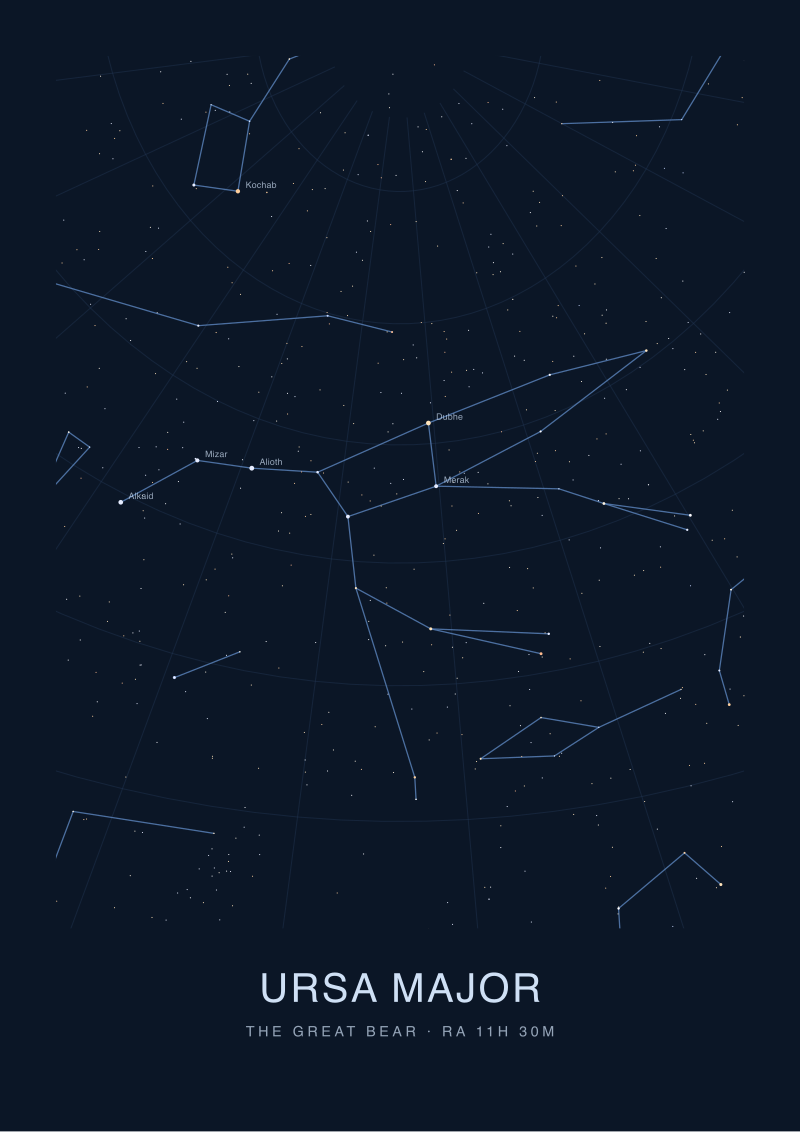
The correct instruction is geometrical, not photometric. Find the bowl. The bowl has two long sides — the side that meets the handle, and the side that faces away from the handle. The two stars on the away-from-handle side are the pointers. The lower of the two is Merak. The upper is Dubhe. Draw a line from Merak through Dubhe. Extend that line, in that direction, five times the distance between them. That is Polaris.
The scout manuals usually just say "the two outer stars." They rarely say which two. They never mention that if you pick the two stars on the handle side of the bowl, you will extend a line through Leo's brightest star and finish about ninety degrees away from Polaris. This has happened to people we have watched.
If Yes
Apply the multiplier. The gap from Merak to Dubhe is your unit. Five of those units, extended along the same line, from Merak through Dubhe and beyond — not the other way — is Polaris. Move to Question 3.
If No
Use shape as a scaffold. The bowl is a rough parallelogram. Whichever pair of stars forms the far edge from the curl of the handle is your pointer pair. Trace the two long sides of the bowl mentally. The one that continues into the sky if extended, rather than curving into the handle, contains the pointers. Then apply the five-times rule.
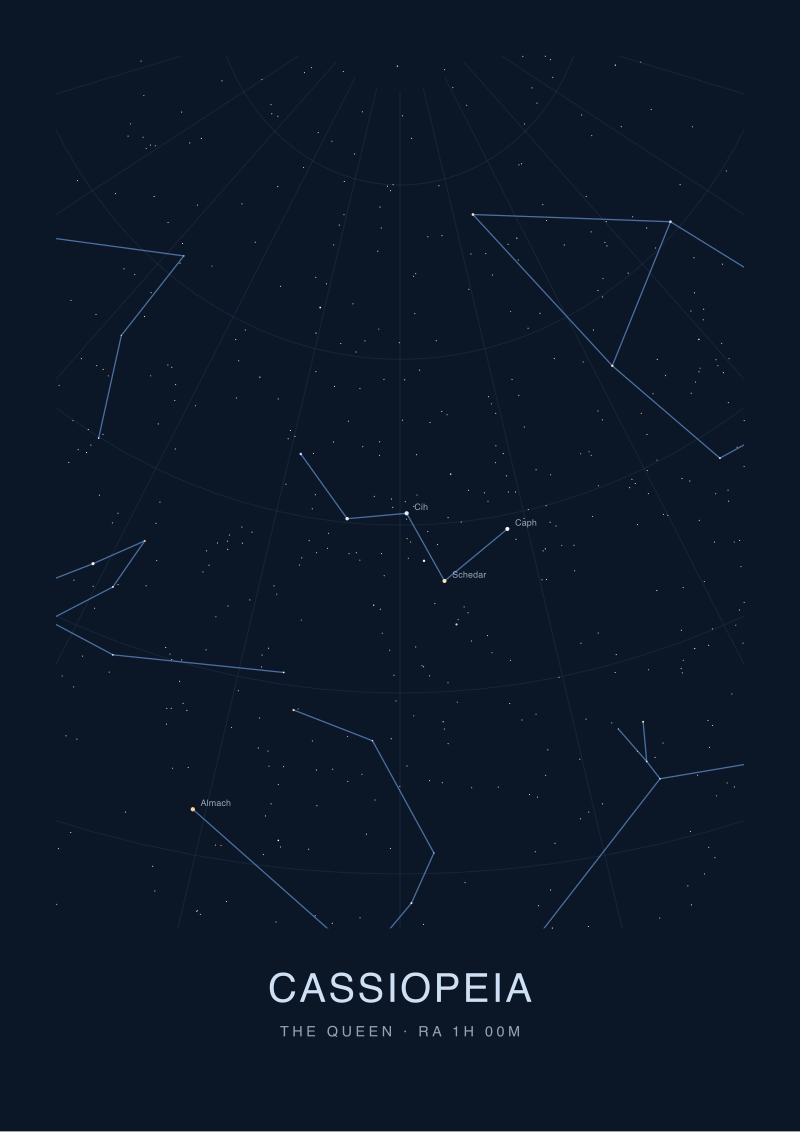 Cassiopeia
The print from this article · from €29.95
View the print →
Cassiopeia
The print from this article · from €29.95
View the print →
Question 3: Is the Northern Horizon Clear Where You Are?
Polaris sits at an altitude above the northern horizon equal to your latitude. From a rooftop in Mumbai at nineteen degrees north, Polaris is nineteen degrees up — often behind buildings, haze, or the sodium dome of the city. From Reykjavik at sixty-four degrees north, Polaris is nearly two-thirds of the way to overhead, clear of almost everything. The pointer line from the Big Dipper is only useful if the endpoint of that line is actually visible.
This is the question that turns a paper method into a working method. You can execute the five-times rule perfectly and still fail because Polaris itself is behind a chimney.
If Yes
Extend the line. The star it lands on will be Polaris. It is not particularly bright — nothing about the north star is exceptional except its location. There is no brilliant beacon. There is a moderate star, alone, roughly where the arithmetic said it would be, and it does not move visibly across the night while everything else does.
If No
Move if you can. Ten meters of horizontal walk to clear a rooftop is worth more than any refinement of the method. If you cannot move, execute the method mentally: mark the direction, note the altitude expected (equal to your latitude), and use the extended line as a compass bearing even if the star itself is hidden. Directional north is what you actually needed.
If You Answered Everything
| Q1: Dipper up? | Q2: Pointers identified? | Q3: Horizon clear? | Recommendation |
|---|---|---|---|
| Yes | Yes | Yes | Extend Merak through Dubhe five times. Polaris sits at the endpoint. Method complete. |
| Yes | Yes | No | Trace the line mentally; use it as a compass bearing even if Polaris is behind an obstruction. |
| Yes | No | Yes | Use the bowl's away-from-handle edge as the pointer pair, then apply the five-times rule. |
| Yes | No | No | Reposition to a clearer vantage before attempting; the method fails on both counts otherwise. |
| No | Yes | Yes | Use Cassiopeia — the W — on the opposite side of Polaris. Same logic, mirrored geometry. |
| No | Yes | No | Wait; both the Dipper and a clear horizon can arrive within hours. |
| No | No | Yes | Learn Cassiopeia from a chart tonight; use it. Return to the Dipper method another season. |
| No | No | No | Tonight is not the night. Consult a printed sky chart for your date and latitude. |
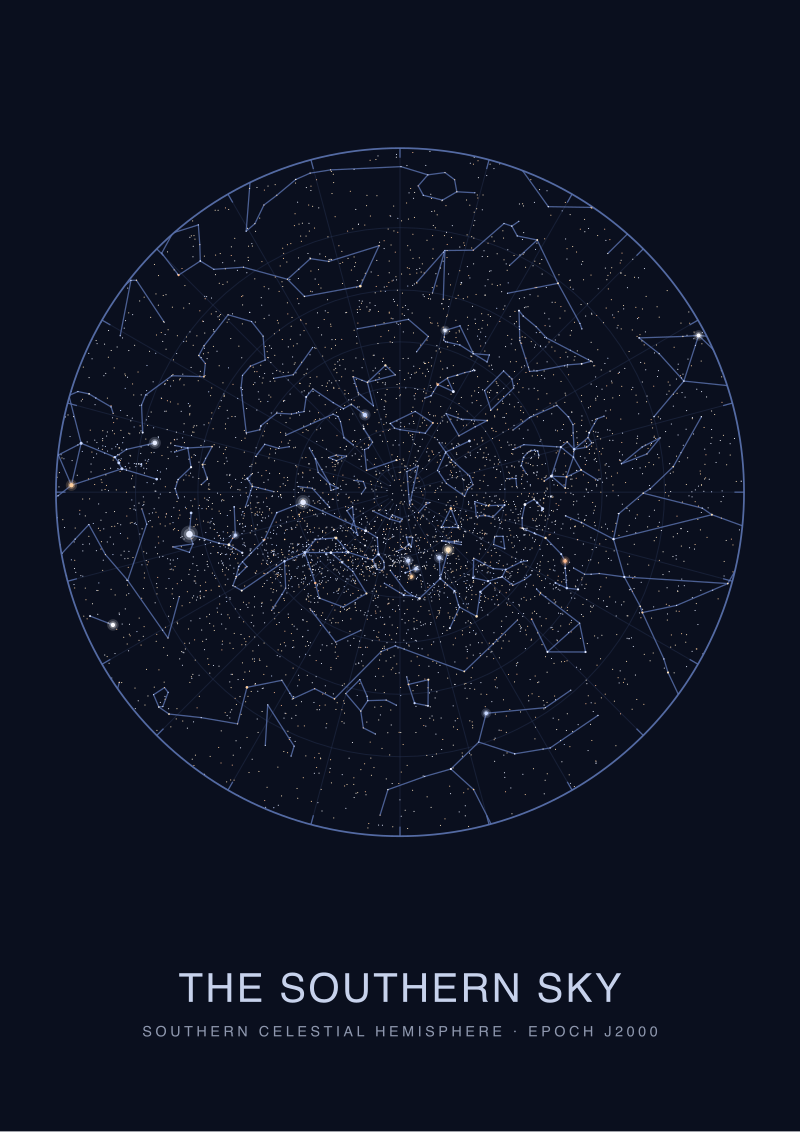
The map above assumes an observer in the northern hemisphere. Below the equator, none of this works — Polaris is beneath the horizon, permanently, and the whole conversation shifts to the southern skies. Rigil Kentaurus, at magnitude minus zero point zero one and declination sixty-one degrees south, is one of the anchors of that other sky, and it is not what you use for direction. There is no southern pole star of comparable brightness. The Southern Cross gets used, imperfectly, in its place — a separate article.
A note on the northern sky's brighter neighbors, so you do not confuse them for Polaris on the way. Vega, at magnitude zero point zero three, sits near the zenith on summer evenings at mid-northern latitudes and is dramatically brighter than the north star. Capella, magnitude zero point zero eight, dominates the northeast on autumn evenings and is likewise brighter. Polaris is neither of these. If the star you extended toward is unmistakably brilliant, you have overshot the geometry.
 Leo
The print from this article · from €29.95
View the print →
Leo
The print from this article · from €29.95
View the print →
The Method's Quiet Expiration Date
Polaris earned the name because it currently sits within about one degree of the true celestial north pole. That gap is not fixed. Earth's rotational axis wobbles slowly — precession, a twenty-six-thousand-year cycle — and the pole is drifting away from Polaris now, at a scale invisible to any single lifetime but visible in millennia. In two thousand years the star we call the north star will be conspicuously off the pole. In twelve thousand years Vega will be closer to true north than Polaris. The five-times rule will still work; the name of its endpoint will change.
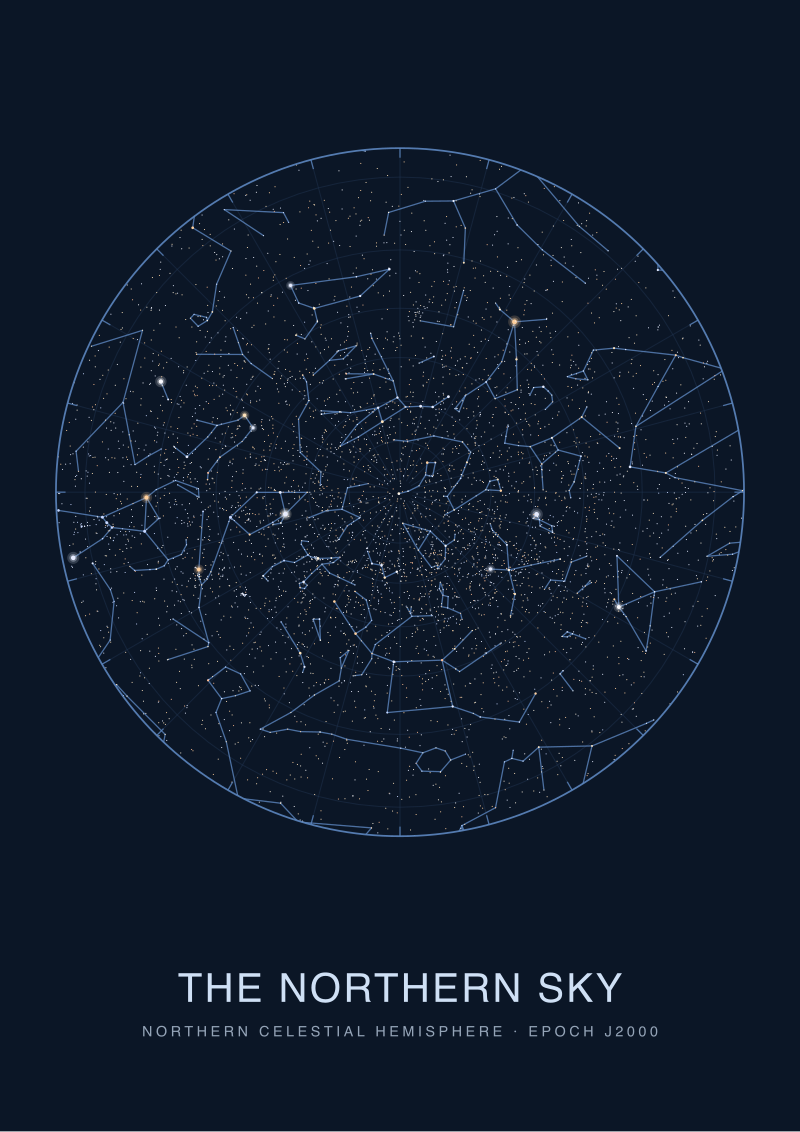
For anyone reading this in the current century, the method is stable. We have plotted the northern skies enough to keep prints of the polar region in the studio catalogue — the Polaris-centered maps are at our shop if you want the geometry hanging on a wall rather than reconstructed each clear night.
FAQ
Which two stars in the Big Dipper actually point to Polaris?
Merak and Dubhe — the two stars on the outer edge of the bowl, meaning the edge farthest from the curved handle. Merak is the lower one, Dubhe the upper. Draw an imaginary line from Merak through Dubhe and extend it in the same direction. This is the correct pair; the two stars on the handle-side edge of the bowl point somewhere else entirely and are a common source of error in casual instructions.
How far along the line is Polaris?
Approximately five times the distance between the two pointer stars themselves. So if Merak and Dubhe are separated by a small visible gap, measure that gap by eye, then walk your eye along the extended line five of those gaps beyond Dubhe. Polaris sits at the endpoint, with a margin of about one degree. The five-times rule is a rule of thumb, not a precise measurement, but it is close enough for any practical use.
Why is Polaris not particularly bright?
Because brightness had nothing to do with why it earned the name. Polaris was chosen for its location, not its magnitude — it happens to sit near the north celestial pole, which makes it directionally useful even at moderate brightness. Truly bright stars like Sirius at magnitude minus one point four four are dramatically brighter, but they wheel across the sky. Polaris stays put. Location beats brightness for navigation.
Does this method work in the southern hemisphere?
No. Polaris is below the horizon south of the equator and cannot be seen at all. The Big Dipper itself is also invisible from most southern latitudes. Southern observers navigate using different landmarks — most commonly the Southern Cross and the two pointer stars near it — and there is no southern equivalent of Polaris close enough to the south celestial pole to serve as a naked-eye anchor.
What if I confuse the Big Dipper with the Little Dipper?
The Little Dipper contains Polaris at the end of its handle, which sounds convenient but is actually the trap. Its stars are fainter and its shape is genuinely difficult to see from any light-polluted location. Almost every real-world identification of Polaris starts from the Big Dipper for exactly this reason — the bright pointer method is more reliable than trying to trace a dim asterism directly. Learn the Big Dipper first; the Little Dipper resolves itself later.
Will this method still work in a thousand years?
The geometric method will continue to work — the five-times rule from the Big Dipper's pointers is a pure arithmetic instruction and does not depend on which star sits at the endpoint. But the endpoint will drift. Precession moves the celestial pole about one degree every seventy years, and over centuries Polaris will visibly separate from true north. Future navigators using the same method will land on a spot near, but not at, a north star that will no longer deserve the definite article.
Five. Not four, not six, and extended from Merak through Dubhe rather than the reverse. Do that, and you have north — with a margin of one degree that will grow over centuries but not over your life. That is the number that decides whether you need any of the apps, compasses or printed charts the rest of the internet will try to sell you tonight. You do not. The math is closed.
From the collection
New charts and 10% off your first print.
One email now with your code. No noise after.