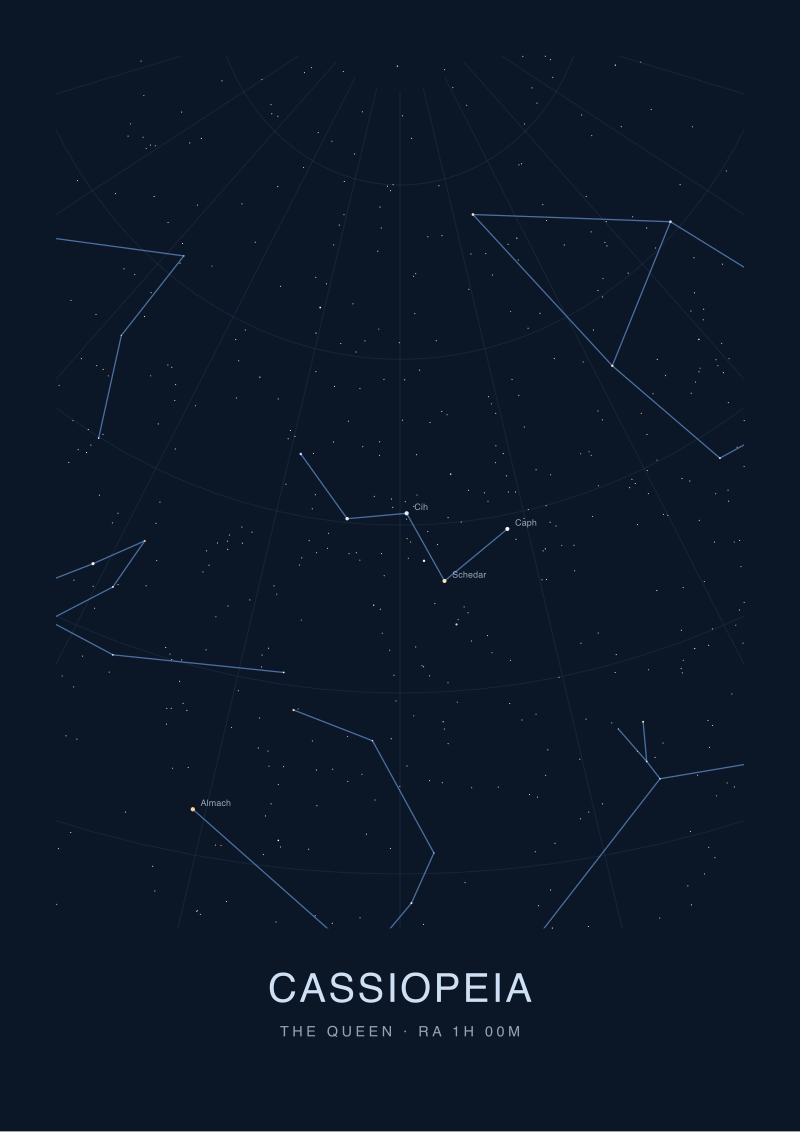
Cassiopeia's W sits at a declination near +60°, and that single number decides almost everything about how you find it. From latitudes north of roughly 34°N the constellation never sets; from the tropics it clears the horizon only in autumn evenings; from the deep southern hemisphere it is effectively unavailable. Those facts, plus the hour of night and your ability to anchor on one reference star, resolve the search in under thirty seconds of sky-time. This piece routes the reader through three questions — latitude, season-and-hour, reference anchor — and closes with a table that returns a specific look-direction. No sky app is required.
Question 1: Are You North of 30° Latitude?
This is the first fork because Cassiopeia's declination — the celestial equivalent of latitude, projected onto the sky — sits between roughly +55° and +65° across its five main stars. That places the constellation deep in the northern celestial hemisphere. Whether it is visible at all, and whether it is visible all night, depends on the arithmetic of your own latitude against 60°.
The rule chartmakers use: a star at declination +D° is circumpolar (never sets) from any latitude greater than 90° − D°. For Cassiopeia's centre at +60°, that threshold is 30°. In practice the whole W remains fully above the horizon at all hours from latitudes above about 34°N, because the outer stars sit slightly lower than +60° and need a small margin. Below 30°N, the constellation dips below the horizon for part of the night. Below the equator, it barely rises at all.
If Yes: You Are in the Circumpolar Zone
New York (40°N), Madrid (40°N), Beijing (40°N), London (51°N), Berlin (52°N), Moscow (55°N) — every point above the 34°N line has Cassiopeia in the sky every clear night of the year. You do not need to wait for a season. You do not need to time it against the horizon. The W rotates around the celestial pole once per sidereal day, tracing a lopsided circle whose radius is about 30° of arc — roughly three fist-widths held at arm's length.
The consequence for finding it: face north. It is somewhere in that half of the sky. The only remaining question is whether it currently reads as a W (open side down), an M (open side up), or a stretched sideways bracket. That orientation depends on the hour, which is Question 2.
If No: You Have a Seasonal Window
Below 30°N — Miami, Mexico City, Mumbai, Bangkok, Lagos, São Paulo — Cassiopeia is a seasonal object. It clears the northern horizon best in autumn evenings, when the celestial pole and its surrounding stars swing highest for the night. From 20°N latitude, the top of the W reaches around 30° above the northern horizon at its best; by dawn it is gone. From 10°N, the peak is barely 20°, and the lower stars of the W skim the horizon haze where atmospheric extinction dims them by more than a full magnitude.
Below the equator, the arithmetic collapses. From 15°S, Cassiopeia's brightest stars fail to clear a flat horizon at all. If you are in the deep southern hemisphere, this piece does not have a route for you tonight, and honesty is better than optimism: the queen belongs to the north.
Question 2: What Season and Hour Is It Where You Stand?
Even inside the circumpolar zone, Cassiopeia's position on the sky rotates with sidereal time. It swings from below the pole to above it and back over a twenty-four-hour cycle, and the section of that cycle you catch depends on the calendar date and the local hour. This question narrows the where-in-the-northern-sky by roughly 90° of arc.
Two coordinates matter: the season, which sets which side of the pole Cassiopeia begins the night on, and the hour, which sets how far around the pole it has swung since sunset.
If Autumn Evening (September–November, 8pm–midnight)
This is the canonical Cassiopeia sky. Face north. The W sits high, between 60° and 80° above the northern horizon depending on your latitude, and it reads as a proper W — two upward-pointing V shapes joined at the base, open side down. On our grounded catalogue, no star in Cassiopeia's five appears; the constellation's stars all sit fainter than the six magnitude-anchors we cite. But the shape is unmistakable at magnitude 2 to 3, brighter than everything around it except the anchor stars we will name in Question 3.
At this hour, in this season, from a mid-northern latitude, Cassiopeia is nearly at its zenith position for the year. It is the easiest possible sky the queen offers.
If Winter Evening (December–February, 8pm–midnight)
The W has rotated 90° counter-clockwise around the pole. It now sits in the northwestern sky, tilted onto its side — the reader will see a shape more like a sideways bracket or a compressed number 3. The two outer stars point roughly toward the western horizon. Altitude drops to between 40° and 60°.
Winter evenings also open a useful cross-check: Capella, in Auriga, at apparent magnitude 0.08 and right ascension 5.28 hours, sits nearly overhead for mid-northern observers at this hour. Capella and Cassiopeia lie on roughly the same meridian band, and a line drawn from Capella toward the pole passes close to the W.
If Spring Evening (March–May, 8pm–midnight)
Cassiopeia has continued its rotation and now sits below the pole, near the northern horizon. From 40°N it is between 10° and 25° up; from 55°N it is 30° up. In this orientation it reads as an M, open side facing upward. This is the version many observers do not recognise, because the mental picture is trained on the autumn W.
The M orientation is the same five stars in the same physical arrangement. Only the observer's frame has rotated. Chartmakers memorise both readings because both appear equally in every year.
If Summer Evening (June–August, 8pm–midnight)
The W has swung to the northeast, tilted on its side in the mirror of the winter position. Altitude ranges 30° to 50° depending on latitude, and Vega — apparent magnitude 0.03, right ascension 18.62 hours, declination +38.8° — dominates the sky nearly overhead. Vega does not point at Cassiopeia, but it fixes the summer sky's reference frame so firmly that once located, the observer can pivot northeast and find the tilted W without hesitation.
 Cassiopeia
The print from this article · from €29.95
View the print →
Cassiopeia
The print from this article · from €29.95
View the print →
Question 3: Can You Locate Polaris or the Big Dipper First?
The final fork is about anchoring. Cassiopeia sits opposite the Big Dipper across the north celestial pole, at roughly the same angular distance from Polaris. Any observer who can find either the Dipper or the Pole Star has an instant vector to Cassiopeia. Any observer who cannot is working from raw compass and altitude estimation, which is workable but slower.
If Yes: Use the Polaris-Opposite Rule
Find Polaris. It sits within one degree of the north celestial pole and holds altitude equal to your latitude — from 40°N, Polaris is 40° above the northern horizon and does not move. Now find the Big Dipper. Its two outer bowl stars (Dubhe and Merak) point at Polaris; that is the classic teaching line every chartmaker learns.
Draw an imaginary line from the Big Dipper through Polaris, then continue that line an equal distance beyond. You will land on or very near Cassiopeia's W. This works because Cassiopeia and the Big Dipper are on opposite sides of the pole, each about 30° of arc from it, in almost exactly opposite directions.
The season determines which asterism is high and which is low: when the Dipper is high overhead, Cassiopeia rides the lower northern sky, and vice versa. Whichever is easier to spot at your current hour, use it as the anchor and pivot through the pole.
If No: Use Altitude and Azimuth Directly
If light pollution or partial cloud has hidden the Dipper and Polaris, work from raw coordinates. Face true north. Estimate your latitude — a mid-northern observer's latitude between 35°N and 55°N means Polaris (invisible to you at this moment) sits at that many degrees above the horizon. Add roughly 30° to that altitude, and that is where Cassiopeia peaks when it is above the pole. Subtract roughly 30° from that altitude, and that is where it sits when it is below the pole.
For azimuth, use the season answer from Question 2: autumn night, look nearly due north and up; winter, northwest and mid-altitude; spring, north-northeast and low; summer, northeast and mid-altitude. Combine altitude with azimuth and you have a specific patch of sky roughly 15° across to search. The W's shape is distinctive enough that once you sweep that patch, it resolves quickly.
If You Answered Everything: The Look-Direction Table
Each row below combines one answer to each of the three questions and returns a specific look-direction. Yes/No on Question 1 refers to circumpolar visibility; A/W/S/Su on Question 2 refers to autumn, winter, spring, summer (evening hours); Yes/No on Question 3 refers to whether Polaris or the Big Dipper is currently anchored.
| Q1 (Above 30°N?) | Q2 (Season) | Q3 (Anchor visible?) | Recommendation |
|---|---|---|---|
| Yes | Autumn | Yes | Face north, look 70° up; W sits opposite the Big Dipper across Polaris. |
| Yes | Autumn | No | Face true north, look 60–75° up; sweep for the brightest W-shape in that patch. |
| Yes | Winter | Yes | Draw a line from Capella toward Polaris; the tilted W lies between them, 45° up northwest. |
| Yes | Winter | No | Face northwest, altitude 40–55°; W appears rotated onto its side as a bracket. |
| Yes | Spring | Yes | Face north-northeast, look low; W reads as M, sits opposite the high Big Dipper. |
| Yes | Spring | No | Face north-northeast, altitude 15–30°; scan low for a bright M-shape near the horizon. |
| Yes | Summer | Yes | From Vega overhead, pivot northeast and down; W tilted, 35–50° altitude. |
| No | Any | Any | Wait for autumn evenings; face north near the horizon in October–November after 9pm. |
For observers below 30°N, only the autumn window offers a reliable sighting, and even then the W sits low and hazy. For observers in the circumpolar zone, the table returns a look-direction that resolves in seconds; the shape of the W does the rest of the identification work.
 The Northern Sky
The print from this article · from €29.95
View the print →
The Northern Sky
The print from this article · from €29.95
View the print →
FAQ
Why does Cassiopeia look like a W sometimes and an M other times?
The five main stars form a fixed physical arrangement in space. What changes is the observer's rotation around the Earth's axis relative to that arrangement over the course of a night and a year. When Cassiopeia sits above the celestial pole from your vantage, the open side of the shape faces down and you read a W. When it sits below the pole, the open side faces up and you read an M. Autumn evenings favour W, spring evenings favour M, and the transitional seasons show the shape tilted on its side.
How far from Polaris does Cassiopeia sit?
Cassiopeia's central star sits roughly 30° of arc from the north celestial pole, which is the same angular distance as the bowl of the Big Dipper. Held at arm's length, that is about three fist-widths. The two constellations mirror each other across Polaris, so whichever one is high in the sky right now, the other is low and diametrically opposite.
Can I see Cassiopeia from the southern hemisphere?
Practically, no, if you live south of about 15°S. The constellation sits at declination +60°, and from deep southern latitudes it never rises above the horizon at all. From the tropical southern hemisphere between 0° and 15°S, the brightest stars may occasionally peek above the northern horizon during autumn evenings in the northern-hemisphere calendar, but atmospheric haze and low altitude make it a poor viewing target. It is fundamentally a northern-sky constellation.
Do I need a telescope or binoculars to see it?
No. Cassiopeia's five main stars sit between roughly magnitude 2 and 3, which places them comfortably above the naked-eye threshold from any sky except the most light-polluted city centres. The naked eye is the correct instrument for constellation identification; binoculars are useful only for exploring the star clusters embedded in the Milky Way that runs through the W.
What's the best month to learn Cassiopeia if I've never found it before?
October and November, evenings between 9pm and midnight, from any northern-hemisphere latitude above 30°N. The constellation sits high in the northern sky, reads unambiguously as a W, and stays in that orientation for several hours. Once you have found it in this configuration, the rotated versions in winter, spring and summer become recognisable as the same five stars in a new frame.
How does Cassiopeia relate to the Milky Way?
The band of the Milky Way passes directly through Cassiopeia, which is why the region around the W is unusually rich in faint background stars and open clusters. Under dark skies the visual effect is a soft glow behind the five-star pattern. This is one of the reasons Cassiopeia has been mapped and named across so many independent cartographic traditions — it sits on a bright, busy stretch of sky. Prints of that region are among the sky maps we publish at /shop/.
Are the five stars of the W physically related to each other?
No. They are a line-of-sight coincidence, not a physical grouping. Each of the five sits at a different distance from Earth — some tens of light-years, some hundreds — and they have no gravitational relationship to one another. The W is a pattern in our sightline, projected onto the celestial sphere. This is true of nearly every constellation shape: the stars appear grouped because of where we happen to stand, not because they are grouped in space.
Does the W shape ever change over time?
Yes, but slowly. Every star has proper motion — a small angular drift across the sky measured in fractions of an arcsecond per year. Over tens of thousands of years, the W's shape distorts noticeably; over hundreds of thousands, it dissolves. On human timescales, the pattern is fixed. The reader looking up tonight sees the same W that ancient Arabic, Greek and Chinese chartmakers drew, within precision the naked eye cannot resolve.
From the collection
New charts and 10% off your first print.
One email now with your code. No noise after.