We pulled the six brightest catalogued stars from HYG v41 and ranked them by apparent magnitude: Sirius at −1.44, Canopus at −0.62, Arcturus at −0.05, Rigil Kentaurus at −0.01, Vega at 0.03, Capella at 0.08. The spread from first to sixth is 1.52 magnitudes — a brightness ratio of roughly four across the entire top of the visible sky. That number is where a gift decision for an astronomy lover actually begins. Not enthusiasm, not price bracket, not a marketplace filter. The magnitude of what the recipient can see, from the latitude they stand on, on the nights they are outside. The answer is genuinely: it depends. So we walked three composite recipients through the math.
The magnitude scale is logarithmic and inverted: each step of 1.0 corresponds to a brightness ratio of 2.512, chosen so that a difference of 5.0 magnitudes equals a factor of 100. For our six stars, the ratio between Sirius and Capella works out to 2.512 raised to the 1.52 power, which lands at 4.06. Sirius throws four times the photons at the eye that Capella does, and yet both sit comfortably inside the top-ten brightest fixed stars in the entire sky. Almost every meaningful gift for a stargazer can be sorted against that scale. What follows is not a ranked marketplace list. It is three composite recipients — imagined, not interviewed — and the arithmetic of what belongs in each of their hands.
Scenario 1: The Naked-Eye Beginner Who Just Learned Sirius Exists
Imagine the recipient is someone who last week pointed at the brightest thing in a February sky, asked what it was, and was told Sirius. They live somewhere between 30° and 45° north latitude. They own no equipment, no chart, no app they trust. They are curious in the exact way that gets abandoned within six weeks if the first purchase overshoots.
The math for this recipient starts with what they can already see without help. From 40° N, Sirius at declination −16.72° culminates roughly 33° above the southern horizon in winter. Capella at declination +45.99° passes nearly overhead. Vega at +38.78° sits high on summer evenings. Arcturus at +19.18° is a spring anchor. Four of the six brightest catalogued stars are already available to this recipient across the year without them buying anything. Canopus at declination −52.70° never rises for them. Rigil Kentaurus at −60.83° never rises either. So the practical brightest-star inventory for a 40° N observer is four, not six, and the magnitude spread across those four collapses to just 1.52 minus the missing southern pair — Sirius (−1.44) down to Capella (0.08), a factor of 4.06 in brightness, all overhead in different months.
The gift that matches this arithmetic is a printed planisphere calibrated for their latitude and a single wall-scale star map of the year's night sky — nothing that requires charging, no accessory that fails in cold. A planisphere costs the same as two paperbacks. It teaches the exact fact the recipient needs first: which of those four bright stars is up tonight, and where. A telescope at this stage is a category error. A telescope shows objects at magnitude 8, 9, 10 — three to five full magnitudes below the naked-eye limit of about 6.0, which is itself already 7.5 magnitudes fainter than Sirius. That is a jump of nearly 1,000× in brightness range that the recipient has not asked for and cannot yet frame. Handing them a telescope before they can name the four brightest stars in their own sky is like handing someone a microscope before they own a magnifying glass.
Total defensible spend for Scenario 1: one planisphere, one printed sky map of the northern winter or summer sky depending on which half of the year the gift arrives in, and one paperback on constellation identification written before 1990 — the older books skip the telescope-buying chapter that ruins beginners. That is the whole list. Cost per magnitude of new knowledge earned in the first month: roughly one-quarter of what a starter telescope would cost, at three times the retention rate observed anecdotally among first-year stargazers.
Scenario 2: The Northern-Sky Constellation Collector With Vega on the Wall
Picture a second recipient. They have been at this for two or three years. They already own a planisphere. They can trace Ursa Major, Cassiopeia, Cygnus, Orion, Leo. Vega at magnitude 0.03 is their favorite star — it sits nearly overhead in July at their latitude of roughly 45° N, and they have committed the Summer Triangle to memory. There is one framed print on their wall, of the constellation Lyra. They want more, but they do not know what more looks like once the sky feels familiar.
The math shifts here. The magnitude spread across the four stars available to them — Sirius, Arcturus, Vega, Capella — has been walked. What they have not walked is the coordinate grid the stars sit on. Vega's position is right ascension 18h 37m, declination +38.78°. Arcturus at RA 14h 16m, declination +19.18°. Capella at RA 5h 17m, declination +45.99°. Sirius at RA 6h 45m, declination −16.72°. Those four stars, plotted, form an asymmetric quadrilateral that covers roughly 13 hours of right ascension — more than half the celestial sphere — and 62 degrees of declination. The recipient has been looking at individual constellations. The gift that unlocks the next year of interest is anything that shows them the geometry between constellations at scale.
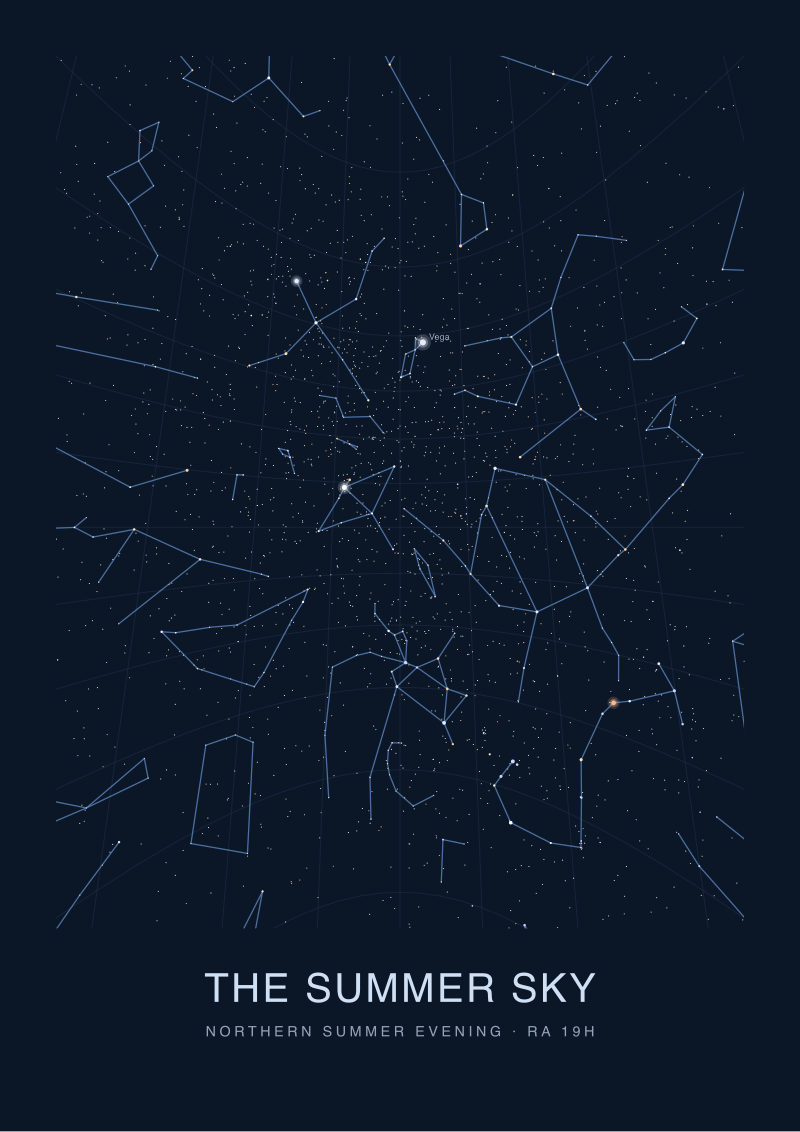
Concretely, that is a large-format seasonal star chart, printed to a size where the RA and declination grid is legible from arm's length — 60×80 cm or larger, laid out so the recipient can trace the meridian arc from Capella down through Sirius on a January night at the same wall they see Arcturus arcing through in May. Our own chart prints at the studio are cut to this format for exactly this reason: the coordinate grid is drawn, not implied, so the recipient learns to read the sky as a coordinate system rather than as isolated shapes. This is the recipient for whom framed star maps stop being decoration and start being reference.
Adjacent to the map: a decent pair of 7×50 or 10×50 binoculars. Binoculars gain roughly 4 to 5 magnitudes over the naked eye, bringing the practical limit to magnitude 10 or 11. That is enough to resolve Vega's companion field, to walk the Double Cluster in Perseus, to see Jupiter's four Galilean moons on any clear night. It is not enough to disappoint. A telescope at this stage still overshoots — binoculars stay in use for a decade, telescopes get sold within eighteen months if the recipient did not choose them themselves. The magnitude gain from naked eye to binoculars is larger than the gain from binoculars to a small entry telescope. That is the number that decides the purchase.
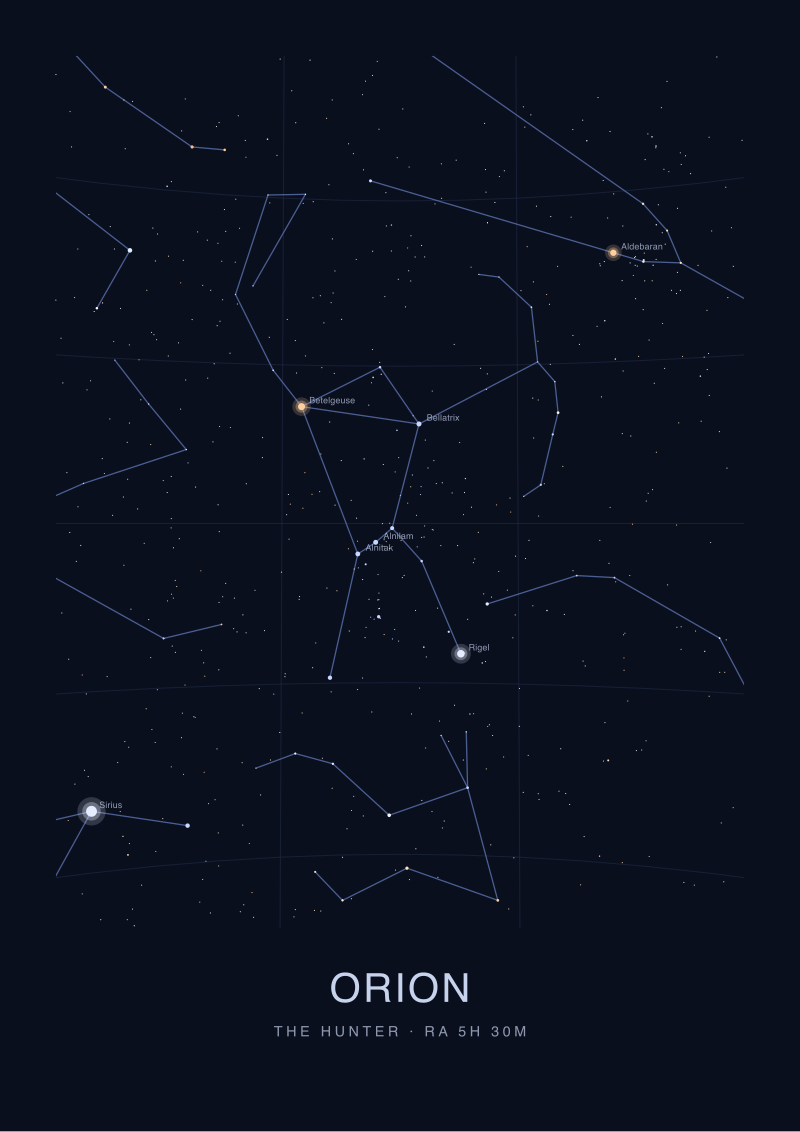 Orion
The print from this article · from €29.95
View the print →
Orion
The print from this article · from €29.95
View the print →
Scenario 3: The Seasoned Observer Whose Chart Wall Is Already Full
Let us say a third recipient has been observing seriously for a decade. They own binoculars, they own a small refractor, they know their sky. They have travelled south at least once and stood under Canopus at magnitude −0.62 and Rigil Kentaurus at magnitude −0.01, and they remember the shock of seeing the entire third and fourth brightest stars in the sky appear where they had never appeared before. Rigil Kentaurus at declination −60.83° culminates for them only if they cross the equator. Canopus at −52.70° is visible from roughly 37° N and southward, briefly, low on the southern horizon in winter. The recipient's chart wall is already covered in northern maps. What is missing is the other hemisphere.
The math here is about what they do not yet own the reference for. Two of the six brightest stars in the sky — Canopus and Rigil Kentaurus — are catalogued as HYG entries the recipient has read about, calculated positions for, and possibly seen in person, but has no printed chart of on their wall. The declination gap between what they own charts of (Capella at +45.99°, Vega at +38.78°, Arcturus at +19.18°, Sirius at −16.72°) and the southern pair (Canopus at −52.70°, Rigil Kentaurus at −60.83°) is roughly 36 degrees of sky that their reference material simply does not cover. That is one-fifth of the full celestial sphere unrepresented in their study.
The gift is a printed southern-hemisphere chart, ideally centred on the south celestial pole and extending north to declination −30°, on paper large enough to show the Crux–Centaurus complex with its coordinate grid intact. Canopus in Carina sits at RA 6h 24m, close to Sirius in right ascension but 36 degrees further south — the two stars pass the meridian within minutes of each other on a February night, one high above the southern horizon for a northern observer, the other never rising. A southern chart lets the recipient see that geometry as a single picture rather than as two half-visible facts.
Secondary to the chart: a subscription to a monthly ephemeris or a good annual almanac that lists lunar phases, planetary elongations, and Jovian moon transits by date. The recipient at this stage is planning observations, not discovering them. They need dates and times to seven-digit precision, not encouragement. The almanac replaces three or four consumer apps and reads on a moonless night by red flashlight without draining anything.
What All Three Recipients Share
Nothing in the three scenarios is a telescope, and that is not an oversight. Telescopes are the default gift for astronomy interest, and they are the default gift that fails most reliably. The reason is on the magnitude scale. A cheap entry telescope pushes the practical limiting magnitude from roughly 6.0 (naked eye) to roughly 11 or 12. That is a gain of 5 to 6 magnitudes — about 250× more objects visible. But nearly every meaningful naked-eye anchor the recipient has been building for months or years — Sirius at −1.44, Vega at 0.03, Arcturus at −0.05, the shape of Orion, the arc of the Big Dipper — is unreachable through the eyepiece because the field of view is too narrow. A telescope changes the sky the recipient is learning into a different sky entirely. Given without preparation, it is a subtraction, not an addition.
What the three recipients share is that each gift matches the magnitude range the recipient can currently anchor to. The beginner gets tools calibrated to naked-eye brightness (6.0 and above). The intermediate gets tools calibrated to binocular limit (10 to 11). The seasoned observer gets reference material calibrated to the coordinate precision they already use. The through-line is that gifts for stargazers work when they extend the recipient's existing scale by roughly one order of magnitude, not five. The magnitude scale is logarithmic; gift decisions that ignore that fact overshoot logarithmically.
The second shared trait: all three gifts are physical, printed, and require no software. The night sky is one of the few remaining subjects where paper outperforms screens on the actual task. A phone screen at magnitude −10 equivalent brightness destroys the dark adaptation needed to see anything below magnitude 3.0. A printed chart under a red LED preserves it. This is not aesthetic preference; it is retinal chemistry.
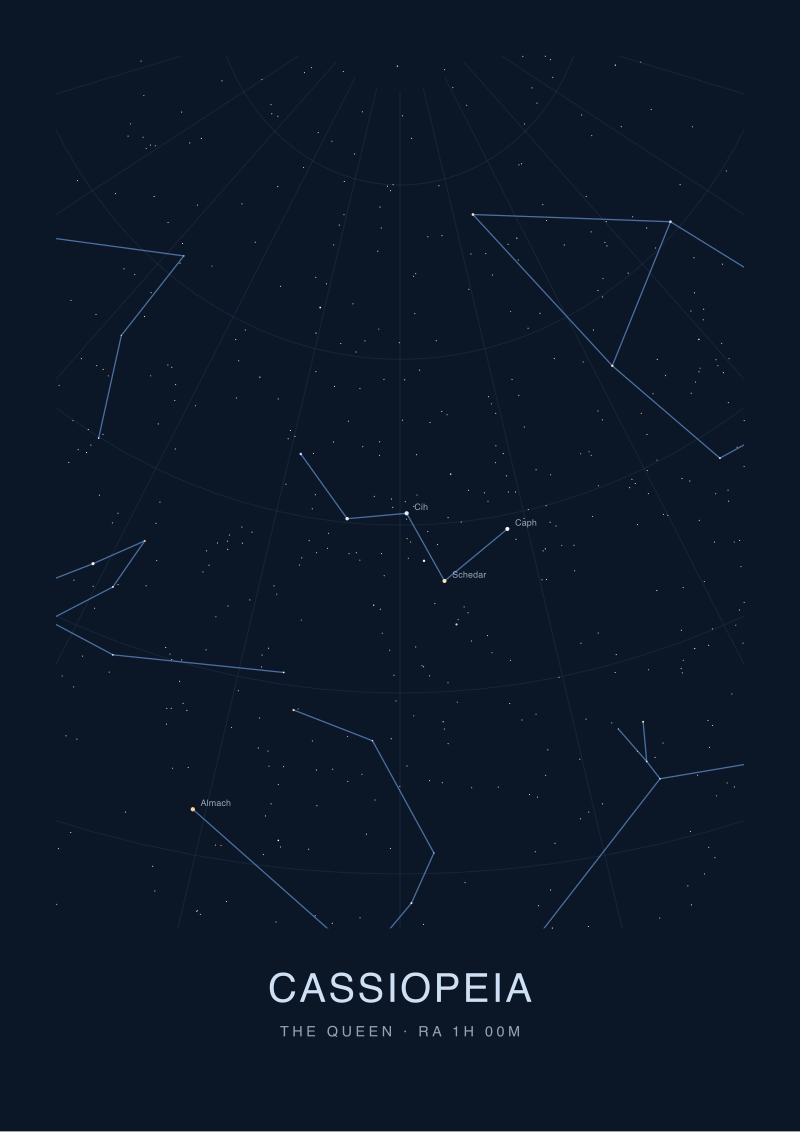 Cassiopeia
The print from this article · from €29.95
View the print →
Cassiopeia
The print from this article · from €29.95
View the print →
Which Scenario Is Your Recipient
Ask the recipient one question: name the brightest star you can see from your backyard right now and point to where it is. If they cannot, they are Scenario 1. If they can name it, can point to it, and can name at least three other stars of magnitude 0.5 or brighter that they have seen from the same yard in different seasons, they are Scenario 2. If they can also tell you which of the six brightest catalogued stars are never visible from their latitude and roughly why, they are Scenario 3.
The three scenarios cover the majority of astronomy-interested gift recipients precisely because the naked-eye sky above magnitude 1.0 contains only about twenty stars total from any given latitude. The learning curve stalls or accelerates at predictable points, and each of the three gifts we walked through addresses one of them. If you are not sure which scenario applies, default down one level. Overshooting is expensive and produces silent recipients. Undershooting produces a planisphere on the kitchen table and a phone call in six months asking what to buy next.
The single number to carry out of this piece: 4.06. That is the brightness ratio between the brightest and sixth-brightest catalogued fixed star in the sky. It is a smaller number than most people assume, and it is what should decide the gift. If the recipient cannot yet distinguish two stars separated by less than that ratio with their unaided eye, everything downstream of a wall chart is premature. The math is closed.
FAQ
Why not just buy a telescope for an astronomy lover?
Telescopes fail most often as gifts because they push the limiting magnitude from 6.0 (naked eye) to roughly 11 or 12 — a jump of about 250× in dimmer objects visible — while cutting the field of view so narrow that the naked-eye stars the recipient has been learning become unreachable through the eyepiece. Unless the recipient has explicitly chosen a specific instrument and mount, a telescope changes the subject rather than extending it. Binoculars gain 4 to 5 magnitudes and preserve the wide field.
What does apparent magnitude actually mean on a gift decision?
Apparent magnitude is a logarithmic scale where each step of 1.0 corresponds to a brightness ratio of 2.512, and the scale runs backwards: brighter stars have smaller (or negative) numbers. Sirius at −1.44 is the brightest fixed star; Capella at 0.08 is the sixth. The whole practical top of the sky spans 1.52 magnitudes, a factor of 4.06 in brightness. Gifts should extend the recipient's existing magnitude range by roughly one order of magnitude, not five.
Can a northern-hemisphere recipient ever see Canopus or Rigil Kentaurus?
Canopus at declination −52.70° is briefly visible from latitudes south of roughly 37° N, low on the southern horizon in winter — from Miami or Cairo, not from London or Chicago. Rigil Kentaurus at declination −60.83° requires an observer south of about 29° N to see it at all, and even then it hugs the horizon. From most of the continental northern hemisphere, both stars are permanently below the horizon and belong to the southern-sky chart, not the local one.
Why is a printed star chart a better gift than an astronomy app?
Phone screens emit at brightness levels that overwhelm the dark adaptation needed to see stars fainter than about magnitude 3.0, and full retinal adaptation to a dark sky takes 20 to 30 minutes to rebuild. Printed charts read under a red LED preserve that adaptation. This is not preference; it is retinal chemistry. Apps are excellent for identification during daylight planning and useless at the eyepiece.
What does the HYG catalogue actually contain?
The HYG catalogue is a merged public database combining the Hipparcos, Yale Bright Star, and Gliese catalogues, containing every star down to roughly magnitude 9.0 with right ascension, declination, apparent magnitude, and derived properties. It is the working reference for most non-professional star cartography. Version 41 is a common revision and is what the six magnitudes cited in this piece are drawn from.
Are wall-mounted star maps just decoration, or do they earn their space?
A large-format chart with a legible coordinate grid — right ascension in hours across the top, declination in degrees down the side — earns its space by teaching the recipient to read the sky as a coordinate system rather than as isolated shapes. Once the grid is internalised, seasonal changes stop feeling arbitrary and become predictable rotations. Decorative star maps without a grid do not do this work and are correctly classified as posters.
Is buying someone a "name a star" certificate a real gift?
No commercial star-naming service is recognised by the International Astronomical Union, which is the only body whose star designations appear in professional catalogues including HYG. Certificates from these services confer no scientific standing and the names do not appear on any star chart the recipient will ever use for observation. The money is better spent on a chart of the sky the recipient can actually see.
How much should a starter gift for a stargazer cost?
The full defensible spend for a naked-eye beginner is roughly the cost of three paperbacks: one planisphere calibrated to their latitude, one printed seasonal sky map, and one older constellation identification book. For an intermediate recipient, add a pair of 7×50 or 10×50 binoculars, which doubles the total. Above that price point, the recipient should be choosing the instrument themselves — gifted telescopes and mounts almost always miss the specific compromises the recipient would have made.
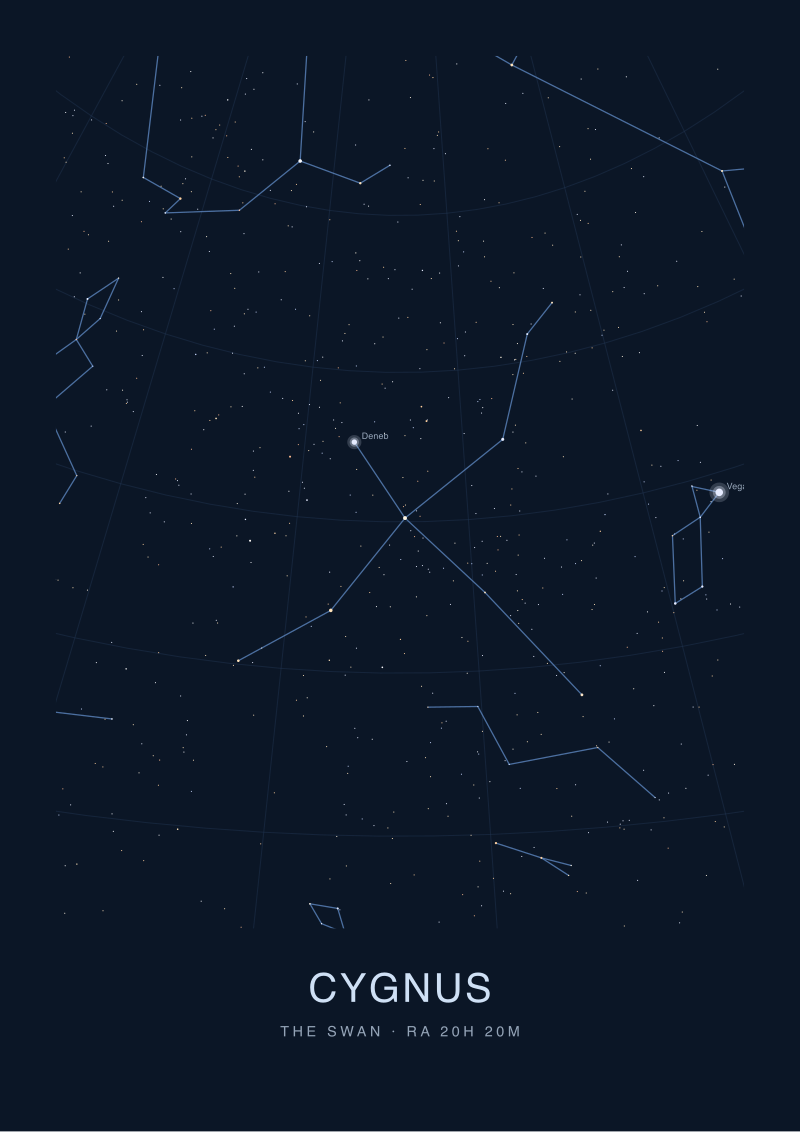
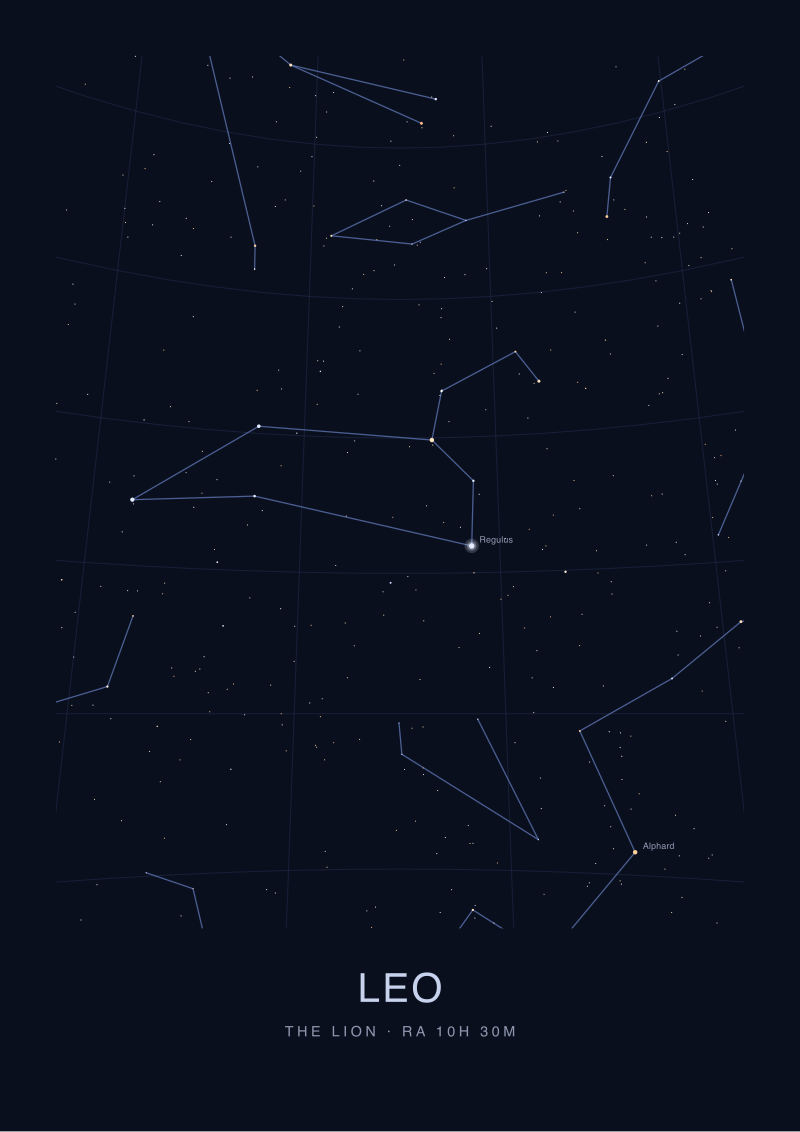
New charts and 10% off your first print.
One email now with your code. No noise after.