We spent an afternoon this week ranking the six brightest stars in our working catalogue by the number the HYG dataset assigns each of them, and the ordering came out backwards from every intuition a reader brings to it. Sirius, in Canis Major, sits at apparent magnitude -1.44. Canopus, in Carina, at -0.62. Arcturus at -0.05, Rigil Kentaurus at -0.01, Vega at 0.03, Capella at 0.08. The brightest star on the list carries the smallest number. The dimmest of the six carries the largest. That inversion is not a quirk. It is the scale itself, inherited from a Greek astronomer who never saw a decimal point, and it is the single thing most readers of a star chart get wrong on first contact.
The confusion is understandable. Every other measurement a modern reader touches runs the intuitive way. Higher temperature is hotter. Higher decibels are louder. Higher lumens are brighter, at the hardware store. The magnitude scale refuses to cooperate with any of that, and it does so for reasons that are half historical accident and half mathematical necessity. Once you see how the two halves fit together, the numbers on a star chart stop being a puzzle and start being a working tool.
What follows is not a rigorous derivation. It is the way we, as chartmakers, teach the scale to ourselves before we plot a sky. Six stars, one system of numbers, and a habit of reading that turns backwards into legible.
Sirius Sits At Minus 1.44, And That Minus Sign Is The Whole Story
The scale was not built from zero upward. It was built from the middle of the sky and rank-ordered by eye, roughly two centuries before the common era, by Hipparchus of Nicaea and later formalised by Ptolemy. The brightest stars visible to a person standing outside without instruments were called stars of the first magnitude. The next tier down, second magnitude. The faintest stars a healthy human eye could catch on a dark night were sixth magnitude. The direction of the scale was not chosen. It was inherited from a ranking of ordinal importance, the way a first-place finisher carries a smaller number than a sixth-place one. There was no room in that mental model for numbers below one because there was no need. Everything visible fit inside the six tiers.
That closed system held for roughly two thousand years, and then telescopes broke it in both directions. On the faint end, the scale kept extending: seventh, eighth, ninth magnitude and downward into the double digits as glass got better. On the bright end, something more awkward happened. When you actually measured the flux from the standard first-magnitude reference stars against the very brightest object in the sky, the brightest object turned out to be about two and a half times brighter than the reference. There was no room for it inside the historical scale. So the astronomers doing the measuring did the only honest thing: they extended the scale into negative numbers. Sirius came out at -1.44 in the HYG catalogue we work from. Canopus at -0.62. Rigil Kentaurus at -0.01. The negative sign is not a special category. It is what happens when a bounded system meets an object that exceeds its upper bound and the bookkeepers refuse to redraw the chart.
There is a temptation to fix this — to flip the sign, to re-anchor at zero, to make bright mean big. Astronomers have declined to do so, consistently, for something like a century and a half. The scale is worth more preserved than reformed, because a huge body of catalogued observation, historical almanacs and cross-referenced photometry would have to be re-labelled to accommodate the change. So Sirius stays at -1.44. Canopus stays at -0.62. The gap between them, 0.82 units of magnitude, is a real physical statement about the ratio of the light our eyes receive from each. What that ratio is, and why 0.82 is not the same as "0.82 times brighter", is the next thing worth understanding.
The Scale Is Logarithmic, Which Is Why Vega And Capella Look Like Twins
Hipparchus's tiers looked evenly spaced to him because human perception of brightness is not linear. Double the photons hitting the eye and the eye reports something less than double the brightness. The relationship is closer to logarithmic than to arithmetic, which is why we can look at the sun and also see stars in the same lifetime without the receiver melting. When Norman Pogson formalised the scale in 1856, he took the historical assertion — that a first-magnitude star was roughly a hundred times brighter than a sixth-magnitude one — and pinned it as an exact definition. Five steps of magnitude equal a factor of one hundred in received flux. One step of magnitude therefore equals the fifth root of a hundred, which comes out to about 2.512.
This is the multiplier that unlocks the six numbers we started with. Sirius at -1.44 and Canopus at -0.62 differ by 0.82 magnitudes. Raise 2.512 to the 0.82 power and you get roughly 2.13. Sirius delivers a little over twice the flux of Canopus at our eyes. That difference is easy to see on any clear night when both stars are up, and it is why the ordering feels correct once you learn to read the numbers. Now consider the other end of the six-star list. Vega sits at 0.03. Capella sits at 0.08. The gap is 0.05 magnitudes, and 2.512 raised to 0.05 is 1.047. Vega is about four and a half percent brighter than Capella, which is well below the roughly ten percent threshold at which the unaided human eye can reliably distinguish two brightnesses. To the naked observer, Vega and Capella are twins. To the photometer, they are separated by a small but real amount. The catalogue keeps that separation because the catalogue is not a description of what the eye sees; it is a record of what the instrument measures.
The same logic explains the tight bunching of Arcturus at -0.05, Rigil Kentaurus at -0.01, Vega at 0.03 and Capella at 0.08. Those four stars span a total of 0.13 magnitudes, which corresponds to about a thirteen percent range in flux across the whole group. All four are, functionally, zero-magnitude stars. They are the tier that Hipparchus would have called first magnitude, and they define what first magnitude means as a practical brightness category on a modern chart. Sirius is a tier above that group, alone. Canopus is between the two tiers, alone. That is the entire vertical structure of the top of the visible sky, and it is legible in five decimals per star.
Reading The Six Brightest Stars As A Working Ruler For The Sky
We keep coming back to these six because, when you plot a sky, you need calibrators. A star chart is a two-axis object with a hidden third variable, brightness, and the reader has to be trained to interpret dot size or dot weight as flux. The training runs on anchors. If a reader knows what Sirius looks like at -1.44 and what Vega looks like at 0.03, they can walk the intermediate values by eye and not miss anything the chart is trying to say.
Consider where these six sit on the celestial sphere, because the ruler only works when you can find its markings. Sirius is at right ascension 6.75 hours, declination -16.7 degrees. That declination puts it visible from every inhabited latitude on Earth, low in the south for northern observers, high overhead for southern ones, dominant in the winter evening sky north of the equator. Canopus is at right ascension 6.40 hours, declination -52.7 degrees, which is far enough south that it never rises above the horizon for anyone north of about 37 degrees latitude. A reader in Athens or San Francisco has never seen Canopus without travelling. A reader in Sydney or Cape Town has never had trouble finding it. Rigil Kentaurus, the star system usually written as Alpha Centauri in narrative contexts, sits at 14.66 hours right ascension and -60.8 degrees declination, deeper south still and functionally a southern-hemisphere reference. Arcturus, at 14.26 hours and +19.2 degrees, is the northern equivalent, high in the spring and early summer sky above the equator, low but visible from most of the southern hemisphere too. Vega, at 18.62 hours and +38.8 degrees, is a northern summer marker. Capella, at 5.28 hours and +46.0 degrees, is a northern winter marker.
Put the six on a single chart and you have covered both hemispheres, three seasons, and a brightness range of 1.52 magnitudes from top to bottom — a factor of about four in received flux. That is enough to calibrate almost any other star a reader will care about, because the vast majority of named stars fall between magnitude zero and magnitude three, which is exactly the interval these six anchor. A chartmaker who has printed the six correctly has printed a working ruler. Everything else is placement. This is one reason our own star map prints, sold at /shop/, are marked with an explicit magnitude legend keyed to Sirius, Vega and Arcturus rather than to an abstract scale bar; the anchor stars are how a chart teaches its own reading.
The last thing worth naming is what magnitude does not do. It does not tell you how far away a star is. It does not tell you how much light the star actually emits. It tells you what arrives at the top of Earth's atmosphere, per unit area, from that direction. A dim, close star and a bright, distant one can share a magnitude. Absolute magnitude, a separate quantity that we have not touched here, is what compensates for distance and gives a truer sense of intrinsic output. Apparent magnitude, the number in the HYG catalogue, is the number a chart needs, because a chart is a picture of a sky and the sky is what arrives, not what was sent.
This piece started as a short note on why Sirius carries a minus sign and turned, somewhere around the third paragraph, into an argument that the whole scale is a legacy system worth keeping. We did not cover absolute magnitude in any real depth, and we did not cover bolometric magnitude, which folds in wavelengths the eye cannot see. We also did not cover atmospheric extinction, which makes any star lower in the sky look dimmer than its catalogue number promises. Each of those is a separate essay, and each of them presumes the reader already knows why the arrow on the scale points the wrong way. That was the argument here.
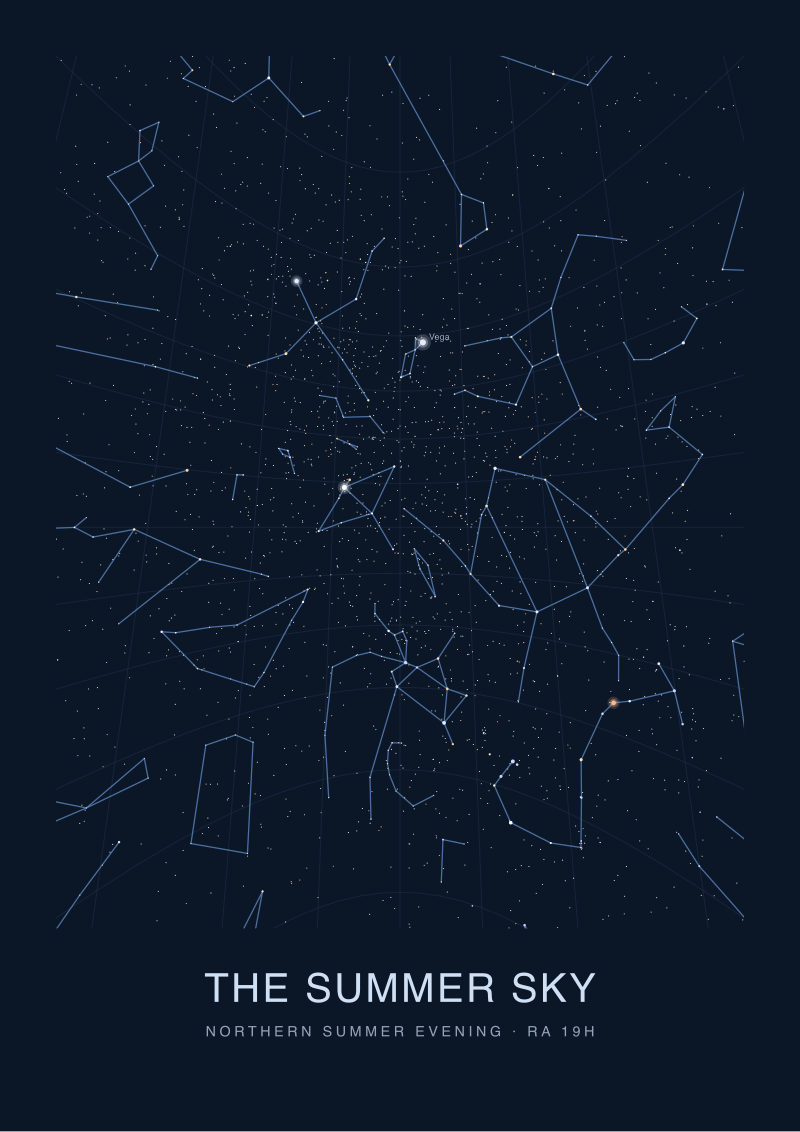 The Summer Sky
The print from this article · from €29.95
View the print →
The Summer Sky
The print from this article · from €29.95
View the print →
FAQ
Why do brighter stars have smaller magnitude numbers?
The scale originated as an ordinal ranking by Hipparchus around the second century BCE, where the brightest naked-eye stars were called first magnitude and the faintest were sixth magnitude. The direction was inherited from ranking, not from measurement. When precise photometry in the nineteenth century found objects brighter than the historical first-magnitude reference, astronomers extended the scale into zero and negative numbers rather than reverse two millennia of catalogues.
What does a negative magnitude actually mean?
A negative apparent magnitude simply means the star is brighter than the historical zero point defined by the reference stars near magnitude zero. Sirius at -1.44 is not exceptional in any physical sense; it is bright enough to sit outside the original one-to-six scale. Canopus at -0.62 and Rigil Kentaurus at -0.01 are similar cases. The minus sign is a bookkeeping consequence of extending an inherited scale, not a special category of star.
How much brighter is a magnitude 1 star compared with a magnitude 6 one?
Exactly one hundred times, by definition. Norman Pogson formalised this in 1856 by taking the historical claim that first-magnitude stars were roughly a hundred times brighter than sixth-magnitude ones and pinning it as the scale's precise mathematical anchor. Every single step of magnitude corresponds to a flux ratio of the fifth root of one hundred, which is approximately 2.512. The scale is therefore logarithmic, not linear.
Why do Vega and Capella look identical to the naked eye?
Vega sits at 0.03 in the HYG catalogue and Capella at 0.08, a difference of 0.05 magnitudes. That corresponds to a flux ratio of about 1.047, meaning Vega delivers roughly four and a half percent more light than Capella. The unaided human eye generally cannot reliably distinguish two brightnesses that differ by less than about ten percent, so the two stars register as functionally the same brightness at a glance, even though instruments separate them cleanly.
What is the difference between apparent and absolute magnitude?
Apparent magnitude is what arrives at the top of Earth's atmosphere from a given direction, and it is the number a star chart uses because the chart depicts what an observer sees. Absolute magnitude is a distance-corrected quantity that expresses how bright a star would appear if placed at a standard reference distance of ten parsecs. Two stars with the same apparent magnitude can have wildly different absolute magnitudes, depending on how far away each one actually is.
Can the naked eye see anything fainter than magnitude 6?
Under genuinely dark skies with fully adapted vision, some experienced observers report catching stars near magnitude 6.5 or occasionally a little fainter. The historical sixth-magnitude limit is a rough average for good conditions, not a hard cutoff. Light pollution collapses that limit dramatically; in a mid-sized city the practical naked-eye limit is often closer to magnitude 3 or 4, which excludes most of the stars a chart plots outside the top tiers.
Does magnitude tell you anything about a star's distance?
No. Apparent magnitude combines a star's intrinsic output and its distance into a single number and does not separate them. A modest star nearby and a luminous star far away can share the same apparent magnitude. Distance is inferred from parallax measurements, spectroscopic clues or standard-candle relationships, and only then can absolute magnitude be computed. The HYG catalogue lists both quantities separately for exactly this reason.
Why hasn't the scale been reformed to run the intuitive way?
Because the cost of reforming it would be enormous and the payoff small. Roughly two thousand years of observational records, nautical almanacs, photometric catalogues and cross-referenced professional databases use the current convention. Reversing the sign would invalidate every published magnitude in every archive and would confuse rather than help working astronomers, who long ago internalised that smaller means brighter. The scale is a legacy system that has earned its keep.
From the collection
New charts and 10% off your first print.
One email now with your code. No noise after.