The zodiac is a band of sky roughly 18 degrees wide, centred on the ecliptic — the line the Sun traces against the stars across one Earth orbit. Twelve constellations sit along it, unevenly. Virgo occupies about 1,294 square degrees of that strip; Scorpius, about 497. None of the six brightest stars in our grounding sit inside it: Sirius at declination −16.7°, Canopus at −52.7°, Arcturus at +19.2°, Rigil Kentaurus at −60.8°, Vega at +38.8°, Capella at +46.0°. The zodiac is a coordinate convenience. This piece does the arithmetic on what that convenience is, and what it is not.
Why the Zodiac Feels Like It Should Mean Something
The zodiac is not an arbitrary invention. It is the sky's busiest lane. Every classical planet, every eclipse, every occultation an ancient observer would have flagged happens inside those 18 degrees. Mercury never strays more than about 7° from the ecliptic; Venus stays inside 3.4°; Mars, roughly 1.85°; Jupiter, 1.3°; Saturn, 2.5°. The Moon's orbit tilts 5.14° from the ecliptic and is inside the band by construction. If you were an observer in 5th-century BCE Mesopotamia logging what actually moved night to night, the zodiac is exactly the coordinate system you would build.
It is, in fact, the coordinate system they built. Twelve equal 30° divisions were codified in Babylonian astronomical tablets by roughly the 5th century BCE, and Hipparchus formalised the ecliptic-based sign system by the 2nd century BCE. That is real work. It let observers predict where a wandering star would next appear, compute lunar phases, and time agricultural calendars against a stable sidereal reference. The zodiac was, at origin, a filing system for solar-system objects seen from Earth.
The system was also portable. The same twelve names travelled from Mesopotamia to Greece to Rome to medieval Europe to modern almanacs, and are still on every planetarium overlay in current use. When a modern chart shows the ecliptic sliced into twelve labelled regions, that is a piece of observational infrastructure two and a half millennia deep. It is a legitimate cultural artefact. It is also a legitimate observational grid. As geometry, as calendar, as shared language for describing where the planets are — the zodiac earned its place, and it earned it with data.
The zodiac is a genuine coordinate strip and a genuine cultural artefact. Where it stops being either is the moment someone translates that strip into a claim about a person.
Where It Breaks Down: The 18-Degree Strip and the 2,150-Year Drift
Precession is where the numbers stop being kind. Earth's rotation axis wobbles like a slow gyroscope with a period of about 25,772 years. Divide that by twelve signs and each sign drifts against the fixed-star background at roughly 2,148 years per 30° sign, or about 71.6 years per degree. Hipparchus fixed the vernal equinox in Aries around 130 BCE. Roughly 2,155 years later — now — the equinox sits inside Pisces, moving toward Aquarius. A modern "Aries" date on an astrological chart lines up with the Sun physically in Pisces on the sky. The sign and the constellation are one full slot out of sync.
The uneven-crossing problem is worse. The IAU's 88-constellation boundaries, ratified in 1930, cut Ophiuchus across the ecliptic between Scorpius and Sagittarius. The Sun spends roughly 19 days each year inside Ophiuchus — a 13th ecliptic constellation the twelve-sign system pretends does not exist. Sun-in-constellation dwell times are similarly uneven: about 45 days in Virgo, about 7 days in Scorpius, about 33 days in Aquarius. The twelve equal 30° signs and the thirteen unequal IAU constellations are two different objects that happen to share names.
Now the stars in our own grounding. Ecliptic latitude β for a star at right ascension α and declination δ is given by
sin β = sin δ · cos ε − cos δ · sin ε · sin α,
with obliquity ε ≈ 23.4393°. Running the six brightest in the file:
- Sirius (CMa, mag −1.44, α = 6.752 h, δ = −16.716°): β ≈ −39.6°
- Canopus (Car, mag −0.62, α = 6.399 h, δ = −52.696°): β ≈ −75.8°
- Arcturus (Boo, mag −0.05, α = 14.261 h, δ = +19.182°): β ≈ +30.7°
- Rigil Kentaurus (Cen, mag −0.01, α = 14.661 h, δ = −60.834°): β ≈ −42.6°
- Vega (Lyr, mag 0.03, α = 18.616 h, δ = +38.784°): β ≈ +61.7°
- Capella (Aur, mag 0.08, α = 5.278 h, δ = +45.998°): β ≈ +22.9°
The zodiac band is ±9° of the ecliptic. Not one of these six sits inside it. The nearest, Capella, is 13.9° north of the band's outer edge. The brightest star in Earth's night sky lives roughly 30° south of the strip. Whatever the zodiac is doing, it is not organising the sky's brightest objects — it is organising the sky's Sun-Moon-planet lane.
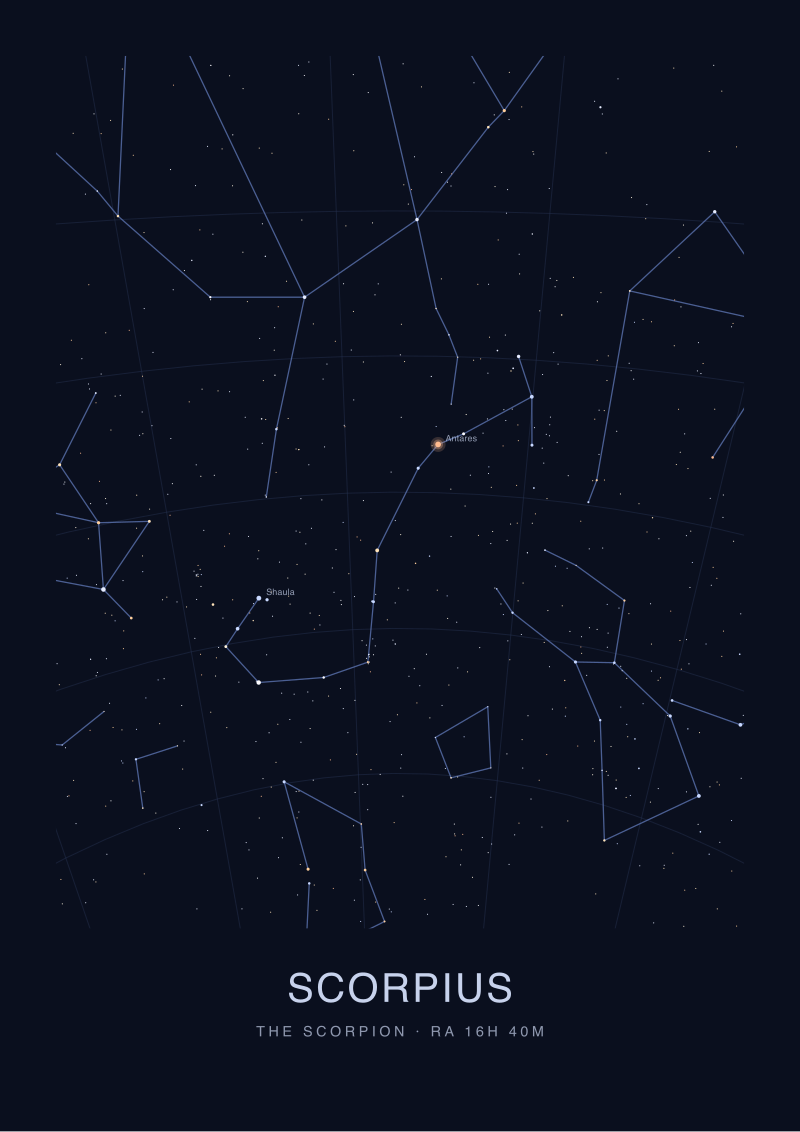 Scorpius
The print from this article · from €29.95
View the print →
Scorpius
The print from this article · from €29.95
View the print →
The Rule We Use Instead: Read the Ecliptic as Geometry
Our rule at the desk is short. The ecliptic is a plane, not a person. Read the zodiac as what it actually is: the projection of Earth's orbital plane onto the celestial sphere, ±9° of latitude, a strip sized to contain the Sun, the Moon within 5.14°, and the classical planets within about 7°. Everything the strip predicts is orbital. It predicts when Mars retrogrades, when Jupiter clears the Beehive Cluster, when the next lunar occultation of Regulus falls, when Venus rises before the Sun and when it sets after. It predicts nothing about a person born on any particular date, because there is no mechanism by which the angular position of the Sun against distant stars could act on an infant on Earth. Gravity from a delivery-room lamp two metres from the crib exceeds gravity from Jupiter at conjunction by roughly six orders of magnitude, and neither does anything measurable to the newborn.
What the ecliptic is genuinely useful for is chartmaking. When we plot a seasonal sky, the ecliptic is the first line down. Everything else — the celestial equator at 23.44° tilt, the meridian for the observer's longitude, the horizon for their latitude — hangs off it. If you want to know whether Saturn will be up at midnight in October from 40° north, you compute Saturn's ecliptic longitude, project to right ascension and declination, and read the hour angle. The zodiac makes that arithmetic legible. It is a coordinate label that says "the Sun is here right now" and, by extension, "the outer planets will be somewhere in this band tonight."
Read that way, the twelve names become useful again. Sagittarius is where the galactic centre sits behind the ecliptic, at α ≈ 17h 46m, δ ≈ −29°. Taurus contains the Hyades and the Pleiades, the two nearest open clusters to Earth, both crossed by the Sun in May and June. Virgo hosts the Virgo Cluster of galaxies at roughly 54 million light-years, most of it well north of the ecliptic proper. These are grounded, checkable, chart-drawable facts. Personality is not on the chart because no one has ever put it there with a measurement.
When the Old Rule Still Wins: Calendar, Ritual, Shared Language
The concession is real. Twelve signs, twelve months, twelve zodiac names — the mapping is embedded in Western calendars, in Chinese and Vedic sidereal systems, in Roman festival cycles that still shape which months carry which associations. As a shared vocabulary for talking about time and season, the zodiac has no serious competitor. Saying "late Leo" locates a reader in the year faster than "the last week of August" for a certain kind of audience, and neither is a claim about magnetism from Regulus. That linguistic function is legitimate. It is not astronomy and it is not astrology; it is calendar.
Where the old system still wins as a chart heuristic: if the Sun is in a given zodiacal region in a given month, that region is invisible at midnight and the opposite region is culminating. That mnemonic costs nothing to keep, and it works on paper the way it works on the sky.
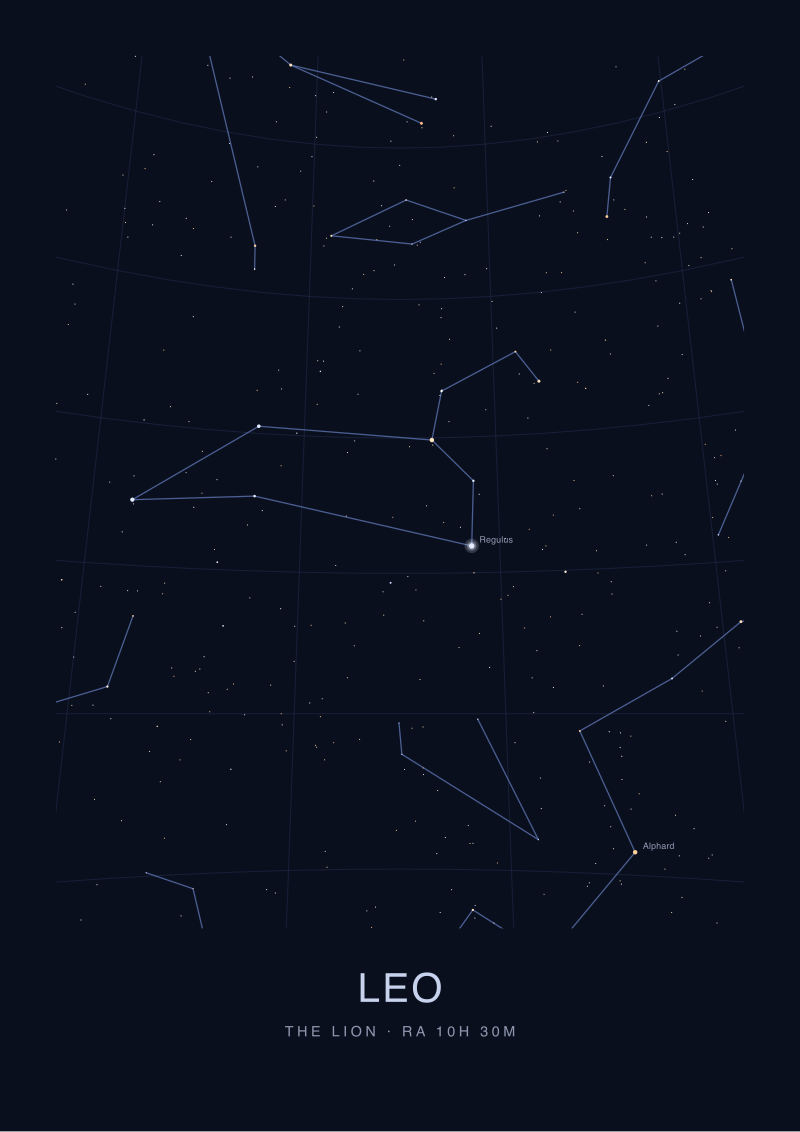 Leo
The print from this article · from €29.95
View the print →
Leo
The print from this article · from €29.95
View the print →
FAQ
What is the difference between astronomy and astrology in one sentence?
Astronomy is the measurement-based study of objects beyond Earth's atmosphere — positions, magnitudes, spectra, distances, motions — and its claims are checkable against instruments. Astrology is a cultural interpretive system that assigns meaning to those positions for individual human lives, and its claims are not checkable against instruments. The two share a vocabulary and a coordinate strip; nothing else survives the comparison.
Are the twelve zodiac signs the same as the twelve zodiac constellations?
They are not. The twelve signs are equal 30° divisions of the ecliptic, fixed to the position of the vernal equinox at their definition. The constellations are unequal patches of sky whose boundaries were formalised by the IAU in 1930. Because of precession — about 71.6 years per degree — the signs have drifted roughly 30° from the constellations they were named after. A "sign of Aries" date now corresponds to the Sun physically in Pisces.
Is there really a thirteenth zodiac constellation?
Yes, in the IAU boundaries. Ophiuchus crosses the ecliptic between Scorpius and Sagittarius, and the Sun spends roughly 19 days a year inside it. The twelve-sign system predates the 1930 boundary decision and does not include Ophiuchus. This is not a new astronomical discovery; it is a mismatch between two labelling schemes covering the same strip of sky.
How wide is the zodiac band and why is it 18 degrees?
The band is defined as ±9° of ecliptic latitude, so 18° total. The number is not arbitrary: it is sized to contain the Sun (on the ecliptic by definition), the Moon (orbit inclined 5.14°), and the classical planets, whose maximum ecliptic latitudes range from about 1.3° for Jupiter to about 7° for Mercury. Nine degrees on each side is the practical envelope that keeps the whole classical solar system inside a single strip.
Do any of the sky's brightest stars sit inside the zodiac band?
None of the six brightest stars in our HYG grounding do. Computed ecliptic latitudes are Sirius at −39.6°, Canopus at −75.8°, Arcturus at +30.7°, Rigil Kentaurus at −42.6°, Vega at +61.7°, and Capella at +22.9°. All are well outside ±9°. The zodiac is a solar-system strip, not a bright-star strip — a useful reminder that the naked-eye headline stars and the ecliptic lane are almost disjoint sets.
Does the position of a planet at birth exert any measurable force on a newborn?
No astronomical force from a planet at conjunction competes with local gravity or electromagnetic influences in a delivery room. Jupiter at opposition exerts a gravitational acceleration on an Earth-surface infant on the order of 10⁻¹² m/s²; a lamp two metres from the crib exerts more by roughly six orders of magnitude. There is no known channel — gravitational, electromagnetic, or otherwise — through which zodiacal position could act on human development.
If astrology is not empirical, why is the zodiac still on modern star charts?
Because the zodiac is a legitimate coordinate label for the ecliptic, and the twelve names are the shortest shared vocabulary astronomers have for "where in Earth's orbit we are." A planetarium overlay shows the twelve signs the way a road atlas shows time zones: as a convenient partition of the underlying plane, not as a claim about the terrain below. The chart itself is astronomy; the interpretive layer some readers place on top of it is a separate question.
How much has the zodiac drifted since Hipparchus defined it?
Hipparchus fixed the vernal equinox in Aries at approximately 130 BCE. With precession running at about 25,772 years per full cycle, the equinox moves roughly one degree of ecliptic longitude every 71.6 years. Across the intervening ~2,155 years, it has migrated about 30° — one entire 30° sign — from Aries backward through Pisces, and is now approaching Aquarius. The signs have moved; the star field has not.
From the collection
New charts and 10% off your first print.
One email now with your code. No noise after.