At apparent magnitude −0.01, Rigil Kentaurus sits among the three brightest stars in the entire night sky — a southern beacon anchored at right ascension 14.66 hours, declination −60.83°, catalogued in HYG v41 as one of the sun's nearest stellar neighbours. A print of it is not a decorative object in the abstract; it is a plotted point, drawn from a real catalogue, that carries a specific hemisphere and a specific brightness. Where such a print hangs in a home is a cartographic question before it becomes an interior one. The room decides whether the map reads as sky, or as wallpaper.
The honest answer to "where should I hang it" is that it depends — on the wall's compass orientation, on the ambient light the room receives at dusk, on whether the reader has ever actually seen the star with their own eyes, and on the working life of the room itself. Rather than issue a single verdict, we will walk through three composite scenarios: three imagined readers, each with a different room, a different relationship to the southern sky, and a different set of constraints. None of them are real people. They are illustrations built to isolate a specific placement problem.
Scenario 1: The North-Facing Studio Flat With One Long Wall
Picture a graphic designer in her late twenties renting a north-facing studio in Lisbon. The flat has one uninterrupted wall of about 4.2 metres, painted a warm off-white, and a single window that admits soft, indirect light for most of the working day. She works from home, so the wall is in her peripheral vision for eight to ten hours a day. She has bought a Rigil Kentaurus print at A2 size — roughly 42 by 59 centimetres — and does not know where on the wall it belongs.
The instinct is to centre the print at eye level, which for a standing adult means the visual midpoint of the frame sits around 145 to 155 centimetres from the floor. That instinct is usually right for portraits and abstract art. For a star chart, it is only half right. A map plotted at declination −60.83° depicts a piece of sky that, from anywhere in Europe, never rises above the horizon. Hanging it at standing eye level makes it read as an interior object; hanging it slightly higher — the print's centre at roughly 165 centimetres — reintroduces the small physical act of looking up, which is the correct posture for the piece it represents.
The north-facing orientation matters more than it seems. Because the wall never receives direct sunlight, the print's contrast holds through the day; the deep field around a magnitude −0.01 star can be printed dark without the ink flattening under a harsh beam at noon. In a south-facing room, the same print at the same hour would lose the fainter reference stars in the field around Rigil Kentaurus, because raking light washes low-magnitude ink into the paper. Here it does not. She can print the field deeper.
On the long wall, the temptation is to hang the map alone and let it hold the surface. For a single southern-hemisphere print, this reads correctly only if the print is large — A1 or bigger. At A2, isolation makes the print look under-scaled, and the wall reads as unfinished. The cartographic solution is to pair the Rigil Kentaurus print with a second, quieter chart at the same scale — a wider Centaurus field, or the surrounding southern sky at low magnitude density — hung to its right, aligned along the top edge rather than the centreline. Top-edge alignment is the convention chartmakers use when displaying charts of different depths side by side, and it will feel structurally correct even to a viewer who has never articulated why.
Scenario 2: The Family Home With a South-Facing Bedroom
Now imagine a couple in a suburban house in Auckland with a south-facing bedroom used by their eight-year-old. The room has two windows, blue walls, and a bed running along the interior wall. They want a Rigil Kentaurus print above the bed because the child has begun asking about the stars visible from the back garden, and Alpha Centauri — the traditional name for the same star system Rigil Kentaurus anchors — is one of the very few he can already identify with his own eyes.
This is the placement scenario that most rewards a star map, and it is also the one where the standard interior-design rules break most sharply. The print here is not decorative. It is a reference object. The child will look up at it before going to sleep, in the morning while dressing, and in the odd interval when he is sent to his room to think about what he has done. It needs to be legible from bed at a viewing distance of roughly two metres.
At two metres, an A2 print is small. Magnitude labels on the field around a −0.01 star become difficult to read; the fainter companion stars in Centaurus lose their positional information. For this room, the print should be A1 (about 59 by 84 centimetres) at minimum, and B1 (70 by 100) is better. Hang the centre 20 to 25 centimetres above the top of the headboard, not at conventional eye level; the sightline from a pillow is upward, and the print's plotted geometry — with declination running vertically — should be encountered along that upward line, not craned against it.
The southern-hemisphere placement carries a small bonus. From Auckland's latitude of roughly −37°, Rigil Kentaurus is circumpolar or near-circumpolar depending on the season, which means the child can, on a clear night, walk out into the garden and locate on the sky what he has been looking at on the wall for months. The print becomes a rehearsal for a real observation. This is the highest use a star chart can be put to, and it argues for a plot that includes surrounding reference stars in the constellation Cen rather than an isolated portrait of one point. A crowded, honest field beats a minimalist single-star treatment when the wall's job is teaching.
South-facing windows here are less of a lighting problem than they would be in the northern hemisphere. In Auckland, a south-facing wall in a residential room receives comparatively little direct sun. The main risk is a summer sunset burning across the print for an hour in December; a UV-filtered glazing solves this without altering the room.
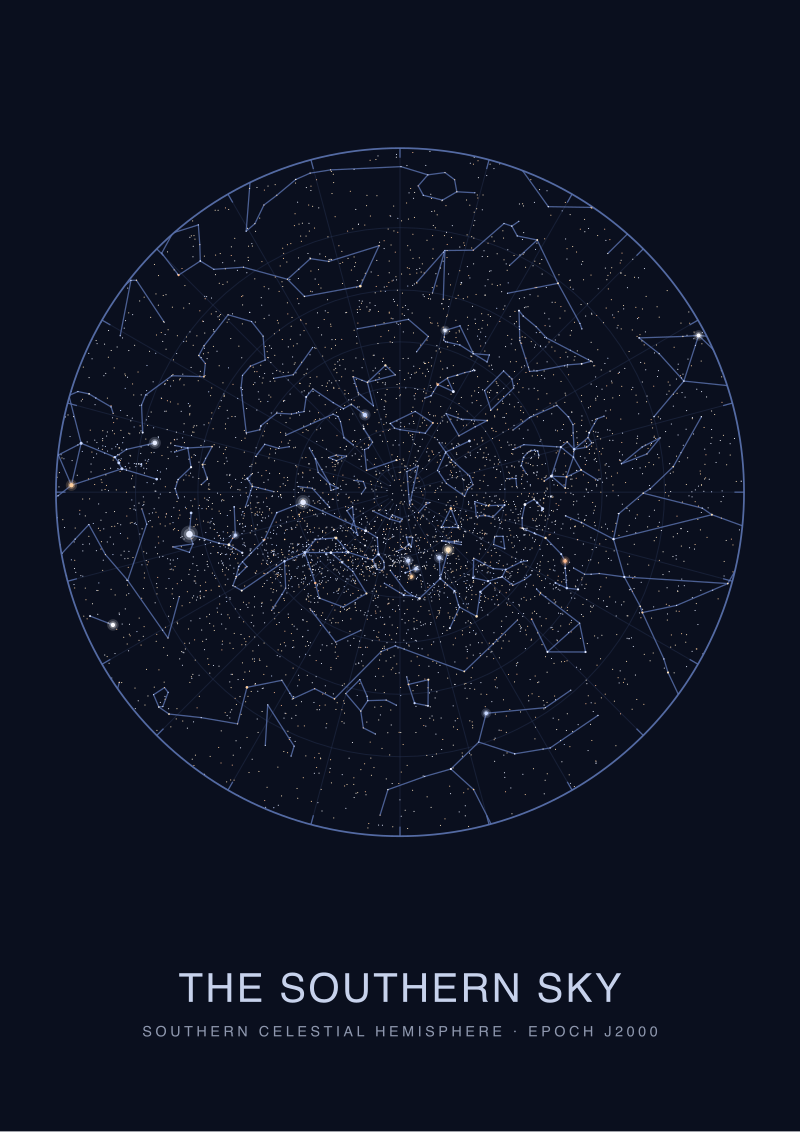 The Southern Sky
The print from this article · from €29.95
View the print →
The Southern Sky
The print from this article · from €29.95
View the print →
Scenario 3: The Northern-Hemisphere Reader Who Will Never See the Star
Consider a retired academic in Edinburgh, latitude roughly +56°, who has bought a Rigil Kentaurus print for his study. He is aware — because he asked before buying — that the star at declination −60.83° is permanently below the horizon from Scotland. It will never rise for him. He wants the print anyway, for reasons that have to do with a two-week trip to Chile in 1978 during which he saw the southern sky properly for the first and only time in his life.
The placement question here is different in kind. This is not a reference print. It is a memory object with cartographic accuracy. The room in question is a small study with dark green walls, a desk against the window, and bookshelves on two sides. There is exactly one wall — the one directly opposite the desk — capable of holding the print. It is 2.4 metres wide, broken by a light switch at 130 centimetres.
For a memory print, the correct scale is smaller than for a reference print. A2 is right; A1 would overpower the room. The print should be hung at seated eye level, not standing eye level, because the reader will encounter it primarily from the desk chair. Seated eye level for a standard chair puts the print's visual centre at roughly 115 to 120 centimetres from the floor — noticeably lower than the wall's midpoint, and lower than a decorator would default to.
The dark green walls change the printing decision. Against a saturated cool background, the surrounding field of a star chart can be lightened without losing the impression of night, because the paper itself is doing part of the sky's work. A slightly warmer paper stock — an off-white with a faint cream cast rather than a pure cold white — will hold the study's palette together and stop the print from reading as a bright rectangular hole in the wall.
The point of hanging a print of a star one will never see is not to pretend the star is overhead. It is to keep, at desk-level and permanently within reach, the coordinates of a piece of sky that mattered once. Placement should respect that. The switch at 130 centimetres, which would ruin the composition if the print were centred on the wall, becomes irrelevant when the print is hung lower and slightly left of centre — a compositional off-axis that the eye reads as intentional rather than accidental.
What All Three Placements Share
Three different rooms, three different readers, three different heights and scales. What connects them is a small set of decisions that any reader of any Rigil Kentaurus print has to make, whether they articulate them or not.
The first shared decision is hemisphere honesty. A magnitude −0.01 star at declination −60.83° is a southern-hemisphere object. Every placement above treats that fact as a design input rather than a footnote. The Lisbon studio raises the print slightly to invoke the act of looking up at sky one has to travel to see. The Auckland bedroom uses the print as a genuine reference for a sky the child can actually observe. The Edinburgh study accepts the impossibility of local observation and hangs the print at seated height, as a coordinate object rather than a directional one. None of them pretend the star is overhead.
The second shared decision is scale-to-distance. Print size is not a taste question — it is a legibility question determined by viewing distance and by how much of the surrounding star field the reader wants to keep readable. A print that isolates the −0.01 primary and drops the field around it can be small; a print that keeps Centaurus's context needs to be large enough that a viewer at typical distance can still resolve the fainter magnitudes.
The third shared decision is wall temperature. Warm walls, cool walls, and neutral walls each interact differently with the ink density of a dark astronomical field. A chartmaker chooses paper stock and printing depth against the wall the print will hang on, not against a neutral studio ideal. When a reader commissions a print without specifying the wall, they are handing that decision to the printer by default. It is worth reclaiming.
Which Scenario Is You
None of the three imagined readers is you exactly. They are illustrations chosen to isolate different placement problems: a working wall in constant peripheral view, a teaching wall used from a low sightline, and a memory wall in a small saturated room. Locate yourself against them.
If the print is going into a room where you will see it many hours a day and it needs to hold that sustained attention without becoming furniture, you are closer to Scenario 1 — think about pairing, alignment, and standing-eye-level plus a small lift. If the print will teach someone — a child, a partner, yourself — to recognise what is over your head at night, you are Scenario 2, and you should print larger than instinct suggests and hang lower relative to the sightline that will use it. If the print carries a specific memory of the southern sky and the wall it goes on is a personal room, you are Scenario 3, and the placement rules for reference prints do not apply — hang for the chair, not the standing viewer.
When you find the plotted-catalogue version of Rigil Kentaurus that matches your room, our own print of the field is available at see the The Southern Sky print, sized to the three cases described here.
FAQ
What direction should a Rigil Kentaurus print face in a northern-hemisphere home?
Direction of the wall matters more for lighting than for astronomical accuracy — the star at declination −60.83° never rises north of about latitude +29°, so no orientation makes it visually "correct." Prefer north-facing walls in the northern hemisphere because they receive no direct sun and preserve the deep field around a magnitude −0.01 primary. South-facing walls will require UV-filtered glazing to prevent ink fade over years.
How high should I hang a star map compared with a regular framed print?
Slightly higher than the standard 145–155 centimetres to visual centre used for artwork, because a star chart's implicit posture is looking up. Aim for 160–170 centimetres in rooms where the print is viewed standing. In bedrooms viewed from a pillow or studies viewed from a chair, invert the rule and hang lower — the sightline is already upward from a seated or reclined position, and additional height wastes legibility.
Does it matter that Rigil Kentaurus is not visible from where I live?
Not for the print's meaning, but yes for what the print should depict. A reader north of about latitude +29° will never see the star from their garden. That argues for a chart that treats Rigil Kentaurus as a coordinate anchor with surrounding southern-sky context, rather than a chart that pretends the star is a local reference. A memory print of a southern sky seen on a trip is a legitimate and common reason to own the piece.
What size should the print be for a bedroom above a headboard?
A1 (about 59 by 84 centimetres) is the practical minimum for readability at typical bedroom viewing distances of 1.8 to 2.5 metres. B1 (70 by 100) is better if the wall can hold it. Anything smaller reduces the magnitude labels and companion stars to decorative marks, which defeats the print's use as a genuine reference for the sky visible outside — assuming the bedroom is in a hemisphere from which the star can be seen.
Should I frame a star chart with glass or without?
Glass, and ideally UV-filtered glass, for any print hung on a wall that receives even indirect sun for part of the year. Astronomical prints tend to be dense in dark inks, and dark inks fade faster and less evenly than light ones. Non-glare glass slightly softens the crispness of magnitude dots, which for a chart of a −0.01 star with a wide-magnitude surrounding field is a small but real cost — weigh it against the light conditions of the specific wall.
Is Alpha Centauri the same as Rigil Kentaurus?
Rigil Kentaurus is the traditional proper name for the brightest component of the Alpha Centauri star system, catalogued in HYG v41 with the coordinates and magnitude referenced throughout this article. Star charts and catalogues use "Rigil Kentaurus" for the point plotted at right ascension 14.66 hours, declination −60.83°. The name comes from the Arabic naming heritage that shaped much of modern star nomenclature.
Can I hang two southern-hemisphere prints together?
Yes, and often it works better than a single print on a large wall. Align them along the top edge rather than the vertical centreline — that is the convention cartographers use when displaying charts of different declination bands next to each other, and the eye reads it as structural even without knowing the rule. Keep the two charts at the same paper stock and the same scale, or the pairing will look accidental.
What lighting works best for viewing a star chart on a wall?
Low, warm, and indirect. Overhead ceiling lights flatten the print and wash out the dark field that a magnitude −0.01 star sits inside. A wall-washer at 2700K aimed to graze rather than strike the print preserves the sense of a dark sky and lets the plotted points hold their apparent contrast. Avoid picture lights that clip to the frame — they create a bright edge that fights the chart's deep field.
From the collection
New charts and 10% off your first print.
One email now with your code. No noise after.