We have read a great many articles about the constellations visible from the northern hemisphere in winter, and they miss the same things in the same order. The list is always the same six or seven: Orion, Taurus, Gemini, Canis Major, Auriga, sometimes Perseus, occasionally Cassiopeia. Sirius gets its obligatory line at magnitude -1.44, the brightest star in the night sky. Capella gets a nod at 0.08, high overhead in the north. Then the piece ends, and the reader closes the tab knowing six names and nothing about how any of it was plotted before it was ever drawn.
That is not a winter sky. That is a memorised caption. A real chart is a set of decisions about coordinates, brightness, and where the horizon cuts — and those decisions are exactly what the standard piece leaves out. We plot before we draw at this desk, and the plotting is the article the reader deserves.
What They All Get Wrong
The first shared error is the list itself. Every guide leans on the same six or seven constellations, delivered in the same march: Orion opens, Taurus and the Pleiades follow, Gemini comes in from the east, Canis Major carries Sirius up behind Orion's heel, Auriga sits high with Capella, Perseus arrives as an afterthought. It is not that these are wrong choices. It is that the order is never justified. Why Orion first? Because it is easy to draw. Because writers copy each other. Not because the reader standing outside in January is looking anywhere in particular.
The second shared error is treating brightness as decoration. Sirius is quoted at magnitude -1.44 the way a car brochure quotes horsepower — a number stuck to a name for authority. Nothing is said about what -1.44 means, or why Capella at 0.08 is roughly four magnitudes fainter and therefore about forty times less luminous to the eye. The magnitude scale runs backwards: smaller numbers are brighter, each step of one is a factor of about 2.5 in received light. This is the single most useful thing a reader can learn to actually see the sky, and it is almost never explained. Instead we get "very bright", "quite bright", "moderately bright", which is the vocabulary of someone who has never plotted anything.
The third shared error, and the one that quietly ruins the whole exercise, is the missing latitude. "Visible in the northern hemisphere in winter" is a geographic claim without a geographic anchor. A reader in Reykjavík at 64° north and a reader in Miami at 25° north are looking at genuinely different skies on the same January evening. From Reykjavík, Sirius at declination -16.7° barely clears the roofs and stays low all night. From Miami, the same star climbs almost seventy degrees above the southern horizon and dominates the sky for hours. Canopus, at magnitude -0.62 the second-brightest star in the sky, is invisible from anywhere in Europe and skims the horizon from the southern United States — Miami sees it, Chicago never does. The standard article writes as if the northern hemisphere were one room. It is not. It is a set of latitudes, each with its own southern cutoff, and the winter list depends on which one you are standing at.
What Is Almost Always Missing
What is missing is the machinery. A star's position is not vibes; it is two numbers. Right ascension, measured in hours from 0 to 24, is the celestial equivalent of longitude. Declination, measured in degrees from -90 to +90, is the celestial equivalent of latitude. Sirius sits at RA 6.75 hours, declination -16.72°. Capella sits at RA 5.28 hours, declination +45.99°. Those four numbers alone, held in the reader's head, are enough to place both stars on any winter chart of the northern sky — Sirius to the south and low, Capella high and near the zenith for mid-latitude Europe and North America. The standard article never surfaces these numbers, so the reader has no way to verify, transfer, or re-plot anything.
Also missing: the observer's own latitude as the master variable. A star is above your horizon on a given night if, roughly, its declination is greater than (your latitude minus 90°). From 40° north — the latitude of Madrid, New York, Beijing — that means every star with declination greater than -50° is at least briefly visible. That lets Sirius through comfortably and locks Canopus out (declination -52.7° is just too far south). From 30° north — Cairo, Houston — the cutoff drops to -60° and Canopus enters the picture as a low southern flare in February evenings. This one calculation replaces an entire genre of vague sentences about what is and is not "visible in winter", and it is almost never shown.
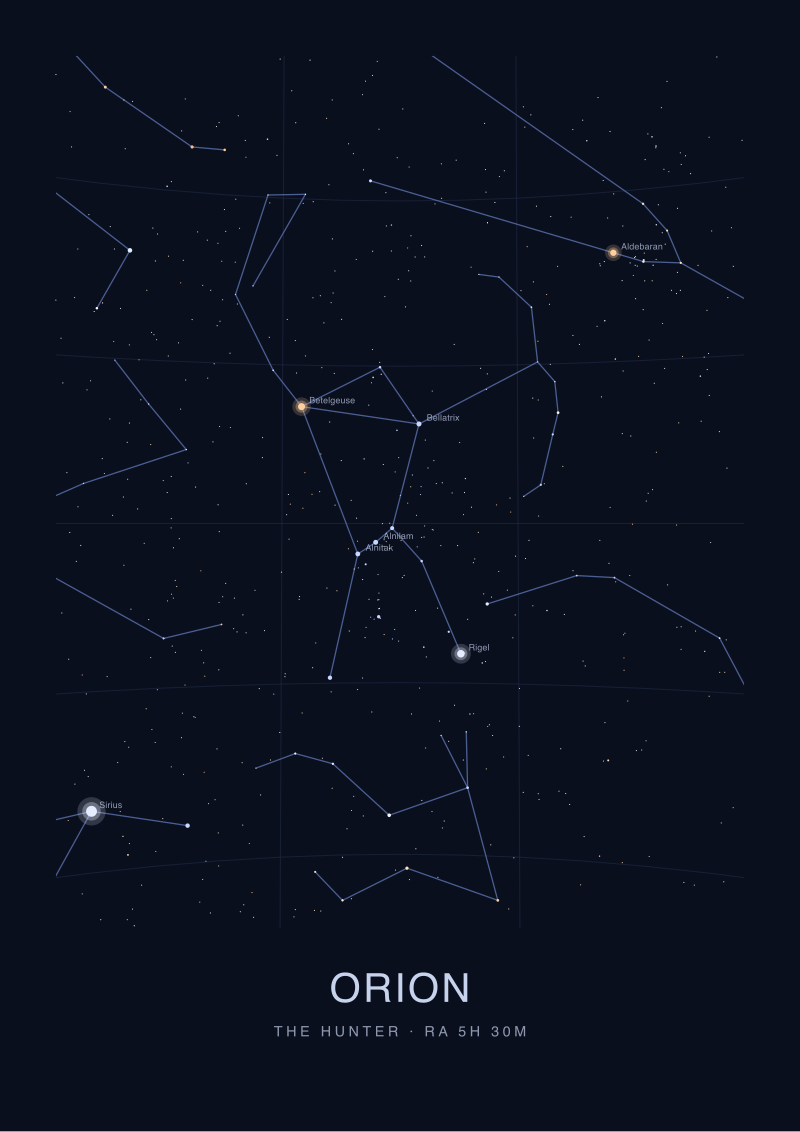
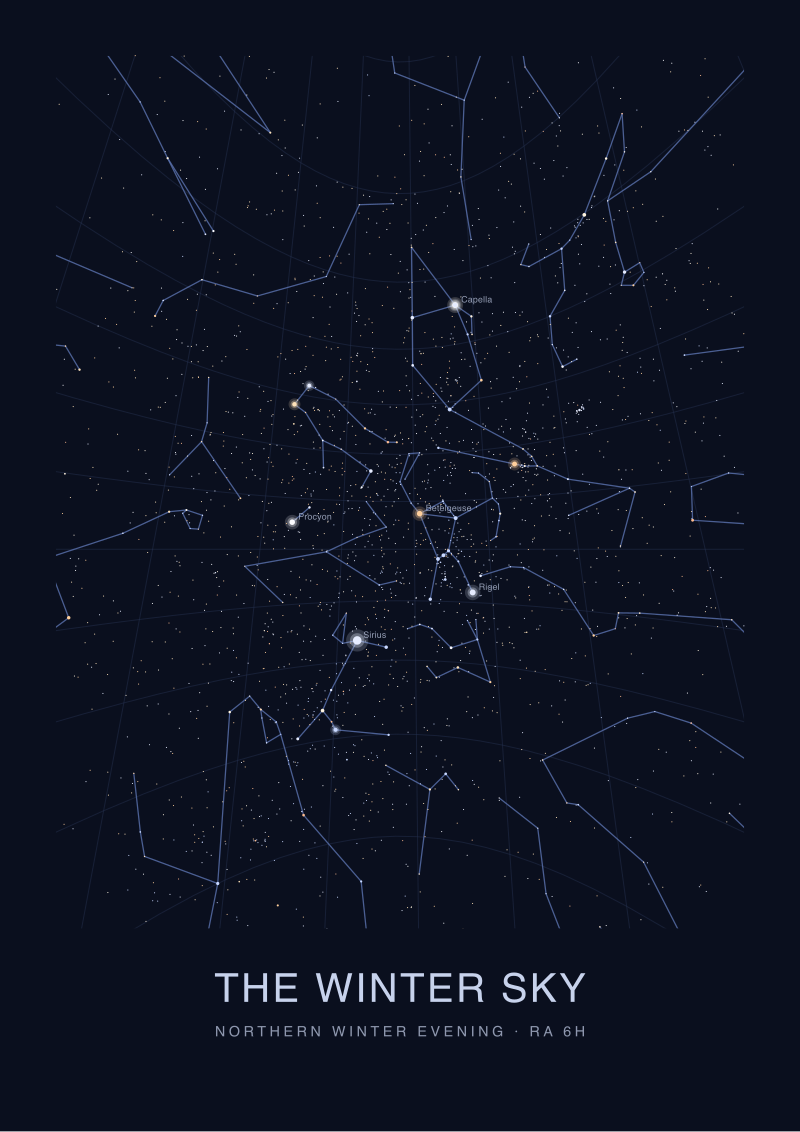
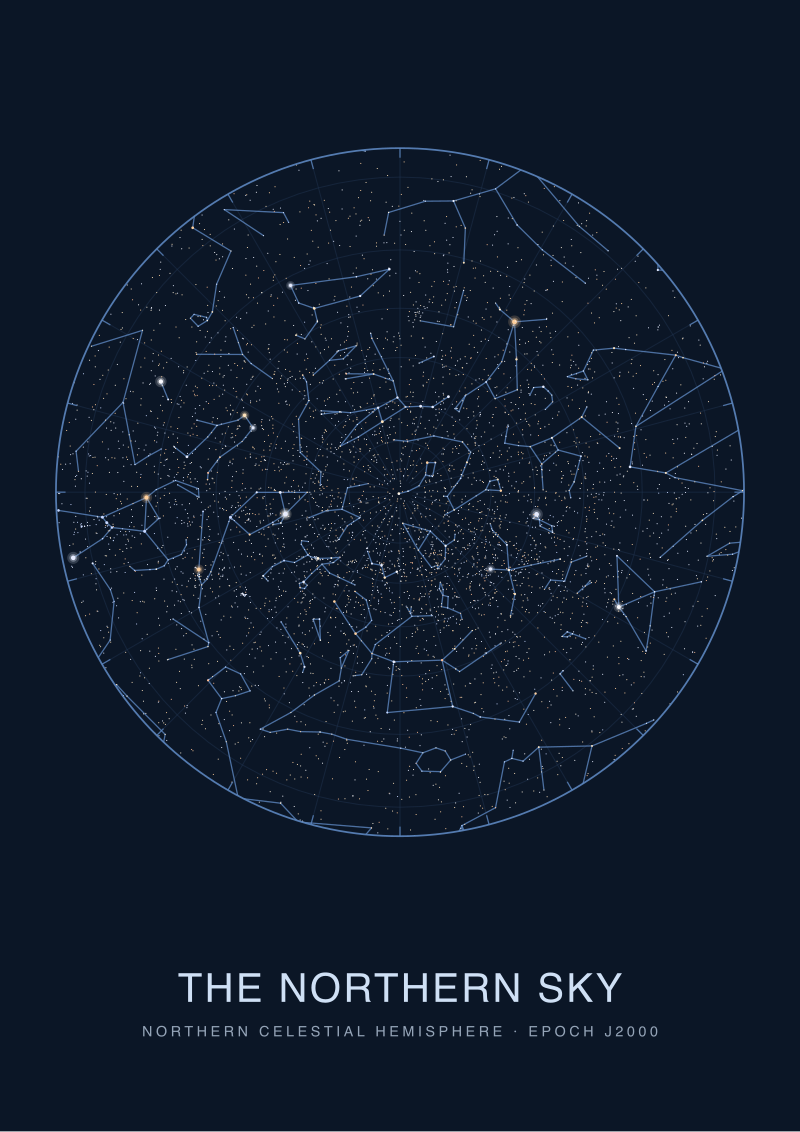
Also missing: the plotting logic behind a chart. When a real star atlas prints the winter sky, it is a projection of a sphere onto a plane, with the observer's zenith at the centre and the horizon at the edge. Constellations near the celestial equator — Orion sits centred there — appear largest and least distorted. Constellations far from it — Ursa Minor near the pole — get squeezed or stretched depending on the projection chosen. The reader who has never been told this thinks a star map is a photograph. It is not. It is a chartmaker's compromise, and every winter-sky guide that shows a plate without saying so is asking the reader to believe a decision that was never explained.
And missing, finally, is time. The sky at 6pm in December is not the sky at 4am in the same December, and neither is the sky at 6pm in February. The Earth turns; the constellations march west across the night. A useful winter guide would anchor each named object to a rough hour and month — Orion due south around 10pm in mid-January from 40° north, for example — rather than gesturing at "winter" as a single frozen tableau.
 Orion
The print from this article · from €29.95
View the print →
Orion
The print from this article · from €29.95
View the print →
What I Would Say Instead
We would begin from the two anchors that the northern winter sky actually gives you, and we would introduce them by their numbers, because the numbers are what make the rest of the chart legible.
Anchor one is Sirius, in Canis Major, at apparent magnitude -1.44 and declination -16.72°. Nothing else in the winter sky comes close on brightness — it is more than a full magnitude brighter than any other star visible from mid-northern latitudes at this time of year, which in eye terms means it is roughly two and a half times more luminous than the next contender. Its low southern declination is the reason it sparkles so aggressively: at 40° north it culminates only about 33° above the horizon, and that long slant through the lower atmosphere is what makes it flare red-green-white on cold clear nights. Sirius is not misbehaving. It is doing exactly what a bright star seen through a lot of air is expected to do.
Anchor two is Capella, in Auriga, at apparent magnitude 0.08 and declination +45.99°. Capella is roughly one and a half magnitudes fainter than Sirius — a factor of about four to the eye — but it sits nearly at the zenith for observers at temperate northern latitudes on winter evenings. That is a rare combination. Most of the sky's brightest stars are equatorial or southern; Capella is the one first-magnitude beacon that a reader in London or Toronto can find by looking almost straight up. Between these two — Sirius low in the south, Capella high overhead — you have already fixed the vertical axis of the winter chart without naming a constellation yet.
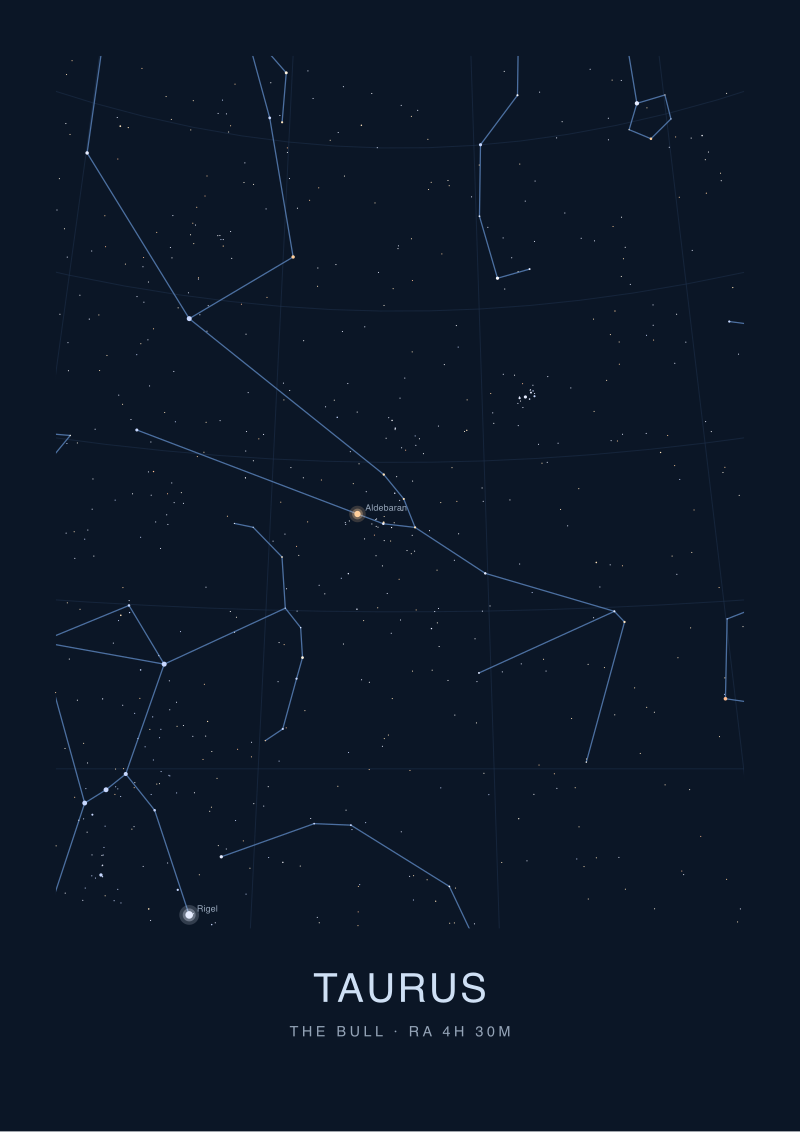
From there the chart draws itself. Orion sits between them, its belt straddling the celestial equator, which is why it is the one constellation that looks identical from every populated latitude on Earth. Taurus is to Orion's upper right, Gemini upper left, Canis Major dragged down beneath Orion's foot toward Sirius. This is the same list every guide gives, but arrived at by geometry rather than by tradition: we placed the two anchors, and the recognisable shapes fall into the frame between them.
What we would then say plainly — and what no other guide seems to say — is what is not on your chart, and why. Canopus at magnitude -0.62 is the second-brightest star in the entire sky, and yet it does not appear in any honest northern-hemisphere winter guide written for readers north of about 37°, because its declination of -52.7° puts it permanently below the horizon there. Arcturus at magnitude -0.05, another of the sky's five brightest, does not belong either: at RA 14.26 hours it is a spring and summer star for the northern evening, rising in the small hours in winter and mostly a pre-dawn object. Vega at magnitude 0.03, RA 18.62 hours, is a summer-triangle star; in December evenings it is setting in the northwest by full dark. Rigil Kentaurus at magnitude -0.01, declination -60.8°, is a southern star the northern hemisphere does not get at any season. Naming what is absent, and giving the coordinate reason it is absent, is what turns a list into a map.
That is the article we would write. Not six names in a fixed order, but two anchors with their coordinates, a magnitude scale explained once and used honestly thereafter, a latitude declared before any claim of visibility, and a short list of famous stars ruled out with the number that rules them out. The reader then owns the winter sky in a way that no memorised caption can give them, and can walk outside on the next clear night and check our work against the real thing overhead.
FAQ
Why does every winter-sky guide list the same six constellations?
Because they copy each other, and because those six — Orion, Taurus, Gemini, Canis Major, Auriga, Perseus — are the easiest to recognise and the easiest to draw. That is a legitimate starting point, but it is not a justified one. A chartmaker's list would begin from the two brightest anchors visible on a January evening, Sirius and Capella, and let the shapes fall into place between them by geometry rather than by tradition.
What does apparent magnitude actually mean?
It is a backwards logarithmic scale for how bright a star looks from Earth. Smaller numbers are brighter; each step of one magnitude is a factor of about 2.5 in received light. Sirius at -1.44 is roughly four magnitudes brighter than Capella at 0.08, which means it delivers about forty times more light to the eye. The scale is old and confusing, but once you learn the direction it runs, every other claim about "bright" and "faint" becomes checkable.
Why is Sirius so low in the sky from Europe and Canada?
Because its declination is -16.72°, well south of the celestial equator. From latitude 40° north, the highest Sirius ever climbs is about 33° above the southern horizon. From latitude 55° north it barely reaches 18°. That long path through the lower atmosphere is also why Sirius appears to twinkle so violently on winter nights — atmospheric turbulence is much stronger near the horizon than overhead.
Is Canopus visible from the northern hemisphere in winter?
Only from the southern edge of it. Canopus sits at declination -52.7° and magnitude -0.62, the second-brightest star in the entire sky. From below about latitude 37° north it clears the southern horizon briefly on winter evenings — the southern United States, southern Europe, and North Africa can catch it low in the south around February. From London, Berlin or anywhere further north, Canopus is permanently below the horizon and will not be seen at any season.
Why does Capella feel like it is directly overhead in winter?
Because its declination of +45.99° is close to the latitude of most of populated Europe and southern Canada. When a star's declination matches your latitude, that star passes through your zenith once a day. For an observer at 46° north — southern France, the north of Italy, Montreal — Capella crosses almost exactly overhead, and in winter evenings that crossing happens after dark, which is why the star reads as so obviously "high" without measurement.
Do I need a specific date and time to use a winter star chart?
Yes, and any chart that does not tell you so is misleading. The sky rotates about 15° per hour and shifts by about 30° per month at the same clock time. A chart labelled "winter" without a date and hour is a compromise between three months of very different skies. A useful reference gives at least one anchor — for example, "Orion due south around 10pm in mid-January from 40° north" — and lets you interpolate from there.
Where do right ascension and declination come from in a star's entry?
They are the celestial equivalents of longitude and latitude, referenced to the vernal equinox and the celestial equator. Right ascension is given in hours (0 to 24) because the sky rotates once a day; declination is given in degrees (-90 to +90). Modern catalogues such as HYG derive their values from Hipparcos and successor missions. Sirius at RA 6.75 hours, declination -16.72°, is the same pair of numbers on every serious chart in the world.
Is the zodiac part of the winter constellation set?
The zodiac is a band of coordinates the Sun appears to travel through over a year, not a personality system. In winter, the Sun sits in the zodiacal constellations of Sagittarius, Capricornus and Aquarius, which means those constellations are behind the Sun and not visible at night. The zodiacal constellations you can actually see on a winter evening are the ones opposite the Sun — Taurus and Gemini are the two on any honest northern winter chart, and they are on it as constellations, not as horoscopes.
 Taurus
The print from this article · from €29.95
View the print →
Taurus
The print from this article · from €29.95
View the print →
From the collection
New charts and 10% off your first print.
One email now with your code. No noise after.