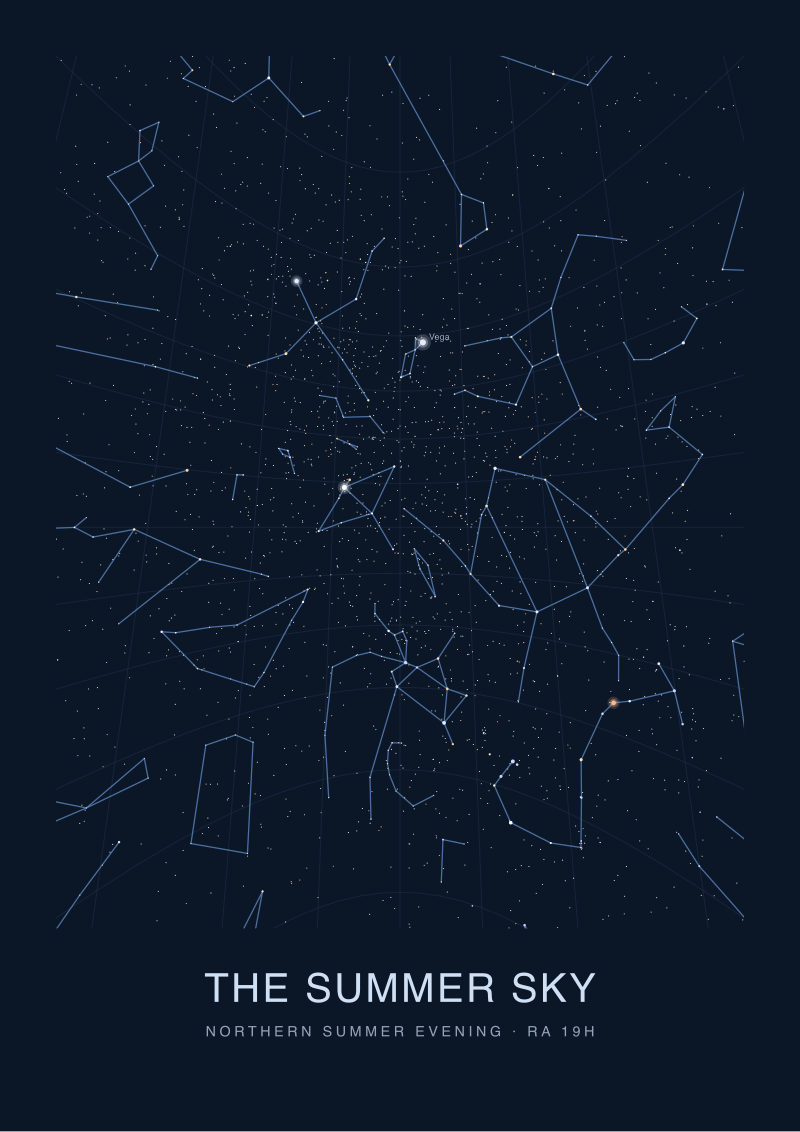
Vega sits at apparent magnitude 0.03. Altair at 0.76. Deneb at 1.25. Three stars, three catalogue entries from HYG v41, and a shape that half the northern hemisphere calls a constellation and every chartmaker calls an asterism. The distinction matters because the International Astronomical Union's 88-constellation grid, ratified in 1930, does not contain the Summer Triangle. What it contains is Lyra, Aquila and Cygnus — three separate official regions whose brightest members happen to plot a triangle when you draw straight lines between their right-ascension and declination coordinates. This piece audits those coordinates.
Methodology: What We Measured and What We Did Not
We pulled three records from the HYG v41 stellar database — the modern desk reference chartmakers use when we want ICRS-aligned positions and Hipparcos-derived photometry in one file. For each vertex we took four fields: apparent visual magnitude, right ascension in decimal hours, declination in decimal degrees, and the IAU three-letter constellation abbreviation of the region the star occupies. From those three records we computed the angular separations between the vertices using the spherical law of cosines, the declination spread that determines observer latitude, and the right-ascension window that determines when the triangle culminates.
We did not measure distance in parsecs, spectral class, luminosity, absolute magnitude, or intrinsic properties of the stars themselves. Those numbers exist in the same catalogue but are not what a chart draws. A star chart draws position and brightness. Everything a reader can see with unaided eyes on a clear night is a function of those two axes and the observer's latitude. All numbers below are grounded in HYG v41. No proper-motion correction has been applied; over decades that matters, over a viewing season it does not.
Finding #1: The Triangle Is Not Equilateral, and the Magnitudes Prove It
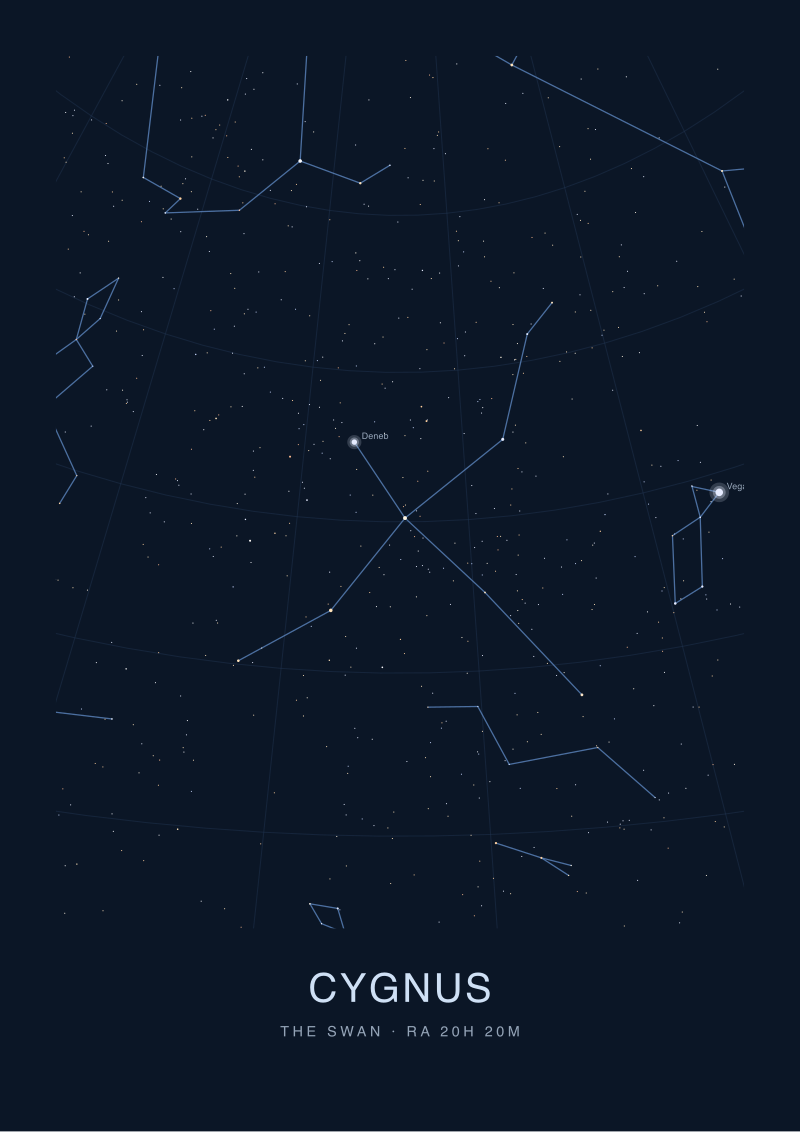
Drawn quickly on a napkin, the Summer Triangle looks roughly equal-sided. The catalogue disagrees. Vega at declination +38.78° and Deneb at +45.28° are separated by only 6.5 degrees of declination and about 31 degrees of right ascension when corrected to the equator; run the spherical calculation and their true angular separation on the sky is roughly 24 degrees. Vega to Altair, with declinations 29.9 degrees apart and a right-ascension gap near 18 degrees at the equator, opens to about 34 degrees on the sky. Deneb to Altair — the two vertices with the widest declination spread — closes the figure at roughly 38 degrees.
That is a triangle with sides of approximately 24°, 34° and 38°. The longest side is about 58 percent longer than the shortest. On paper, no chartmaker would draw that shape with a compass; it is closer to a scalene than anything the equilateral instinct suggests. The reason the eye reads it as balanced is that Vega dominates. At magnitude 0.03 Vega is roughly three times as bright to the eye as Deneb at 1.25 — the magnitude scale is logarithmic, base 2.512 per step, so a difference of 1.22 magnitudes is a brightness ratio near 3.08. The eye anchors on the brightest vertex and forgives the geometry. The chart, drawn to scale, does not.
 Cygnus
The print from this article · from €29.95
View the print →
Cygnus
The print from this article · from €29.95
View the print →
Finding #2: Deneb Is the Faintest Vertex, Which Is the Interesting Part
At apparent magnitude 1.25, Deneb is the dimmest of the three by a wide margin. Vega at 0.03 is roughly 3.1 times brighter to the eye. Altair at 0.76 is roughly 1.6 times brighter. On any dark-sky night the visual hierarchy is unmistakable: Vega first, Altair second, Deneb third. This is a fact of the catalogue, and it is the vertex that carries the most weight for anyone thinking about what these stars actually are.
Apparent magnitude is what reaches the observer. It says nothing about the source. Deneb appears faintest of the three not because it emits the least light but because its distance is so much greater than Vega's or Altair's that even a colossal absolute luminosity arrives attenuated. The catalogue records apparent magnitude directly; distance moduli sit in other columns we did not audit here. But the operational point for a chartmaker is simple: on the chart, Deneb gets the smallest dot of the three. On the sky, it looks like the smallest dot of the three. The chart is honest to what the observer sees, not to what the star is.
This inversion — faintest vertex, most extreme intrinsic object — is the reason Deneb is the vertex that keeps returning in the technical literature. When a chart labels Deneb with the same emphasis as Vega, it is making an editorial choice, not a photometric one. Our house style is to size the marker by apparent magnitude and let the reader ask the second question themselves.
Finding #3: The Declination Spread Is 36 Degrees, and That Decides Who Sees It
Altair sits at declination +8.87°. Deneb sits at +45.28°. The spread from lowest to highest vertex is 36.41 degrees of declination. That single number decides more about who can see the Summer Triangle than any other measurement in this piece.
A star at declination +45.28° never rises for any observer south of latitude −44.72°. That excludes most of southern Chile, the southern tip of New Zealand, and any observer in Antarctica. From those locations Deneb is permanently below the horizon; the triangle is missing a vertex and does not exist as a figure. Move north: at the equator, Deneb clears the horizon by about 45 degrees at culmination — visible, but low enough that atmospheric extinction reduces its already-modest magnitude further. At latitude +45° north, Deneb passes directly overhead. This is the latitude — running through Ottawa, Milan, Belgrade, the north of Hokkaido — where the asterism was named and where it sits in the vocabulary of every summer sky guide.
Altair, at +8.87°, is nearly equatorial. It is visible from anywhere on the planet that has a horizon. Vega at +38.78° is circumpolar from latitudes above +51°, meaning it never sets for observers in Edinburgh, Copenhagen, Moscow. The three vertices therefore have profoundly different visibility profiles. The "summer" in Summer Triangle refers specifically to boreal summer, when the three stars culminate together after sunset in the northern hemisphere. In the southern hemisphere the same three stars appear together in the austral winter sky, low on the northern horizon — same triangle, wrong season, upside down.
Finding #4: The Right Ascension Window Is Only Two Hours Wide
Vega's right ascension is 18.62 hours. Altair's is 19.85. Deneb's is 20.69. The total spread from westernmost to easternmost vertex is 2.07 hours of right ascension — a slim window of the sky that transits the local meridian in just over two hours of sidereal time.
This is what makes the asterism useful as a seasonal marker. When Vega crosses the local meridian, Altair follows about 74 minutes later, and Deneb about 50 minutes after that. In practical terms, if you catch Vega at your zenith at midnight local sidereal time, the entire triangle is above the horizon and near culmination for the following two hours. There is no other bright three-star figure in the northern sky that resolves this cleanly within a two-hour transit window. Orion's Belt sits inside a single degree of declination and transits together; that is a different phenomenon — three stars of one region rather than three regions sharing a season.
The narrow RA window also explains why the triangle is a summer object and not a year-round one. At right ascensions between roughly 18 and 21 hours, the stars are highest in the evening sky when the Sun is in the opposite half of the ecliptic — that is, near right ascension 6 to 9 hours, which the Sun occupies in June, July and August. In February the same three stars are still there, still bright, still triangular, but they transit at dawn and the Sun washes them out. The catalogue does not change. The clock does.
 Orion
The print from this article · from €29.95
View the print →
Orion
The print from this article · from €29.95
View the print →
Comparison: The Three Vertices Side by Side
| Star | Constellation (IAU) | Apparent mag | RA (h) | Dec (°) |
|---|---|---|---|---|
| Vega | Lyra (Lyr) | 0.03 | 18.62 | +38.78 |
| Altair | Aquila (Aql) | 0.76 | 19.85 | +8.87 |
| Deneb | Cygnus (Cyg) | 1.25 | 20.69 | +45.28 |
| Spread | 3 regions | 1.22 mag | 2.07 h | 36.41° |
All values HYG v41. Magnitude spread converts to a brightness ratio near 3.1 between the brightest and faintest vertex. The RA and Dec spreads together define the sky area the triangle occupies.
What This Does NOT Prove
The audit above is a positional and photometric snapshot. It does not prove anything about the physical relationship between the three stars, because there is no physical relationship. Vega, Altair and Deneb sit at wildly different distances from Earth and are not gravitationally associated; the triangle is a line-of-sight coincidence, the same category of accident as any other asterism drawn from unrelated stars. Nothing in HYG v41 changes that.
The measurements also do not prove that the Summer Triangle is or is not a "real" figure in any binding sense. The IAU's 1930 grid is a legal convention about which region of sky belongs to which of 88 named boxes for the purpose of unambiguous designation of variable stars, novae and deep-sky objects. It is not a ruling about which shapes humans are allowed to see. Asterisms are cultural cartography; the Big Dipper, the Northern Cross, the Southern Pointers and the Summer Triangle all exist in the practice of chart-reading even though none of them are IAU constellations. This piece audited the coordinates. It did not audit the meaning.
The Takeaway
Three stars, three catalogue rows, one triangle that is neither equilateral nor a constellation. The chart draws what the numbers say; the eye fills in the rest.
FAQ
Why is the Summer Triangle not classified as an IAU constellation?
The IAU's 1930 resolution defined 88 constellations as bounded regions of sky, not as star patterns. Each star on the celestial sphere falls inside exactly one region. Vega sits inside Lyra, Altair inside Aquila, Deneb inside Cygnus — three separate regions. The Summer Triangle crosses all three boundaries and therefore cannot itself be a constellation under the definition. It is an asterism: a recognized shape drawn from stars that already belong to other regions.
Which of the three stars is intrinsically brightest?
Apparent magnitude ranks them Vega (0.03), Altair (0.76), Deneb (1.25) — Vega brightest, Deneb faintest. But apparent magnitude confuses distance with output. Deneb appears third-brightest despite being, in absolute terms, by far the most luminous of the three; the distance modulus is what suppresses it. This piece audited what the observer sees, not what the star emits. The chart marker on Deneb is the smallest of the three because that is what the sky actually shows.
Can the Summer Triangle be seen from the southern hemisphere?
Yes, but with two caveats. First, all three vertices are above the horizon only for southern latitudes north of about −44.7°; below that, Deneb never rises and the figure is incomplete. Second, from the southern hemisphere the triangle appears low on the northern horizon during austral winter (June–August) rather than overhead in summer. The name refers to the northern-hemisphere calendar. In Buenos Aires the triangle is a low winter object; in Wellington much of it is invisible.
How wide is the Summer Triangle on the sky?
Using HYG v41 coordinates and the spherical law of cosines, the three sides measure roughly 24° (Vega–Deneb), 34° (Vega–Altair) and 38° (Deneb–Altair). The declination spread from Altair to Deneb is 36.4 degrees. That makes the triangle a large sky object — for scale, a clenched fist held at arm's length subtends about 10 degrees, so the longest side is roughly four fists. This size is part of why it functions well as a seasonal navigation figure rather than a fine-detail asterism.
When during the year is the Summer Triangle best positioned?
The vertices span right ascensions from 18.62h (Vega) to 20.69h (Deneb) — a 2.07-hour window. Stars at those right ascensions culminate near local midnight in July and near sunset in late September, for northern-hemisphere observers. Peak evening visibility runs roughly July through October. In February and March the same three stars are still catalogued at the same positions but transit during daylight hours and are washed out by the Sun.
Does the shape of the Summer Triangle change over time?
On the timescale of a human observing career, no. The three stars have measurable proper motions in the HYG catalogue, but the annual displacement is milliarcseconds — invisible without instrumentation. Precession slowly rotates the entire coordinate grid on a 26,000-year cycle, but that shifts where the triangle appears relative to the celestial pole rather than distorting the figure itself. For any practical chart drawn this decade or next, the geometry recorded above is the geometry the observer will see.
Is Deneb's faintness a permanent feature?
Deneb is a known variable, but its magnitude variation is small — well under half a magnitude — and does not change its rank among the three vertices at any observed epoch. It remains the faintest vertex of the Summer Triangle across all normal viewing conditions. The audit above uses the standard catalogue value of 1.25; observations on any given night may register a hundredth or two brighter or fainter without disturbing the triangle's visual hierarchy.
From the collection
New charts and 10% off your first print.
One email now with your code. No noise after.