How did the sky over our cities go from a shared inheritance of thousands of stars to a curated shortlist of six, and what does the paper trail actually say?
1958: Flagstaff Writes the First Ordinance
On the record, the first municipal law anywhere in the world written to protect an astronomer's sky was passed in Flagstaff, Arizona in 1958. The document was short. It banned certain kinds of outdoor searchlights — commercial advertising beams pointed at the atmosphere — because the beams were washing out the seeing at Lowell Observatory, a hilltop compound the astronomer Percival Lowell had founded in 1894.
Nobody in 1958 called this "light pollution." The term did not yet exist as a phrase of art. What Flagstaff called it was interference. A telescope was a public instrument, in the civic sense that the university and the observatory were community fixtures, and interference with a public instrument was a nuisance the same way loud noise near a hospital was a nuisance. The ordinance treated wasted upward light as a form of trespass, and the reasoning was legally quiet enough that nobody appealed it.
The Flagstaff ordinance is the moment the ledger starts. Every later document — every dark-sky designation, every citizen-science paper, every satellite atlas — traces back to a city council in northern Arizona deciding, before the interstate highway system was complete, that a sky belonged partly to the people who wanted to look at it. In 2001 the International Dark-Sky Association formalized what Flagstaff had done and named it the world's first International Dark Sky City. By then the paperwork was forty-three years old, and Lowell's original telescopes were still on the ridge above town, and the city's core sodium-vapor streetlamps still cut off at a certain angle by ordinance.
1988: The Founding of the International Dark-Sky Association
Thirty years after Flagstaff, in 1988, two men in Tucson formalized the movement into an organization. David L. Crawford was a senior astronomer at Kitt Peak National Observatory, a mountaintop complex that by the 1980s was already losing sky quality to the growing metropolitan region below it. Tim Hunter was a physician and an amateur astronomer. Together they founded the International Dark-Sky Association — the IDA — and structured it to do three things at once: publish outdoor-lighting design standards, certify dark-sky places, and lobby municipalities.
The IDA's early work was legalistic in tone. Rather than argue that stars had aesthetic value — an argument no city planning commission cared to entertain in the late 1980s — the association argued that upward-directed light was engineering waste. A streetlamp that lit the sky was a streetlamp lighting nothing. This framing shifted the conversation into the language of electrical efficiency and municipal budgets, and it moved. Communities that would not pass an ordinance to protect an astronomer would pass one to reduce their utility bill.
The organization also codified the framing that the loss of the sky was a public-health and ecology story, not only a scientific one. Migratory birds, sea turtle hatchlings, nocturnal insects — each became part of the case file. But at its founding, the IDA's most important act was rhetorical. It gave the phenomenon a settled name in the English-speaking world: light pollution. The name closed the conceptual dispute. If a thing has a pollution term attached to it, it becomes something a city measures and regulates.
February 2001: The Bortle Scale Gives the Loss a Number
The measurement problem was that dark skies were being lost faster than anyone could describe. In the February 2001 issue of Sky & Telescope magazine, John E. Bortle — a New York state amateur astronomer with four decades of visual observation logs — solved the description problem with a nine-step scale.
Class 1 was pristine. Under a Bortle 1 sky, the Milky Way cast visible shadows and the zodiacal light was bright enough to compete with the summer galaxy. Class 9 was the inner city. Under a Bortle 9 sky, the naked-eye limiting magnitude collapsed to somewhere between roughly 2.0 and 4.0 on a good clear night — meaning the entire visible star population from a Manhattan rooftop reduced to those objects the HYG catalogue records at second magnitude or brighter, and often only those brighter than magnitude 1.5.
The scale was descriptive, not instrumental. Bortle did not measure lumens. He counted stars, evaluated Milky Way visibility, checked whether the Andromeda Galaxy was naked-eye at all, and assessed the color of the sky at zenith. This was the scale's power — anyone with functioning eyes could apply it. It became, almost immediately, the vocabulary in which amateur astronomers, planetarium educators, and later peer-reviewed papers described sky quality. When a 2016 paper needed to translate calibrated satellite luminance data into terms readers understood, it translated to Bortle. The nine-step scale from an amateur's magazine article became the field's operational grammar.
June 2016: The World Atlas of Artificial Night Sky Brightness
On 10 June 2016, the journal Science Advances published a paper titled *The new world atlas of artificial night sky brightness*. The lead author was Fabio Falchi, of the Light Pollution Science and Technology Institute in Thiene, Italy. The co-authors included Pierantonio Cinzano, Christopher Elvidge, and researchers using calibrated data from the VIIRS Day/Night Band aboard the Suomi NPP satellite. The paper was the first global inventory of light pollution at the resolution municipalities actually operate in.
The headline numbers, published in the abstract, changed the argument. Eighty-three percent of the world's population lived under light-polluted skies. Ninety-nine percent of the United States and European populations lived under skies affected by artificial light. More than one-third of humanity could no longer see the Milky Way at all. In the United States that figure rose to nearly eighty percent. In Western European countries with dense populations — the Netherlands, Belgium, Germany — Milky Way invisibility approached total.
The atlas mapped the losses geographically. Singapore, Kuwait, Qatar, the United Arab Emirates — small, wealthy, densely urbanized countries — had populations under skies so bright that full dark adaptation of the human eye was impossible anywhere in the national territory. The paper quantified in objective units what Bortle had qualitatively described. And it made explicit what the Flagstaff ordinance had assumed in 1958: that a dark sky, once shared, could be measured, mapped, and treated as an inventoryable resource. By 2016 the inventory was mostly spent.
January 2023: The Citizen Science Confirmation
The satellite record and the ground record disagreed. Satellite instruments measured brightness looking down; naked-eye observers measured what they could see looking up. On 20 January 2023 the journal Science published a paper by Christopher Kyba, Yiğit Öner Altıntaş, Constance Walker and Mark Newhouse that reconciled the two records and delivered a number.
The paper drew on 51,351 observations submitted by citizen scientists to the Globe at Night program between 2011 and 2022. Volunteers around the world had reported the faintest star they could see in a target constellation, giving each observation a naked-eye limiting magnitude. Aggregated globally, the trend was that sky brightness was increasing at approximately 9.6 percent per year — an annual growth rate that doubles the background roughly every seven and a half years.
The number was much worse than the satellite data suggested. Satellite instruments were losing sensitivity to blue-white LED emission — the very technology that had, since about 2010, replaced sodium-vapor streetlamps in most cities. What the satellites could not fully see, the human eye could. LED conversions marketed as energy-efficient upgrades were, on the ground, dimming the sky at a rate faster than any earlier lighting technology had. The Kyba paper made explicit that light pollution was accelerating, not stabilizing. Between 2011 and 2022, a child who could see 250 stars from their backyard would have watched that number fall to roughly 100. On the same trajectory, in another eight years, it will fall to fifty.
What It All Means
The paper trail from Flagstaff 1958 to Kyba 2023 answers the question the article opened with. The sky over a modern city is not gone. It is filtered. What passes the filter is a specific, small, and predictable set of objects, and their names appear in every star catalogue back to Ptolemy.
At Bortle 8 or 9 — the sky over a well-lit urban block — the naked-eye limiting magnitude sits somewhere between 2.0 and 4.0 on a clear night. The HYG catalogue lists the brightest fixed stars by apparent magnitude, and the objects that survive that filter are the same ones at any latitude at which they rise. From the northern hemisphere the reliable set is Sirius, in Canis Major, at apparent magnitude −1.44 — bright enough to punch through Manhattan haze in February. Arcturus, in Boötes, at magnitude −0.05, dominant in the eastern spring sky. Vega, in Lyra, at 0.03, high in the summer. Capella, in Auriga, at 0.08, near the zenith in winter. From the southern hemisphere the same catalogue adds Canopus, in Carina, at magnitude −0.62, and Rigil Kentaurus, the nearer component of Alpha Centauri, at −0.01. These six are the brightest single stars in the visible universe from a human eye at sea level, and a Bortle 9 sky over São Paulo or Los Angeles will still deliver most of them on demand.
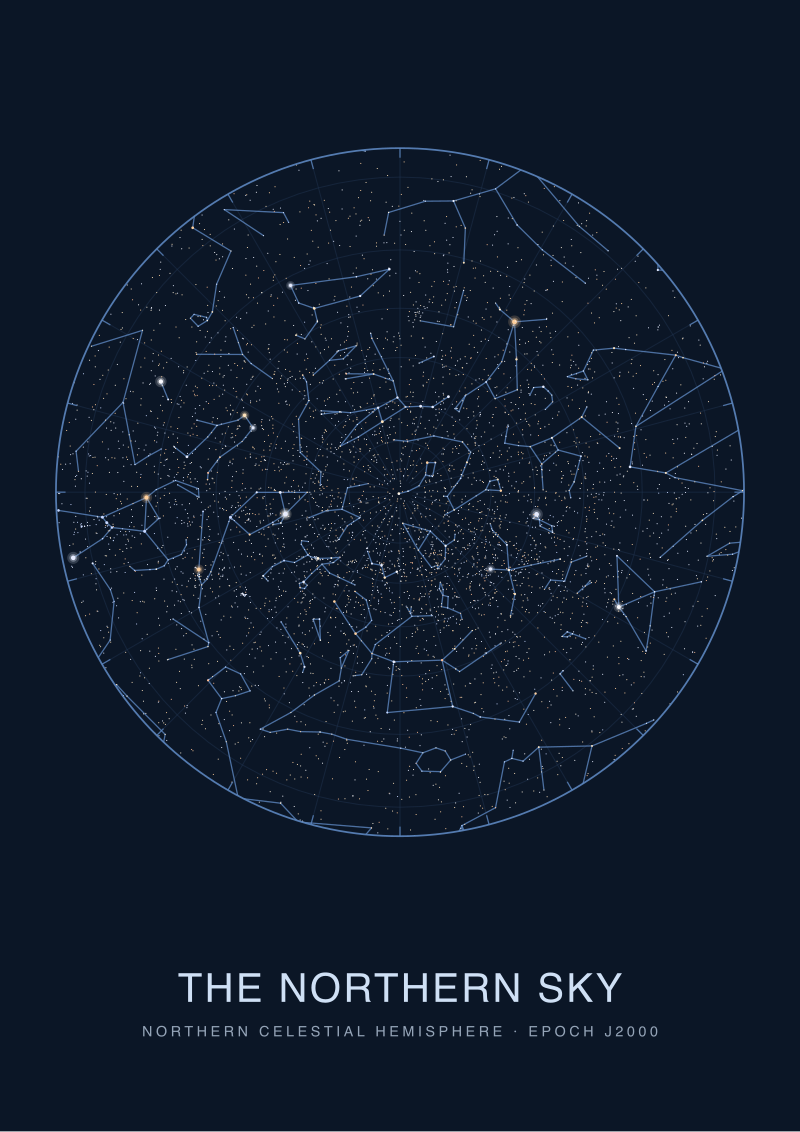
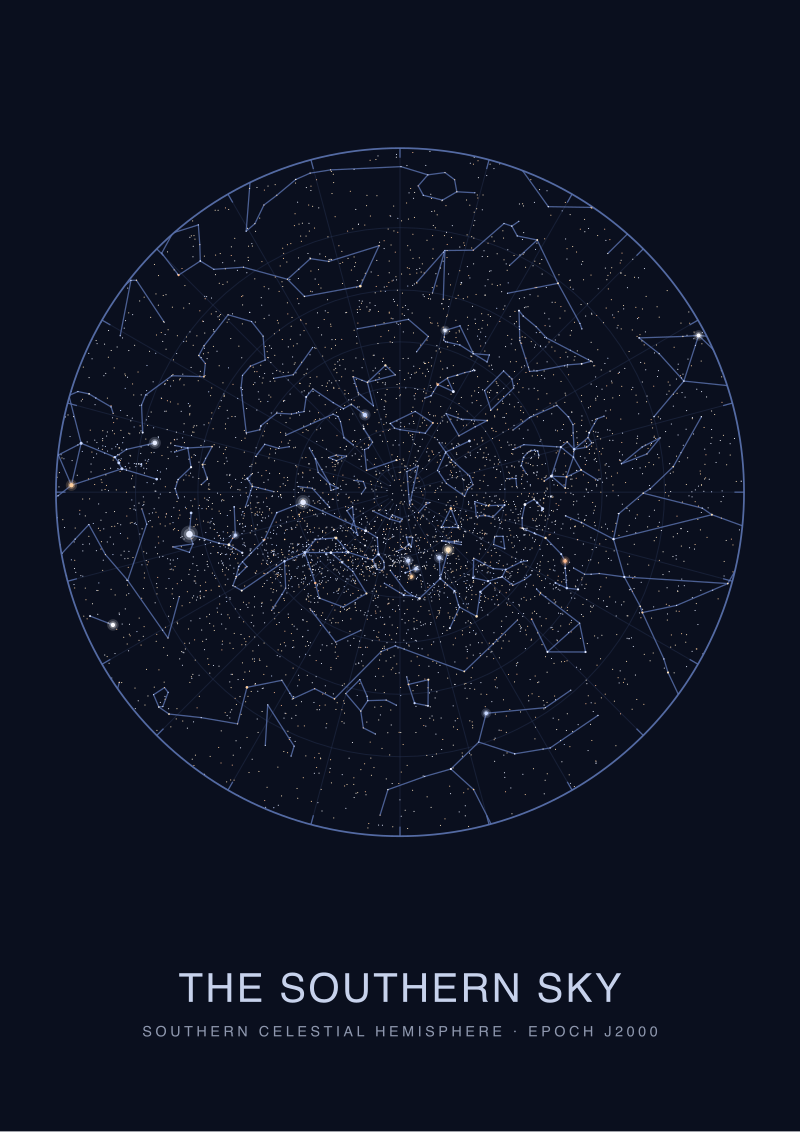
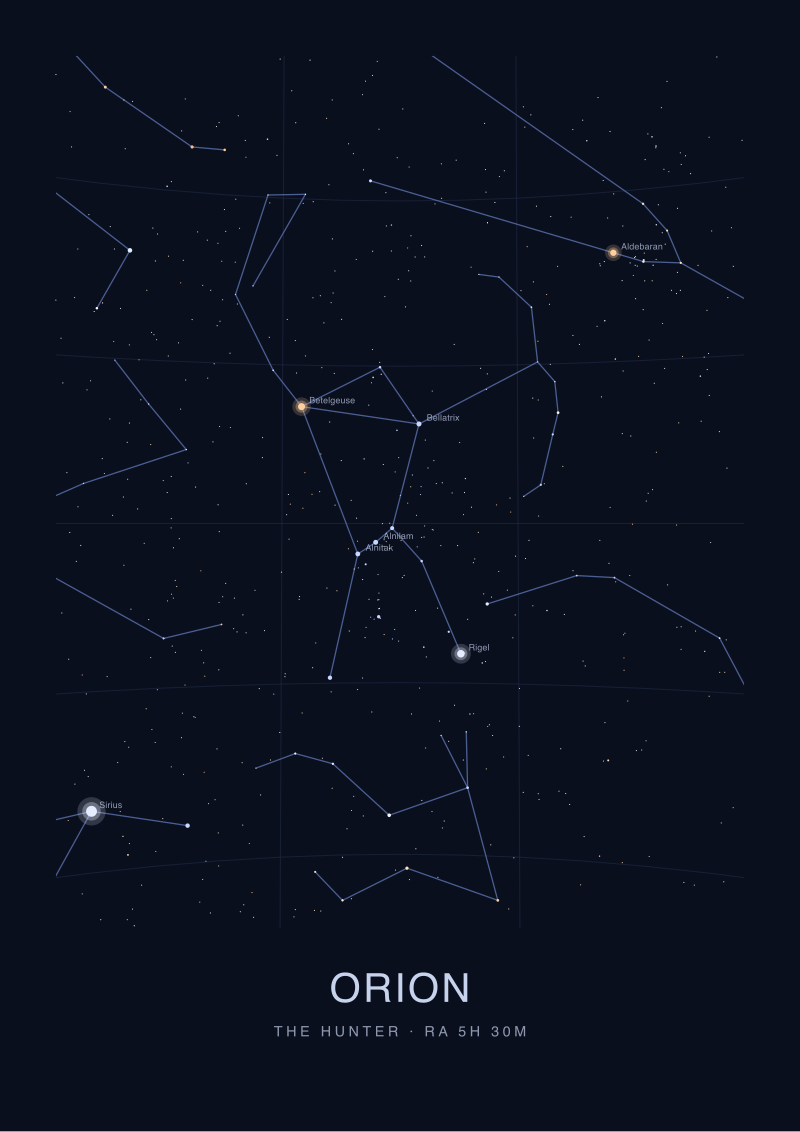
The residual measurement is this. In 1958 a Flagstaff resident could see something on the order of two thousand stars from a backyard. In 2023, from a Bortle 8 block, that same resident's descendant sees between twenty and fifty. Six of those are almost always Sirius, Canopus, Arcturus, Rigil Kentaurus, Vega and Capella. The rest are the shifting cast of first- and second-magnitude stars — Rigel, Betelgeuse, Procyon, Aldebaran, Altair, Deneb, Antares — that the calendar rotates in and out with the season. That is the map the city leaves you. It is worth drawing, and the studio at /shop/ draws it from the same HYG positions any observatory uses. 9.6 percent per year is the number. It is what should decide whether you wait for a dark-sky trip you may not take, or step out tonight and learn the six stars a city cannot erase. The paperwork says start tonight.
FAQ
Can you actually see stars from Manhattan or central London?
Yes, but a small and specific list. On a clear Bortle 8 or 9 night, the naked-eye limiting magnitude typically sits between 2.0 and 4.0. The reliable objects from mid-northern latitudes are Sirius (apparent magnitude −1.44), Arcturus (−0.05), Vega (0.03), and Capella (0.08), rotated through the year by the season. Between them, an observer who knows where to look will always find at least two of the four overhead on any clear evening.
What is the Bortle scale and how do I estimate my own class?
The Bortle Dark-Sky Scale is the nine-step visual classification John E. Bortle published in Sky & Telescope in February 2001. Class 1 is pristine — the Milky Way casts visible shadows. Class 9 is inner-city. To estimate your own class, count the stars you can see in a constellation you know well and check whether the Milky Way is visible at zenith. Class 8–9 typically shows twenty to fifty stars total; Class 4–5 shows several hundred to a thousand.
Is light pollution really getting worse, or is that alarmist framing?
The 20 January 2023 Kyba et al. paper in Science quantified the trend using 51,351 citizen-science observations between 2011 and 2022. Global sky brightness measured from the ground is increasing at approximately 9.6 percent per year. That doubles roughly every seven and a half years. Satellite data underestimated the rate because it undercounts blue-white LED emission, the technology now standard in urban streetlighting. The trend is measured, peer-reviewed, and published in a first-tier journal.
Why can I see Sirius but not the Milky Way from my city?
The Milky Way is a diffuse surface brightness — it competes with the entire sky's background glow. Once the sky background exceeds a certain luminance, the Milky Way is mathematically indistinguishable from it. Sirius is a point source at apparent magnitude −1.44, roughly twenty-five times brighter than Vega, and it only needs to punch through the atmospheric column above a single point on the sky. Point sources survive light pollution far longer than diffuse ones.
Does moving to the suburbs actually help?
It helps proportionally to distance and to the specific direction. The Falchi 2016 atlas shows that light domes from major cities extend fifty to a hundred kilometers into surrounding countryside. A suburb ten miles from a city core is typically still Bortle 6 or 7; a genuinely dark Bortle 3 sky requires roughly a hundred kilometers from the nearest metropolitan area, and more if the city is coastal and the observing direction is inland toward the light dome.
What about LED streetlights — aren't they supposed to be dark-sky friendly?
Some are, most are not. The LED transition that swept municipal lighting from roughly 2010 onward often replaced warm sodium-vapor lamps with 4000–6000 K blue-white LEDs — a spectral shift that scatters more efficiently in the atmosphere and reaches further from the source. Dark-sky-friendly LEDs exist: fully shielded fixtures at 2700 K or warmer are the IDA design standard. The problem is municipal procurement, not physics.
Which star is the brightest thing I can see from the worst city sky?
Depending on hemisphere and season, either Sirius (northern winter, magnitude −1.44) or Canopus (southern winter, magnitude −0.62). Both are bright enough to survive significant urban haze. In the northern hemisphere from late spring into summer, Sirius sets early and Arcturus (−0.05) takes over as the brightest reliably visible star, joined by Vega (0.03) climbing in the east.
If I want to actually see more stars, what is the single most useful thing I can do?
Give your eyes twenty minutes to dark-adapt without checking a phone screen. Dark adaptation is a chemical process — retinal rhodopsin has to rebuild — and it is completely destroyed by a single glance at a white or blue-white light source. One unshielded screen glance resets the twenty-minute timer to zero. This costs nothing and roughly doubles the number of stars a Bortle 8 sky delivers, from perhaps twenty visible to perhaps forty.
From the collection
New charts and 10% off your first print.
One email now with your code. No noise after.