We have read a great many articles about the constellation Cygnus, the asterism called the Northern Cross, and the star at its tail called Deneb. They are written by different hands, in different decades, for different audiences, and they make almost exactly the same three mistakes. The mistakes are not factual errors in the strict sense — the magnitudes usually check out, the coordinates are close enough, the mythology is credited to the Greeks. The mistakes are editorial. They flatten a chartmaker's problem into a tour guide's script, and in doing so they lose the only thing that makes Cygnus interesting to look at twice: the tension between what the sky contains and what a culture decided to draw on top of it.
The three mistakes recur with a regularity that suggests they are copied more often than they are observed. We list them here not to correct individual writers but to name a pattern, because the pattern is what has to change if anyone is going to write about this constellation and say something the reader could not have guessed from the title.
What They All Get Wrong
The first mistake is treating Deneb's brightness as a property of the star rather than a property of a specific number on a specific scale seen from a specific rock. The typical piece introduces Deneb as "the brightest star in Cygnus" and stops there. Deneb's apparent magnitude in the HYG v41 catalogue is 1.25. That number is the entire load-bearing claim of the sentence. It is not intrinsic. It is not a ranking against the constellation in the abstract. It is a measurement of the light that arrives here, at Earth, from a source at right ascension 20.69053 hours and declination +45.28034 degrees. The moment an article says "brightest" without saying "as seen from here", it has already ceded the chartmaker's problem to the tour guide's script — and made a claim about the star that is really a claim about the observer.
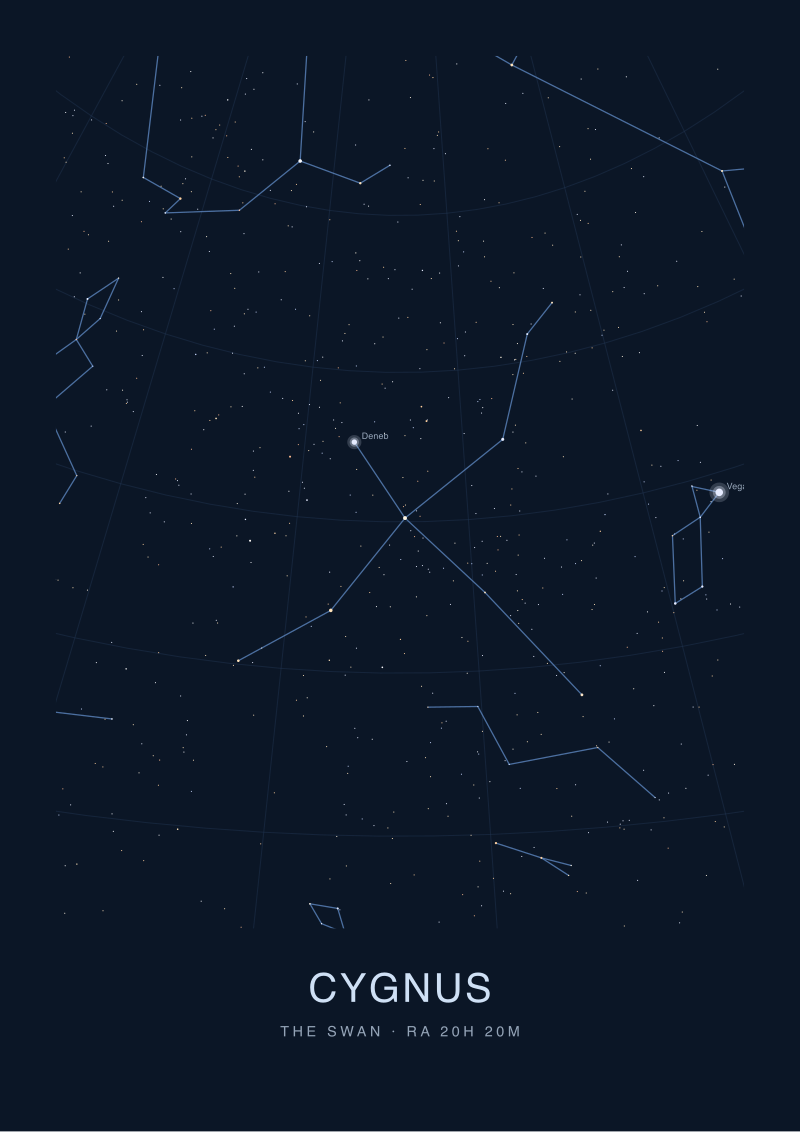
The second mistake is conflating two things a working cartographer separates with a ruler: the constellation Cygnus and the asterism called the Northern Cross. The IAU-recognised constellation is a bounded region of sky containing dozens of catalogued stars, a stretch of the Milky Way, and a set of named substructures. The Northern Cross is a subset of six of those stars — Deneb at the tail, Albireo at the head, and the four stars of the crossbar — arranged in a shape that resembles a Latin cross to observers standing upright in mid-northern latitudes. A cross is not a swan. The two figures point in opposite conceptual directions: one is a bird drawn along the flow of the Milky Way, the other is a symbol pinned across it. General articles routinely use the two names as synonyms, and in doing so they lose the layering entirely. The swan and the cross are the same six stars connected by different lines, and the difference between the lines is the entire history of who was looking.
The third mistake, and the most costly, is treating the Greek mythology as the constellation's origin story. It is one origin story, and a comparatively late one. The pattern of stars was seen and named by cultures that never wrote in Greek. Mediaeval Arabic astronomers called the tail star Al-Dhanab al-Dajājah — "the tail of the hen" — and it is from that phrase, via Latin transliteration, that the modern name Deneb descends. That lineage has nothing to do with Zeus or Leda and everything to do with a systematic project of cataloguing bright stars in Arabic during the ninth and tenth centuries. A responsible piece on Cygnus would name the tradition each time it told a story. Most pieces do not, which is how a Greek myth ends up quietly asserted as the meaning of a shape that was seen and drawn long before and long after.
What Is Almost Always Missing
What is missing from nearly every general-audience article about Cygnus is the machinery. Not the equations — the reader does not need those — but the sense that behind each stated position and each stated magnitude there is a system doing work, and that the system has a history worth knowing.
The first missing piece is the coordinate frame. Right ascension 20.69053 hours and declination +45.28034 degrees are not universal Cartesian coordinates. They are angular addresses on a celestial sphere whose reference points precess. The equinox drifts. The pole star of two thousand years ago was not Polaris. Deneb's numeric address is a snapshot within a chosen epoch — J2000 in most modern catalogues, HYG among them. An article that gives coordinates without telling the reader that coordinates have dates is an article that hands over a map without a legend. The reader is left with the impression that the numbers are permanent, and they are not.
The second missing piece is the constellation boundary itself. The public imagination treats a constellation as a group of stars connected by a stick figure. The professional treatment is different: since the International Astronomical Union's 1930 codification by Eugène Delporte, each of the 88 constellations is a precisely bounded polygonal region of the celestial sphere, and every star in the sky belongs to exactly one such region. Cygnus is not the swan-shape; the swan-shape is drawn inside the region called Cygnus. Deneb belongs to Cygnus not because it is at the tail of a swan but because its coordinates fall within the polygon assigned to Cyg in 1930. That is a subtle but total inversion of how the popular articles present the sky, and it is the inversion a chartmaker starts from. Once the polygon is the primary object, the swan and the cross become annotations on top of it.
The third missing piece is the setting. Cygnus lies along a bright stretch of the Milky Way. The dark rift that splits the summer Milky Way in the northern hemisphere — the Great Rift — runs directly through the constellation, and Cygnus contains some of the densest visible star fields available to unaided eyes from a dark site. The Northern Cross is drawn against this backdrop, not against black. A picture of Cygnus that removes the Milky Way removes the reason the swan is a bird flying somewhere rather than a bird pinned to nothing. Most articles reproduce a plain black chart because it is easier to reproduce and easier to caption, and the cost is that the reader never learns the swan is airborne over a river of light.
The fourth missing piece is distance. Apparent magnitude 1.25 tells the reader nothing about how much light Deneb emits. A dim star very close and a luminous star very far can produce the same number on the same scale. The HYG entry in our grounding is silent on Deneb's distance and evolutionary state, because HYG at this level records apparent magnitude and position, not intrinsic luminosity. A careful article respects that silence rather than reaching from memory. But it should at least tell the reader the silence exists, because the missing dimension is the one that would change everything.
 Cygnus
The print from this article · from €29.95
View the print →
Cygnus
The print from this article · from €29.95
View the print →
What I Would Say Instead
An honest article about Cygnus, the Northern Cross and Deneb would begin not with a star but with a shape and a question: whose shape, and drawn onto what. It would treat the constellation as a bounded region of sky assigned by the International Astronomical Union in 1930, the swan-figure as a Greek reading of the pattern of bright stars inside that region, and the Northern Cross as a later Latin-Christian overlay convenient to mid-northern observers who were literate in a specific iconography. It would name each tradition each time it drew from it, so the reader understood that they were watching a layered artefact rather than reading a fact of nature. The layering is not a distraction from the astronomy. It is what makes the sky at this longitude of the galaxy a cultural object as well as a physical one, and it is what any decent star map of Cygnus has to hold in both hands at once.
It would then anchor to what the grounding catalogue supports and only that. HYG v41 records Deneb at apparent magnitude 1.25, at right ascension 20.69053 hours and declination +45.28034 degrees. Those three numbers are enough to place the star, describe how bright it appears from Earth, and situate it in the northern hemisphere at a declination high enough to be circumpolar or near-circumpolar from most inhabited parts of Europe, Canada and the northern United States. The article would say exactly that and stop, rather than reaching for adjectives about supergiant luminosity that HYG at this granularity does not license. When it wanted to say more about intrinsic brightness or evolutionary state, it would either bring in a different catalogue explicitly or leave the claim unmade. The discipline of citing the catalogue is not pedantry; it is the difference between a chart and a poster.
The Northern Cross would be described for what it is: an asterism of six stars, one of which is Deneb at the tail of the swan and the top of the cross. The article would note that the same six stars form both figures, and that the difference between "swan" and "cross" is entirely a matter of which line-connections a culture chose to draw between them. Neither figure is written into the sky. Both are cartographic choices. This is the point at which a general reader learns something they cannot get from the tour-guide version — the shapes are not out there, and once you see that, you can start to draw your own. The reader begins to look at the constellation the way the desk looks at it, which is as a page waiting for a pencil rather than a picture already printed.
It would treat the naming of Deneb as an act of translation. The modern spelling is an English rendering of a Latin transliteration of an Arabic phrase meaning the tail of the bird. Each layer of that chain represents an astronomer or a scribe who thought the star mattered enough to fix in a name. The Greek Zeus-and-Leda story would appear once, credited to the Greek tradition, and would not be repeated as though it were the meaning of the constellation. The Arabic naming tradition would get equal weight, because it is the reason we say Deneb rather than something else, and equal weight is what a layered artefact deserves.
It would mention the Milky Way. Not as decoration but as context: Cygnus sits on a bright stretch of the galactic plane, split by the Great Rift of interstellar dust, and any account of the constellation that omits its backdrop has already lost the reason it is called Cygnus in the first place — a bird pattern makes sense flying along a river of light, and no other explanation is required. A star map print of this region drawn honestly shows the Milky Way as a shaded band, the boundary of the IAU constellation as a fine polygon, the swan figure and the cross figure as two different sets of connecting lines over the same six named stars, and Deneb marked with the magnitude 1.25 and the coordinates recorded above. That is the map the desk would draw; we keep prints of the Cygnus region on paper in the /shop/. The shape is not out there. The chart is the work.
From the collection
New charts and 10% off your first print.
One email now with your code. No noise after.