Ask any first-time reader of a star chart where constellation names come from and the answer arrives fast: Greek mythology. Orion the hunter, driven eternally across the sky by Scorpius. Cassiopeia the vain queen, bound to her throne. Perseus holding the head of Medusa. Andromeda in chains, waiting for the hero. In this telling the night sky is a Greek epic pinned to a dome — a stage where Zeus and Poseidon settled family arguments by turning offenders into asterisms, and where the constellations we plot in a modern chart are the direct descendants of Hesiod, Aratus and Eratosthenes.
It is a story that gets repeated by planetarium narrators, primary-school textbooks, and every glossy coffee-table book on the sky for good reason. Forty-eight of the 88 constellations the International Astronomical Union formalised in 1930 come, essentially unchanged, from Ptolemy's Almagest, written in Alexandria in the second century AD. The names are Latinised Greek — Ursa Major, Leo, Virgo, Aquila. The narratives are Greek. The heroes are Greek. The cultural continuity from Aratus's Phaenomena in the third century BCE to a printed atlas on a bookshelf today is one of the longest unbroken naming traditions in human record.
So when someone says "these are Greek constellation names," they are not wrong. They are telling a version of a story that has been told correctly, and mostly consistently, for more than two thousand years. The question is whether that version tells the whole story, or only the middle chapter of it.
Why This Is Actually True
Ptolemy really is the ancestor. His forty-eight catalogued figures are the direct textual source for almost every northern-hemisphere constellation drawn on a modern chart. The Perseus family — Andromeda, Cassiopeia, Cepheus, Perseus itself — is grouped exactly as Greek myth grouped it, with the sea monster Cetus placed suggestively to the south. The zodiac we still divide the ecliptic into is the zodiac Ptolemy divided it into, with the same twelve figures in the same order. The IAU committee that ratified the modern list in 1930 kept the Ptolemaic names because they had been used continuously in Latin, Greek and Arabic astronomical texts since Alexandria, and rejecting them would have thrown away twenty-two centuries of cross-referenced observation.
The star names of the three brightest objects on our grounding list carry that same Greek pedigree. Sirius, alpha Canis Majoris at apparent magnitude −1.44, is the Greek *Seirios*, meaning scorching or searing. Canopus, alpha Carinae at magnitude −0.62, is *Kanopos*, named for the pilot of Menelaus's fleet in the return from Troy. Arcturus, alpha Boötis at magnitude −0.05, is *Arktouros*, the bear-guardian, positioned in the sky to watch Ursa Major as she circles the pole.
Three of the six brightest stars over Earth carry names spoken in Athens two millennia ago. Forty-eight constellations preserved intact. A narrative tradition — Perseus rescues Andromeda, Orion angers Artemis, the Great Bear is Callisto — that has never been out of print. If someone asks why Cassiopeia is called Cassiopeia and you answer "she was a queen in a Greek myth," you are answering a real question with a real answer. The Greek layer is genuinely there.
But here is what that framing misses entirely: the sky Ptolemy catalogued was not originally his, and the star names on a modern chart are not, for the most part, in Greek.
Where It Breaks Down
Two things collapse under closer reading. The first is that the constellation shapes themselves were older than Greek civilisation by roughly a thousand years. The Mesopotamian star catalogue MUL.APIN, compiled on cuneiform tablets around 1000 BCE and drawing on older material, already contains recognisable versions of Taurus, Leo, Scorpius, the Twins, and a horse-bodied figure that Greek writers would later read as Chiron the centaur. Aratus's *Phaenomena* in the third century BCE reads, to a modern historian of astronomy, less like an original composition and more like a Greek re-telling of celestial geography the eastern Mediterranean had been sharing for centuries. The narratives were Greek; the divisions of the sky were inherited.
The second collapse is more visible on a modern chart. Look at the other three stars in our grounding list — the three that are not Greek. Rigil Kentaurus, alpha Centauri at magnitude −0.01, is the Arabic *Rijl al-Qanṭūris*, the foot of the centaur. Vega, alpha Lyrae at magnitude 0.03, is *al-Nasr al-Wāqi'*, the swooping eagle. Capella, alpha Aurigae at magnitude 0.08, is the Latin *capella*, a little she-goat carried on the shoulder of the charioteer.
So of the six brightest stars over Earth's sky, three carry Greek names, two carry Arabic names, and one carries Latin. That is a fifty-fifty split at best, in a category where the conventional story predicts a clean sweep. Widen the frame beyond these six and the disproportion sharpens: of the roughly three hundred proper star names the IAU has now formally approved, about two-thirds are Arabic in origin. Betelgeuse from *Yad al-Jauzā'*, the hand of the giant. Aldebaran from *al-Dabarān*, the follower. Rigel from *Rijl*, the foot. Altair from *al-Nasr al-Ṭā'ir*, the flying eagle. Deneb, Fomalhaut, Alnilam, Alnitak, Mintaka, Alcor, Mizar — the list runs long and it does not run through Athens.
The reason is a specific chapter of scholarly history. Between roughly 800 and 1200 CE, Ptolemy's Almagest survived because Arabic-speaking astronomers in Baghdad, Damascus, Cairo and later Toledo translated it, corrected its numerical errors, and expanded its star lists. When Latin Europe wanted the Almagest back, it did not receive it from Alexandria. It received it from Toledo, through Gerard of Cremona's 1175 translation of an Arabic manuscript. The stars kept the names their translators had given them.
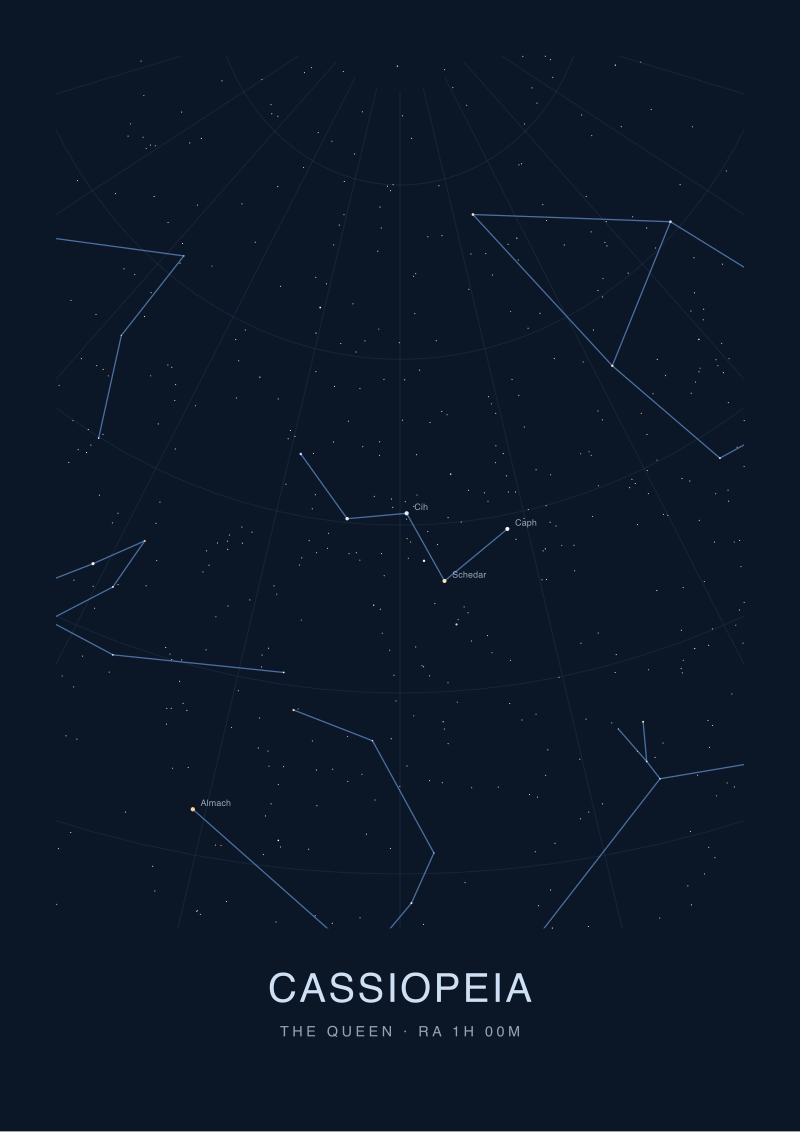 Cassiopeia
The print from this article · from €29.95
View the print →
Cassiopeia
The print from this article · from €29.95
View the print →
The Rule I Use Instead
The rule is simple and it matters when we sit down to plot a chart: name the layer.
A star map has three separable layers of naming, and pop-astronomy collapses them into one. The constellation figure — the outline of Orion, the W of Cassiopeia, the plough of Ursa Major — is mostly a Ptolemaic-Greek layer for the northern sky, with southern additions filled in by European navigators and cataloguers between 1603 (Bayer's *Uranometria*) and 1752 (Lacaille's southern catalogue). The constellation myth — Orion offending Artemis, Cassiopeia's vanity — is a second, distinct layer, largely Greek, though grafted onto older Mesopotamian divisions. The individual star names inside those figures are a third layer, and that layer is dominated by ninth- and tenth-century Arabic scholarship.
Take Centaurus as a working case. The figure is old: a horse-bodied being present in Babylonian tablets long before any Greek recorded it. Greek writers gave it the myth layer — Chiron the wise centaur, tutor of Achilles. Its brightest star, at apparent magnitude −0.01, carries a proper name that describes the same anatomy Ptolemy described — foot of the centaur — but in Arabic, *Rijl al-Qanṭūris*, written down a thousand years after Chiron was first named. Three civilisations. One star. The same sky, re-drawn three times.
We keep the layers separate on every print that leaves the studio. If a chart labels bright stars by their proper names, it is telling the reader: this is the Arabic layer, this is Baghdad's contribution. If it labels stars only by Bayer's alpha–beta–gamma letters, it is telling the reader: this is the 1603 European systematisation. If it draws the constellation figure, it is Ptolemaic-Greek. If it draws only the dotted IAU boundaries, it is the 1930 committee. Reading a chart is reading four editorial hands at once, and the pleasure of the map is largely the pleasure of noticing which hand drew which line.
When the Old Rule Still Wins
The "it's all Greek myth" shorthand still works well at one specific altitude: the first look up. When somebody on a first clear night asks why that seated figure is called Cassiopeia, "she was a queen in Greek mythology" is a correct-enough, useful, humane answer. The layer distinction is a second-pass tool. It rewards a reader who already knows the constellation and wants to know why the second-magnitude star inside it is called Schedar. It does not help a reader who is still learning to find the W.
The shorthand also holds well for the mythological narratives themselves, when narrowly framed. Perseus really is a Greek myth. Andromeda really is a Greek myth. The Herakles who kneels near Vega really is Herakles. The shapes may descend from Babylon, but the stories most readers have inherited descend from Hesiod. That is not a small thing.
Where the shorthand breaks is star names, southern-sky constellations added after 1600, and any question that asks why a particular star was worth naming to a particular tradition. For those, "Greek myth" is not so much wrong as it is a door labelled correctly but left closed. The layer behind it — Arabic, Latin, Mesopotamian, occasionally Polynesian for the far south — is where the more interesting half of the answer lives, and where the star maps we plot at /shop/ tend to spend most of their attention.
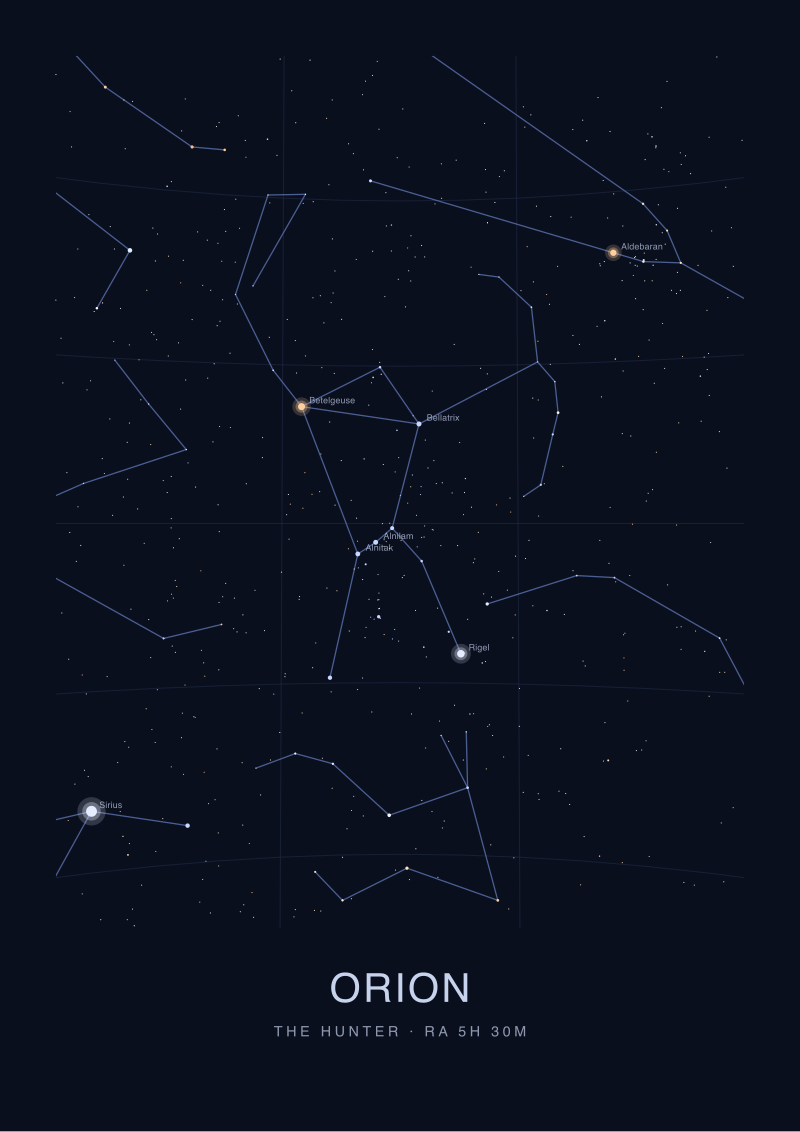 Orion
The print from this article · from €29.95
View the print →
Orion
The print from this article · from €29.95
View the print →
FAQ
Are all 88 modern constellation names from Greek mythology?
Forty-eight of the 88 IAU-approved constellations come directly from Ptolemy's Almagest and carry Greek mythological narratives, so the majority for the classical northern sky is Greek. The remaining forty were added between 1603 and 1763 by European astronomers — Bayer, Hevelius, Lacaille — to fill the southern sky and gaps between Ptolemaic figures. Those later constellations carry Latin names for scientific instruments and animals, not Greek myths. Microscopium and Antlia are not in Homer.
Why are so many star names in Arabic rather than Greek?
Because between roughly 800 and 1200 CE, Ptolemy's star catalogue was preserved, corrected and expanded almost exclusively by Arabic-speaking astronomers in Baghdad, Cairo and Andalusia. When Latin Europe recovered the Almagest — through Gerard of Cremona's 1175 translation done in Toledo from Arabic manuscripts — the individual stars kept the Arabic proper names their translators had used. Three of the six brightest stars in our sky carry Arabic or Latin names for that reason, not Greek.
What is the difference between a constellation name and a star name?
A constellation name identifies a figure or region of sky — Orion, Ursa Major, Centaurus. A star name identifies a single point of light inside that figure — Betelgeuse inside Orion, Rigil Kentaurus inside Centaurus. The two categories were named at different times, by different traditions, in different languages. Ptolemy named most classical constellations; Arabic astronomers named most bright individual stars; the IAU codified both lists in the 20th century.
Are the zodiac constellations Greek in origin?
The narratives attached to them — Taurus the bull carrying Europa, Leo the Nemean lion — are Greek. The twelvefold division of the ecliptic and the specific animal figures used, however, are much older, appearing in Mesopotamian star lists a millennium before Aratus. The Greeks inherited the zodiac's structure from Babylonian astronomy and grafted their own mythological cast onto figures that were already there. It is a Greek retelling of a Babylonian scheme.
What does Alpha Centauri mean and why does it also have another name?
"Alpha Centauri" is the Bayer designation given by Johann Bayer in 1603, ranking the brightest star in Centaurus as its alpha. "Rigil Kentaurus," from the Arabic *Rijl al-Qanṭūris*, is the proper name meaning foot of the centaur — the star's anatomical location within the constellation figure. Both refer to the same star, magnitude −0.01, but one is a 17th-century European systematisation and the other is a much older descriptive name.
How many constellations were added after Ptolemy?
Roughly forty, added in two waves. Northern gap-filling constellations like Vulpecula, Lynx and Canes Venatici were introduced by Johannes Hevelius in the late 17th century. Southern-sky constellations invisible from Mediterranean latitudes — Musca, Tucana, Pavo, Microscopium, Reticulum, Fornax — were introduced by Petrus Plancius, Johann Bayer and, most systematically, Nicolas-Louis de Lacaille in his 1751–1752 southern catalogue compiled from the Cape of Good Hope.
Why do modern astronomers still use these old mythological names?
Because they are anchors. Two millennia of cross-referenced observations — comets recorded near Aldebaran, novae recorded in Cassiopeia, variable stars catalogued by their Bayer letter — would become unreadable if the naming reset. The IAU keeps the old system because scientific continuity is more valuable than tidiness. The names carry cultural baggage the modern discipline no longer needs, but they also carry the address book of every observation ever made.
New charts and 10% off your first print.
One email now with your code. No noise after.