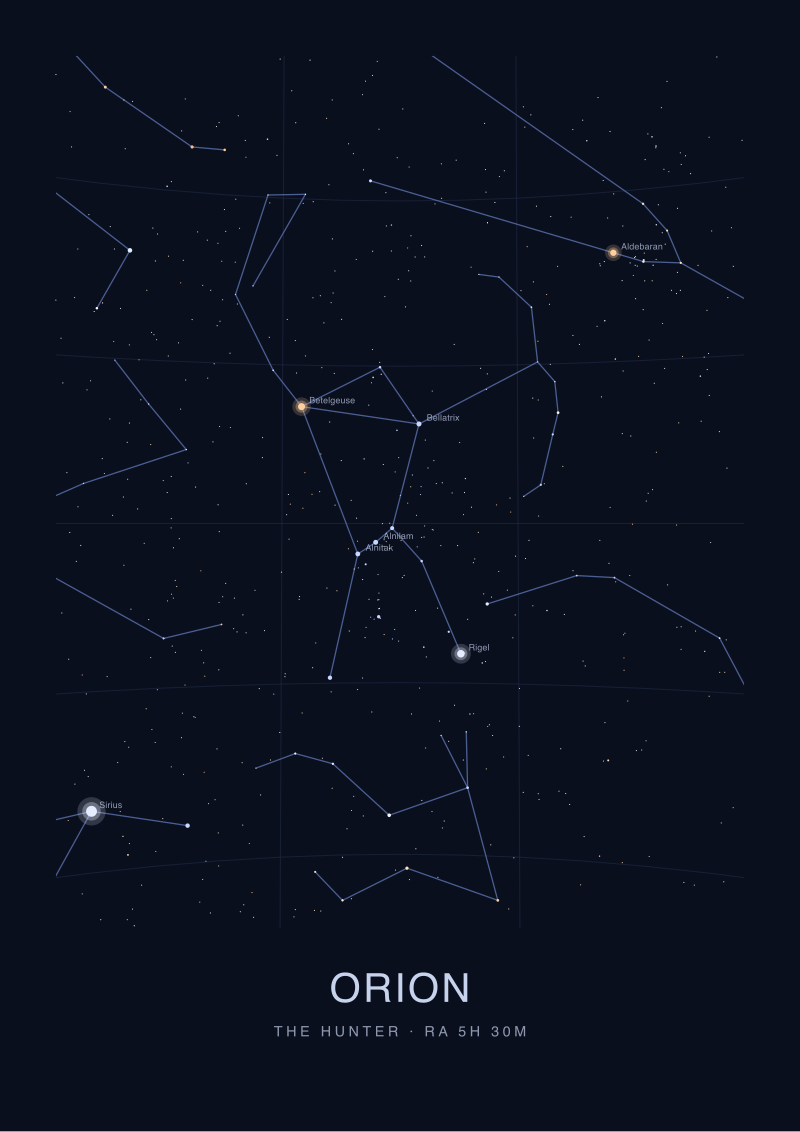
Orion is not the constellation you think you know. Hear me out. What you are looking at is a coordinate frame straddling the celestial equator, anchored by two very different stars — Rigel at apparent magnitude 0.18 in the south-west of the figure, Betelgeuse at 0.45 in the north-east — and a belt whose famous three-star alignment is a sightline coincidence, not a physical row. This piece routes you through the constellation by asking three yes/no questions. Answer each one honestly for your own sky. The table at the end maps all eight answer combinations to a single concrete recommendation. No horoscopes. No mysticism. Just how a chartmaker plots the hunter before drawing him.
Question 1: Are You Observing From the Northern Hemisphere?
This is the first fork because Orion sits almost exactly on the celestial equator. Rigel's declination is −8.20°; Betelgeuse's is +7.41°. The constellation is bisected by the equator, which means it is visible from every inhabited latitude on Earth — but the sky it appears in is not the same sky. In the north, Orion is a winter constellation, hanging in the southern sky between November and March. In the south, it is a summer figure and appears inverted, with Betelgeuse below the belt from the observer's perspective and Rigel above it.
If Yes
You are looking for Orion in the southern portion of your sky, most easily between mid-evening in November and early evening in March. Face south. The belt runs roughly horizontal. Betelgeuse is the upper-left shoulder, orange-red even to the naked eye at magnitude 0.45. Rigel is the lower-right knee, cooler and brighter at magnitude 0.18. The figure stands the way European chartmakers drew him for four centuries.
If No
You are looking north. The figure is inverted relative to every classic chart printed in Paris, London or Amsterdam. Betelgeuse now appears in the lower-right of the figure from your point of view; Rigel occupies the upper-left. The belt still points, but the orientation of the hunter is upside-down by northern convention. Chartmakers working from Sydney, Buenos Aires and Cape Town have redrawn him accordingly — the same stars, the same magnitudes, a different figure on the page.
Question 2: Is Your Site Dark Enough to See Stars Below Magnitude 3?
The magnitude scale runs backwards: brighter stars have lower numbers. Rigel at 0.18 and Betelgeuse at 0.45 are among the ten brightest stars in the entire night sky and will punch through almost any urban glow. The belt stars are fainter — around magnitude 1.7 to 2.0 — still visible from a suburban backyard. But the sword hanging below the belt, the fainter body-outline stars, and the Great Orion Nebula inside the sword all require darker sky. Magnitude 3 is roughly the naked-eye limit of a well-lit suburb.
If Yes
You will see the full figure. The two anchor stars, the belt, the sword, the shoulders, the raised club, the shield. The Orion Nebula appears as a soft grey smear inside the sword to the naked eye and resolves into structure with binoculars. This is the Orion the classical chartmakers were drawing — the one where a hunter's outline actually emerges from the stars, rather than a scatter of bright anchors that require imagination to connect.
If No
You will see the skeleton, not the figure. Rigel and Betelgeuse dominate. The three belt stars line up cleanly. Everything else fades into the light dome. This is enough to identify the constellation and to trace the belt sightline, but not enough to draw the hunter. A chartmaker's advice: work from what you can see. Anchor Rigel and Betelgeuse first. Confirm the belt. Do not try to sketch the sword or the club under a bright sky — you will guess, and guesses go on the page as errors.
 Orion
The print from this article · from €29.95
View the print →
Orion
The print from this article · from €29.95
View the print →
Question 3: Are You Trying to Sketch the Constellation, or Only to Identify It?
Identification is a naked-eye exercise: match what you see to a chart. Sketching is a chartmaker's exercise: plot positions before you draw. The two demand different amounts of care. The grounding data for this article gives Rigel at right ascension 5.24h, declination −8.20°, and Betelgeuse at 5.92h, +7.41°. Those are the two anchor points every Orion sketch depends on. Everything else in the figure is measured relative to them.
If Yes
You are sketching. Start by placing the two anchors on your page in the correct relative position. Rigel is roughly 0.68 hours west of Betelgeuse in right ascension terms and 15.6° south in declination. On paper, that is a substantial diagonal — down and to the right if you follow northern chart convention. Set that diagonal first. Then plot the belt between them, offset toward Rigel's side of the frame. Only after the anchors and the belt are correctly placed should you draw the sword, the shoulders and the club. The order matters: anchors, belt, body. Chartmakers do not draw hunters. Chartmakers draw coordinates and then let the hunter appear.
If No
You are identifying. Find Rigel first — it is the brightest star in the south-western portion of the figure at magnitude 0.18, blue-white and steady. From Rigel, trace up and slightly north-east to the belt. From the belt, continue in roughly the same direction to Betelgeuse. That path — Rigel, belt, Betelgeuse — is the spine of the constellation. Everything else can be triangulated from those three references. You do not need to memorise the whole figure. You need those three.
If You Answered Everything
The eight possible answer combinations route to one concrete recommendation each. Q1 asks hemisphere. Q2 asks sky darkness. Q3 asks purpose.
| Q1 (Northern?) | Q2 (Dark sky?) | Q3 (Sketching?) | Recommendation |
|---|---|---|---|
| Yes | Yes | Yes | Sketch from anchors: place Rigel and Betelgeuse first, then the belt, then the nebula inside the sword. |
| Yes | Yes | No | Identify the full figure — shoulders, belt, sword, club — using Rigel and Betelgeuse as reference. |
| Yes | No | Yes | Sketch only what you can verify: the two anchor stars and the three belt stars. Leave the body blank. |
| Yes | No | No | Trace the spine only: Rigel low-right, belt middle, Betelgeuse upper-left. Do not guess fainter stars. |
| No | Yes | Yes | Sketch the inverted figure: Rigel becomes upper-left on your page, Betelgeuse lower-right, belt between. |
| No | Yes | No | Identify Orion as the summer constellation, inverted from European charts, with the full body visible. |
| No | No | Yes | Sketch anchors only, plotted for southern-hemisphere orientation. Skip the sword and outline. |
| No | No | No | Confirm the three-star spine in inverted form. Save fainter identification for a darker site. |
The table is not decoration. Each recommendation is calibrated to what your sky can actually deliver. A dark-sky sketcher in the north gets the full figure with the nebula. A light-polluted casual observer in the south gets a three-star spine and no false confidence. The chartmaker's rule is that you plot only what you can verify — and that rule holds whether you are drawing on paper or reading with your eyes.
One point of grounding. The two magnitudes anchoring this entire walkthrough come from the HYG v41 catalogue: Rigel at 0.18 and Betelgeuse at 0.45. Betelgeuse is a known variable — it dimmed noticeably between late 2019 and early 2020 in the event now referred to as the Great Dimming — so its magnitude on any given night may differ from the catalogue reference. Rigel is comparatively stable. If tonight's Betelgeuse looks fainter than Rigel by a wider margin than usual, you are watching real astrophysics, not a printing error.
Prints of Orion drawn from these coordinates — northern-figure and southern-inverted versions, magnitude-scaled — are available from the studio at see the Orion print.
Signals to Watch
The constellation is not static — either in the sky or in the record. Three specific signals will update your reading of it:
- Betelgeuse's current magnitude. The catalogued 0.45 is a reference, not a promise. Amateur photometry campaigns and professional monitoring both publish current values. When Betelgeuse climbs past magnitude 1.0, it is dimmer than any belt star. When it drops below 0.3, it rivals Rigel.
- Orion's first-evening rising date at your latitude. The date on which Orion becomes visible after sunset shifts with the seasons and, over longer timescales, with precession of the equinoxes. In the northern hemisphere at mid-latitudes, first evening visibility currently falls in mid-November. In four thousand years it will be different — precession is slow but real.
- Which star names get IAU formal status. Rigel is Arabic for "foot"; Betelgeuse is a corrupted Arabic phrase for "shoulder of the giant". The IAU formalised both in 2016. Watch which additional traditional names get formal status in future rounds — the sky's naming heritage is still being catalogued.
FAQ
Why is Rigel brighter than Betelgeuse if Betelgeuse is a much larger star?
Apparent magnitude measures how bright a star looks from Earth, not how much light it emits. Betelgeuse is a red supergiant several hundred times the sun's diameter, but much of its output is in the infrared, which the eye does not register. Rigel is a hot blue supergiant emitting more of its energy in visible wavelengths, at a broadly comparable distance. The result on our sky, per the HYG catalogue: Rigel at magnitude 0.18, Betelgeuse at 0.45.
Is Orion's Belt three stars that are physically close together?
No. The three belt stars align along our line of sight but sit at very different distances from Earth. The straight line you see on the sky is a coincidence of sightline, not a bar in space. Chartmakers have known this for a century; the aesthetic value of the belt is that it looks like a row, which is a different fact from being one. It is a superb visual anchor and a poor physical grouping.
When is the best time to see Orion from the northern hemisphere?
From roughly 40° north, Orion is visible in the evening sky from mid-November through late March, peaking overhead around midnight in mid-December and shifting earlier through the winter. By April the constellation sets shortly after sunset and disappears from the evening sky until the autumn. Further north, the visibility window narrows slightly; further south, it widens.
Can I see Orion from the southern hemisphere?
Yes. Orion is one of the few constellations visible from every inhabited latitude, because it straddles the celestial equator with Rigel at −8.20° declination and Betelgeuse at +7.41°. From south of the equator it appears in the northern sky, inverted relative to European chart conventions. It is a summer constellation for southern observers, most visible in December and January evenings.
Is Betelgeuse going to explode as a supernova soon?
"Soon" in astronomical terms means within the next hundred thousand years, which is not soon for anyone reading this. Betelgeuse is a red supergiant near the end of its life and will eventually go supernova, but predictions of imminent collapse based on the 2019 to 2020 dimming turned out to be a dust-obscuration event, not a pre-explosion signal. The star is currently behaving as a variable, not as a countdown.
What is the difference between the constellation Orion and the asterism of the belt?
A constellation is an IAU-defined region of sky with formal boundaries and includes every star within them. An asterism is an informal pattern within or across constellations — the belt is an asterism inside Orion. The distinction matters for chartmakers because constellation boundaries determine which stars belong to which name in catalogues; asterisms are pattern-recognition shortcuts and have no formal boundary at all.
Does the zodiac include Orion?
No. The zodiac is the narrow band of sky along the ecliptic — the sun's apparent yearly path — and includes only the traditional constellations that band passes through. Orion sits south of the ecliptic and is not a zodiac constellation. The zodiac is a coordinate band used historically to track planetary motion; it is not a personality system, and Orion's location outside it is a matter of geometry.
 The Northern Sky
The print from this article · from €29.95
View the print →
The Northern Sky
The print from this article · from €29.95
View the print →
From the collection
New charts and 10% off your first print.
One email now with your code. No noise after.