Six. That is how many stars in the entire sky sit brighter than magnitude 0.1: Sirius at −1.44, Canopus at −0.62, Arcturus at −0.05, Rigil Kentaurus at −0.01, Vega at 0.03, and Capella at 0.08. Every other point of light you might mistake for a planet is dimmer than all six. Venus, Jupiter, and Mars routinely outshine that entire list. This is where the most-repeated advice on the internet — "planets don't twinkle, stars do" — starts to fall apart, and where a chartmaker's three-question decision tree earns its place over the shortcut.
We are going to route you through three questions. Each has a Yes branch and a No branch. At the end, a table collapses the eight possible answer combinations into a single, honest verdict.
Question 1: Is the Light Steady, or Is It Twinkling Hard?
The twinkle test is the piece of advice that appears in almost every backyard astronomy explainer, and it is not wrong. It is incomplete. Twinkling — scintillation, in the chartmaker's vocabulary — happens because starlight arrives at your eye as a point source. The atmosphere is a stack of moving air layers of slightly different temperature and density, and each layer bends the incoming ray a hair differently. A point flickers. A tiny disk averages out.
Planets present a resolvable disk to the eye once they get close enough to us — Jupiter and Venus are the obvious cases — so the disk smears the scintillation and the light looks steady. That much of the folk rule is real. The problem is what it does at low altitudes and on very bright stars.
If Yes — the light is scintillating visibly
You are almost certainly looking at a star. This holds strongly when the object is high in the sky, at least 40 degrees above the horizon, and you can see the flicker with your naked eye. At that altitude the atmosphere you are looking through is thin, and only a true point source will scintillate.
But note the edge case that most guides omit. Sirius at magnitude −1.44 is bright enough that when it rises in the east or sets in the west, it flashes red, blue, and green so violently that people call the police thinking they have seen a UFO. This is not a planet doing something weird. This is a very bright star, seen through a thick horizon atmosphere, doing what the folk rule says it should do — only more so. If the scintillating object is within about 20 degrees of the horizon and it is dazzlingly bright, do not stop at Question 1. The twinkle test has told you what it can. Go to Question 2.
If No — the light is steady, deliberate, almost stern
This is where the folk rule earns its keep and where amateurs get most planet identifications right. A steady, non-flickering point of light that is brighter than everything nearby is a planet candidate. Venus at maximum brilliancy reaches roughly magnitude −4.7, which is more than ten times brighter than Sirius. Jupiter at opposition sits near magnitude −2.9. Nothing on the six-star list above comes close.
Caveat: a bright star seen high overhead through unusually stable, cold air can also present as steady. On mountain nights and desert nights, Vega at magnitude 0.03 or Capella at magnitude 0.08 can hold surprisingly still. Steady light is a planet indicator, not a planet proof. Route to Question 2 either way.
Question 2: Is the Object Sitting Within a Few Degrees of the Ecliptic?
This is the question the twinkle articles almost never ask, and it is the one that closes the case most cleanly. Planets in our solar system orbit the Sun in a plane. From Earth, that plane projects onto the sky as a great circle called the ecliptic — the same line the Sun traces through the year, the same line the Moon stays close to, the same line that runs through the zodiac constellations. A planet cannot leave that band. A star can be anywhere.
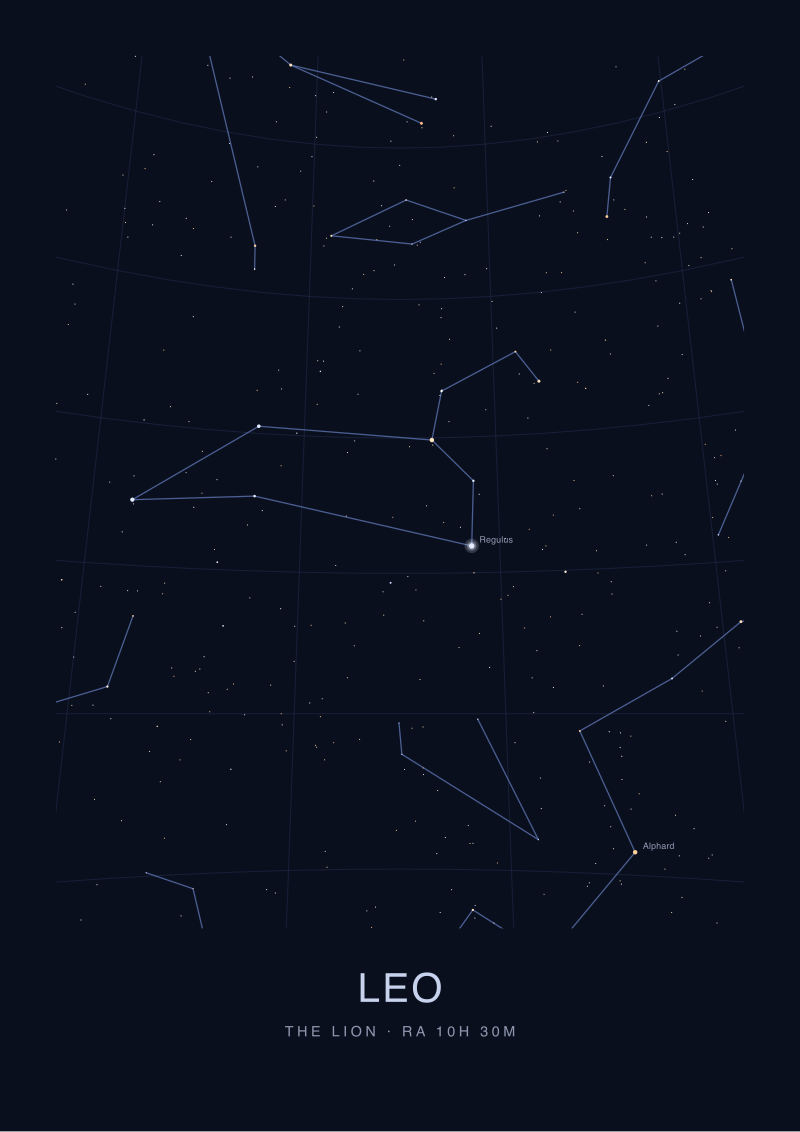
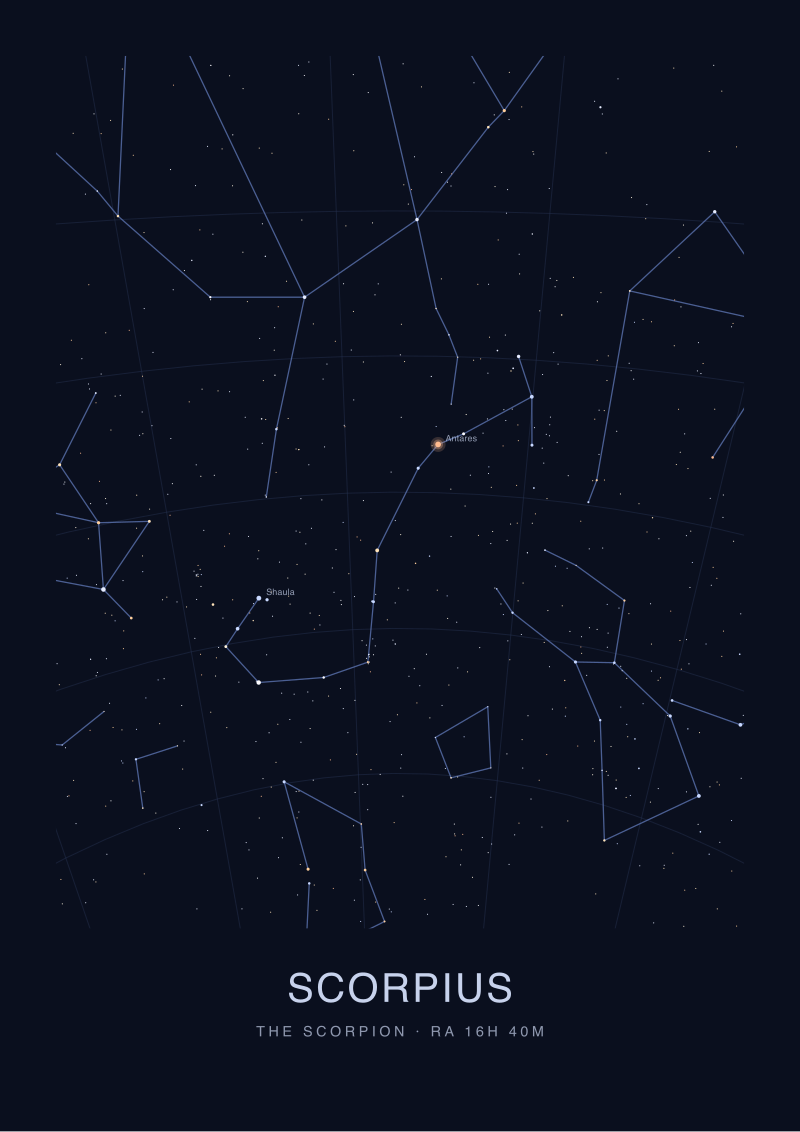
The ecliptic is not marked on the sky in ink, but it is easy to find. It runs through Taurus, Gemini, Cancer, Leo, Virgo, Libra, Scorpius, Sagittarius, Capricornus, Aquarius, Pisces, Aries. If you can identify a nearby zodiac constellation, you have the ecliptic within a few degrees.
If Yes — the bright object sits on or near the ecliptic
The odds have shifted heavily toward a planet. Of the six brightest stars in the sky, only one — Rigil Kentaurus at declination −60.83 — sits far enough south to be permanently off the ecliptic for northern observers. The rest are at declinations that put them nowhere near the zodiac band. Sirius sits at −16.72 declination in Canis Major, well south of the ecliptic. Arcturus at +19.18 in Boötes is well north of it. Vega at +38.78 in Lyra is far north. Capella at +45.99 in Auriga is farther still. Canopus at −52.70 in Carina is far south.
None of them will ever appear on the ecliptic. So if you have a very bright object that is sitting near or between two zodiac constellations, you have ruled out every one of the six brightest stars. What remains, at that brightness, is a planet. Combined with a Yes on Question 1, the case is stronger. Combined with a No on Question 1 — steady light on the ecliptic — the case is essentially closed.
If No — the bright object is well off the ecliptic
You are looking at a star. The geometry is not negotiable. No planet in our solar system deviates more than about eight degrees from the ecliptic even at maximum inclination, and the visible-to-the-naked-eye planets — Mercury, Venus, Mars, Jupiter, Saturn — stay within a few degrees of it. If your object is sitting thirty or forty degrees off the zodiac band, it is a star. Match the brightness against the six-star list. If it is very bright and high in the northern sky, you are probably looking at Vega, Capella, or Arcturus. If it is very bright and in the southern sky, Canopus or Rigil Kentaurus. If it is very bright and lower in the winter sky, Sirius.
This is one of those cases where the folk rule and the geometry can disagree. A high, steady Vega on a still night will pass Question 1's "planet" branch. Question 2 kills the planet hypothesis on the spot. That is why we ask both.
 Leo
The print from this article · from €29.95
View the print →
Leo
The print from this article · from €29.95
View the print →
Question 3: Has It Moved Against the Background Stars in a Week?
The word "planet" comes from a Greek verb meaning to wander. That is the deepest test we have, and it is the one the ancients used before magnitudes and coordinates existed. Planets move across the fixed pattern of the stars. Stars do not — not in any span a human notices without instruments. A week is enough time for the naked eye to catch Mercury, Venus, or Mars shifting position noticeably against nearby stars. Jupiter is slower, Saturn slower still, but both are detectable over a month.
This question requires patience the other two do not. You have to look at the same patch of sky at roughly the same hour on two nights separated by at least seven days, and you have to remember or sketch where the bright object sat relative to at least two nearby fixed stars the first time. This is exactly what pre-telescopic astronomers did, and it is why the planet-star distinction is older than any instrument.
If Yes — the object has visibly shifted position
Case closed. Fixed stars do not shift over a week. Their apparent positions are anchored by parallax movements measured in fractions of arcseconds per year — utterly invisible to the naked eye. Proper motions are similarly imperceptible on human timescales for all but a tiny handful of nearby dim stars, none of which would be candidates in a "is that a planet" question. A visible shift is a planet, regardless of what the twinkle test said and regardless of the exact ecliptic position on any single night.
The direction of the shift is itself informative. Superior planets — Mars, Jupiter, Saturn — normally drift eastward against the background but occasionally reverse into retrograde loops near opposition. Venus and Mercury, being interior to Earth's orbit, appear to swing back and forth relative to the Sun. Any of these motions across a week is diagnostic.
If No — the object holds its position exactly
You have a star. Combined with a Yes on Question 1 and a No on Question 2 (off the ecliptic), you have a triple-confirmation. It is the definitional case. Match brightness and constellation against a catalogue and you have a name. Fixed position over multiple nights is the final, oldest, most reliable test the naked eye can perform.
A brief honest note. If the object was visible on night one but not on night seven, that is not a fixed-position answer — it is either a planet that has moved into a difficult horizon geometry, a satellite that was never a planet or star in the first place, or an atmospheric phenomenon. Rule out those cases before you route to No.
If You Answered Everything: The Decision Table
Eight combinations, one row each. Read your three answers in order — Q1 (twinkling?), Q2 (on ecliptic?), Q3 (moved in a week?) — and find the matching row.
| Q1: Twinkling? | Q2: On ecliptic? | Q3: Moved in a week? | Verdict |
|---|---|---|---|
| Yes | Yes | Yes | Bright star seen through thick air near a planet — check position again next night. |
| Yes | Yes | No | Star on or near the zodiac band, likely low altitude; brightness identifies which. |
| Yes | No | Yes | Contradiction — recheck Q3, as fixed stars do not shift over a week. |
| Yes | No | No | Fixed star off the ecliptic — match brightness against the six-star list. |
| No | Yes | Yes | Planet, confirmed on all three tests; steady light, right band, wandering. |
| No | Yes | No | Planet candidate on a night when it is between motions; recheck Q3 in two weeks. |
| No | No | Yes | Contradiction — an object cannot both be off the ecliptic and be a wandering planet. |
| No | No | No | Bright star seen on a still, high-altitude night — Vega, Capella, or Arcturus most likely. |
Two rows in the table are marked as contradictions. That is deliberate. The three questions are not independent; the geometry constrains what the sky can actually do. If your three answers land you in a contradiction row, one of the observations is wrong. Almost always it is Question 3 — a week is not always long enough to catch a slow outer planet, and dim companions near a bright object can fake a shift. Give it another week before you commit to the verdict.
The twinkle test alone would have decided six of these eight rows the same way. Only two rows — Yes/Yes/No and No/No/No — get their correct verdict from all three questions together and would have been misread if we had stopped at Question 1. That is the case for the decision tree over the shortcut. Two rows in eight is a twenty-five percent error rate on the folk rule, and the eight brightest objects in the sky are precisely where those errors happen.
The number that should change how you look up next: six. Six stars brighter than magnitude 0.1, all of them named, all of them off the ecliptic. Anything brighter than that six, sitting on the ecliptic, is not a star at all. That single fact, held in the head, does most of the work the twinkle rule was supposed to do — and it does it without the horizon exception, without the still-air exception, and without any need to squint.
 Scorpius
The print from this article · from €29.95
View the print →
Scorpius
The print from this article · from €29.95
View the print →
FAQ
Why does the "planets don't twinkle" rule fail on Sirius near the horizon?
Sirius, at magnitude −1.44, is bright enough that even ordinary atmospheric turbulence produces vivid scintillation the eye reads as flashing color. Near the horizon the light travels through a much thicker slice of atmosphere, amplifying the effect. The rule assumes a moderately bright star at moderate altitude. On a magnitude −1.44 object seen through ten degrees of horizon air, the flicker is dramatic enough that people mistake Sirius for aircraft, planets, or unidentified lights every winter.
What magnitude does a planet need to reach to outshine every star in the sky?
Any object brighter than roughly magnitude −0.7 is brighter than every fixed star except Sirius, and any object brighter than −1.5 outshines Sirius as well. Venus at maximum brilliancy reaches around −4.7, Jupiter near opposition around −2.9, and Mars during close approaches can approach −2.9 as well. When a very bright point appears on or near the ecliptic and outshines the entire six-star list, the planet identification is essentially decided by brightness alone.
How close to the ecliptic do planets actually stay?
The visible planets — Mercury through Saturn — orbit within about seven degrees of the ecliptic plane at maximum inclination, and most stay within a few degrees on any given night. Mercury has the largest inclination among the classical five, around seven degrees. On the sky this means a planet sits inside the zodiac band running through Taurus, Gemini, Cancer, Leo, Virgo, Libra, Scorpius, Sagittarius, Capricornus, Aquarius, Pisces, and Aries. Anything well outside that band is not a planet.
Can a star ever appear to move against the background over a week?
Not to the naked eye. Stellar parallax is measured in fractions of arcseconds per year, and even the largest stellar proper motions — Barnard's Star at about ten arcseconds per year — are far below unaided detection over any human interval. If a bright point appears to have shifted position over a week relative to nearby stars, it is a planet, a satellite, or an observation error. Fixed stars do not budge on that timescale.
How long does it take Jupiter or Saturn to shift visibly against the stars?
Jupiter moves roughly one degree across the sky every twelve days on average and completes a zodiac lap in about twelve years. Saturn is slower, taking about twenty-nine years to lap the zodiac, which works out to roughly one degree per month. Over a single week Jupiter's shift is subtle but detectable if you have anchored it against two nearby fixed stars. Saturn typically needs three to four weeks before the naked eye registers the shift confidently.
Is Polaris on the ecliptic, and could it be confused with a planet?
Polaris sits at declination +89.3, essentially at the north celestial pole, which is roughly sixty-six degrees from the ecliptic — as far from the zodiac band as any star gets in the northern sky. It also holds a modest magnitude of about 2.0, dimmer than every star on our six-star list and vastly dimmer than any visible planet. A bright, low, wandering object cannot be Polaris, and Polaris cannot be a planet. The geometry rules both out.
What about satellites and the International Space Station — can they fool this decision tree?
Yes, if you skip Question 3. The ISS at maximum brightness reaches around magnitude −4, comparable to Venus, and it can pass near the ecliptic on any given night. What distinguishes a satellite is speed: it crosses a substantial arc of sky in minutes, not weeks. If a bright, steady point traverses noticeable sky in under ten minutes, you are looking at a satellite, not a planet. The three-question tree assumes you have already ruled out anything moving that fast.
Does the twinkle test work better with binoculars or a small telescope?
The test changes character rather than getting stronger. Under magnification a planet's disk becomes visible — Jupiter shows its four Galilean moons, Saturn its rings, Venus a phase — and the identification is decisive on the first look. A star at any magnification remains a point of light because its true angular size is below the resolution of any amateur instrument. So instruments do not sharpen the twinkle test; they replace it with a direct visual verdict that does not need the test at all.
From the collection
New charts and 10% off your first print.
One email now with your code. No noise after.