At 22:03 GMT on 14 January 2026, Sirius — apparent magnitude −1.44, catalogued in HYG v41 at right ascension 6.75248 hours and declination −16.71612° — cleared the horizon at a mid-latitude northern site roughly forty minutes after Orion's Belt had already risen to the southeast. The sequence is not accident. It is the operational reason we teach Orion first: a bright anchor sits close by, three stars in a straight line hang at the centre of the figure, and the whole pattern returns to the same patch of sky at the same clock hour every year. This piece is a flowchart in prose. We will ask three questions about where and when you are standing, and route you to a plan.
Question 1: Are You North or South of the Equator Tonight?
The first fork is geographic, and it is the fork that decides which half of the sky you will be looking at. Orion straddles the celestial equator — the belt itself sits within roughly two degrees of declination zero — which is why the figure is visible from almost every inhabited latitude on Earth. What differs is orientation. From the northern hemisphere the hunter stands upright with his sword hanging down; from the southern hemisphere the same three belt stars look like a saucepan tipped on its side, and the figure appears inverted. That inversion trips beginners more than any other single thing.
The question matters because a chart printed for one hemisphere is misleading from the other. Southern observers who consult a northern-drawn diagram spend the first ten minutes rotating their heads and doubting themselves. Northern observers reading a southern chart do the same in reverse. The pattern is the same pattern — the sky does not care — but the mental model of "up" changes.
If Yes (North of the Equator)
Face south. Orion rises in the southeast in the early evening from October onwards and swings through due south by mid-winter around 22:00 local time. Look for the belt first: three roughly equal-magnitude stars in a tight, straight line, tilted maybe fifteen degrees off horizontal, sitting between fifteen and forty degrees above the southern horizon depending on your latitude. Once the belt is fixed, the shoulders and knees fall out of it automatically. From latitudes above forty degrees north, Orion never rises very high, and hedges, buildings and low haze eat the lower half of the figure — plan for a clear southern sightline.
If No (South of the Equator)
Face north. The same three belt stars will be up there, but now they lead the figure across the sky in the opposite orientation. What northern observers call the hunter's head sits closer to the horizon; what northern observers call the sword points up. Southern hemisphere summer, roughly November to February, is Orion season. From mid-southern latitudes the figure climbs high — often past sixty degrees altitude — which is why many southern star lore traditions treat this patch of sky as overhead territory rather than a distant frieze on the horizon.
Question 2: Is It Between October and April in Your Hemisphere's Evening Sky?
The second fork is temporal. Orion is a seasonal figure. It is not visible in the evening sky all year; for roughly four months on either side of northern summer solstice, the constellation sits on the daylight side of the Sun and is invisible to naked-eye observers. The window when Orion is a reasonable evening target — meaning it rises before midnight and reaches a usable altitude before you want to go to sleep — runs roughly October through April in the northern hemisphere, and the mirror slice November through March in the southern.
This question matters because a beginner who tries to learn Orion in July from a northern latitude will fail. The pattern is up during daylight hours only. Beginners who fail once often stop trying, which is why the calendar check comes before the sky check.
If Yes (In-Season Evening)
You are in the productive window. Pick a night with clear skies and a moon less than a quarter full — the belt reads fine under moonlight, but the fainter sword region gets washed out quickly. Give yourself twenty minutes outside for your eyes to adapt; the difference between five minutes of adaptation and twenty is roughly a full magnitude of sensitivity, which is exactly the difference between "I see three bright stars and nothing else" and "I see the whole figure with shoulders and knees intact".
If No (Out of Season)
You have two options. Wait until the calendar comes back around, which for most readers means waiting a few months. Or, if you cannot wait, look before dawn instead of after dusk. From August onwards in the northern hemisphere, Orion rises in the small hours and is well up by first light. Pre-dawn observing is a real practice — Egyptian and Greek writers described the "heliacal rising" of Sirius, Orion's neighbour, precisely because that pre-dawn appearance marked calendar events. The trade-off is obvious: you are up at 04:30 in the cold.
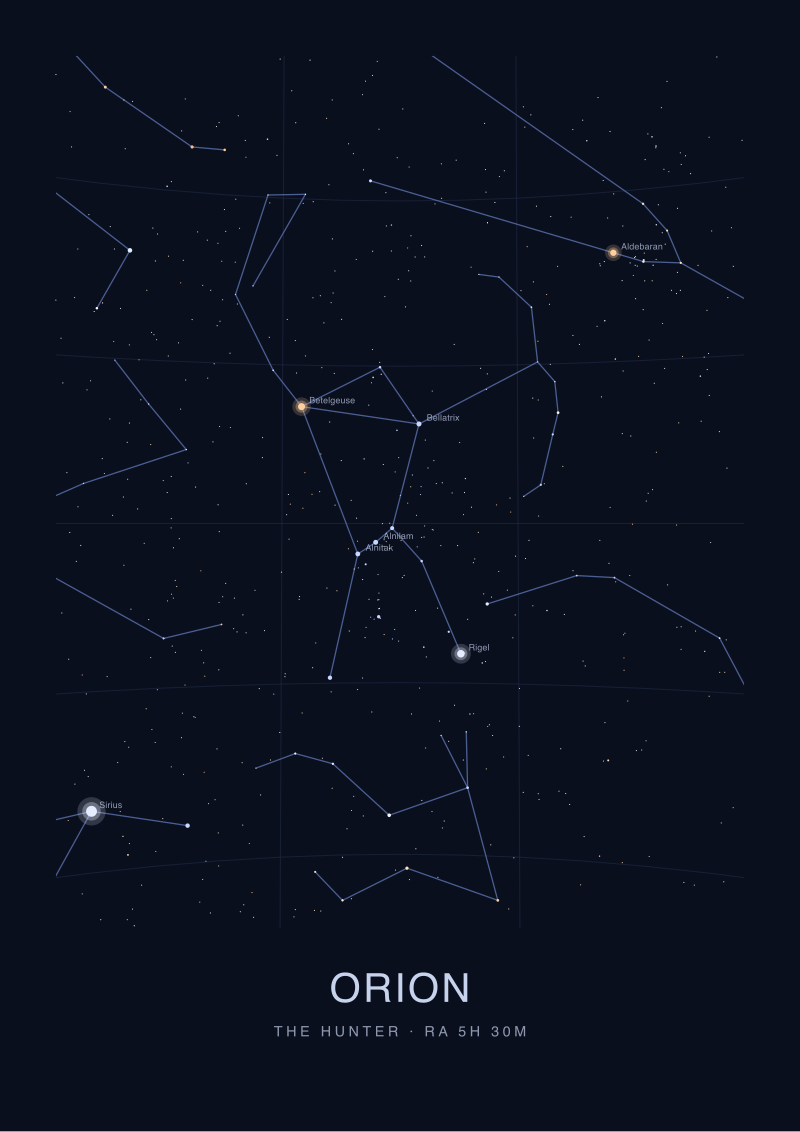 Orion
The print from this article · from €29.95
View the print →
Orion
The print from this article · from €29.95
View the print →
Question 3: Can You See Stars Brighter Than Magnitude 2 From Where You Stand?
The third fork is about your sky itself. Orion is easy to teach only when the sky cooperates. The belt stars sit at magnitudes around 1.7 to 2.2. The shoulders and knees — Betelgeuse, Bellatrix, Rigel, Saiph — sit brighter. The sword, and the fainter figure connections, drop toward magnitude 3 and below. A city sky often clips at magnitude 2 or 3, which means the belt and shoulders survive but the outline degrades.
The magnitude system runs backwards, which we have written about elsewhere: brighter objects have smaller numbers. Sirius, sitting to the southeast of Orion in Canis Major, is the brightest star in the night sky at magnitude −1.44. Canopus, in Carina, sits second at −0.62 but is only accessible from southern and low-northern latitudes. Arcturus (−0.05) and Vega (0.03) do not help you find Orion but they anchor other seasonal sky diagrams and give you calibration points for what "very bright" looks like.
If Yes (Rural or Suburban, Magnitude 4 or Better)
You will see the whole figure. Teach yourself the outline in this order: belt first, then Betelgeuse (upper left shoulder, distinctly orange), then Rigel (lower right knee, blue-white and slightly brighter than Betelgeuse most of the time), then Bellatrix (upper right shoulder, fainter), then Saiph (lower left knee, fainter still). The sword — a smudge below the belt with the Orion Nebula at its centre — is the reward for dark skies. Under magnitude 5 or better skies you can see the nebula as a distinct fuzziness even without optical aid.
If No (Urban, Magnitude 3 or Worse)
The belt still works as a teaching anchor. So does Betelgeuse, which is bright enough to survive most city sky-glow, and Rigel, similarly. What fails is the outline: the connections between the shoulders and knees are drawn by the eye rather than by visible stars, and in bright skies the eye has nothing to draw with. Teach only the belt and the two bright shoulders in urban conditions. Save the full figure for a trip to darker sky, or use the belt as a pointer: extend it to the southeast and Sirius is the very bright star it lands on, roughly a hand-span at arm's length away.
If You Answered Everything: The Recap Table
The three yes/no answers combine into eight routes. The recommendation column is the shortest useful instruction we can give for each combination.
| Q1 (Hemisphere) | Q2 (In Season) | Q3 (Dark Enough) | Recommendation |
|---|---|---|---|
| North | Yes | Yes | Face south after 20:00 local; find the belt, then trace to Betelgeuse and Rigel. |
| North | Yes | No | Learn the belt and two shoulders only; use the belt to point to Sirius southeast. |
| North | No | Yes | Set an alarm for 04:30, face southeast; Orion will be well up before dawn. |
| North | No | No | Wait until October; urban pre-dawn attempts rarely succeed for beginners. |
| South | Yes | Yes | Face north around 21:00 local; the figure will look inverted, belt still central. |
| South | Yes | No | Learn the belt as a saucepan shape; trace it north to Sirius, ignore the outline. |
| South | No | Yes | Try pre-dawn in the eastern sky from about April; the pattern climbs quickly. |
| South | No | No | Wait until November; the summer sky delivers Orion overhead and unmissable. |
The table is a shortcut, not a substitute for going outside. Every experienced observer we know learned Orion the same way: they went out, they were wrong for ten minutes, they got right for the rest of their life. If your first attempt confuses you, come back the next clear night. The belt is patient.
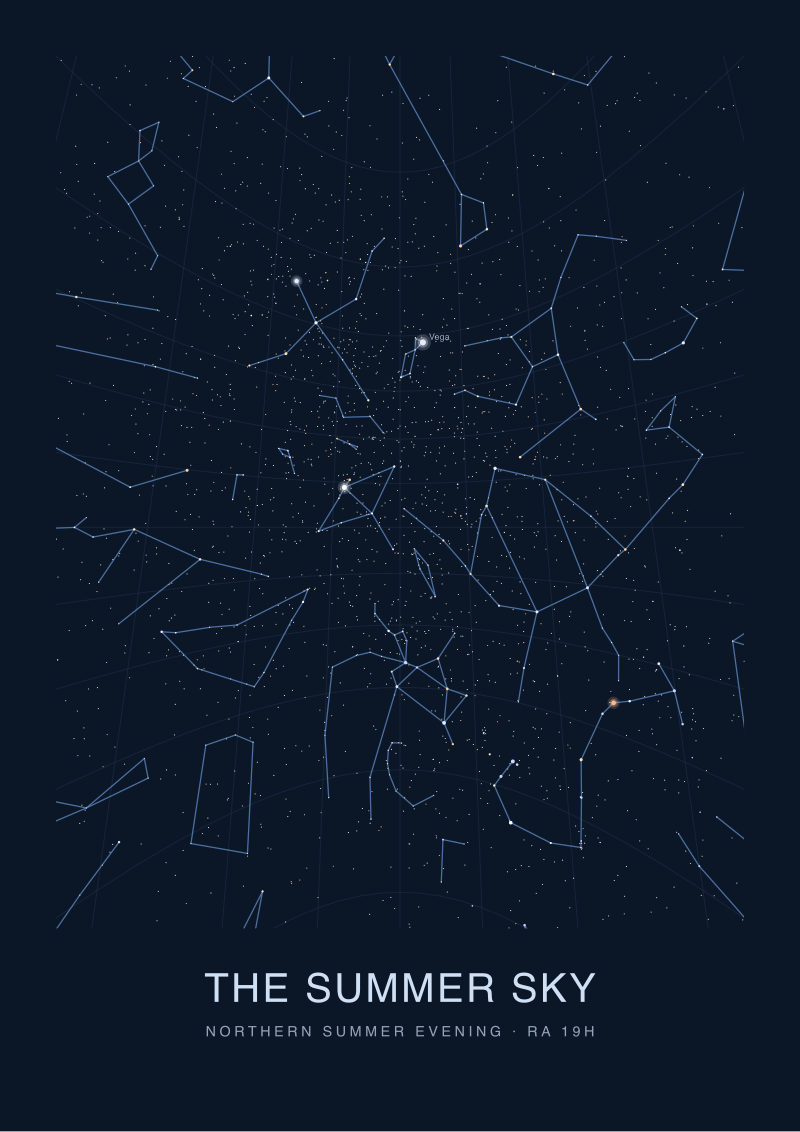 The Summer Sky
The print from this article · from €29.95
View the print →
The Summer Sky
The print from this article · from €29.95
View the print →
The Anchor Point, and the Print
Orion is the constellation we teach first because it does the teaching for us. Three stars in a line at the centre of the figure; two bright shoulders and two bright knees framing it; Sirius sitting a hand-span away as a check star; the whole thing returning to the same evening sky every winter. No other constellation combines a mid-sky anchor, near-perfect geometric simplicity, and a bright pointer star this cleanly.
If you want to keep the shape near your desk while you learn it, we plot the Orion field ourselves at see the Orion print as a printed chart, positions drawn from HYG catalogue data rather than eyeballed. What we did not cover here: the deep-sky detail inside the sword (the Orion Nebula deserves its own piece), the Arabic-origin names of Betelgeuse and Rigel and what they meant to medieval navigators, and the physics of why Betelgeuse's brightness varies noticeably from year to year. Each of those is a separate argument.
FAQ
Which star in Orion should I find first if I have never done this before?
The belt. Three stars in a straight line, close together, all at similar brightness — roughly magnitude 1.7 to 2.2 — and sitting near the centre of the figure. Nothing else in the winter sky imitates that exact arrangement. Once the belt is fixed, everything else falls out of it: the shoulders above, the knees below, the sword hanging down from the belt's middle. Beginners who try to find Betelgeuse or Rigel first usually pick a wrong bright star; nobody mis-identifies the belt.
How do I use Orion to find Sirius, the brightest star in the sky?
Extend the line of Orion's Belt toward its lower-left end (from the northern hemisphere) or upper-right end (from the southern). Follow that line about a hand-span held at arm's length — roughly twenty degrees — and it lands on Sirius, catalogued at magnitude −1.44. Sirius is unmistakably the brightest object in that patch of sky, and it will often twinkle vividly because it sits low in the atmosphere from most northern latitudes. This "belt-to-Sirius" pointer is the oldest star-hopping trick in northern-hemisphere teaching.
Why does Orion look upside-down from the southern hemisphere?
Because you are standing on the other side of the Earth, facing the same patch of sky from an inverted perspective. Orion sits on the celestial equator, so it is visible from both hemispheres, but northern observers face south to see it while southern observers face north. What one sees as the hunter's head near the top, the other sees near the bottom. The pattern itself does not change — only your orientation does. Southern observers often re-learn the belt as a saucepan handle rather than a hunter's waist.
What time of year is Orion not visible at all?
Roughly May through July in the northern hemisphere evening sky, and June through August in the southern. During those months, the Sun sits in the same patch of sky as Orion, so the constellation is above the horizon only during daylight hours and drowned in solar glare. It returns to the pre-dawn eastern sky in August (northern) or September (southern), which is when careful observers can catch it before sunrise. Fully-dark evening visibility resumes in October and November respectively.
Can I learn Orion from a city with heavy light pollution?
Partially. The belt and the two bright shoulders — Betelgeuse and Rigel — survive most urban sky-glow because they are magnitude 1 or brighter. The fainter stars that draw the outline of the figure (the connecting stars in the shield, the sword, the raised arm) fade below the urban limiting magnitude and disappear. From a city, teach yourself only the belt-and-shoulders skeleton, then travel to a darker site once a season to see the full figure. The belt alone is enough to orient yourself.
Is Betelgeuse actually going to explode soon?
"Soon" in astronomical terms means anywhere in the next hundred thousand years, which is not soon in any human sense. Betelgeuse is a red supergiant late in its life, and its brightness varies visibly — it dimmed noticeably during 2019 and 2020, which prompted speculation, but it has since returned to typical brightness. The star will end as a supernova at some point, but the timing is not predictable to any useful precision. For learning Orion, treat it as the orange upper-left shoulder and leave the timeline alone.
Do I need a telescope or binoculars to learn Orion?
No. Every star used to trace the classical figure of Orion is visible to the naked eye from a reasonably dark site. Binoculars help for the Orion Nebula in the sword, and any small telescope reveals the young stars embedded in it, but the naming and shape work is naked-eye work. Beginners who reach for equipment first often skip the outline entirely and never learn where the stars sit relative to each other — which is the actual point of learning a constellation.
Why does Orion come back to the same place at the same clock hour every year?
Because Earth completes one orbit around the Sun every 365 and a quarter days, and the constellations are effectively fixed points on the far side of that orbit. A given constellation returns to a given position in the sky at a given local time roughly once per calendar year. That is why Orion is a January constellation for northern evening observers and always will be, within a human lifetime — precession slowly shifts the alignment over thousands of years, but for practical star-hopping the sky is a repeating annual clock.
From the collection
New charts and 10% off your first print.
One email now with your code. No noise after.