Most beginner guides to star charts open with a diagram of right ascension and declination, and lose the reader by the second paragraph. We are going to do the opposite. A star chart is a decision, not a diagram — the sky above you tonight is not the sky above someone in Santiago, and the chart that works for one is useless for the other. So we will ask you three questions, in order, and route you to the correct map, the correct anchor star from the six brightest in the modern catalogue, and the correct first constellation to trace. Answer honestly. The chart follows.
Question 1: Are You in the Northern or Southern Hemisphere Tonight?
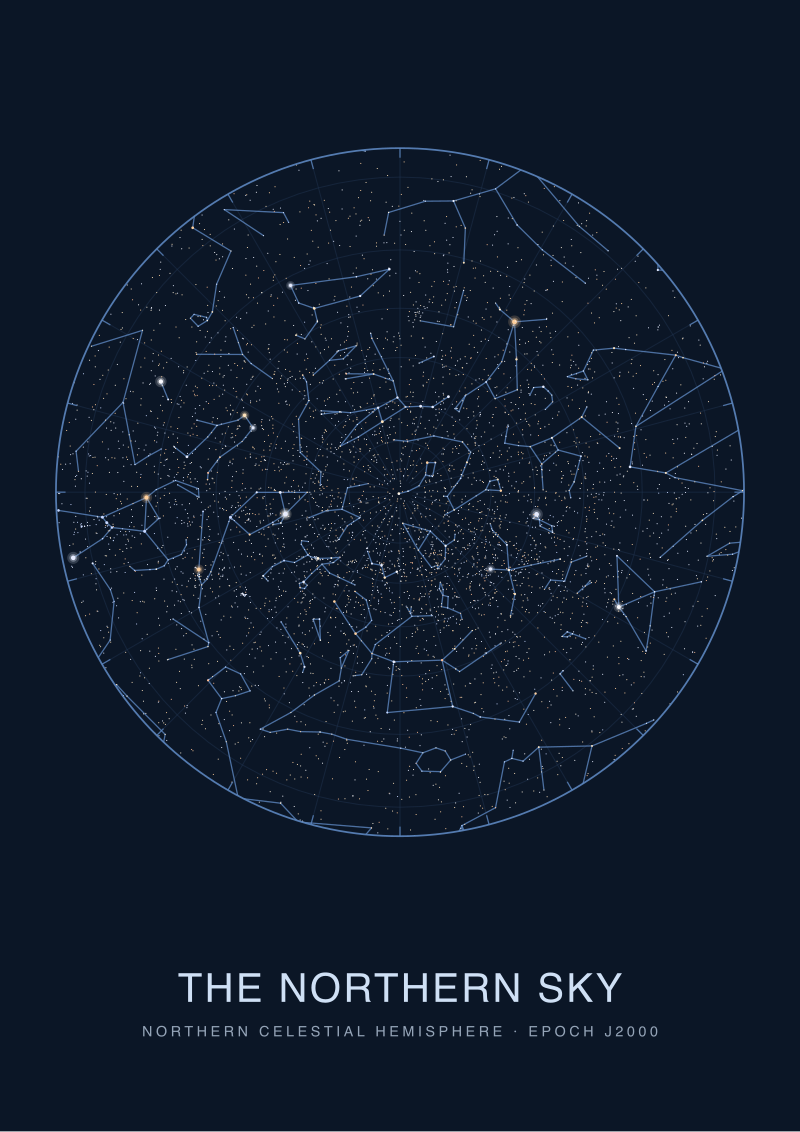
This question sounds trivial, and it is the one beginners get wrong most often — not because they cannot answer it, but because they do not realise it decides which half of the map they should be holding. A star chart is not a globe. It is a projection, and the projection assumes a latitude. Hand a reader in Reykjavík a chart drawn for São Paulo and they will spend forty minutes hunting for stars that are physically below their horizon. Before you open any app, before you print any map, decide which sky you actually own tonight. The six brightest stars in the modern catalogue split cleanly along this line: three of them favour the north, two favour the south, and one — the brightest of all — is generous to both.
If Yes (you are north of the equator)
Your workable anchor stars from the top six are Capella (apparent magnitude 0.08, in Auriga), Vega (magnitude 0.03, in Lyra) and Arcturus (magnitude -0.05, in Boötes). Capella sits at declination +45.998 degrees, which means for anyone north of about 44 degrees south latitude it never fully vanishes in the seasonal rotation — it is a genuinely northern anchor. Vega, at declination +38.78 degrees, is the anchor of the Summer Triangle and dominates northern summer evenings. Arcturus, at declination +19.18 degrees, is the transitional one: high in northern spring, still workable well into the southern tropics. Choose the app or paper chart set to your latitude — Stellarium's default location or a printed planisphere sized for your parallel. Do not open a chart drawn for equatorial or southern latitudes; the sky's orientation will be wrong and you will lose faith in the map.
If No (you are south of the equator)
Your anchors change entirely. Canopus (apparent magnitude -0.62, in Carina) at declination -52.70 degrees and Rigil Kentaurus (magnitude -0.01, in Centaurus, better known as Alpha Centauri) at declination -60.83 degrees are the two great southern beacons — neither is visible from most of Europe or the northern United States, and both are near-permanent fixtures in southern skies. Set your app to your southern latitude; a planisphere printed for the northern hemisphere is not just unhelpful, it is inverted. Sirius, at declination -16.71 degrees, is the shared star — the brightest in the sky at apparent magnitude -1.44, generous to both hemispheres, and often the correct answer when a beginner asks "what is that very bright thing." If you are in the southern hemisphere and you are unsure of your latitude, Sirius plus Canopus plus Rigil Kentaurus is your calibration triangle: find them, and the rest of the chart falls into position.
Question 2: Is the Sky Above You Dark Enough to See Magnitude 3?
Magnitude is the scale astronomers use to measure brightness, and it runs backwards — smaller numbers are brighter, negative numbers are the brightest of all. Sirius at magnitude -1.44 is bright. Vega at magnitude 0.03 is only slightly dimmer to the eye than Arcturus at magnitude -0.05, because the scale is logarithmic and small numeric differences correspond to modest visual ones. The reason we ask about magnitude 3 specifically is this: the stars that form the recognisable shapes of most constellations — the corners of Cassiopeia's W, the tail of Ursa Major, the belt of Orion — are largely in the magnitude 1.5 to 3.5 range. If your local sky drowns out anything dimmer than magnitude 2, most constellations will refuse to appear at all, and you will end up trying to trace a shape with two of its five stars missing. A star chart that shows every mag-4 star is a promise your sky may not be able to keep.
If Yes (you can see the fainter stars)
You have a genuinely dark site — rural, mountain, desert, or a well-preserved regional park. Congratulations; you are in the minority. Use a full-detail chart, one that plots down to magnitude 5 or 5.5, and do not be intimidated by the density of dots. The trick under a dark sky is not to see more stars — you already do — but to ignore most of them. Pick your anchor (Vega, Arcturus, Sirius, Canopus, whichever is above your horizon for the hour) and let its brightness dominate. Trace outward from that star only. A chart at a dark site is a map you have to actively simplify; your eyes will otherwise pull you into asterisms that are not on the chart at all, because at magnitude 5 the sky begins to resemble noise until you impose the constellation grid over it.
If No (you are in an urban or suburban sky)
Most readers are here. Ignore any chart that shows stars below magnitude 3 — those dots correspond to points of light that literally do not exist for you tonight. Switch your app to a "urban" or "high light pollution" mode if it has one; Stellarium, SkySafari and Stellarium Web all support this. What remains on the chart after that filter is applied is what you can actually see. From a bright suburb, the six brightest stars in the modern catalogue are still visible without exception: Sirius, Canopus, Arcturus, Rigil Kentaurus, Vega and Capella. Everything else is negotiable, and most of it is a lie your chart is telling you. Anchor on one of those six, trace only to first-magnitude neighbours, and accept that under an urban sky "reading a star chart" means reading one-fifth of the chart. That is not a failure. That is the correct method.
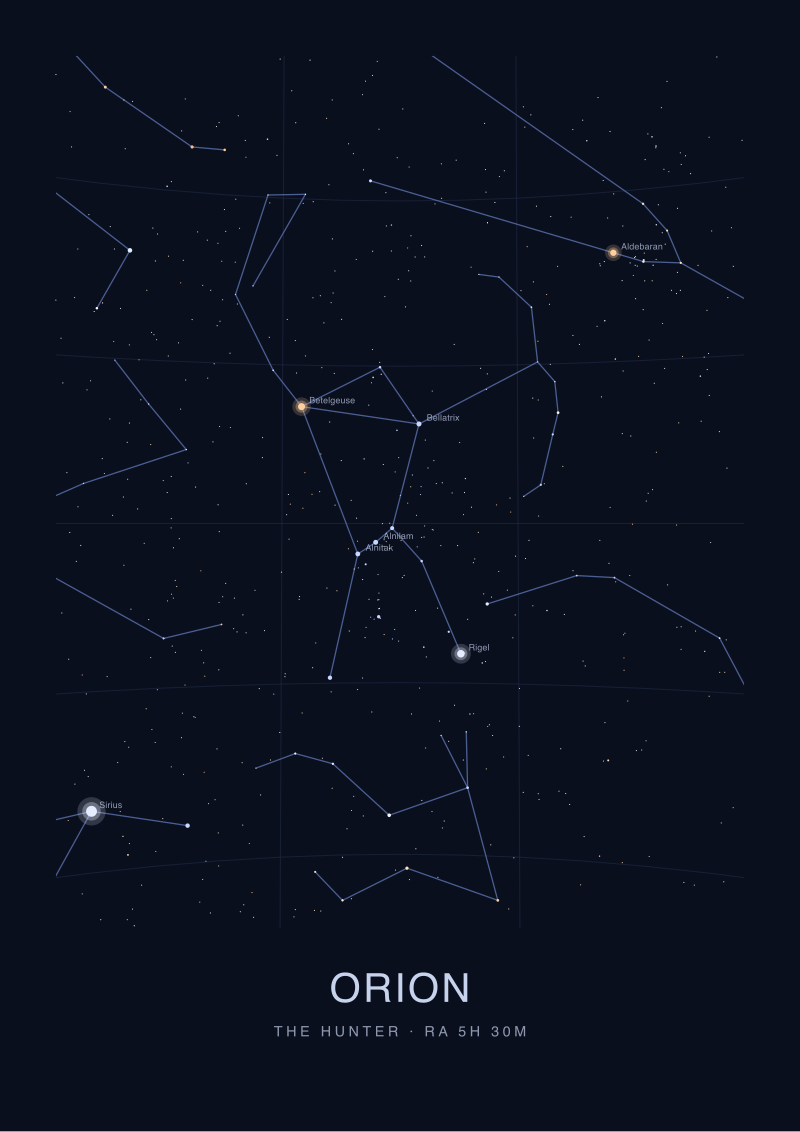 Orion
The print from this article · from €29.95
View the print →
Orion
The print from this article · from €29.95
View the print →
Question 3: Do You Know Which Direction Is South (or North)?
A star chart is oriented. Every planisphere has a horizon edge marked N, S, E, W, and the map only tells you the truth if you rotate it so those letters match the compass under your feet. Beginners forget this. They hold the chart flat in front of them the way you hold a book, and then wonder why the sky refuses to cooperate. Northern-hemisphere readers traditionally find Polaris to establish north; southern-hemisphere readers use the long axis of Crux, the Southern Cross, extended roughly four and a half times its length toward the south celestial pole. Both techniques assume you already know which stars you are looking at, which is a chicken-and-egg problem for the beginner. So the honest question is: do you have a reliable non-astronomical way to find cardinal direction tonight, or not?
If Yes (you have compass, phone, or landmark orientation)
Use it, without shame. A phone compass calibrated in the last hour is more accurate than a first-week beginner's Polaris identification, and it removes the compounding error that ruins the rest of the reading. Face the direction of your target — south, if you are in the northern hemisphere and looking at a southern constellation like Orion; north, if you are in the southern hemisphere looking at Orion the other way up. Rotate the chart so its bottom edge matches the direction you are facing. From here the map is honest with you: the star at the top of the chart is the star near your zenith, and the star at the bottom is the star near your horizon. Anchor to your chosen star and trace one shape only, before moving on.
If No (you have no reliable orientation)
Do not begin with a constellation. Begin with a single bright star and let it teach you the direction. In the northern hemisphere on a summer evening, the brightest star high overhead is almost certainly Vega — it will be nearly at the zenith at northern mid-latitudes in July and August, and once you have identified it, west is behind you and east is ahead of you when you face it in the early evening. In the southern hemisphere, the brightest star high in the evening sky in southern winter is Canopus, and Rigil Kentaurus sits south of it — meaning if you face Canopus with Rigil Kentaurus to your left, you are approximately facing west. Sirius is the universal anchor, brightest across both hemispheres at magnitude -1.44, and its position in the sky at a known hour on a known date is enough to derive south (northern) or north (southern) with an astronomy app that computes altitude and azimuth. Read the app's number for Sirius, look at Sirius, and you now have direction.
If You Answered Everything: The Route Table
The three questions produce eight possible answer combinations, and each one routes to a different first-night strategy. Read your row across.
| Q1 (Hemisphere) | Q2 (Dark enough for mag 3?) | Q3 (Know direction?) | Recommendation |
|---|---|---|---|
| North | Yes | Yes | Anchor Vega (mag 0.03) in Lyra; trace the Summer Triangle, then Cygnus. |
| North | Yes | No | Find Capella (mag 0.08) near the northern horizon; use it to derive north first. |
| North | No | Yes | Anchor Arcturus (mag -0.05) in Boötes; ignore any star dimmer than magnitude 2. |
| North | No | No | Open the app, locate Sirius (mag -1.44), face it, then read direction from its azimuth. |
| South | Yes | Yes | Anchor Rigil Kentaurus (mag -0.01) in Centaurus; trace Crux, then Carina. |
| South | Yes | No | Find Canopus (mag -0.62); it is unmistakable, and its position derives south for you. |
| South | No | Yes | Anchor Sirius (mag -1.44) or Canopus; ignore constellations, learn the two stars. |
| South | No | No | Use phone compass, aim south, find Rigil Kentaurus; the Cross falls into place from there. |
Two notes on the table. First, "recommendation" is a first move, not a lesson plan — pick the row that matches your night, execute it, and stop. A beginner who traces one constellation correctly beats a beginner who half-traces four. Second, the star magnitudes in the recommendations column are from the HYG v41 catalogue and are the honest numbers; they will feel unintuitive at first, because the scale runs backwards, and magnitude 0.08 (Capella) is brighter than magnitude 0.03 sounds like it should be. Trust the sky over the number the first time you compare them by eye.
Six stars. That is the count you actually need to read a star chart on your first night out. Not eighty-eight constellations, not the two thousand stars a planisphere prints, not the seven thousand a full catalogue lists — six. The magnitude spread across those six, from Sirius at -1.44 to Capella at 0.08, is roughly a factor of four in brightness, and every one of them will be visible from most inhabited latitudes on most clear nights of the year. That number — six — is what should decide how you spend your first hour under the sky. Not tracing shapes. Learning anchors. The shapes come next month.
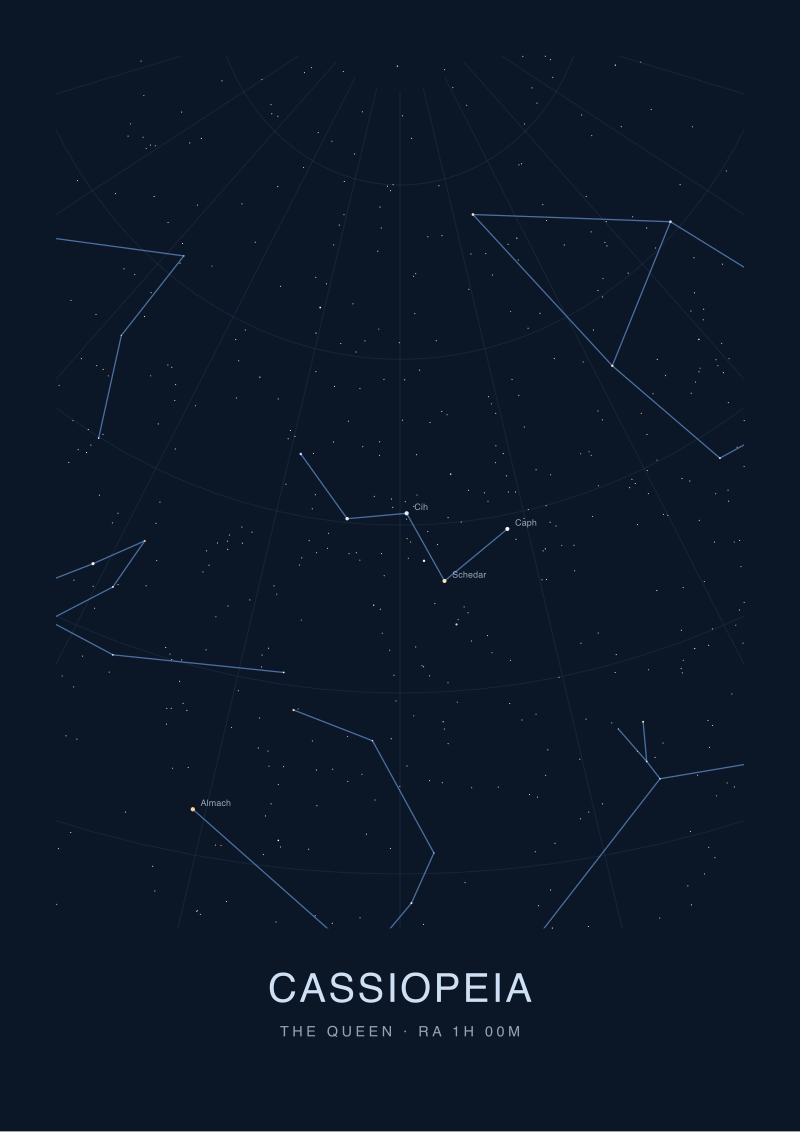 Cassiopeia
The print from this article · from €29.95
View the print →
Cassiopeia
The print from this article · from €29.95
View the print →
FAQ
Do I need a paper star chart or is a phone app enough?
For a first night, an app is better — Stellarium, SkySafari and Stellarium Web all compute the sky for your exact latitude, longitude and hour, which a printed planisphere cannot do without you interpolating. The catch is that phone screens destroy your night vision. If you commit to an app, set it to red-light or night mode, dim the brightness to the lowest usable level, and put it away between checks. A paper planisphere becomes worthwhile from about the third night, when your eyes are the bottleneck, not the map.
Why do the star charts I see online show more stars than I can find?
Two reasons. First, most online charts plot every star down to magnitude 5 or 6, and from an urban or suburban sky you cannot see anything dimmer than about magnitude 3. Second, atmospheric conditions, moon phase and altitude above the horizon all further dim what you observe versus what the catalogue says. A chart is drawn as if the sky were perfectly transparent and you were at the zenith; your actual sky is neither. Filter your chart to magnitude 3 and the map matches your night.
What is the difference between apparent magnitude and absolute magnitude?
Apparent magnitude is how bright a star looks from Earth — Sirius at -1.44, Vega at 0.03, and so on — and it is the only number that matters for reading a chart. Absolute magnitude is how bright a star would look at a standard distance of ten parsecs, and it is used for comparing intrinsic luminosities. Sirius is bright to us mostly because it is close, only 8.6 light-years away; Canopus at magnitude -0.62 is intrinsically far more luminous but sits over 300 light-years distant. For chart reading, only apparent matters.
Can I read a star chart during twilight or do I need full darkness?
You can start during twilight, and for beginners it is often easier — the fainter stars are not yet visible to confuse you, and the six anchors covered above (Sirius, Canopus, Arcturus, Rigil Kentaurus, Vega, Capella) all appear before full night. Reading the chart during nautical twilight, roughly 45 minutes after sunset, means you see only the brightest points, which is exactly what a beginner's chart should show. Wait for astronomical darkness once you want to trace constellations beyond the anchors.
How do I know if a "star" I am seeing is actually a planet?
Planets do not twinkle appreciably; stars do, especially near the horizon. Planets also move against the star background over days and weeks, and none of the six brightest points in the sky covered here are planets — Sirius, Canopus, Arcturus, Rigil Kentaurus, Vega and Capella are all fixed stellar anchors. If a very bright object appears where your chart shows no star of that magnitude, and it is not twinkling, it is almost certainly Venus, Jupiter or Mars. An app cross-check settles it in seconds.
The chart lists right ascension and declination — do I need to understand them tonight?
No. Right ascension and declination are the sky's coordinate system, equivalent to longitude and latitude on Earth, and they matter enormously for telescope users and for anyone plotting positions. For a first-night beginner reading a chart to find constellations, the coordinates are noise. What matters is the relative position of stars on the map versus their relative position in the sky above you. Return to the coordinates on your fifth or sixth night, once you have the anchors and can appreciate why declination -60 puts Rigil Kentaurus permanently out of reach for northern readers.
From the collection
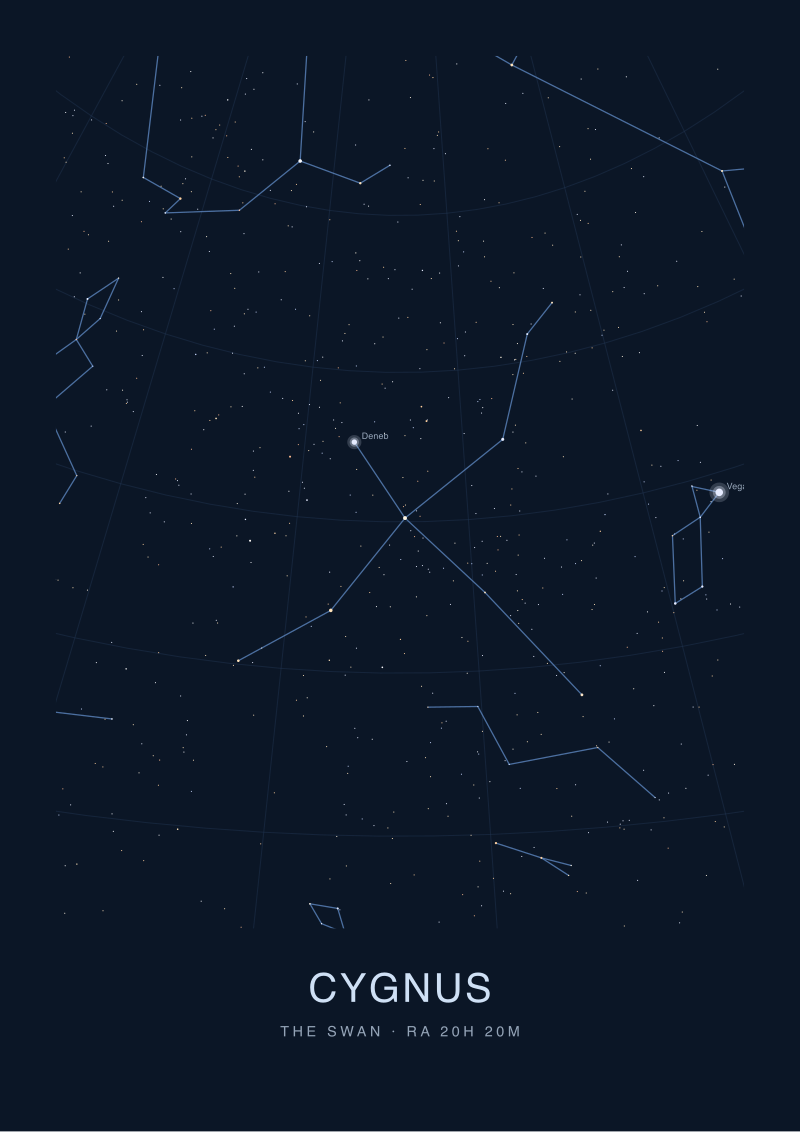
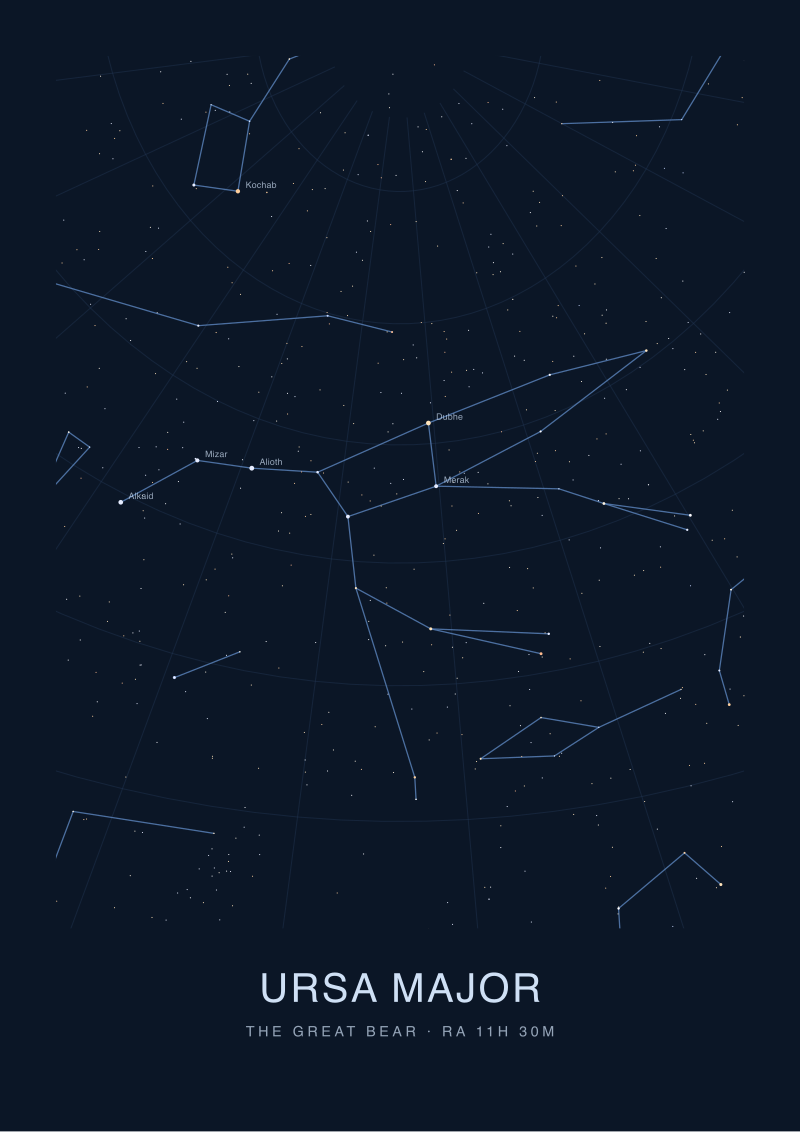
New charts and 10% off your first print.
One email now with your code. No noise after.