The night sky at equinox and solstice differs by six hours of right ascension. That is the mechanism. Everything downstream — which stars dominate at midnight, which constellations pin themselves circumpolar, how long twilight stretches — is that six-hour offset applied to the celestial sphere. You do not need to be an astronomer to see this. You need nine terms. This glossary is the shortest route between them and the sky above your head tonight.
Celestial Sphere
The celestial sphere is the imaginary spherical shell centred on Earth onto which every star is projected as if it sat at infinite distance.
The sphere is the coordinate substrate. Distances are erased and only angles remain, which is precisely what allows a chartmaker to plot stars 8 light-years away and stars 300 light-years away on the same paper without correction. Nothing on a star chart records depth. The sphere flattens the whole galaxy into a two-angle system.
Sirius (α Canis Majoris, apparent magnitude −1.44, HYG v41) sits at right ascension 6.75 hours, declination −16.72°. Those two numbers are its address on the sphere. From Athens, from Nairobi, from Santiago, Sirius occupies the same coordinate — what changes between those observers is only which portion of the sphere is above the horizon at a given moment.
Celestial Equator
The celestial equator is the projection of Earth's equator outward onto the celestial sphere.
It is the reference latitude of the sky. Any star sitting on it — declination 0° — rises due east and sets due west from every latitude on Earth, and spends exactly twelve hours above the horizon. Stars north of it favour northern-hemisphere observers; stars south favour the southern. This one line decides whether a star is even available to you.
Arcturus (α Boötis, magnitude −0.05) sits at declination +19.18° — 19° north of the celestial equator. Rigil Kentaurus (α Centauri, magnitude −0.01) sits at declination −60.83°. That 60.83° figure is not decoration. It means Rigil Kentaurus never clears the horizon for anyone north of roughly 29°N. Athens does not see it. Miami does not see it. Sydney does. The celestial equator is what draws that line.
The Ecliptic
The ecliptic is the apparent annual path the Sun traces across the celestial sphere.
It is not a physical object. It is the plane of Earth's orbit read from the Earth's point of view. But the ecliptic is tilted 23.44° to the celestial equator, and that tilt is the mechanical fact from which every seasonal consequence in the sky descends. Without the tilt there is no solstice, no equinox, no seasonal star.
The Sun's right ascension advances roughly two hours per month along the ecliptic. In late March it sits at RA 0h; by late June it has walked to RA 6h — the same neighbourhood on the sphere as Sirius (RA 6.75h) and Capella (RA 5.28h). Which is exactly why those stars are lost in daylight in June and dominant in December. They have not moved. The Sun has.
Obliquity
Obliquity is the 23.44° angle between the celestial equator and the ecliptic.
It is the number underneath everything. Halve it and equinoxes and solstices become weaker markers; zero it and they cease to exist as distinct events. The obliquity of the ecliptic is what makes the Sun's declination cycle between +23.44° and −23.44° across the year — and it is that declination cycle, not any change in the star field itself, that shifts what dominates the night.
Vega (α Lyrae, magnitude 0.03) sits at declination +38.78°. From 40°N — Madrid, Ankara, Beijing — Vega climbs nearly overhead in July, because the Sun's June-solstice declination has swung to +23.44° and the entire night has slid 47° of declination south of Vega's meridian arc. Same star. Same 38.78°. Different sky.
Equinox
The equinox is one of the two annual moments when the Sun sits exactly on the celestial equator, giving nearly equal day and night from every latitude.
Around 20 March, the Sun's right ascension is 0h. Around 22 September, it is 12h. At either moment, stars whose right ascension differs from the Sun's by twelve hours transit the meridian at local midnight. The equinox sky is not a chaos of stars; it is a very specific slice of right ascension raised to its highest overnight position.
At the March equinox with the Sun at RA 0h, Arcturus at RA 14.26h rises in the east around 20:30 local time and dominates the pre-dawn hours from a mid-latitude observer. At the September equinox, six months later, Arcturus has become a dusk object, already high in the west at sunset and sinking through the early evening. Same star. Opposite half of the night.
Solstice
The solstice is one of the two annual moments when the Sun reaches maximum declination — +23.44° in late June, −23.44° in late December.
At solstice the Sun sits at its extreme ecliptic latitude, and its right ascension is either 6h (June) or 18h (December). The stars whose right ascension is exactly twelve hours opposite own the midnight meridian. Solstice skies are dense with named stars precisely because the geometry concentrates the two brightest portions of the whole sphere overhead at once, on opposite sides of the year.
At the December solstice the Sun sits at RA ~18h. Stars near RA 6h transit at midnight: Sirius (RA 6.75h, magnitude −1.44), Canopus (RA 6.40h, magnitude −0.62, visible only south of ~37°N), Capella (RA 5.28h, magnitude 0.08). Three of the six brightest stars in the sphere, together, on the meridian, only in this season — a chart of that specific midnight is one we plot in the studio and print in /shop/.
Right Ascension
Right ascension is the east-west coordinate on the celestial sphere, measured in hours from the March-equinox point on the ecliptic.
It is the coordinate that predicts time of transit. A star at RA 6h culminates six sidereal hours after the equinox point does. Combined with the Sun's own right ascension for the date in question, RA determines whether a given star is a dawn object, a midnight object, a dusk object, or entirely daylit and invisible for weeks.
Sirius at RA 6.75h is the cleanest example. The Sun reaches RA 6.75h in late June, meaning Sirius transits the meridian at solar noon and is invisible. Six months later the Sun has walked to RA 18.75h, and Sirius therefore transits at solar midnight. The magnitude −1.44 figure is fixed. The visibility is a right-ascension calculation.
Sidereal Time
Sidereal time is a timekeeping system tuned to the stars, in which one full rotation is 23 hours 56 minutes 4 seconds — the interval in which Earth returns the same star to the same meridian.
The four-minute discrepancy against the solar day is the mechanism by which a star rises roughly four minutes earlier every night, and by which the constellation dominant at equinox slides out of the night by the solstice. Sidereal time is why the sky changes at all across a year despite the sphere being effectively static.
Vega at RA 18.62h transits at local midnight roughly at the start of July. By the September equinox, sidereal drift has advanced its transit to about 18:30 local — Vega is already high in the west at dusk, sinking through the evening rather than owning it. Same star. Ninety days. Six hours earlier.
Precession
Precession is the 25,772-year wobble of Earth's rotation axis, which slowly relocates the equinox point along the ecliptic against the fixed stars.
Precession is the reason star catalogues must be dated. The HYG v41 coordinates cited here are epoch J2000.0 — not "the sky", but the sky as of 1 January 2000. Over a human lifetime the drift is small but real. Over thirteen thousand years, the equinox point walks halfway round the ecliptic and the pole star changes identity.
Vega — now at RA 18.62h, declination +38.78° — will then be the pole star, replacing Polaris. Fifty arcseconds per year against the fixed stars is the residual figure. Twenty minutes of transit-time drift per century is what it produces. That number is what should decide whether an antique celestial chart is decorative or navigational. It is decorative. The math is closed.
FAQ
Which is the "longest night" — equinox or solstice?
The December solstice, for northern-hemisphere observers, and the June solstice for southern-hemisphere observers. At solstice the Sun sits at its extreme declination (−23.44° in December, +23.44° in June), which for the opposite hemisphere means the smallest arc above the horizon and the longest continuous stretch of astronomical darkness. Equinoxes give near-equal day and night everywhere on Earth, which by definition is a shorter night than the winter-solstice value at any latitude away from the equator.
Do the constellations at equinox really differ from those at solstice, or is it only their timing?
The same 88 IAU constellations exist year-round; what changes is which of them are above the horizon at night. A constellation whose right ascension puts it near the Sun for the date in question is invisible — physically present but daylit. Sirius at RA 6.75h is a December-solstice midnight star and a June-solstice noon star, entirely absent from the June night sky. So the difference is not that new stars appear but that a different six-hour slice of the sphere occupies the meridian at midnight.
Why do star charts still list positions from the year 2000?
Because precession moves the coordinate system, not the stars. Right ascension and declination are measured from the equinox point, and that point drifts about 50 arcseconds per year along the ecliptic. Catalogues therefore freeze the equinox to a specific date — epoch J2000.0 is the current standard — so that a coordinate stays meaningful. The HYG values cited throughout this piece (Sirius at RA 6.75h, Vega at RA 18.62h) are J2000.0. For most amateur purposes, the drift since 2000 is negligible.
How much does the length of astronomical twilight change between equinox and solstice?
At the equator, essentially none — twilight is roughly the same short duration all year. At mid-latitudes (40°N or 40°S), astronomical twilight can stretch from about 90 minutes near equinox to over two hours at summer solstice. Above roughly 48° of latitude, the summer-solstice Sun does not fully descend 18° below the horizon at all, producing so-called "white nights" where astronomical darkness never begins. Solstice twilight is always longer than equinox twilight; the effect scales with latitude.
Does the same star rise at the same time from Buenos Aires and Berlin at solstice?
No. Rising time depends on the observer's longitude and, more consequentially, on the star's declination relative to the observer's latitude. Sirius (declination −16.72°) rises noticeably earlier and higher for Buenos Aires (~35°S) than for Berlin (~52°N) at the December solstice. Rigil Kentaurus (declination −60.83°) rises in Buenos Aires and never rises at all in Berlin. Right ascension governs when a star transits at a given longitude; declination governs whether it is available to that latitude.
Are the newspaper zodiac dates aligned with what the Sun actually sits in front of at solstice?
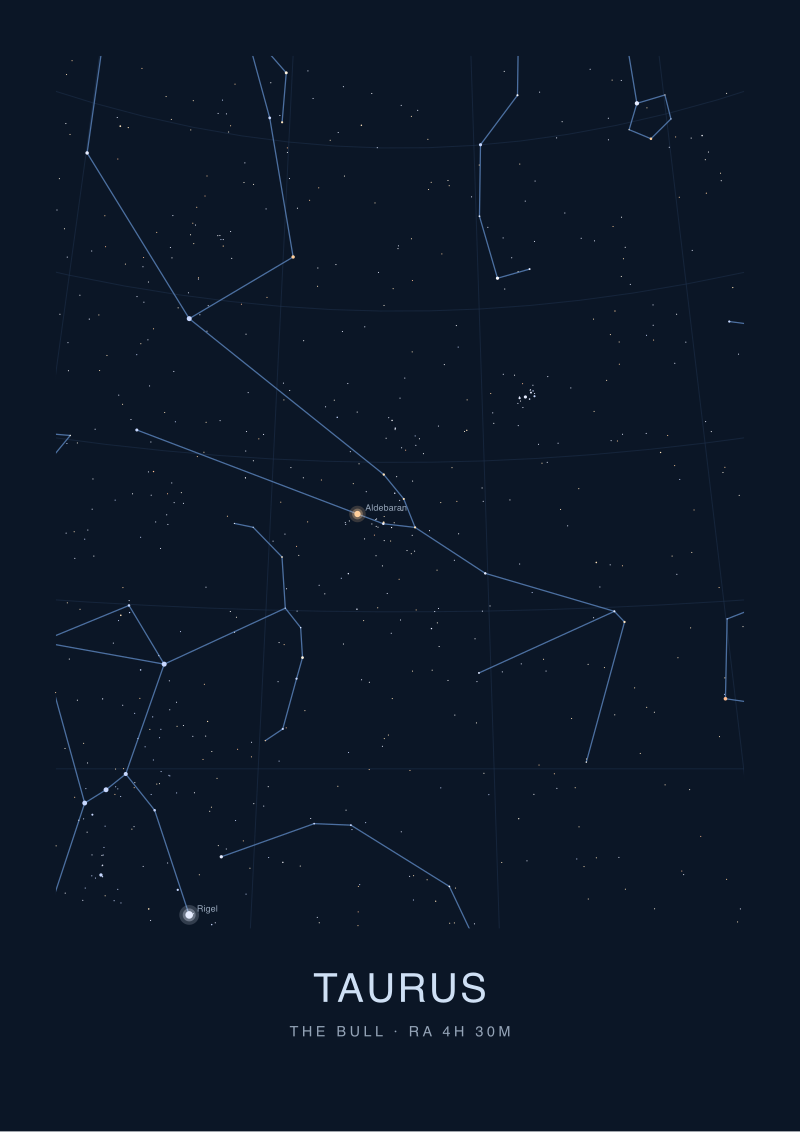
They are not, and this is a coordinate matter rather than a personality one. The tropical zodiac used in horoscope columns is anchored to the March equinox point, which precession has moved by roughly 24° since the system was fixed. The Sun's actual position against the fixed background at the June solstice is now inside Taurus, not Gemini as the tropical dates imply. The zodiac is a 16°-wide band along the ecliptic — a coordinate strip — and precession has decoupled its labels from the stars behind them.
 Taurus
The print from this article · from €29.95
View the print →
Taurus
The print from this article · from €29.95
View the print →
From the collection
New charts and 10% off your first print.
One email now with your code. No noise after.