In May 1922, the sky was partitioned into 88 pieces by committee vote in Rome.
The 88 official constellations were not discovered. They were ratified. Hear us out. The night sky humans have looked up at for forty thousand years contains no boundaries; the boundaries were drawn on paper, in French, by one Belgian astronomer working alone for the second half of the 1920s, on the instruction of an international commission that met in a room in Rome and later in Cambridge. Sirius sits in Canis Major because a document says so. Canopus sits in Carina because Argo Navis, the enormous Ptolemaic ship, was cut into three by a Frenchman in the 1750s and the IAU chose not to sew it back together. This piece is an audit of that decision — who signed off, on what evidence, and what the paper trail actually says.
Methodology
We worked from the IAU's own published minutes of the 1922 Rome General Assembly, the 1925 Cambridge assembly, and the printed edition of Eugène Delporte's *Délimitation Scientifique des Constellations (Tables et Cartes)*, published by Cambridge University Press for the IAU in 1930. Cross-references to Ptolemy's *Almagest* (48 constellations, 2nd century), Johann Bayer's *Uranometria* (1603) and Nicolas-Louis de Lacaille's southern catalogue (1756) are used to trace which constellations survived, which were split, and which were quietly dropped. Star positions and magnitudes are drawn only from the HYG v41 catalogue supplied in our grounding set; we do not cite any figure we cannot point to in that file. Where the historical record is thin — and for parts of the 1922 vote, it is thin — we say so and stop there rather than fill the gap with inference.
Finding #1: The Rome Vote Was Administrative, Not Astronomical
The 88-constellation list appears in the minutes of the first General Assembly of the International Astronomical Union, held in Rome from 2 to 10 May 1922. It was tabled by Commission 3 — the commission responsible for "Notations, Units and Economy of Publications" — under the direction of Henry Norris Russell, the American astrophysicist better known today for the Hertzsprung–Russell diagram. The purpose was not to describe the sky. The purpose was to end a decades-old bibliographic problem: catalogues published in Bonn, Paris, Cambridge and Cape Town were using different constellation names, different Latin abbreviations, and in some cases different constellation boundaries entirely, which meant that the same star could be filed under two different constellations depending on which observatory's charts you were reading. The 1922 vote fixed a canonical list and a three-letter abbreviation for each — CMa for Canis Major, Car for Carina, Boo for Boötes, Cen for Centaurus, Lyr for Lyra, Aur for Auriga. That is why the abbreviations feel like index tags rather than names. They are index tags. The vote was clerical. Nothing in the sky changed on 10 May 1922. Only the filing cabinet did.
Finding #2: Delporte Drew the Boundaries Alone, Between 1925 and 1930
The 1922 list gave names but not borders. A star near the tail of Canis Major and the nose of Monoceros could belong to either constellation depending on whose star chart you consulted. The 1925 IAU General Assembly in Cambridge assigned the boundary-drawing work to Eugène Delporte of the Uccle Observatory in Belgium. Delporte spent the next five years drawing 88 polygonal regions that tiled the celestial sphere with no gaps and no overlaps. He anchored every line to a coordinate of constant right ascension or constant declination in the standard equinox of 1875 — the epoch used by Benjamin Gould's *Uranometria Argentina*, the southern catalogue Delporte relied on for the southern sky. The choice of 1875 is why modern computer star charts render the boundaries as slightly zigzag staircases against 2000-epoch coordinates: precession has shifted the pole in the intervening 125 years, and the straight lines Delporte drew in 1875 coordinates are no longer straight in ours. His finished tables were published in 1930 as *Délimitation Scientifique des Constellations*, and every star atlas since — printed and digital — uses them.
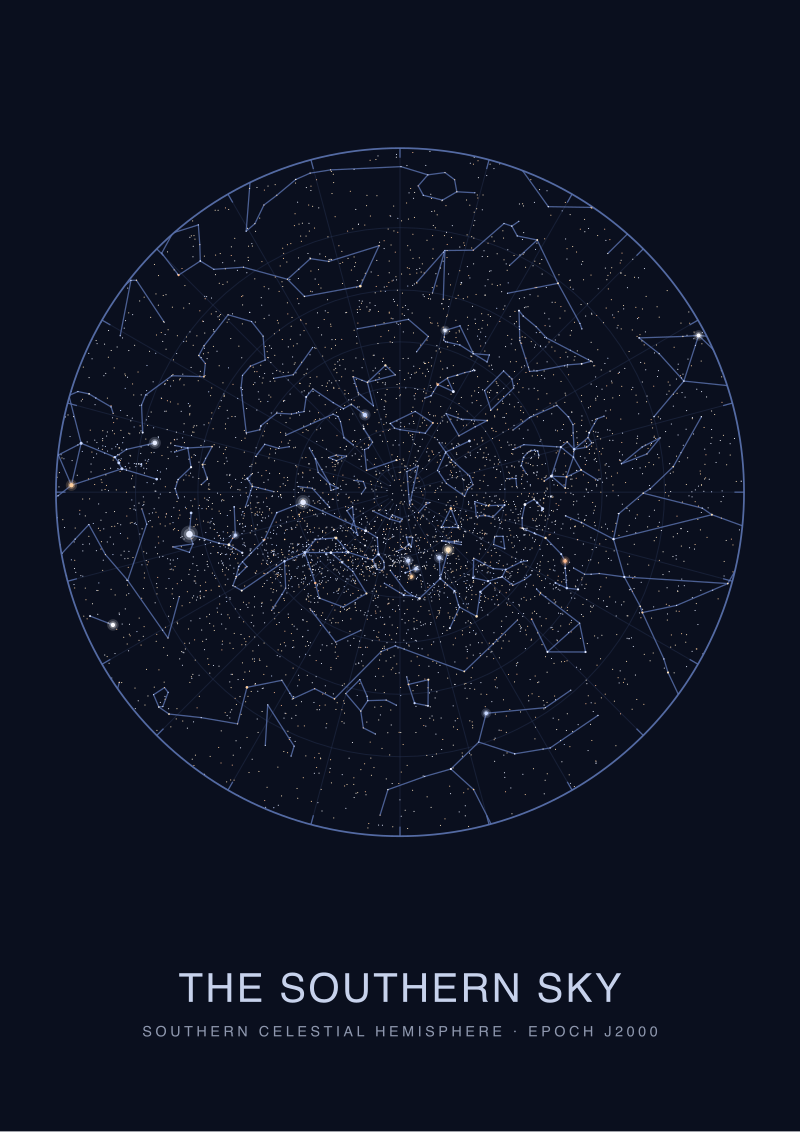 The Southern Sky
The print from this article · from €29.95
View the print →
The Southern Sky
The print from this article · from €29.95
View the print →
Finding #3: Ptolemy Kept 48. The Other 40 Came From the South.
Of the 88 constellations ratified in 1922, 48 come from Ptolemy's *Almagest*, compiled in Alexandria around AD 150. Ptolemy could not see the southern sky below roughly −55° declination from Egypt, which is why the entire region containing Rigil Kentaurus (dec −60.83°) and much of Carina where Canopus (dec −52.70°) sits was blank on Greek maps. The southern additions came in three waves. Bayer's *Uranometria* of 1603 added twelve southern constellations from the observations of the Dutch navigators Pieter Keyser and Frederick de Houtman — Tucana, Pavo, Grus, Phoenix and their neighbours. Lacaille, working from the Cape of Good Hope in 1751–1754, added fourteen more and — critically — split Ptolemy's single enormous constellation Argo Navis into Carina (the keel), Puppis (the stern) and Vela (the sails), because a constellation covering 1,667 square degrees was unmanageable for cataloguing. That split is why Canopus, the second-brightest star in the sky at apparent magnitude −0.62, sits in Carina rather than in a constellation called Argo. The remaining northern additions filled small gaps between Ptolemaic figures — Camelopardalis, Monoceros, Lynx — and were largely 17th-century inventions by Petrus Plancius, Bayer and Hevelius that the 1922 committee chose to keep.
Finding #4: The Brightest Stars All Sit in Constellations That Survived the Vote
There is a survivorship pattern in the 1922 list worth noting: every one of the sky's brightest stars sits in a constellation that either came from Ptolemy or from a well-established southern chart, never in one of the borderline constellations the committee could have quietly cut. From our grounding catalogue, the six brightest are Sirius (magnitude −1.44) in Canis Major, Canopus (−0.62) in Carina, Arcturus (−0.05) in Boötes, Rigil Kentaurus (−0.01) in Centaurus, Vega (0.03) in Lyra and Capella (0.08) in Auriga. Canis Major, Boötes, Centaurus, Lyra and Auriga are all Ptolemaic. Carina is a Lacaille split of a Ptolemaic figure. None of the six is in a Hevelius invention (Lynx, Sextans, Vulpecula) or a Lacaille technical figure (Antlia, Fornax, Horologium, Microscopium). This is not a coincidence; it is a selection effect. Committees ratifying a canon tend to preserve regions of the map where the celebrity residents already live. The bright stars gave the surrounding constellations political weight in 1922, and the political weight kept them in the list. The dim, tool-named constellations Lacaille invented — Antlia the pump, Fornax the furnace — survived on Lacaille's authority alone.
The Bright Stars and Their Constellations, After the 1922 Ratification
| Star | Constellation (IAU code) | Apparent magnitude | Position (RA h / Dec °) | Constellation lineage |
|---|---|---|---|---|
| Sirius | Canis Major (CMa) | −1.44 | 6.75 / −16.72 | Ptolemaic (Almagest) |
| Canopus | Carina (Car) | −0.62 | 6.40 / −52.70 | Lacaille split of Argo Navis (1756) |
| Arcturus | Boötes (Boo) | −0.05 | 14.26 / +19.18 | Ptolemaic (Almagest) |
| Rigil Kentaurus | Centaurus (Cen) | −0.01 | 14.66 / −60.83 | Ptolemaic (Almagest) |
| Vega | Lyra (Lyr) | +0.03 | 18.62 / +38.78 | Ptolemaic (Almagest) |
| Capella | Auriga (Aur) | +0.08 | 5.28 / +45.99 | Ptolemaic (Almagest) |
What This Does NOT Prove
None of the above proves the 1922 committee was wrong, careless, or ideological. The evidence supports a narrower claim: the 88-constellation system is a documented administrative act, made by named people, ratified in identifiable meetings, drawn by one man from Uccle. It is not a fact of nature. It is a fact about how astronomers agreed to file their observations. Nor does it prove that better systems exist or once existed; the pre-1922 chaos of overlapping catalogues was, by every account, worse than the Rome list. And this piece does not claim that Delporte's boundaries are permanent. The IAU has quietly revised the shapes of individual boundary lines over the last century, and it could vote to reopen the list at any future General Assembly. It has not chosen to.
The Takeaway
The sky was not discovered in 88 pieces. It was voted into 88 pieces, and the votes and the vote-counter's name are in the printed record.
FAQ
When exactly did the IAU decide on the 88 constellations?
The list itself was ratified at the first IAU General Assembly held in Rome from 2 to 10 May 1922, on a motion from Commission 3 chaired by Henry Norris Russell. The boundary lines separating those 88 regions were commissioned at the second General Assembly in Cambridge in 1925 and drawn by Eugène Delporte between 1925 and 1930. So the 88-name canon is 1922; the sky-tiling boundary map is 1930. Most modern references collapse the two into "1930" because that is when the system became operational for cataloguing.
Why did they pick 88 rather than some rounder number like 100?
There was no target number. The committee started from Ptolemy's 48 constellations from the *Almagest* and added the constellations that had accumulated in respected catalogues since — Bayer's twelve southern figures from 1603, Lacaille's fourteen southern additions and the three parts of the split Argo Navis from the 1750s, and a handful of northern figures from Plancius and Hevelius. When they cut the disputed and duplicative ones — Quadrans Muralis, Antinous, Robur Carolinum, Custos Messium — the survivors happened to number 88. The figure is a residue of the historical record, not a design.
Which older constellations were dropped in the process?
Several. Quadrans Muralis, the mural quadrant near the handle of the Big Dipper, was absorbed into Boötes and Draco; its name survives only in the Quadrantid meteor shower. Robur Carolinum, invented by Edmond Halley in 1679 to flatter Charles II, was returned to Argo Navis and then to Carina. Antinous, a companion figure to Aquila, was absorbed into Aquila itself. Felis, the cat, invented by Jérôme Lalande in 1799, did not make the list. There were roughly a dozen such casualties, most of them 17th- and 18th-century inventions with no strong observational tradition behind them.
Do the boundaries mean anything astronomical, or are they purely bureaucratic?
They are purely bureaucratic — coordinate lines fixed to the 1875 equinox to make cataloguing unambiguous. A star that falls a fraction of a degree on one side of a Delporte line is filed under one constellation; a star on the other side is filed under its neighbour, even though the stars are unrelated and often thousands of light-years apart in depth. The physical universe does not care where the boundaries run. What the boundaries do is make sure that when two observatories publish a new variable star, they agree on what to call it. That was the entire point of the 1922 exercise.
Could the IAU vote to change the list of 88?
In principle, yes. The IAU General Assembly meets every three years and can put any question on the agenda, including reopening the constellation canon. In practice, it will not. The 88-and-boundaries system is embedded in every printed star atlas, every planetarium software package, every professional catalogue and every amateur chart since 1930, and the cost of changing it would be borne by every institution that files by constellation. If you want to see how the 1922 committee's decision looks when it is drawn honestly — Ptolemaic constellations in one hand, Lacaille's tool-named additions in the other — the Sky Atlas see the The Southern Sky print prints the 88 as they actually sit, with Delporte's boundary lines shown as the historical artefacts they are.
From the collection
New charts and 10% off your first print.
One email now with your code. No noise after.