Canopus sits at declination minus fifty-two point seven degrees, magnitude minus zero point six two — the second-brightest star in the night sky, and a low, luminous anchor for any southern chart. Sizing a print of it is not a taste question first; it is a geometry question. Before we plot the sheet, we run the reader through three forks. How close will you stand. How much sky sits around the star. How much wall the print has to hold on its own. Answer those three and the dimensions choose themselves. We ask; you route.
Question 1: Will You Sit Closer Than Two Metres From the Print?
This is the fork that decides resolution before it decides format. A star chart is a dense object — coordinate grid, magnitude glyphs, a constellation boundary drawn to fractions of a degree — and the sheet has to carry that density at the distance you actually read it from. Two metres is the threshold where the human eye stops resolving fine typography on a wall print without leaning in. Under two metres, the reader engages the sheet like a page. Over two metres, they engage it like a poster.
We put the question first because getting it wrong is the most expensive mistake in the whole tree. A small sheet hung across a room reads as a smudge; a large sheet mounted above a reading chair overwhelms the sightline and forces the eye to scan rather than settle. Canopus in particular punishes the second error. At magnitude minus zero point six two it wants to be the anchor of the composition — one dominant point of light — and a chart too large for its viewing distance dilutes that anchor into a field of competing glyphs.
Measure the distance honestly. Not the width of the room; the distance from where the reader will actually stand or sit. A hallway print is read at one metre. A bedroom print above the bed is read at two-and-a-half. A living-room feature wall is read at three or four.
If Yes — Under Two Metres
You are in reading range. A print between roughly A3 and A2 (approximately 30 × 42 cm to 42 × 59 cm) will hold Canopus, the Carina field around it, and a legible coordinate grid at the distance your eye is doing the work. The declination line at minus fifty-two point seven degrees will read as a labelled reference, not decoration. Magnitude glyphs will resolve as individual marks. The chart behaves like a page you can walk up to and study.
Go smaller than A3 only if the print is genuinely intimate — a desk mount, a shelf lean, a bedside frame — and the reader is inside one metre. Below A4 (roughly 21 × 30 cm) the coordinate grid stops being readable at any sensible distance and the chart collapses into ornament.
If No — Over Two Metres
You are in poster range. A2 becomes the floor, A1 (approximately 59 × 84 cm) the working default, A0 (approximately 84 × 118 cm) the ceiling for a single-star composition. At three metres from an A1 sheet, Canopus reads as a decisive point of light against a labelled southern field; the eye takes in the whole composition first and steps closer to read the annotations second.
Do not push past A0 for a Canopus-anchored print unless the wall is genuinely architectural — a stairwell, a double-height room, a lobby. A star at minus zero point six two magnitude carries a poster; it does not carry a mural. Above A0 the empty sky around the star begins to feel like unresolved paper rather than composed void.
Question 2: Is the Sheet Just Canopus, or the Full Carina Field Around It?
The second fork is about the field of view the print draws. Canopus is a single point at right ascension six point three nine nine hours, declination minus fifty-two point seven. The chart around it can be a tight portrait — a few degrees of sky centred on the star — or a wide plate showing the whole Carina constellation, the false cross to its east, and the Milky Way band that runs through the region. These two framings want different sheet sizes for the same viewing distance.
A tight portrait is a study of one star. It rewards a smaller, denser sheet because the composition has one subject and the surrounding paper is deliberate silence. A wide field is a study of a region. It rewards a larger sheet because the reader's eye needs room to travel from Canopus across to the Carina nebula complex, up to the false cross, and back — and each of those secondary features needs enough physical space on the paper to resolve as its own object rather than compressing into a blur.
The mistake is treating this as a taste question. It is a density question. A wide field printed too small becomes an unreadable star cloud; a tight portrait printed too large becomes a lonely dot on a plain.
If Just Canopus — the Tight Portrait
A tight portrait — roughly ten to fifteen degrees of sky centred on the star — sizes down. A3 to A2 covers almost every use case. The star sits as the visual centre, the declination line at minus fifty-two point seven anchors the horizontal, and the surrounding sky is intentional negative space rather than empty paper. The reader understands immediately that the subject is Canopus specifically, not the southern sky generally.
If the room forces a larger sheet — a big wall, a distant reading position — resist the pull to scale the tight portrait up past A1. A single star at A0 on an otherwise empty sky reads as an oversized specimen card. Better to switch framings than to inflate the format.
If the Full Carina Field — the Wide Plate
A wide plate wants A2 as the floor and A1 or A0 as the natural home. The Carina constellation sprawls across enough sky that at A3 the secondary stars — Miaplacidus, Avior, Aspidiske — compress into typographic noise around Canopus. At A1 they resolve as their own labelled anchors, and the constellation reads as a system rather than a halo around one dominant point.
The false cross to the east and the edge of the Milky Way band both benefit from the extra sheet. A wide plate at A0 in the right room is one of the strongest single-constellation compositions in southern cartography because the field genuinely earns the space.
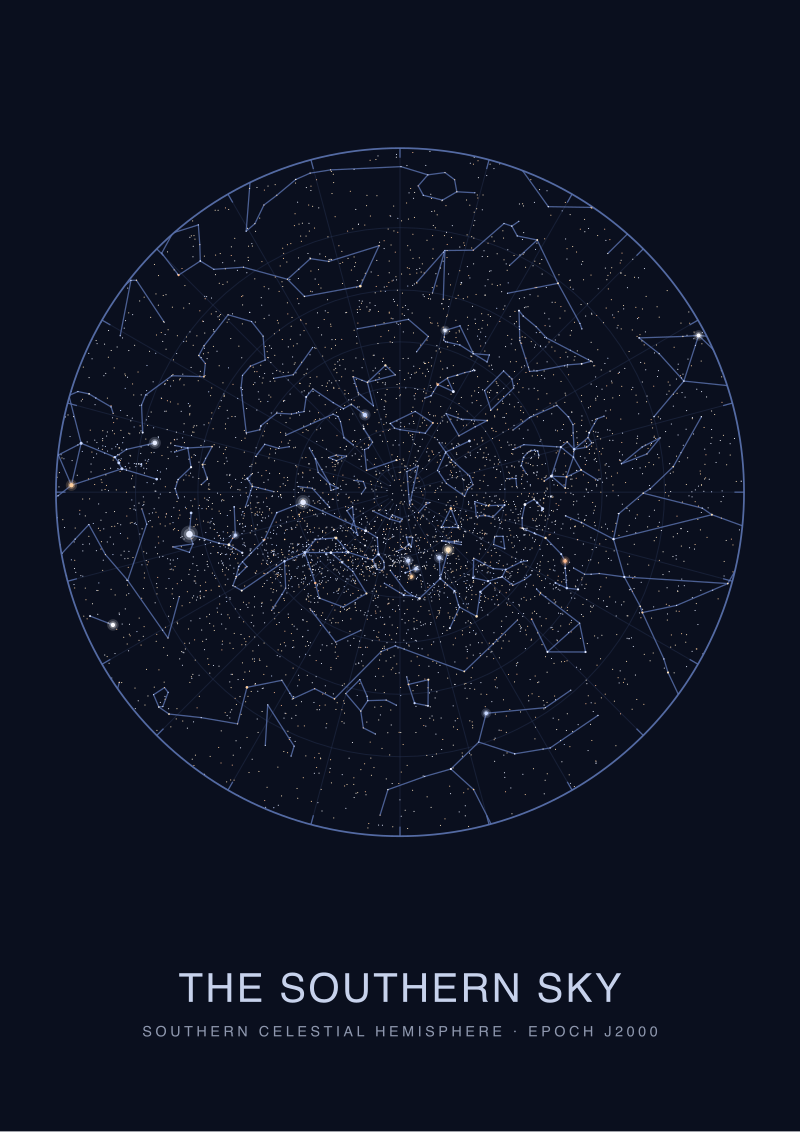 The Southern Sky
The print from this article · from €29.95
View the print →
The Southern Sky
The print from this article · from €29.95
View the print →
Question 3: Does the Wall Stand Alone, or Share the Room With Other Art?
The third fork is about the print's neighbours. A chart that hangs alone on a dedicated wall behaves differently from one that sits in a gallery arrangement — a grid of frames, a picture rail, a curated shelf. A solo print is judged on its own scale against the wall. A grouped print is judged against the frames next to it. Getting this wrong produces the classic error where a beautifully sized chart hangs at exactly the wrong dimension for the room it lives in.
The solo case is unforgiving of undersizing. A print that would be commanding on a gallery wall reads as a postage stamp in the middle of a bare plaster expanse. The grouped case is unforgiving of oversizing. A chart that dominates a mixed arrangement destroys the balance of the group and pulls every eye to itself, whether or not it is meant to be the anchor.
Look at the wall before answering. Count the frames already on it. Note the largest existing piece. That is your reference dimension, not the wall's total area.
If Standalone — the Solo Wall
Size up. A solo print on a dedicated wall should occupy roughly two-thirds of the visual width of the wall's usable surface, measured at eye level. For most domestic walls this puts you at A1 or A0. Under-sizing here is the more common error by a wide margin — the sheet arrives, gets hung, and looks apologetic against the surrounding plaster.
Canopus works exceptionally well as a solo subject at A1 because the star's dominance in the field gives the composition a clear visual centre even at poster scale. The eye lands on the star, reads the label, follows the declination line, then explores the surrounding chart. A weaker subject would need scaffolding — a border, a title block, decorative typography — to hold the same wall.
If Grouped — the Shared Arrangement
Match the group. If the existing frames are mostly A3, your Canopus print is A3. If they are mostly A2, match to A2. The chart's role in a mixed arrangement is to be one legible voice among several, not to shout over the others. A star map at A1 next to a wall of A3 photographs will unbalance the entire arrangement and the chart itself will read as accidentally too big rather than deliberately dominant.
The one exception is when the chart is explicitly meant to be the arrangement's anchor — the piece the smaller frames orbit around. In that case size one step up from the largest neighbouring frame, not two. A single-step jump reads as intentional hierarchy; a two-step jump reads as compositional mistake.
If You Answered Everything: The Size Map
The three questions produce eight combinations. The table below routes each to a concrete recommendation.
| Q1: Under 2m? | Q2: Just Canopus? | Q3: Standalone Wall? | Recommendation |
|---|---|---|---|
| Yes | Yes | Yes | A2 tight portrait — reading-range solo, dense composition holds the wall. |
| Yes | Yes | No | A3 tight portrait — matches surrounding frames, reads as an intimate study. |
| Yes | No | Yes | A2 wide plate — Carina field at reading range, solo anchor with room to travel. |
| Yes | No | No | A3 wide plate — the tightest wide field we recommend; any smaller and Carina compresses. |
| No | Yes | Yes | A1 tight portrait — Canopus as a decisive point of light across the room. |
| No | Yes | No | A2 tight portrait — poster-range grouped, sized to sit with larger neighbours. |
| No | No | Yes | A1 wide plate — the natural home for the full Carina field, standalone. |
| No | No | No | A2 wide plate — poster-range grouped, wide field compressed but still legible. |
The table is the closed form of the tree. Two answers dominate the map: reading-range plus tight portrait routes to A3–A2, and poster-range plus wide plate routes to A1. Those two configurations are where a Canopus chart earns its wall most reliably, because the geometry of the star — one dominant magnitude minus zero point six two anchor in a field of quieter southern stars — sits naturally with either an intimate study or a wide standalone composition.
The Sky Atlas Canopus prints are produced in A3, A2, A1 and A0, each plotted from the same HYG-catalogue coordinates the chart shows on the sheet. If you have run the tree and want to see the format you routed to, the current editions are at see the The Southern Sky print.
The residual number worth carrying out of this piece is declination minus fifty-two point seven degrees. That is where Canopus actually sits in your chart's coordinate grid, and it is the reason the star reads as a low anchor rather than a high one — it hangs deep in the southern sky, and every sizing decision above is, in the end, a decision about how much room to give that one southern latitude on your wall.
FAQ
What is the smallest sheet size that still shows Canopus with a legible coordinate grid?
A4, at roughly 21 × 30 cm, is the practical floor. Below that the declination line at minus fifty-two point seven degrees and the right-ascension marks at six point three nine nine hours stop resolving as readable labels and become decorative marks. A4 works only for genuinely intimate viewing — a desk mount or bedside frame read from under one metre. For any wall use, start at A3.
Does viewing distance really matter more than wall size for star chart prints?
Yes, and it is the most commonly ignored variable. Wall size determines the maximum sheet you can hang; viewing distance determines the minimum sheet that will actually read. A dense chart hung across a room needs poster-scale format to resolve at all, regardless of how much wall is available. Sizing to the wall alone routinely produces prints that look correct empty and unreadable occupied.
Should a Canopus print be portrait or landscape orientation?
It depends on what you framed in Question 2. A tight portrait centred on the star works in either orientation, though portrait tends to feel more like a study and landscape more like a plate. A wide Carina field prefers landscape because the constellation sprawls east–west across the sky more than it extends north–south, and landscape gives that geometry room without wasting sheet.
Is Canopus visible from the northern hemisphere at all?
Only from latitudes south of roughly thirty-seven degrees north, and even then it appears very low on the southern horizon in winter months. This is why the star is treated as a southern chart subject in almost every cartographic tradition. The declination of minus fifty-two point seven degrees means Canopus never rises for observers in most of Europe, Canada, or the northern United States.
How does Canopus compare in brightness to other stars on a chart?
At apparent magnitude minus zero point six two, Canopus is the second-brightest star in the night sky. Only Sirius, at roughly minus one point four six, appears brighter to the naked eye. On a magnitude-scaled chart Canopus will render as one of the two largest glyphs on the entire sheet, which is why single-star compositions built around it hold their visual centre well even at poster scale.
Can I frame a star map behind glass without losing chart detail?
Yes, provided the glass is anti-reflective and the print is matte rather than glossy. Reflective glass over a dense chart competes with the coordinate grid and washes out lower-magnitude stars under room lighting. For A1 and A0 formats the added weight of glass also becomes a mounting consideration — many larger charts are hung with acrylic or dry-mounted directly rather than framed conventionally.
Does the sheet size affect how the chart is plotted, or just how it prints?
It affects both. Sky Atlas replots each format from the source HYG catalogue coordinates rather than scaling a single master file up or down. Larger sheets show more stars because the magnitude cutoff extends deeper — an A0 Carina plate reveals stars fainter than magnitude six that an A3 sheet would compress into background. The chart is genuinely denser at larger formats, not just visually enlarged.
What if the wall is between two and three metres away — neither reading range nor poster range?
Treat two-and-a-half metres as the transition zone and size to whichever behaviour you want the print to reward. If the reader will occasionally step closer to study the chart, size for reading range at A2. If they will engage the print only from the seated position, size for poster range at A1. The wrong choice here is splitting the difference — a print sized for neither behaviour serves neither.
From the collection
New charts and 10% off your first print.
One email now with your code. No noise after.