Two numbers, pulled from the HYG v41 catalogue, sit at the heart of a quiet argument every chartmaker eventually has with themselves. Canopus, in Carina, carries an apparent magnitude of -0.62 and a declination of -52.69566 degrees. Polaris, in Ursa Minor, carries an apparent magnitude of 1.97 and a declination of 89.26411 degrees. The conventional star-lore instinct is to reach for Polaris first — the pole star, the fixed point, the one every navigation primer opens with. The catalogue disagrees. It says one of these stars is roughly ten times brighter than the other, and it is not the one on the coffee mug.
The Conventional Wisdom: Polaris as the Sky's Anchor Star
Open almost any beginner's guide to the northern sky published in the last century and Polaris arrives on the first working page. The story is told the same way each time: find the outer edge of the Big Dipper's bowl, extend the line five times, and there stands the star that does not move. Ships used it. Caravans used it. The fact that Polaris sits at a declination of +89.26411 degrees — less than a degree from the celestial pole itself — is treated as the single most important astronomical fact a novice needs to know. Everything else on the chart is taught in reference to it.
This framing is not wrong. It is what every northern navigator, from the Phoenicians onward, eventually converged on. Polaris is the star that lets you fix latitude in the northern hemisphere with nothing more sophisticated than an outstretched fist, and it is the star that makes long-exposure photography of star trails look the way it does — every other point smearing in a circle while one stays fixed. Star maps of the northern sky are drawn with Polaris at their pivot for the same reason a wall clock is drawn with 12 at the top.
The result, three centuries into modern celestial cartography, is that most casual readers know the name Polaris and vaguely believe it is either the brightest star in the sky or close to it. Neither is true. But the mythology is durable enough that you can survey a room of educated adults and find the belief still standing.
Why This Is Actually True
The pole star framing earns its dominance honestly, and any teardown that dismisses it as folklore is missing the engineering. A star at declination +89.26411 degrees rotates through a circle whose radius is roughly forty-four arcminutes — smaller than the width of the full Moon. To the naked eye of a person standing anywhere north of about ten degrees latitude, Polaris is functionally motionless. The rest of the sky wheels. It does not. That is a genuinely rare property, and it took a specific accident of precession to hand it to a star bright enough to be seen at all from a lit city.
Because of that near-immobility, Polaris does something no other bright star can do: it tells you your latitude without a clock, a table, or a computation. The altitude of Polaris above the horizon, measured in degrees, is your latitude in degrees. The formula has no correction terms worth arguing about at the naked-eye level. A magnitude of 1.97 puts it comfortably above the visibility threshold in all but the worst light pollution, meaning the trick works in a suburban backyard where fainter reference stars have already disappeared into the sky glow. That is a real gift.
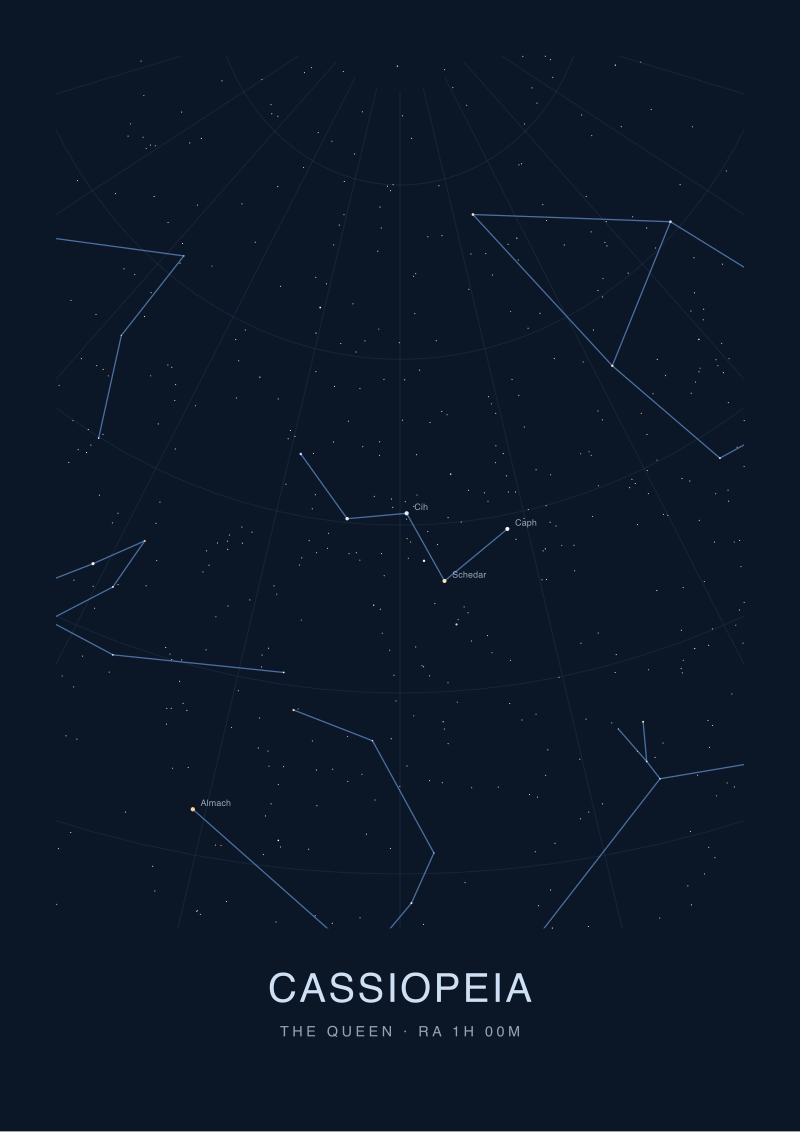
The wider consequence is that Polaris became the reference point around which the entire northern astronomical grid was practically taught. Circumpolar constellations — Ursa Major, Ursa Minor, Cassiopeia, Draco, Cepheus — are all learned as pieces of geometry hung off the pole. When a chartmaker plots the northern sky on a polar projection, Polaris is the center of the paper for the same reason a compass rose puts north at the top. The star is not the brightest thing up there, but it is the most useful piece of navigational furniture the northern hemisphere has ever inherited, and pretending otherwise for the sake of a contrarian argument would be dishonest.
The catalogue is not making an argument about Polaris. It is making an argument about what the word "important" hides when brightness and position are collapsed into a single hierarchy.
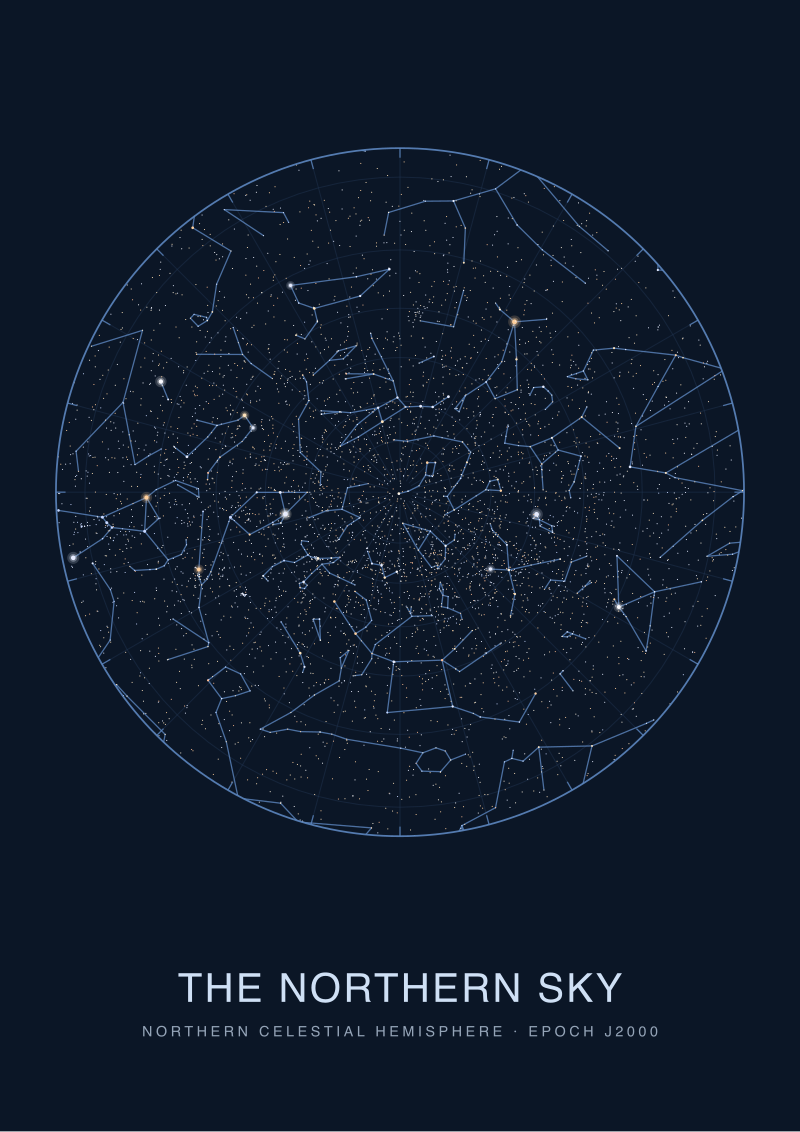 The Northern Sky
The print from this article · from €29.95
View the print →
The Northern Sky
The print from this article · from €29.95
View the print →
Where It Breaks Down: The Magnitude Gap Nobody Prints Plainly
Return to the two numbers. Polaris: apparent magnitude 1.97. Canopus: apparent magnitude -0.62. The gap between them is 2.59 magnitudes. The magnitude scale is logarithmic and inverted — a difference of exactly five magnitudes corresponds to a brightness ratio of 100, and each single-magnitude step is a factor of roughly 2.512. Run the arithmetic on 2.59 magnitudes and the ratio comes out at just under eleven. Canopus, in raw photons hitting the eye, is on the order of ten times brighter than Polaris. Ten. Not marginally brighter. Not "also very bright". An order of magnitude.
This is where the tidy northern-primer picture starts to leak. The star that the average educated northerner thinks of as "one of the brightest in the sky" is, in the honest catalogue accounting, a middling second-magnitude object — the fifty-first brightest star visible to the naked eye by conventional rankings. Meanwhile, Canopus, sitting at declination -52.69566 degrees in the constellation Carina, is the second-brightest star in the entire night sky after Sirius. And the reason most northern readers have never knowingly looked at it is not that it is faint. It is that it lives in the wrong half of the sky.
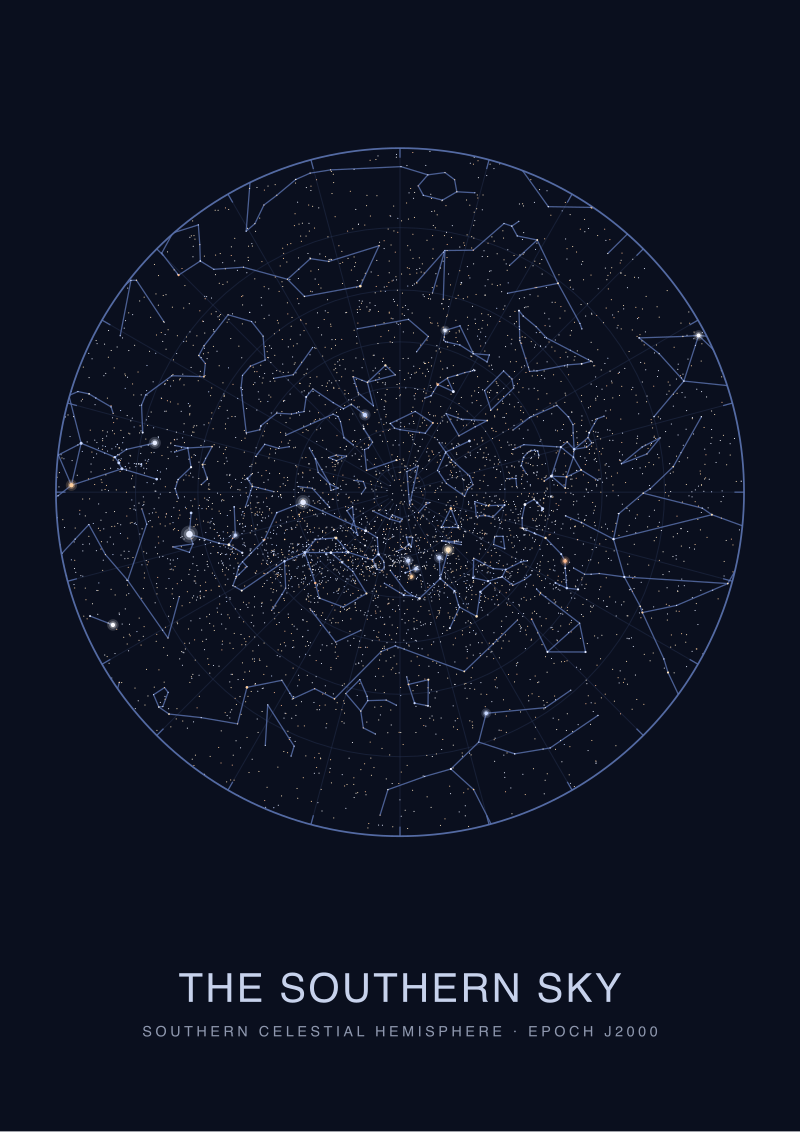
The declination number is the mechanism. Any star with a declination of -52.69566 degrees is invisible from any observing latitude north of about +37 degrees, because the celestial equator tilts it below the horizon for the entire twenty-four hours of the sidereal day. That places Canopus below the horizon, always, from Madrid, from New York, from Beijing, from anywhere along or above that line. A reader in Athens can see it briefly as it grazes the southern horizon; a reader in Miami sees it low but properly; a reader in Sydney sees it high overhead in summer, a torch of a star that has no rival for pure brightness at that altitude other than Sirius.
The comparison that never appears in the standard northern guide, then, is this: the sky's second-brightest star, at magnitude -0.62, is a piece of the map that half the human population has structurally never seen, while the pole star, at magnitude 1.97, is treated as the sky's most important object because of where it sits, not what it emits. Both statements are catalogue-defensible. Only one is usually printed.
The Rule I Use Instead: Read Declination Before Brightness
The habit worth building, if you plan to plot skies with any seriousness, is to read the declination column of the catalogue before you read the magnitude column. Magnitude tells you how much light the star is throwing. Declination tells you whether the light ever reaches you. A star that is spectacular at magnitude -0.62 but sits at -52.69566 degrees is, from the observer's latitude, either a rare southern-horizon sighting or a physical impossibility. A star at magnitude 1.97 that lives at +89.26411 degrees is, from the same observer's latitude, a nightly certainty for anyone in the northern half of the world. The order matters, and reversing it is the single most common source of chart designs that look correct on paper and fail in the field.
The reason it took me a long time to formalize this rule is that most astronomy education is written from the implicit standpoint of a mid-northern-latitude reader. The catalogue does not have that bias — the HYG values for Canopus and Polaris are stated in equatorial coordinates that treat both hemispheres as equally real — but the surrounding literature does. Books published in London, New York, and Paris quietly assume the sky they are describing is the sky over London, New York, and Paris. Under that assumption, brightness alone is a sufficient ranking, because everything bright enough to matter is roughly reachable from the roof. The moment the reader moves — to Nairobi, to Auckland, to São Paulo — the assumption breaks and the ranking has to be rebuilt.
Reading declination first is the correction. It forces the question that matters before the question that flatters: not "how bright is this?" but "does this belong to the observer's sky at all?" Canopus at -52.69566 degrees is a first-class object for the southern hemisphere and a rumor for the northern. Polaris at +89.26411 degrees is a fixture for the north and, from any point south of the equator, does not exist above the horizon at any hour of any day. Two catalogue entries, two magnitudes, two declinations — and the useful hierarchy is different for every reader depending on where they stand.
 Cassiopeia
The print from this article · from €29.95
View the print →
Cassiopeia
The print from this article · from €29.95
View the print →
When the Old Rule Still Wins: The Northern Navigator's Case
None of this dislodges the pole star from the specific job it was hired to do. If you are north of the equator and you need latitude without instruments, magnitude 1.97 is more than enough visibility and declination +89.26411 degrees is the property no other bright star possesses. Canopus, at magnitude -0.62 and declination -52.69566 degrees, cannot substitute in that role no matter how bright it is — its brightness is worthless to a navigator who cannot see it above the horizon in the first place, and it is worthless as a fixed reference to a southern navigator because it wheels through the sky like any other star not lying near the pole. The old rule — reach for Polaris first — is the correct rule for the specific case of a northern observer solving the specific problem of latitude by eye. Where the rule fails is when it is imported wholesale into a general theory of which stars are important. That is a different question, and the catalogue answers it differently.
From the collection
New charts and 10% off your first print.
One email now with your code. No noise after.