For the reader trying to make sense of why star charts stop being useful the night a full moon rises, the answer is that the moon at full phase sits near magnitude -12.7 and the brightest star in the sky, Sirius, sits at -1.44 — an eleven-magnitude gap that translates to roughly thirty thousand times more light reaching the eye. The obvious objection is that magnitudes are a small-looking scale — the numbers -12 and -1 sound close, and every planetarium poster prints them on the same axis — so the gap reads gentler than it is. We are going to defend the thirty-thousand figure with the catalogue in front of us.
The steel-man for treating the moon and the stars as comparable is the honest one: they are both point-adjacent sources projected onto the same celestial sphere, they are both plotted on the same magnitude scale, and a beginner chart is entitled to show them in one legend. Nothing in that is wrong. It is only that the scale itself hides what the eye actually experiences, and once we open the catalogue we find no way to draw the full moon and Sirius on the same page without one of them ceasing to be information.
The Number That Ruins the Comparison Before It Starts
Magnitude is a logarithm dressed as an integer. The convention we still use descends from Hipparchus and was formalised in the nineteenth century into a rule that five magnitudes correspond to exactly a factor of one hundred in brightness. That means each single magnitude step is the fifth root of one hundred, which is about 2.512. Two stars a magnitude apart differ by a factor near two and a half. Five magnitudes apart, by a factor of a hundred. Ten magnitudes apart, by ten thousand.
The scale runs backwards, which we will get to. What matters first is that it is compressive. A number line that goes from -12 to +6 looks like it spans eighteen small steps. In brightness terms it spans a factor of nearly seventeen million. This is the entire reason why the moon-versus-star question is so misleading when written on paper. The moon at -12.7 and Sirius at -1.44 are eleven and a quarter magnitude apart. Raise 2.512 to the 11.26th power and the answer lands around thirty thousand. The full moon delivers roughly that many times more light to the eye than the brightest true star we have.
There is nothing subjective in this. It is not "the moon looks brighter". It is not "the moon overwhelms the sky for other reasons". Thirty thousand is the coefficient of light. A chart that plots both without warning the reader is not lying, exactly, but it is holding the scale so tightly that the reader will misread it every time.
Sirius Is the Brightest Star We Can Cite, and It Is Not Close to the Moon
The HYG catalogue we plot from lists Sirius at apparent magnitude -1.44, sitting in Canis Major at roughly 6h 45m in right ascension and -16.7 degrees in declination. It is the brightest fixed star in the terrestrial night sky by a wide margin, and even so the gap to the moon is not something that closes at any lunar phase short of eclipse.
Take the full moon at its conventional peak brightness, -12.7. The delta to Sirius is 11.26 magnitudes. Using the 2.512-per-magnitude rule, that is 2.512^11.26, which lands in the neighbourhood of 30,000 to 32,000, depending on exactly which value you assign to the moon on the night in question (the moon's magnitude varies slightly with distance and phase geometry — perigee full moons run a touch brighter than apogee ones, by tenths of a magnitude, not units).
Consider what that ratio means at the eyepiece. If you photograph Sirius with an exposure that just brings its Airy disc to a clean point, the same exposure on the full moon would saturate the sensor by more than four orders of magnitude. If Sirius delivers, hypothetically, a single photon to a particular pixel in a given millisecond, the full moon delivers thirty thousand photons to a comparable patch of sky in that same millisecond. The eye does not measure this linearly — human vision compresses its own response — which is why the moon does not feel thirty thousand times more painful to look at. It only feels like the brightest thing in the sky by an obvious margin. The measurement, though, is what it is.
The Six Brightest Stars We Plot Sit Inside a One-and-a-Half Magnitude Band
Pull the top of the catalogue and the compression at the bright end of the stellar sky becomes clear. Below Sirius, the next brightest star we plot is Canopus in Carina at -0.62. Then Arcturus in Boötes at -0.05, then Rigil Kentaurus in Centaurus at -0.01, then Vega in Lyra at +0.03, then Capella in Auriga at +0.08. Six stars, a range of only 1.52 magnitudes from top to bottom, and yet inside that band lie the anchors of most of the seasonal skies humans have named.
The lesson here is that the fixed stars huddle. The gap between Sirius and Capella — the brightest star in the sky and the sixth-brightest — is a factor of about four in light. The gap between Sirius and the full moon is a factor of thirty thousand. All the drama the constellations offer the eye happens inside a narrow bright end that the moon does not belong to. When we draw the catalogue, we have to pick a magnitude cut — often magnitude 5 or 6 for a naked-eye chart — and the moon, if plotted at all, cannot share the scale.
| Object | Apparent magnitude | Light relative to Sirius |
|---|---|---|
| Full moon (nominal) | -12.7 | ~30,000x brighter |
| Sirius | -1.44 | 1.00 (reference) |
| Canopus | -0.62 | 0.47 as bright |
| Arcturus | -0.05 | 0.28 as bright |
| Rigil Kentaurus | -0.01 | 0.27 as bright |
| Vega | +0.03 | 0.26 as bright |
| Capella | +0.08 | 0.25 as bright |
Read that last column and the point makes itself. The six brightest stars we plot fall inside a factor of four. The moon sits outside the frame by a factor of thirty thousand. There is no shared axis on which these two things can be drawn honestly at the same time.
Why Star Maps Get Redrawn Around the Lunar Cycle
This is the practical consequence, and it is why the studio treats lunar phase as a first-class parameter when plotting a night. The full moon does not simply outshine the stars. It raises the entire sky background. A dark sky reaches magnitude 21 or 22 per square arcsecond at zenith on a moonless night in a proper dark-sky reserve. Under a full moon, the background rides up to magnitude 18 or brighter, and every star fainter than roughly magnitude 3.5 becomes difficult to hold in vision. The naked-eye limit under a full moon collapses toward magnitude 3.
That collapse is what a chartmaker actually cares about. The six stars in the table above — Sirius, Canopus, Arcturus, Rigil Kentaurus, Vega, Capella — all survive a full moon. The stars that outline the shapes people know them by, the ones at magnitude 2 and 3 that draw the belt of Orion or the bowl of the Big Dipper, mostly hold. Everything below that, which is where most catalogue entries live, ceases to be visible until the moon is past third quarter and rising later in the night. A chart that does not tell the reader this is a chart the reader will curse when the sky arrives.
We plot each print around a chosen date and a chosen sky. When the client's date lands near full moon, we say so on the chart itself. A star map is not just a diagram of positions — it is a promise about what the reader will see, and the moon has veto power over that promise for roughly a week out of every four.
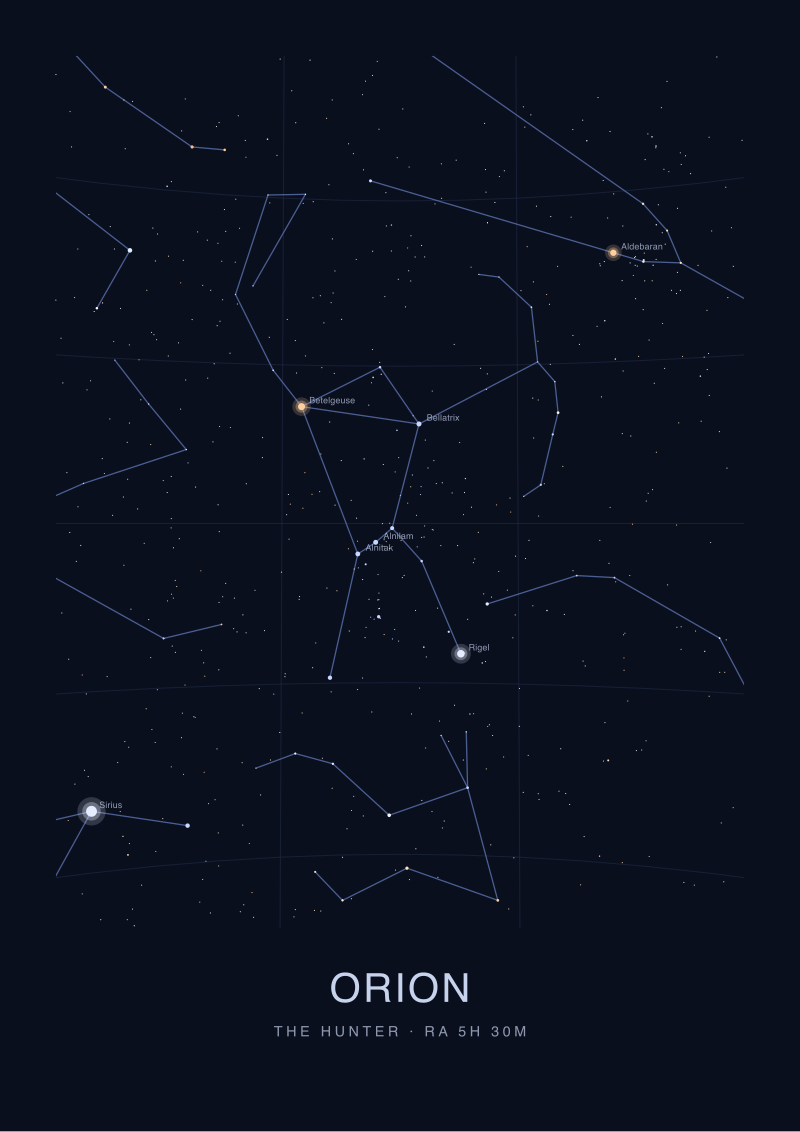 Orion
The print from this article · from €29.95
View the print →
Orion
The print from this article · from €29.95
View the print →
What You Should Actually Do
If you are trying to reason about the brightness of the full moon against the stars — because you are planning a night of observation, buying a chart, or trying to understand why an astrophotograph looks the way it does — carry the eleven-magnitude, thirty-thousand-times figure as your anchor. It is the number that closes every version of the question. The moon is not "much brighter than Sirius". It is roughly thirty thousand times more light on the eye, and every downstream decision about when to observe, what to photograph, and which stars will still be there when you look up flows from that ratio.
If you want to hold this in a form you can hang on a wall, the star maps we plot at Sky Atlas mark lunar phase for the exact date they render — so a print of the sky over your chosen night shows the constellations that will actually be visible, not the ones a moonless idealisation would draw. You can see the current catalogue in our see the Orion print. Beyond that, the practical rule is simple: for constellation work, aim for the week either side of new moon; for the six brightest stars, any night at all will do, because they sit above the moonlight the same way lighthouses sit above sea spray. They are not competing on the same scale. Neither, really, is anything else.
FAQ
How bright is the full moon in astronomical magnitudes?
The full moon sits near apparent magnitude -12.7 at its nominal peak brightness. The exact value varies slightly with distance — a perigee full moon (sometimes called a supermoon) runs a few tenths of a magnitude brighter than an apogee one — and with the precise phase geometry at the moment of observation. For any practical comparison against stars, -12.7 is the working figure, and the range across a year is roughly -12.5 to -12.9.
How many times brighter is the full moon than Sirius?
Roughly thirty thousand times. Sirius sits at apparent magnitude -1.44 in the HYG catalogue, which puts it 11.26 magnitudes fainter than the full moon. Each magnitude corresponds to a factor of about 2.512 in brightness, so 2.512 raised to the 11.26th power lands near 30,000. That is not "a lot brighter" — it is four and a half orders of magnitude, which is why star charts cannot honestly draw the moon and Sirius on the same axis.
Why does the magnitude scale run backwards?
Because Hipparchus catalogued the brightest stars as "first magnitude" and the faintest naked-eye stars as "sixth magnitude" in the second century BCE, and by the time the scale was formalised mathematically in the nineteenth century, the convention was already too entrenched to invert. Brighter objects get lower — and eventually negative — numbers. Astronomers have discussed reversing it for over a century and have never done it. The scale is a historical fossil that we have all agreed to keep.
Can you see Sirius during a full moon?
Yes. Sirius at magnitude -1.44 is more than twelve magnitudes brighter than the naked-eye limit under a moonlit sky, which collapses to around magnitude 3. All of the top six stars we plot — Sirius, Canopus, Arcturus, Rigil Kentaurus, Vega, and Capella — remain easily visible under a full moon. What disappears is the fainter web of stars that gives the constellations their outlines below the second-magnitude anchor points.
How much fainter than the full moon is the faintest naked-eye star?
The naked-eye limit under a dark, moonless sky sits at magnitude 6, which is 18.7 magnitudes fainter than the full moon. That works out to a brightness ratio of about thirty million. Under the full moon itself the sky background rises enough that the practical naked-eye limit rides up toward magnitude 3, which is another factor of roughly sixteen tighter. That collapse is why constellation charts become nearly useless for a week each lunar cycle.
Does the moon's brightness change enough to matter for observing?
Yes, though the change over a single night is small. The full moon's magnitude varies by roughly four-tenths of a magnitude across the year depending on Earth-moon distance, which is a brightness swing of about 45 percent — visible in photographs but not obvious to the eye. What matters more is phase. A first-quarter moon is only about a ninth as bright as full, not half, because the illuminated crescent geometry compresses the light more than the exposed area suggests.
Is there any star brighter than the full moon?
No fixed star, no. The brightest stellar object in the sky is Sirius at -1.44, more than eleven magnitudes below the full moon. Nothing in the stellar catalogue closes that gap. Venus at greatest brilliance reaches about -4.9, still nearly eight magnitudes fainter than a full moon and about a factor of a thousand short. Only the sun, at roughly magnitude -26.7, exceeds the moon on the same scale, by a factor near four hundred thousand.
From the collection
New charts and 10% off your first print.
One email now with your code. No noise after.