We have read a great many articles about the best constellations to find with the naked eye, and they all miss the same things in the same order. They open with Orion, they promise Ursa Major from anywhere, they treat the sky as a static poster on a wall, and they never once tell the reader what magnitude they are actually looking at. Sirius, at apparent magnitude −1.44 in Canis Major, gets one line. Canopus, at −0.62 in Carina and invisible to most of the Northern Hemisphere, gets none. The result is a genre of writing that sounds like astronomy and functions like a horoscope: confident, universal, and quietly wrong about where the reader is standing.
What They All Get Wrong
The first error is the Orion-first opening. Every list treats Orion as the universal onboarding constellation, which is defensible in January from a temperate latitude in the Northern Hemisphere and indefensible the rest of the year. A reader in Buenos Aires in July who follows this advice will spend an evening staring at a piece of sky that does not contain Orion. A reader in Reykjavík in June will not have real night at all. The genre does not tell them either of these things. It just says "start with Orion" and moves on.
The second error is the "Ursa Major from anywhere" promise. Ursa Major is circumpolar from roughly 41° north and above — which is true for London, Berlin, and Chicago but false for Miami, Cairo, and every reader in the Southern Hemisphere, where the Big Dipper barely clears the northern horizon in spring and is gone the rest of the year. The word "anywhere" is doing a great deal of untrue work in these paragraphs, and no one seems to notice.
The third error, and the most telling one, is that these articles almost never define the magnitude scale they are implicitly using. They will call Sirius "the brightest star in the night sky" without saying it sits at −1.44, and they will not tell the reader that a magnitude of zero (Vega, at 0.03 in Lyra; Capella, at 0.08 in Auriga) is already exceptionally bright, or that each step of one magnitude is roughly a 2.5× change in brightness. The reader is handed a ranked list of stars with no unit on the ranking. It would be like recommending wines by price and refusing to mention the currency.
The fourth error is the static-poster fallacy. The sky rotates once every 23 hours 56 minutes and drifts against the solar year, which means the constellation that dominated your local sky at 10 p.m. in January is nowhere near overhead at 10 p.m. in July. A "best constellations" article that does not include the words "season", "latitude", or "hour" is not describing observation. It is describing a wall poster in a museum gift shop.
The fifth error is treating the 88 IAU constellations as if they are all the same kind of object. They are not. Some are compact, high-contrast shapes with two or three anchor stars brighter than magnitude 2 — Orion, Cassiopeia, the Southern Cross. Others are sprawling official regions on the celestial sphere with no memorable figure at all — Hydra covers more than 1,300 square degrees and contains almost nothing that will help a beginner. Recommending them side by side, without saying which is which, is the writing equivalent of recommending a city and a national forest as if they were the same afternoon.
What Is Almost Always Missing
What is missing, first, is latitude. A beginner in Nairobi (roughly 1° south) sees a genuinely different sky from a beginner in Edinburgh (roughly 56° north). The Nairobi observer can see Rigil Kentaurus, the −0.01 magnitude anchor of Centaurus, well above the horizon on a March evening — it is the closest stellar system to the Sun and one of the four brightest stars in the sky. The Edinburgh observer will never see it in their life without traveling. A useful guide to the naked-eye sky begins by asking the reader where on Earth they are standing. None of them do.
What is missing, second, is the actual shape of the magnitude scale. The scale runs backwards — smaller numbers are brighter — and it is logarithmic rather than linear, which is not intuitive. A star at magnitude 0 (Arcturus, at −0.05 in Boötes) is roughly 100 times brighter than a star at magnitude 5, which is near the naked-eye limit under a genuinely dark sky. A city reader with heavy light pollution may not reliably see anything fainter than magnitude 3 or 4, which removes most of the sky's stars from their working vocabulary. A guide that does not warn them of this is setting them up to feel like they are failing at a task no one told them the rules of.
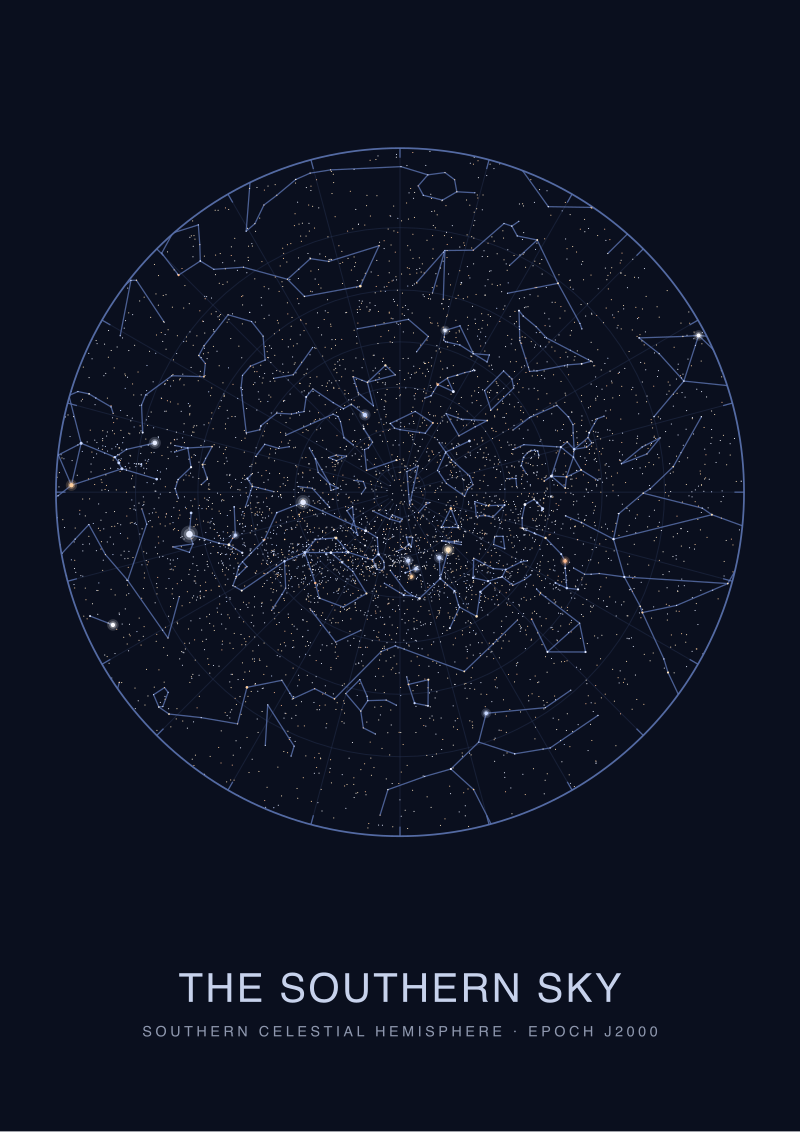
What is missing, third, is the Southern Hemisphere. Of the six stars we can cite from our catalogue for this piece, three of the four brightest — Canopus (−0.62, Carina), Rigil Kentaurus (−0.01, Centaurus), and Sirius (−1.44, Canis Major) — are best seen from, or exclusive to, southern skies. Sirius is technically visible from most of the Northern Hemisphere in winter, but Canopus and Rigil Kentaurus require the reader to be roughly south of 37° N and 29° N respectively. Northern-authored beginner lists leave both out and never explain why. A serious guide to naked-eye constellations that treats the entire southern half of the celestial sphere as a footnote is not a guide. It is a regional pamphlet with global pretensions.
What is missing, fourth, is time. Not clock time — calendar time. The constellations you can find at 9 p.m. shift by roughly two hours per month against the same stars. Orion is high in the south in January evenings from mid-northern latitudes; by April it is setting; by July it is gone from the evening sky entirely and returns as a pre-dawn object. The Summer Triangle, anchored on Vega (0.03) in Lyra, is a summer evening object in the Northern Hemisphere for exactly that reason. A recommendation without a month attached is a recommendation without a subject.
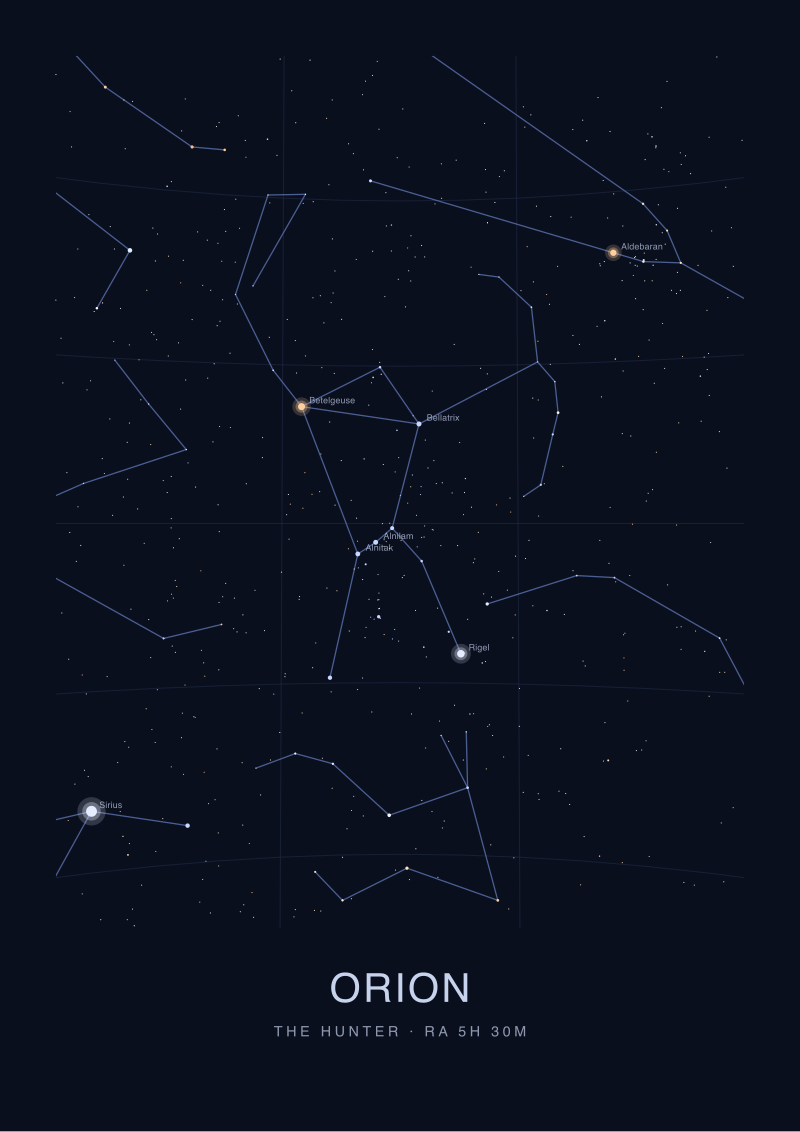 Orion
The print from this article · from €29.95
View the print →
Orion
The print from this article · from €29.95
View the print →
What I Would Say Instead
We would tell the reader, first, to stop asking which constellations are "best" and start asking which anchor stars are currently above their horizon. The naked-eye sky is organised around a small number of unusually bright stars — the six in our catalogue for this piece are all brighter than magnitude 0.1, which is the brightness tier that survives urban light pollution and finds you before you find it. Sirius at −1.44, Canopus at −0.62, Arcturus at −0.05, Rigil Kentaurus at −0.01, Vega at 0.03, and Capella at 0.08 are the reliable entry points. Learn those six and their constellations, and you have a working key to roughly a quarter of the year's evening sky from either hemisphere.
We would tell them, second, that the useful question is not "what is the best constellation" but "what is the brightest thing I can see right now, and what is it part of". If they are in northern temperate latitudes on a winter evening, the answer is Sirius, and the constellation is Canis Major — a small, high-contrast figure organised around one dominating star. If they are somewhere south of about 37° N on a February evening, they can also find Canopus, roughly forty degrees below Sirius, anchoring Carina — the keel of the old ship Argo. If they are in the Northern Hemisphere on a summer evening, Vega is nearly overhead and Lyra is the small, tight constellation around it. If they are anywhere between the Arctic and southern Australia on a May evening, Arcturus is the brightest thing high in the sky, and Boötes is the kite-shape trailing behind it.
We would tell them, third, that the two constellations most worth learning first from mid-latitudes are the ones organised around a magnitude-zero anchor and a clear geometric shape: Lyra around Vega in Northern summer, Auriga around Capella in Northern winter, Boötes around Arcturus in Northern spring, Centaurus around Rigil Kentaurus in Southern autumn. These are constellations that will find you. Orion, for all its fame, is a January-through-March recommendation for one hemisphere. The magnitude-zero anchor stars work across more of the year and, taken together, across the whole sphere.
We would tell them, fourth, that the shape of the sky is not something to memorise from a list but something to plot for a specific place and date. A star chart drawn for London on the evening of the first clear night in October will teach a beginner more about the visible constellations than any ranked article, because it will show them exactly which of the anchor stars are up, where they sit relative to the horizon, and what figures they belong to. That is the entire premise of what a chart desk does before it prints a map — and it is why we sell dated charts at see the Orion print rather than a generic poster of "the constellations". The sky the reader can actually see is a function of latitude, date, and hour. Any recommendation that pretends otherwise is selling a decoration, not a guide. And the honest first constellation to learn is whichever one contains the brightest star currently above your horizon tonight.
This piece does not address telescopic targets — the deep-sky objects inside these constellations (the Orion Nebula, the Andromeda Galaxy, the globular clusters of Sagittarius) are a separate craft, requiring aperture and darker skies than most readers have. It does not address the mythology of these figures beyond naming the traditions that carried them, because the naming histories of Arabic, Greek, Chinese and Polynesian sky traditions each deserve their own essay rather than a paragraph. And it does not address the practical question of light-pollution mitigation in urban observation, which is a real subject with real tools and one we will take up on its own terms.
FAQ
What is the single easiest constellation to find with the naked eye tonight?
It depends on your latitude, date, and hour — which is exactly the honest answer the genre refuses to give. As a working rule: find the brightest star currently above your horizon and identify the constellation around it. From mid-northern latitudes in winter evenings, that is Sirius (magnitude −1.44) in Canis Major. In summer, it is Vega (0.03) in Lyra. In spring, Arcturus (−0.05) in Boötes. Each of these anchor stars sits inside a small, compact constellation that is genuinely learnable in one sitting.
Why do most beginner guides start with Orion?
Because Orion is a genuinely spectacular constellation with several bright anchor stars and a clear geometric belt, and because most beginner guides are written by Northern-Hemisphere authors in January. The problem is not Orion itself — it is the implicit universalisation. Orion is a winter-evening object from the Northern Hemisphere and a summer object below the equator; it is invisible from mid-Northern skies for months at a time. Recommending it without a season and a latitude is where the genre fails.
What does apparent magnitude actually measure?
Apparent magnitude is how bright a star looks from Earth, on a logarithmic scale that runs backwards: lower numbers mean brighter objects. Sirius at −1.44 is the brightest star in the night sky. Vega at 0.03 and Capella at 0.08 are near the top of the ordinary bright-star tier. The scale is calibrated so that a five-magnitude difference corresponds to a factor of one hundred in brightness, which means each single magnitude step is roughly a factor of 2.5.
Can I see Canopus or Rigil Kentaurus from Europe or North America?
Mostly, no. Canopus (−0.62, Carina) requires an observer south of roughly 37° north, which excludes almost all of Europe and the northern United States. It is visible from the southernmost fringes of the U.S. and from the Mediterranean rim, low on the horizon. Rigil Kentaurus (−0.01, Centaurus), the third-brightest star in the sky and the closest stellar system to the Sun, requires an observer south of roughly 29° north and is essentially a Southern Hemisphere object for practical purposes.
Does light pollution make constellation-hunting pointless in a city?
No, but it changes the vocabulary. Under heavy urban light pollution, only stars brighter than roughly magnitude 3 or 4 remain reliably visible, which removes the faint background stars that fill in most constellation figures. The magnitude-zero anchor stars — Sirius, Canopus, Arcturus, Rigil Kentaurus, Vega, Capella — survive city skies comfortably. Constellations organised around them (Canis Major, Lyra, Boötes, Auriga) remain findable from balconies and rooftops. Constellations organised around magnitude-3 and fainter stars mostly do not.
How many constellations are there officially?
Eighty-eight, as fixed by the International Astronomical Union in 1930. These are not shapes so much as regions of the celestial sphere: every point of sky belongs to exactly one constellation. Some contain a striking figure with bright anchor stars; others are large, dim regions with no memorable outline. Treating all 88 as equivalent recommendations is one of the ways beginner articles set new observers up to feel lost — the constellations are not a menu of equally good options.
Is the zodiac relevant to naked-eye observation?
Only as coordinate geography, not as anything else. The twelve zodiacal constellations sit along the ecliptic — the path the Sun appears to follow across the sky over a year — which means they are also roughly where the Moon and the naked-eye planets travel. That is a genuine and useful piece of sky organisation for observers. It has nothing to do with personality or prediction. Astrology is a separate cultural tradition that borrowed the coordinate band and stopped there.
Do the constellations look the same as they did to ancient observers?
Almost, but not exactly. Individual stars have proper motions — small drifts across the sky — that over thousands of years slightly deform the shapes. More importantly, precession slowly rotates which stars are near the celestial poles: Polaris is our current north pole star, but it will not be forever, and it was not five thousand years ago. On a human timescale of decades, the constellations are stable. On a timescale of millennia, they are a slowly changing map.
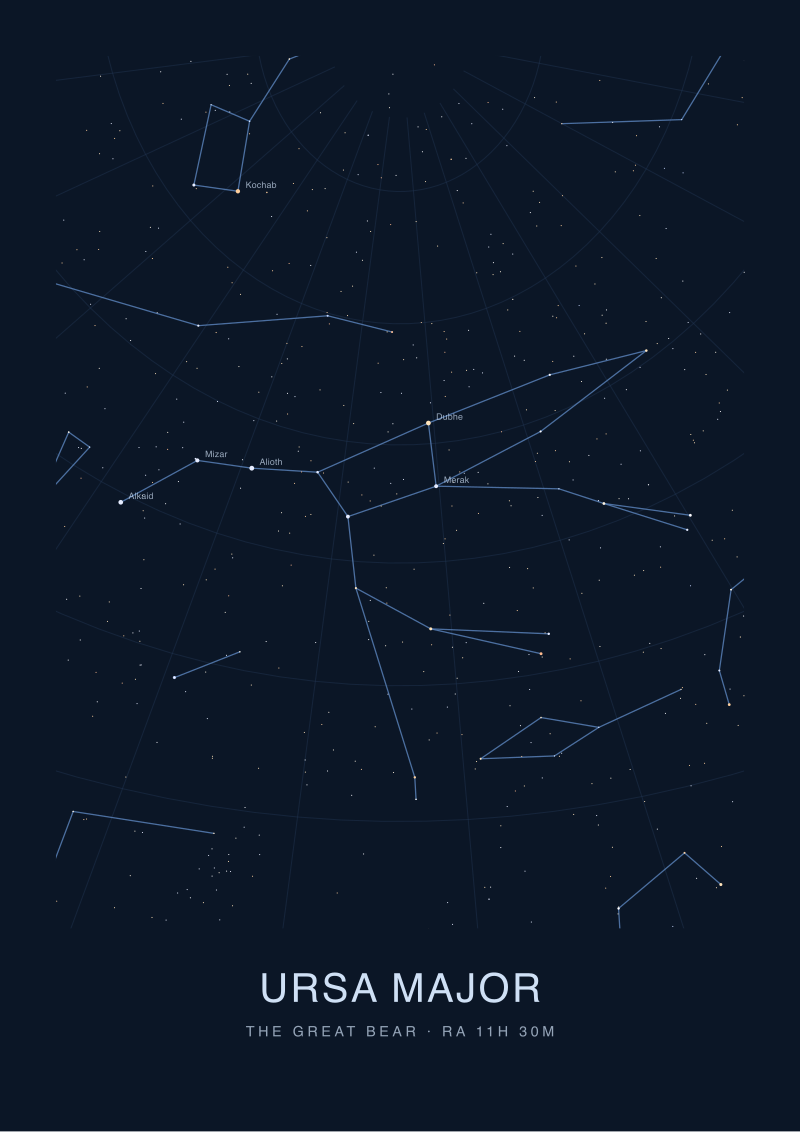 Ursa Major
The print from this article · from €29.95
View the print →
Ursa Major
The print from this article · from €29.95
View the print →
From the collection
New charts and 10% off your first print.
One email now with your code. No noise after.