Sirius sits at apparent magnitude -1.44 in the HYG catalogue, and that number does not change when the calendar turns to December. Nor does Canopus at -0.62, nor Capella at 0.08. The stars themselves are indifferent to our seasons. And yet the winter sky, for an observer at mid-northern latitudes, really does look brighter — fuller of first-magnitude points, more crowded with named stars, more legible as a map. The reason is not stellar. It is a question of which direction the night-side of Earth happens to face in January, and a handful of definitions worth owning before the next clear evening.
Apparent Magnitude
Apparent magnitude is how bright a star appears from Earth, not how bright it actually is. The distinction matters because it folds together three things the eye cannot separate: the star's intrinsic output, its distance from us, and the thin shell of air we read it through. When we pulled the HYG v41 catalogue to settle this question, every star in the file carried a single number next to its name — Sirius at -1.44, Canopus at -0.62, Arcturus at -0.05, Rigil Kentaurus at -0.01, Vega at 0.03, Capella at 0.08 — and that number is fixed. It does not swing with the calendar. A star that reads magnitude 0.08 in July reads magnitude 0.08 in January. What changes between those two dates is which stars are above the observer's horizon after sunset, and for how many hours, and at what elevation. The catalogue is a static document. The sky over a given city is a schedule.
The Magnitude Scale
The magnitude scale runs backwards and runs on logarithms, which is why it confuses almost everyone the first time. A lower number is brighter; a difference of five magnitudes corresponds to a factor of exactly one hundred in brightness. The system descends from Hipparchus, who in the second century BCE sorted the visible stars into six classes with the brightest as "first magnitude", and modern astronomy never fixed the inheritance — it anchored it instead, defining Vega near zero. In the catalogue we worked from, Vega sits at 0.03 and Arcturus at -0.05, which looks like a trivial gap on paper but is a measurable step for a trained eye. Sirius at -1.44 is roughly four times as bright to the eye as Vega. Capella at 0.08 is five hundredths dimmer than Vega, which no observer will notice unaided. Understanding the scale is the first defence against the common claim that a star "looks brighter tonight". It usually does not. The sky it sits in has changed.
The Winter Hexagon
The Winter Hexagon is the practical reason the January sky reads as crowded with bright stars. It is a six-cornered figure drawn across the southern-and-overhead sky for mid-northern observers from roughly December to March, and two of its corners are in our grounding catalogue: Sirius, at magnitude -1.44 in Canis Major, and Capella, at magnitude 0.08 in Auriga. The hexagon is not a constellation. It is an asterism — a drawn pattern that cuts across constellation boundaries to connect the brightest first-magnitude points available at that longitude of the ecliptic. When you can see Sirius and Capella at the same time, standing roughly at opposite ends of a line that passes near the zenith, you are looking at the geometric case for the "winter is brighter" instinct. Those two anchors alone, taken from the catalogue without any other star, span a magnitude range of 1.52 — more spread than most whole constellations contain.
The Winter Triangle
Nested inside the hexagon is a smaller, tighter figure: the Winter Triangle. Our grounding catalogue holds only its brightest vertex — Sirius at magnitude -1.44, by a wide margin the brightest star in the entire night sky as seen from Earth — but the triangle itself is one of the most interrogated asterisms in observational history, used for teaching azimuth and timing since at least the medieval Arabic star catalogues. The pedagogical point is that Sirius does the heavy visual work. Chartmakers plotting the January sky are plotting around a single dominant light source, and every other star in the frame gets measured against it. When readers ask us whether stars look brighter in winter, the honest answer begins here: no, but Sirius is up, and Sirius alone shifts the perceived brightness of the surrounding half-sphere. One star, correctly placed, rewrites the whole page.
The Orion Arm
The structural reason the winter sky is dense with bright stars is galactic. Our solar system sits on the inner edge of a minor spiral feature called the Orion Arm — sometimes the Orion-Cygnus Arm — and in Northern Hemisphere winter, the night side of Earth faces outward along that arm, toward a stretch of relatively young, hot, high-luminosity stars that formed in the same stellar nurseries. In July, the same observer looks the other way: across the plane of the galaxy toward the dense but dustier centre, where the brightest nearby objects are fewer. The catalogue reflects this quietly. Of the six brightest stars in our grounding — Sirius, Canopus, Arcturus, Rigil Kentaurus, Vega, Capella — three are winter-sky objects for mid-northern latitudes and three are not. The geography of the Milky Way, not any seasonal property of the atmosphere, is doing the first and largest piece of this work. We are oriented, in January, toward a brighter neighbourhood.
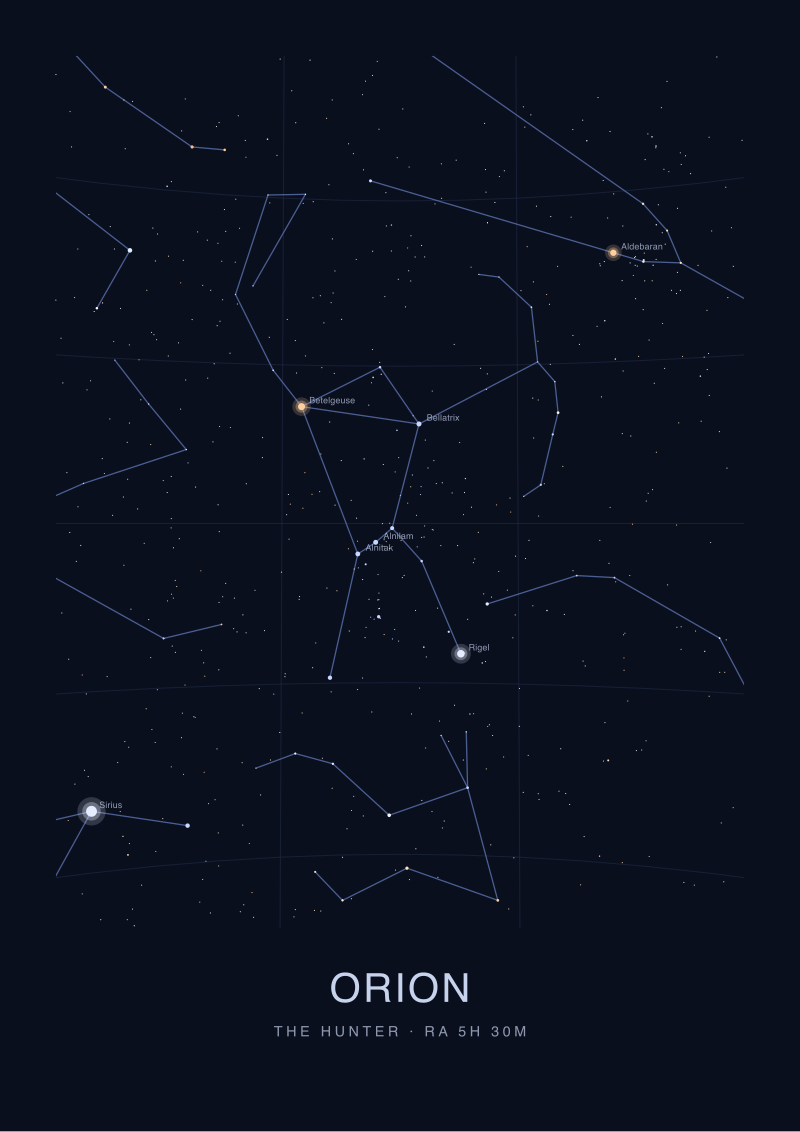 Orion
The print from this article · from €29.95
View the print →
Orion
The print from this article · from €29.95
View the print →
Atmospheric Transparency
Transparency is the amount of starlight that survives the trip through the atmosphere to the observer's retina, and it is a seasonal quantity. Cold air holds less water vapour; winter nights at mid-northern latitudes are statistically drier at ground level than summer nights, and dry air scatters less light at the blue end of the spectrum where the hottest, brightest stars radiate most of their energy. Dust loading is also typically lower in winter outside wildfire-prone regions. The practical consequence: Vega at magnitude 0.03, observed on a clear February night from a dark site, reads marginally brighter to the eye than the same star does in August haze — not because its catalogue magnitude has changed, but because less of its light is being lost between the stratosphere and the observer. The gain is small, perhaps a tenth of a magnitude on a good night, but it compounds across a crowded sky. Clearer air multiplies density. The hexagon reads sharper.
Scintillation
Scintillation is the technical name for twinkling, and winter has more of it than any other season. The cause is turbulence: layers of air at different temperatures sliding over each other at altitude bend starlight on its way down, so a point source arrives at the eye as a rapidly flickering, sometimes colour-shifting dot. Sirius, our catalogue's -1.44 anchor, is famous for this. Low on the horizon on a January evening it can flash red and blue and green within a single second, and amateur observers routinely file reports of "colour-changing UFOs" that turn out to be Sirius undergoing standard atmospheric scintillation while being watched more carefully than usual. The paradox is that scintillation does not make a star brighter — the integrated light output over time is unchanged — but it makes the star more visually conspicuous, more insistent on being noticed. Winter's dense, turbulent air is bad for telescope resolution and good for naked-eye drama. The sky looks more alive, which the brain reads as more.
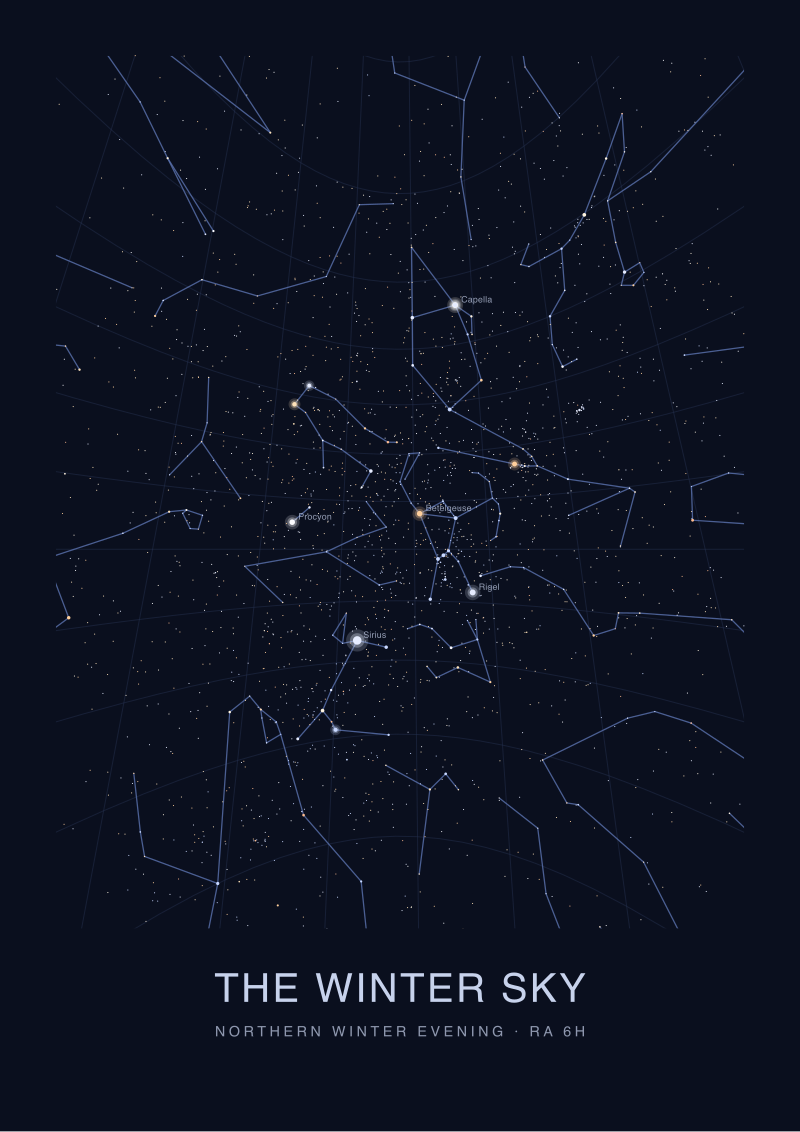 The Winter Sky
The print from this article · from €29.95
View the print →
The Winter Sky
The print from this article · from €29.95
View the print →
Dark Adaptation
Dark adaptation is the physiological process by which the human eye recovers sensitivity in low light, and it is a thirty-minute arithmetic that most observers never run. The rod cells of the retina, responsible for faint-light vision, require roughly twenty to thirty minutes in near-total darkness to reach full sensitivity; a single glance at a phone screen resets the clock. Winter contributes two things to dark adaptation that summer does not. Nights are longer at mid-northern latitudes — a January evening sky is fully dark by six — which means more observers are outside under genuinely dark conditions rather than during the long summer twilight that keeps the sky grey until well past ten. And winter observers tend to arrive at the window or the garden already in low ambient light, having spent the evening indoors with lamps rather than daylight. A fully dark-adapted eye registers Capella at 0.08 as significantly more present than the same eye five minutes out of a lit kitchen. The star has not moved. The receiver has.
Angular Elevation
Angular elevation is how high a star stands above the horizon, and it governs how much atmosphere its light has to cross before reaching the observer. A star at the zenith is viewed through roughly one atmospheric thickness — astronomers call this one airmass. A star ten degrees above the horizon is viewed through nearly six airmasses, meaning five times more atmospheric scattering, absorption, and reddening between the catalogue magnitude and the retina. For a mid-northern observer, the winter sky's bright stars climb notably high. Capella at declination +45.99 degrees transits almost directly overhead from most of Europe and the northern United States in January evenings; Vega at +38.78 degrees does the same in July but at a less favourable twilight hour. Sirius at declination -16.71 degrees never clears the overhead but rides much higher in a January midnight sky from New York than Canopus at declination -52.69 degrees ever does from anywhere in the mainland United States. Elevation is why the winter hexagon reads as elevated. It literally is.
Hemisphere Asymmetry
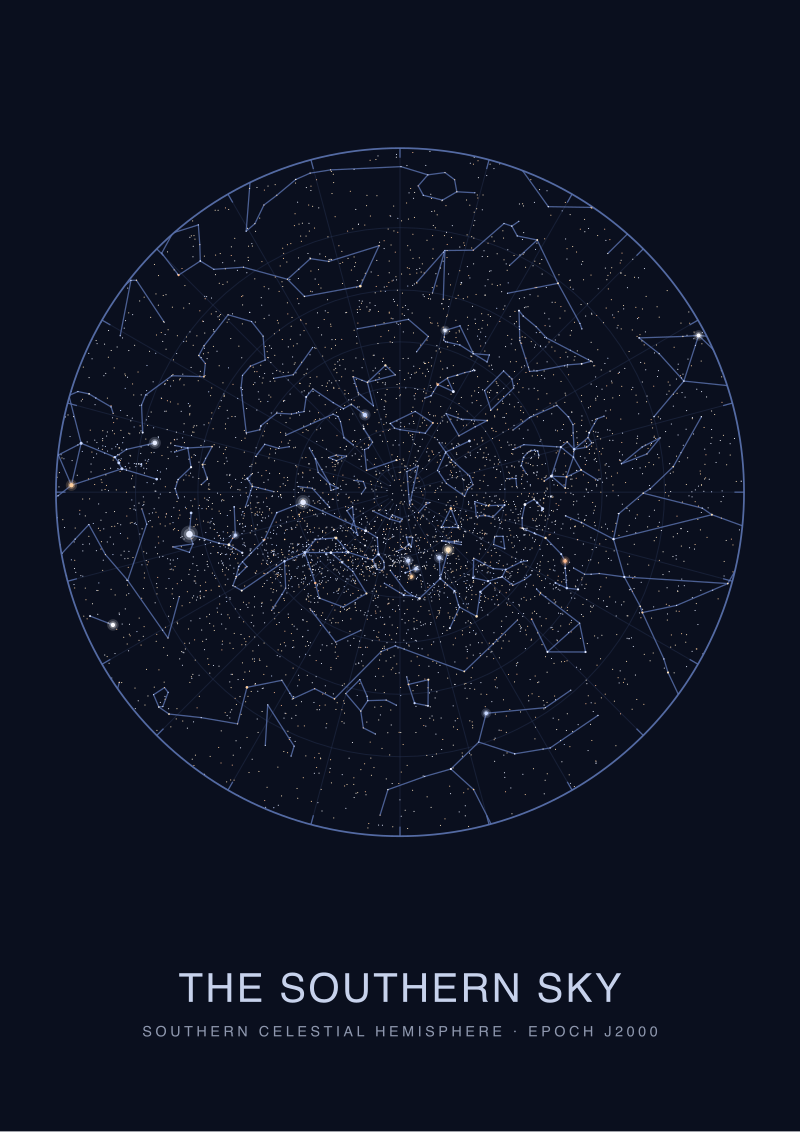
The entire argument reverses in the Southern Hemisphere, and the catalogue proves it. Canopus at magnitude -0.62 and declination -52.69 degrees is a circumpolar fixture for observers below about -37 degrees latitude — permanently high, permanently available — while remaining invisible from most of the Northern Hemisphere's inhabited latitudes. Rigil Kentaurus at magnitude -0.01 and declination -60.83 degrees is similarly a southern birthright, the nearest bright stellar system to the Sun and a routine naked-eye object from Sydney, Santiago, or Johannesburg. The question "are stars brighter in winter" therefore has a hemisphere embedded in it that most English-language search queries leave unspoken. Northern winter faces outward along the Orion Arm into Sirius, Capella, and the hexagon. Southern winter — July — faces into the galactic centre and the richest Milky Way band of the year, with Canopus and Rigil Kentaurus riding high as a counterweight. The sky's seasonal arithmetic is symmetric. The catalogue is one document. Which half of it an observer gets depends on which hemisphere they stand in.
From the collection
New charts and 10% off your first print.
One email now with your code. No noise after.